War in Heaven

3%

Pacific Press Publishing Company · Oakland, California · Oct 22, 1896

FromSigns of the Times, Vol. 22, No. 42.

Read the full edition

War in Heaven

THE CONTROVERSY OF THE AGES. NO. 3.

War in Heaven.

THE sixth verse of Revelation 12 follows logically, altho not closely chronologically, after verse 5. It is a prophetic statement of the great tribulation of the church and the preserving power of God. It will be considered more fully when we reach verse 14, where the same thought is repeated in other words. In this paper we will consider verses 7-9, which carry us back to a period preceding verse 5. Verses 7-9 read as follows:—
"And there was war in heaven; Michael and his angels going forth to war with the dragon; and the dragon warred and his angels; and they prevailed not, neither was their place found any more in heaven. And the great dragon was cast down, the old serpent, he that is called the Devil and Satan, the deceiver of the whole world; he was cast down to the earth, and his angels were cast down with him." R. V.
Michael means "who is like God." He is elsewhere called the Archangel, who has power over death (Jude 9; 1 Thess. 4:16), "the great Prince which standeth for the children of thy people" (Dan. 12:1). These facts, together with the meaning of the name
Michael, would clearly indicate that Michael is the Son of God, the Chief over all the angels, the Lord of hosts, or armies, the Angel, or Messenger, of whom Jehovah said, "My name is in him." (Ex. 23:21.)
The war in heaven, then, must be a war which existed between the Son of God and the good angels and Satan and the angels who fell with him, from the time he sinned, culminating in his defeat and overthrow, an overthrow so marked, so clearly manifesting the weakness and wickedness of sin as compared with the inherent strength and vitality of love, as to forever set at rest among the principalities and powers in heavenly places the ultimate and all-comprehending authority of the God of love.

Satan Triumphant over Man.

When Lucifer fell he was not immediately cast down to hell [tartarus (2 Peter 2:4), the regions encompassing and including this sin-cursed earth], but he was allowed a freedom in the universe of God not now known. This is evident from glimpses which the word of God gives of his history and work. Adam was given dominion of this earth, subject to the throne of heaven. Over every other inhabited world God also had his sons to whom dominion was given. These, as well-regulated government and the highest enlightenment, unity, efficiency and good of God's creatures demanded, met from time to time before the Lord and gave report of their respective domains. This earth was not represented by its rightful prince—Man—to whom it had been given. Man had yielded himself a slave, and yielding himself, he yielded his kingdom to Satan. So "when the sons of God came to present themselves before the Lord," "Satan came also among them." When asked from whence he came, he replied: "From going to and fro in the earth, and from walking up and down in it." (See Job 1:6, 7).
While cast out from the immediate presence of God, he yet came among the other angels. He was there as a usurper, to justify which he became an accuser. He asserted that his way was right, his Maker's wrong. Having in his very purpose the elements of corruption and death, he promised and yet promises liberty to his dupes. He claimed the earth as his by the power of might. "From going to and fro in the earth, and from walking up and down in it" showed that Satan felt that in the earth he was king—he did as he liked. By the same power of fraud and force he was determined to conquer the universe, and exalt his throne "above the stars of God." (Isa. 14:13.) Michael met him on the eternal principle of love—righteousness. With Satan, "might is right," "the end justifies the means," were molding principles; with the Son of God, right is might, the righteous means will be justified by the eternal end, were the principles on which his warfare was conducted. Satan "can not brook delay," but Michael and all the good "can well afford to wait." Yea, tho longing for the universal reign of righteousness, the principle of righteousness may not be departed from in obtaining it.
All must wait God's time for the vindication of right.
We have two examples of evil undeveloped, and the course of the Son of God in meeting that evil, knowing it to be evil. First, when he came down with his shining hosts to raise Moses from the dead, (see Jude 9), Satan was there to oppose him. The devil claimed Moses as his lawful captive in his own prison-house, the grave. He contended that Jesus had no right there, that the earth was his own by conquest, and that every sinner, and all who died, were his lawful slaves and captives. Jesus does not argue the question. He could not stoop to this. He did not present his own claims or position as a reason why the doors of the grave should unlock and release the servant of God. He simply said to him who in all his temptations and badgerings and satanic devices of forty years could get but one failure from the "man of God," "The Lord rebuke thee," leaving to the eternal future his right to "release the prisoners."
Again, in the record of Zech. 3:1-5, we have a similar instance. The Angel of the Lord, Michael, and Joshua the high priest, representing Israel, clothed in filthy garments, symbols of their sins, and Satan, the adversary, at Joshua's right hand to resist him, are the actors in this drama of the ages, a typical scene of which is opened before us. Joshua pleads with God before the Angel for acceptance and relief. Satan is there to accuse, and to declare that forgiveness of such vile sins can not be granted. He declares that Jehovah punished him for sins less vile—for Joshua and Jerusalem there is no hope. Again are heard the words: "The Lord rebuke thee, O Satan; even the Lord that hath chosen Jerusalem rebuke thee; is not this a brand plucked from the burning?" And so the conflict went on for the ages, Satan tempting to sin, accusing the sinner, and yet claiming his course to be justified by God's arbitrary dealings with man, while Christ, and good angels waited till such time as the final battle should be fought and the eternal principles of God's character vindicated.

Stooping to Conquer.

This came when the man child was brought forth by the waiting church. Satan won the kingdom from Adam by becoming incarnate. Michael—"who is like God"—must win it back by becoming incarnate. When man yielded his heart to Satan, sin became incarnate, dominant over the flesh. When the Son of God, who, tho in God's form, did not affect to be like God, humbled himself to save man (Phil. 2:5-7, R. V.), he took the body of a flesh of sin, prepared for him of God (Heb. 10:5), that he might be both a brother and Saviour to man. And in this
body of flesh, such as all men bear, righteousness became incarnated by Jesus Christ. Still is he Michael to all the angelic host, but how changed—a man, poor, weak from fasting, a seeming failure in all but character, in himself helpless.
Thus he was when met by Satan during, and especially at the close, of the forty days' fast. Eve was led by Satan to doubt God. "Hath God said, Ye shall not eat of every tree of the garden?" asked Satan with a sneer, in order to induce doubt. "If thou be the Son of God" he suggests to the Seed of the woman. From outward appearance, how suggestive the "if." But the voluntarily weak Michael is strong in God's word and in the principle of right. "It is written" is his ever ready and all-potent weapon. Twice he replies as tho Satan was what he claimed to be, an angel of light; but when the adversary demanded worship which belonged to God, he is answered in words which show to him that his true character is revealed: "Get thee hence, Satan; for it is written."
THE MANIFESTATION OF GOD'S LOVE.
Michael had conquered by the King's weapons, and had withstood every assault by the armor of righteousness. Every power and device of the prince of darkness and evil had been used against Incarnate Righteousness, every assault had been completely met by the Prince of life and righteousness. It was the battle in the conflict of the ages between good and evil, and all the heavenly host witnessed the duel with interest that mortal never knew. It was eternal defeat to Satan, it was eternal victory for Christ and the faithful.

Results of Victory.

The demons acknowledge this defeat, and the disciples rejoice in the results before they understand the struggle which made it possible. Shortly after, Jesus—the Michael of the angelic host—meets a poor sufferer, possessed, or controlled, by demons, angels of the
dragon. They know his power, and cry out: "What have we to do with thee, Jesus, thou Son of God? art thou come hither to torment us before the time?" (Matt. 8:29.) They knew defeat had come; they knew that eventually punishment was certain; and reasoning from their own injustice, they feared it might be visited previous to the time appointed by the Judge. (See also Luke 4:34.) On another occasion, the seventy disciples returned from a mission with joy, and declared, "Lord, even the devils [demons] are subject unto us through thy name." They had never known such things before. Poor lunatics! many were controlled by demons, but man could not before this, to their knowledge, cast them out. Jesus revealed the secret. "I beheld Satan as lightning fall from heaven. Behold, I give unto you power to tread on serpents and scorpions, and over all the power of the enemy." (Luke 10:18, 19.) The battle had been fought, the victory
won. The dragon had fought and his angels, and Michael had fought and his angels, the great spiritual warfare, but Righteousness Incarnate triumphed.
But the dragon did not rest here. In some unguarded moment, doubtless, he reasoned, Jesus might fall even as did Moses. He would follow Jesus still. He would stir up against him a proud, self-righteous, ungrateful people. He would persecute and harass him. He would flatter him by a selfish and unthinking populace which wanted a king. He would get Jesus to take glory to himself; he would discourage him by turning against him his own nation and even his own disciples. But none of these things led to even a compromise of one principle of right. Weakened and distressed humanity could sometimes sigh for deliverance, but above the
sigh rose the prayer of the heart that God's will might be wrought. As he nears the last fearful hour of agony the prayer arises: "Now is my soul troubled; and what shall I say, Father, save me from this hour?" but for this cause came I unto this hour. Father, glorify thy name."
That hour is reached in its fulness in the agony of Gethsemane's Garden. Again we hear the human wail of agony: "Abba, Father, all things are possible unto thee; take away this cup from me." Humanity shrinks from the trying ordeal. But this is not the petition of the heart above all others. Paramount to that agonizing cry is what immediately follows: "Nevertheless, not what I will, but
what thou wilt.” (Mark 14:36.) The struggle is over. God’s will,—the cruel scourging, the humiliation, the mock honor, the crown of thorns, the cross of Calvary, the darkness of death, the hiding of the Father’s face, the sins of the world, the climax of the eternal sacrifice with God’s righteous will and a redeemed race, are all preferable to all other glory gotten by a single compromise of right, a single yielding to self.
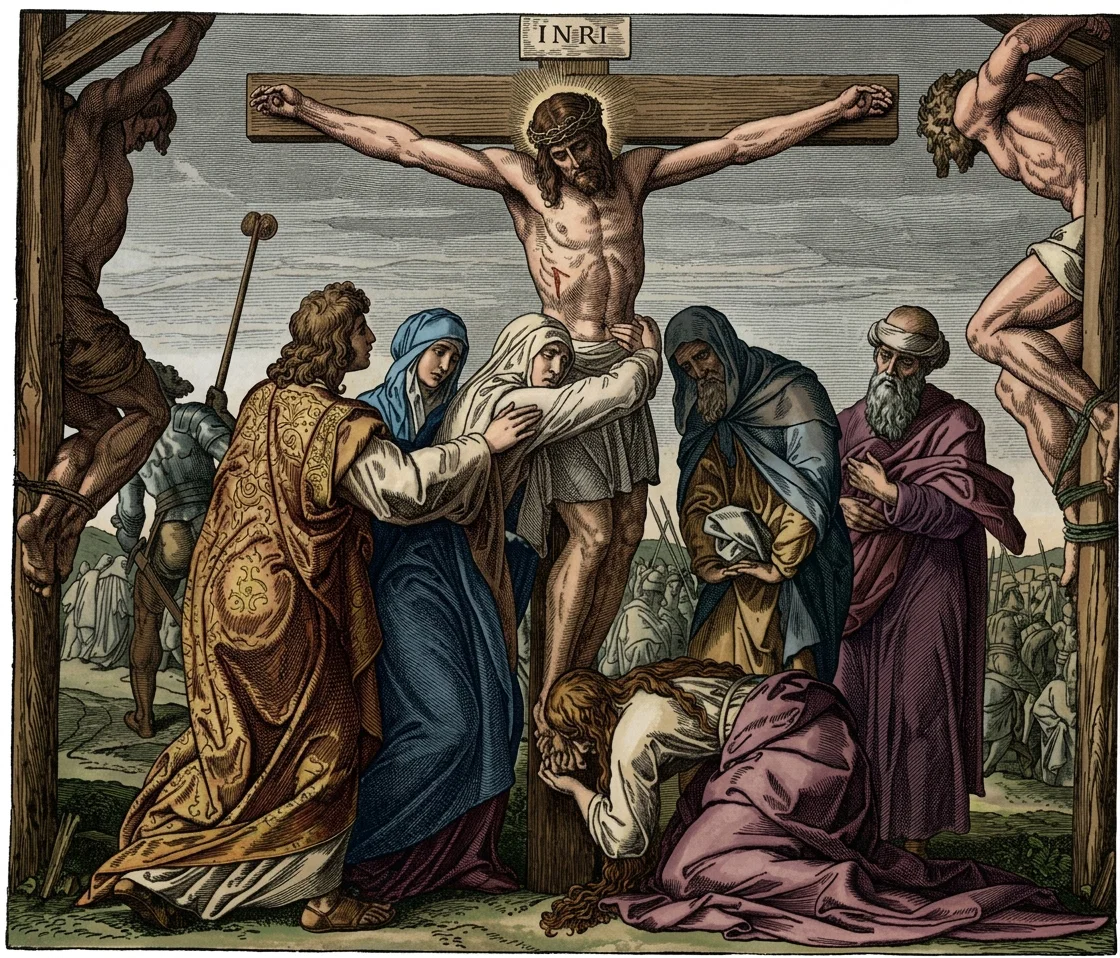
Jesus Christ died, but for others. He laid down his own life. He was buried. The portals of the grave closed above him. A seal was set to the grave by the authority of one of the dragon heads—Pagan Rome—whose empire then filled the world. A Roman guard and demons of darkness were set to watch the sepulcher. Michael, he who was once like God in heaven, he who had laid aside that glory for man and become Immanuel, was at last locked in the tomb, in the prison-house of Satan. His disciples mourned. Nature grew black at his death. The hosts of God must have well-nigh despaired. But altho under the power of death, “it was not possible that he should be holden of it” (Acts 2:24). Right is Might. Righteousness is life. All the powers of darkness commanding all the powers of earth could not lock the tomb over Eternal Righteousness, incarnate tho it were. In God’s time he would come forth; and God’s time came on the third day. Angels of light shine away the darkness, and Michael, the triumphant and eternal Conqueror, steps forth.
(To be continued.)