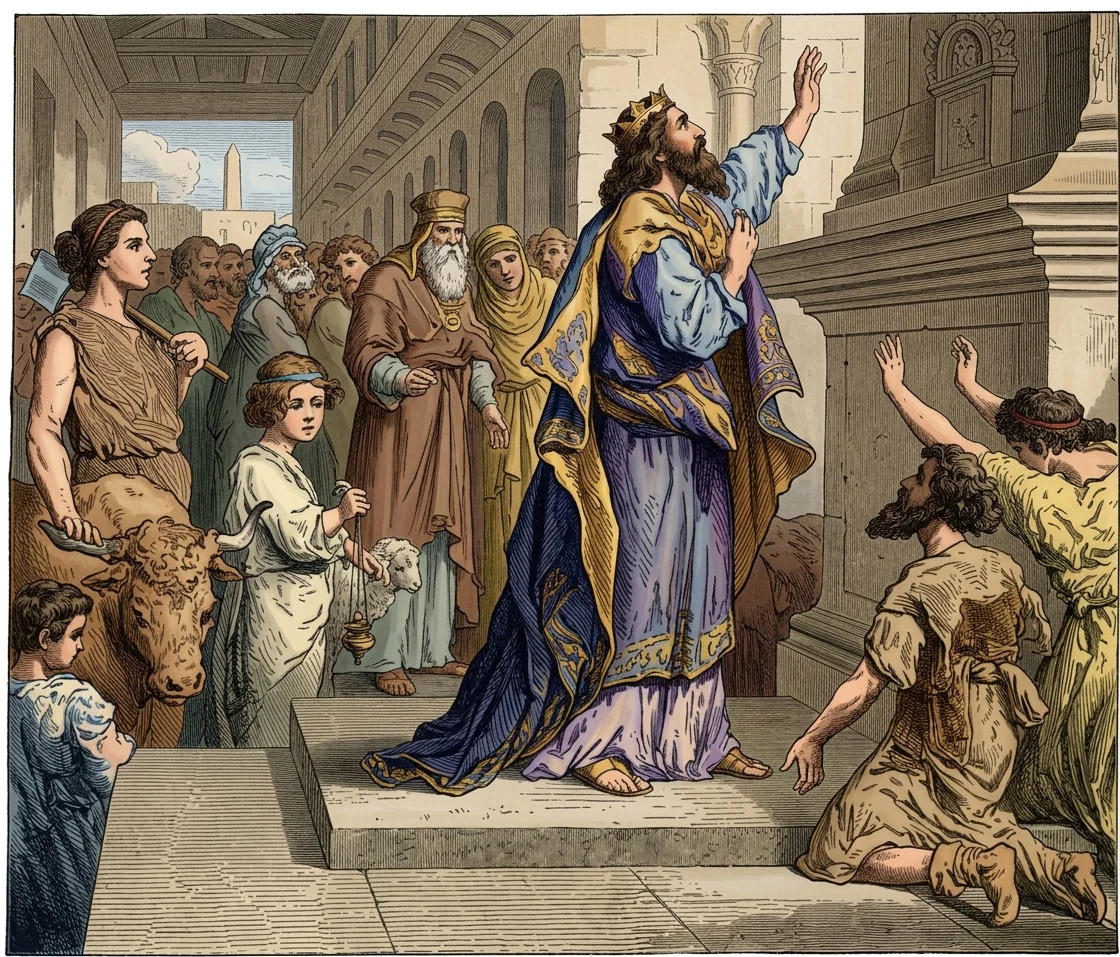
54. AND it was so, that when Solomon had made an end of praying all this prayer and supplication unto the Lord, he arose from before the altar of the Lord, from kneeling on his knees with his hands spread up to heaven. 55. And he stood, and blessed all the congregation of Israel with a loud voice, saying, 56. Blessed be the Lord, that hath given rest unto his people Israel, according to all that he promised; there hath not failed one word of all his good promise, which he promised by the hand of Moses his servant. 57. The Lord our God be with us, as he was with our fathers; let him not leave us, nor forsake us; 58. That he may incline our hearts unto him, to walk in all his ways, and to keep his commandments, and his statutes, and his judgments, which he commanded our fathers. 59. And let these my words, wherewith I have made supplication before the Lord, be nigh unto the Lord our God day and night, that he maintain the cause of his servant, and the cause of his people Israel at all times, as the matter shall require; 60. That all the people of the earth may know that the Lord is God, and that there is none else. 61. Let your heart therefore be perfect with the Lord our God, to walk in his statutes, and to keep his commandments, as at this day. 62. And the king, and all Israel with him, offered sacrifice before the Lord. 63. And Solomon offered a sacrifice of peace-offerings, which he offered unto the Lord, two and twenty thousand oxen, and an hundred and twenty thousand sheep. So the king and all the children of Israel dedicated the house of the Lord.
Golden Text: "The Lord is in his holy temple; let all the earth keep silence before him." Hab. 2:20.
NOTE.—The dedication of the temple took place a month before its full completion, at the time of the Feast of Tabernacles. Study for this lesson 1 Kings 8, and 9: 1-9; 2 Chronicles 5, 6, and 7. The place was Jerusalem, and the time the eleventh year of Solomon's reign, according to Hale and others, 1020 B.C.
SUGGESTIVE QUESTIONS.
(1) What was the principal burden of Solomon's prayer? (2) What attitude had Solomon assumed during this prayer? Verse 54. (3) What did he do when the prayer was finished? Verse 55. (4) For what did he bless the Lord? Verse 56. (5) In what words did he invoke God's presence? Verse 57. (6) If the Lord inclined their hearts to him, what would it lead them to do? Verse 58. (7) How much of God's care did he implore? Verse 59. (8) Why did Solomon ask all these things? Verse 60. (9) How did he admonish the people? Verse 62. (10) Of what did the dedicatory peace-offering consist? Verse 63.
NOTES.
1. All this prayer, etc.—The prayer was preceded by the placing of the ark of the covenant in the most holy place, and bringing into the temple the holy vessels that were in the tabernacle. When this was done the glory of the Lord, as a cloud, filled all the house, thus signifying that the Lord was pleased to accept this temple as the place on earth where he would manifest his special presence in his worship. The king then recounted God's promise to David, and the part he himself had acted in building the temple. The prayer itself follows. This remarkable dedicatory prayer is worthy of study. It is found in our lesson chapter, verses 23 to 53.
2. Kneeling.—This is the first instance in the Bible of a kneeling posture in prayer. For the occasion Solomon had built a raised platform or altar of brass before the altar of burnt-offering, on which he might stand in the sight of the people. The student will find it interesting to look up the various attitudes assumed in prayer by different Bible worthies.
3. His good promise.—The king referred directly to the promise through Moses, recorded in Deut. 12:10, 11, that when the people had rest from all their enemies, then a place should be established where he would "cause his name to dwell." Jerusalem was the city chosen, and the temple the immediate spot.
4. The earth may know.—The purpose of the Lord in choosing Israel from among the nations was that through them a knowledge of God might be given to the world. This was the design in giving them greatness and wealth, and this object Solomon recognized. It is not in God's plan that men or nations should accumulate riches for selfish ends. If such things are theirs, it is their duty to honor God and exalt his name in proportion to their means and opportunities. Not all are rich in goods or money, but there are riches of ability in other directions, and these all constitute the talents intrusted to man. This we are to recognize, and whatever our lot may be, our one chief aim should be to show forth the mercies and goodness of God to those who know him not.
5. Peace-offerings.—The flesh of the peace-offerings was eaten (Leviticus 7), and from the great number of beasts slain we gain some idea of the immense throng of worshipers that must have assembled at Jerusalem at this time. They came from "the entering in of Hamath [the extreme north] unto the river of Egypt." Not only the "elders of Israel, the heads of the tribes, and the chief of the fathers," but "all the men of Israel assembled themselves" (1 Kings 8:1, 2),—all who could possibly come. The feast usually lasted seven days, but this feast was continued fourteen days. Verse 65.