Topics for review:—
(a) Show by Scripture man's exalted position by creation, his nature, and the kind of life he possessed.
(b) Through what change must he pass before he can be restored to that which he lost by sin?
(c) Who only can work this change?
Divisions of the lesson: (1) Death Came by Disobedience. (2) Nature of Death. (3) Power of Death.
QUESTIONS.
DEATH CAME BY DISOBEDIENCE.
1. How did death come into the world?
"Wherefore, as by one man sin entered into the world, and death by sin; and so death passed upon all men, for that all have sinned." Rom. 5:12.
Upon how many did death come, and why?
What is sin?
"Whosoever committeth sin transgresseth also the law; for sin is the transgression of the law." 1 John 3:4.
4. What is the wages of sin?
"For the wages of sin is death." Rom. 6:23.
5. How many came under the death sentence through Adam's transgression?
"For as in Adam all die." 1 Cor. 15:22.
NATURE OF DEATH.
6. What is said of the thoughts of man in death?
"His breath goeth forth, he returneth to his earth; in that very day his thoughts perish." Ps. 146:4.
7. What is said of the memory?
"For in death there is no remembrance of Thee; in the grave who shall give Thee thanks?" Ps. 6:5.
8. What does the apostle Paul say of those who fall asleep if Christ be not risen?
"Then they also which are fallen asleep in Christ are perished." 1 Cor. 15:18. See note 1.
What occurs at man's death?
Where are the dead at the time of the resurrection?
"Marvel not at this; for the hour is coming, in the which all that are in the graves shall hear His voice." John 5:28.
Are individuals who are asleep conscious of things taking place around them? See note 2.
What is the condition of those that are asleep in their graves?
"There the wicked cease from troubling; and there the weary be at rest. There the prisoners rest together; they hear not the voice of the oppressor." "His sons come to honor, and he knoweth it not; and they are brought low, but he perceiveth it not of them." Job 3:17, 18; 14:21.
"For the living know that they shall die; but the dead know not anything, neither have they any more a reward; for the memory of them is forgotten." "Whatsoever thy hand findeth to do, do it with thy might; for there is no work, nor device, nor knowledge, nor wisdom, in the grave, whither thou goest." Eccl. 9:5, 10.
14. What can be said of time as related to those who are asleep in death? See note 3.
THE POWER OF DEATH.
15. What sentence was pronounced upon Adam in case he transgressed?
"But of the tree of the knowledge of good and evil, thou shalt not eat of it; for in the day that thou eatest thereof thou shalt surely die." Gen. 2:17.
What power is there in death? See note 4.
What is death called?
"The last enemy that shall be destroyed is death." 1 Cor. 15:26.
18. Who has the power of death?
"Forasmuch then as the children are partakers of flesh and blood, he also himself likewise took part of the same; that through death he might destroy him that had the power of death, that is, the devil." Heb. 2:14.
19. For what purpose was Christ manifested?
"He that committeth sin is of the devil; for the devil sinneth13from the beginning. For this purpose the Son of God was manifested, that he might destroy the works of the devil." 1 John 3:8.
NOTES.
1. A more literal reading of 1 Cor. 15:18 would be, "They which have fallen asleep in Christ have gone to nothing." Paul follows the above with these words: "If in this life only we have hope in Christ, we are of all men most miserable." In his reasoning, he regards the first Adam as a whole, a material man made of the dust, and that without redemption man would certainly go to nothing at death. As water, when the hydrogen and oxygen are separated, ceases to be water, so, when the elements that made man are separated, man ceases to exist.
2. One of the marked characteristics of sleep is unconsciousness. An individual may feel a sense of drowsiness and yet realize what is going on around him, but we do not say that he is asleep until he is lost to all that is around him. Sight, smell, hearing, and touch fail, and all voluntary motion ceases. This is sleep, a profound unconsciousness. The Saviour, who knew its nature full well, in the case of Lazarus used it to express the condition of man in death. John 11:11.
3. In unconsciousness there is no account of time. This has been illustrated many times in case of accident. Persons receiving a stroke upon the head have been unconscious for several days. If they have received the blow while speaking, the sentence is broken off till consciousness is restored, when they finish the sentence, having no knowledge of the intervening time. So in death, there may be a long time from death to the resurrection, but to the dead it is nothing. One moment it is losing consciousness, while the next it is awakening by the voice of Jesus Christ. The sleep of the saints in Jesus Christ is not, therefore, a gloomy doctrine.
"Asleep in Jesus! soon to rise,
When the last trump shall rend the skies:
Then burst the fetters of the tomb,
And wake in full immortal bloom."
4. SATAN is the author of sin (1 John 3:8), and death came by sin (Rom. 5:12); therefore all the power of Satan is in death. Sin is disorganizing and destructive, not merely of happiness, but of life itself. James 1:14, 15.
heaven, and in thy sight, and am no more worthy to be called thy son.
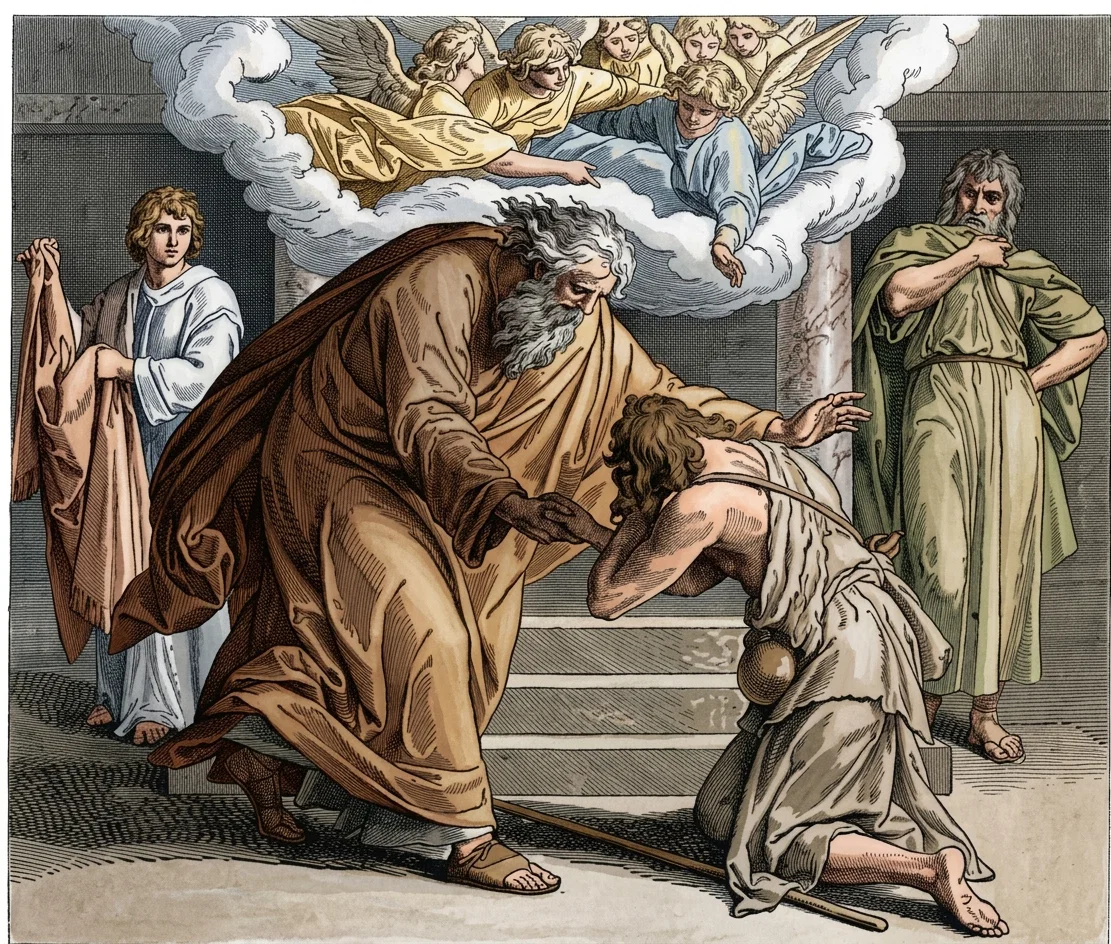
But the father said to his servants, Bring forth the best robe, and put it on him; and put a ring on his hand, and shoes on his feet;
And bring hither the fatted calf, and kill it; and let us eat, and be merry;
For this my son was dead, and is alive again; he was lost, and is found. And they began to be merry.
(Memorize verses 18-20.)
Golden Text: "Likewise, I say unto you, there is joy in the presence of the angels of God over one sinner that repenteth." Luke 15:10.
NOTE.—Read the whole chapter, carefully comparing the three parables, which teach the same lesson. In the first, a shepherd loses one sheep from his flock of one hundred; in the second, a woman loses one piece of silver from her store of ten pieces; in the third, the father of the two sons loses one son by his going astray. In each there is a search, a finding of the lost one, and great rejoicing, all illustrative of the return of those lost in sin to the house, the fold, the possession of the All-Father.
SUGGESTIVE QUESTIONS.
(1) How did Jesus introduce the parable of the prodigal son? Verse 11. (2) What did the younger son say? Verse 12. Note 1. (3) What did the father do? Same verse. (4) What did the son proceed to do? Verse 13. (5) How did he prosper? Verse 14. (6) What did he do for relief, and what work was he given to do? Verse 15. Note 2. (7) To what extremity did he finally come? Verse 16. Note 3. (8) When he came to himself, what did he say? Verse 17. Note 4. (9) What did he determine to do and say? Verses 18, 19. (10) How did his father meet him? Verse 20. Note 5. (11) What did the son say? Verse 21. (12) But what command did the father give? Verses 22, 23. Note 6. (13) What reason did he give for this manifestation? Verse 24. (14) What was the happy result? Same verse, last clause, also verse 7. Note 7.
NOTES.
1. The portion of goods.—According to Jewish law the older son inherited a double portion. Deut. 21:17. In this case the younger would inherit one-third of the estate at his father's death. But he desired his father to anticipate the future and give him his share now in money or jewels, "which is a common form of investing wealth to this day in the east." "And he divided unto them his living," that is, the portions were indicated by giving the younger son the value of his third. The Lord endows all men with life and the possession of reasoning faculties, with power to act. As the parable indicates, there are two ways, two courses, that one may exercise his choice upon. The Lord does not exercise coercion, but simply sets before man the blessings of righteousness, and shows him the end of wickedness. He has the power to choose the right or the wrong.
2. Joined himself to a citizen.—Literally, "glued himself" to a citizen. That is, he virtually became his slave. He was sent to feed swine, the lowest and most degraded occupation one could have, especially for a Jew, which we suppose the son, from the customs mentioned, to have been.
3. Would fain.—Literally, he was coveting, longing for, ardently desiring, so hungry was he. The husks were the pods and seeds of the locust or carob tree, "a common evergreen tree bearing an abundant crop of fruit,—long, curved pods, which are used for feeding cattle, and are largely exported to England for feeding horses, under the name of locust beans. They are capable of sustaining human life, like the acorns of the oak; . . . and as in Germany and England the swine are driven into the woods to feed on the fallen acorns, so in Syria they feed under the locust trees."—Canon Tristram. The pods are "six to eight inches in length, and one inch in breadth, and about a quarter of an inch thick." No man gave unto him, not necessarily of the husks, but of proper food. He had not one friend, is the idea.
4. When he came to himself.—Note some of the points in his downward career. He went into a far country, wasted—scattered—his substance, spent all; there arose a famine; because he had not one friend in his poverty, he was in want, hired out to feed swine, and probably ate swine's food. A desperate picture indeed! Yet one which has had its counterpart many times in actual life. At the last extremity he came to himself. He suddenly awakened to a consciousness of his deplorable condition. The Satanic spell that had lured him on as in a dream towards ruin was broken. And how often it is that financial reverses or the total failure of plans for this world's gain bring a man to his senses! The squandering of the gifts of mind and of wealth go hand in hand, for the serving of mammon, or security in riches, results in forgetfulness of God. So it is with all worldly ambition, in whatever line. "The friendship of the world is enmity with God." James 4:4. But happy is that soul, no matter to what depths it has fallen, that comes to itself, and realizes, even at the last moment, that the Father still remains, and is ever the same. There is all hope for such an one.
5. His father saw him.—The inference is that the father was on the lookout continually for the return of the son who had gone astray. And when he saw him, his love caused him to run to meet him, and fold him in his arms. That love had been reaching out without ceasing after the prodigal during his entire absence. This represents the attitude of God towards the sinner. In a sense the sinner is the erring son, and the love of God, with all its fullness and power, is continually searching for an entrance to his heart to bring him home. In the parable of the lost sheep is represented the successful mission of the Son of God in rescuing the lost world,—the world lost through sin.
"But none of the ransomed ever knew
How deep were the waters crossed,
Nor how dark was the night that the Lord passed through
Ere he found his sheep that was lost.
Out in the desert he heard its cry,—
Sick and helpless, and ready to die."
6. The best robe.—The first, outer, chief robe, kept for special occasions. Here it means the robe of righteousness, indicative of a changed life, really the life we obtain through Christ. The ring on his hand, the symbol of rank, or authority, a restoration to dignity and power. Shoes on his feet. "Shoes were worn only by free men, never by slaves."
7. My son was dead, and is alive again.—Sin is a condition of death, for the end is death. So the return was as tho from the grave. He was lost, but found. And they began to be merry, for their great joy. Note the extreme danger of the sinner. Deliverance from some small pain or danger would occasion no such joy. The greatness of the joy in heaven (verse 7) is a measure of the greatness of the danger. It is "a brand plucked out of the fire."