The Public Schools

3%

Pacific Press Publishing Association · Mountain View, California · Sep 10, 1912

FromSigns of the Times, Vol. 39, No. 35.

Read the full edition

The Public Schools

American Federation of Catholic Societies
Louisville, Kentucky, August 18-21, 1912
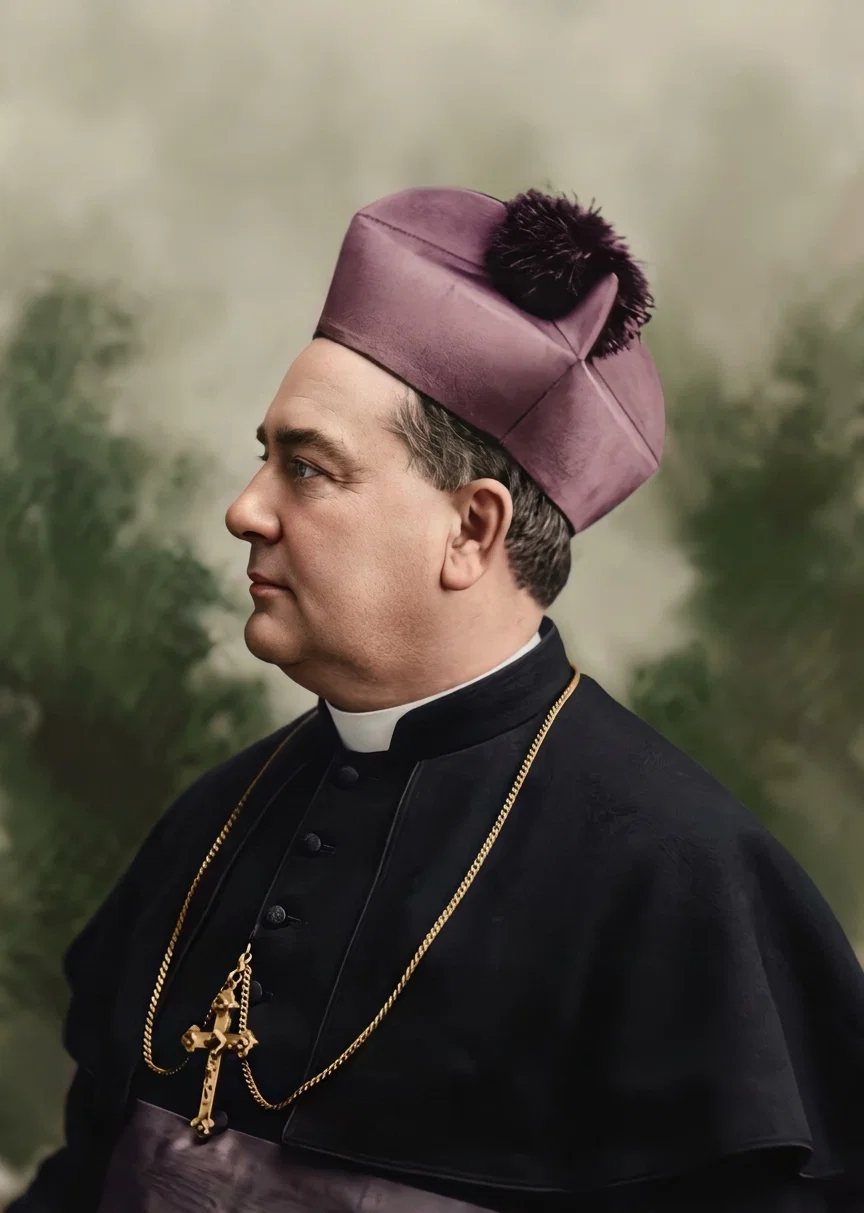
Bishop James McFaul, of Trenton, New Jersey
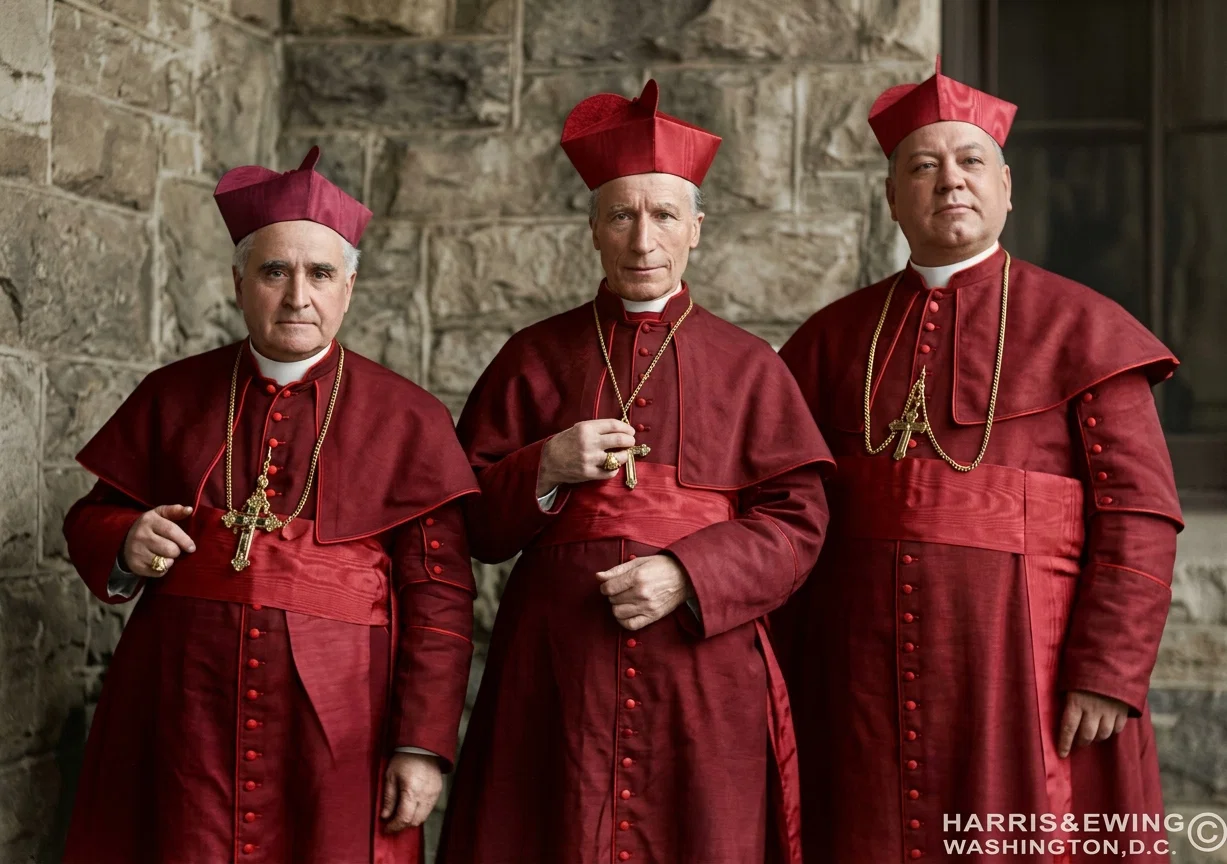
THE THREE AMERICAN CARDINALS From left to right: Cardinals Farley, Gibbons, and O'Connell
THE eleventh annual convention of the American Federation of Catholic Societies, held at Louisville, Kentucky, August 18-21, was ushered in by the greatest and most spectacular parade ever witnessed in this city. There were in the parade about 26,000 men, women, and children. There were seventy-four expensive floats in the procession, representing various epochs in the history of the Catholic Church in America. The state of Kentucky was called on liberally to help make the event one long to be remembered, and the state responded with its soldiers, its artillery, and its governor and lieutenant-governor. Every public edifice in the city bore the trade-mark of Rome, the yellow and white bunting emblematic of the pope's temporal dominion; and the great business houses owned by non-Catholic concerns were careful to make a generous display of the papal colors in the interest of business. They have learned by past experience that a lack of generosity in this particular may mean a deficit at the end of the year.
The convention was welcomed to the state and to the city by the governor and the mayor, with words of commendation for "the great work which the Catholic Church has accomplished for humanity." These dignitaries of the civil realm sat with the dignitaries of the ecclesiastical realm to review the mammoth parade at the reviewing station in the front of the Catholic cathedral. While it was purely a religious function, arranged expressly and solely for the glorification of the church and the advancement of her interests, these civil functionaries deem it a matter of political expediency to assist her in her objects, that she may not turn her great power and influence against them. Not only at the reviewing stand, but at her opening meeting, she ex-acts the influence of their presence, with their accompanying words of adulation for her, which are then heralded to the people through the public prints. Such things add to her standing in the eyes of the general public, and make her propositions seem less obnoxious to them.
That she has abandoned no whit of her pretensions, and that her ambitions for the control of America grow stronger with each year, was abundantly manifest in the propositions which the federation has set before its members, and in the reports of the things which the federation has accomplished.

The Public Schools

The federation now claims a membership of nearly three million, and its demands upon politicians or upon state officials are backed by the threat of political power. The same declarations against the public school were heard in this convention as in former gatherings of this kind. The same demand was put forth for a division of the public school funds, so that parochial schools may be supported by public taxation. We heard the reiteration of the oft repeated demand that America be made Catholic. Said
Bishop McFaul, one of the original founders of the federation:
"Let it be one of the aims of this federation to spread Catholic literature, and become an apostolate of the laity, and to use the press for the propagation of the faith, for the cultivation of virtue, for the destruction of error, and the advancement of truth. Thus shall we confer countless blessings upon Catholics and non-Catholics, and bring about the consummation of our hopes by making America a Catholic country, and the brightest gem in the crown of our holy mother, the church."
The federation has set itself against the establishment of a federal university, declaring that such an institution is wholly unnecessary. This was but to be expected in view of the fact that the university was not to be under Catholic control. To be consistent with itself in opposing the public school, it must oppose such an institution as that mentioned. The federation is still working upon the proposition of accomplishing in some way the exclusion, from the United States mails, of all publications which contain attacks upon the Catholic faith. It has not yet accomplished what it hoped to do in that particular, and has been advised by the postal authorities at Washington that under the Constitution as it is, such legislation as it desires could not be enacted.

Stricter Observance of Sunday

In the report of the federation's national secretary, it was made very plain that the federation is working for a stricter observance of Sunday, and this matter was emphasized by others. Resolutions were passed condemning a failure to observe Sunday. One resolution was passed which, in the light of the church's purposes concerning the control of the nation, has a stronger meaning than appears from a casual reading. It reads:
"We would remind our fellow citizens, and particularly Catholics, that there is but one standard for public and private life; that in exercising their civil functions, they must be guided at all times by the interests of God and country, which must never be supplanted by merely partisan consideration; and that Catholics holding public office are specially bound to live up to their church's standards and be exemplars of the highest citizenship."
The "interests of God and country" are invariably interpreted for the Catholic laity by the priesthood; and this resolution, without doubt, means the control of the official by the clergy. In other words, Catholic office-holders must be subservient to the dictates of the hierarchy. This is in perfect keeping with the oft repeated declarations, on the part of the federation, of its loyalty and obedience to the supreme pontiff, and to his representative, the papal delegate.

Influencing Legislation

During the past year, the federation's officials have been very active in dictating or interfering with legislation, in this country, in the Philippines, and even in Cuba. The Philippine Assembly had passed a bill making legal the granting of divorce on certain grounds. The bishop of Manila besought the aid of the American Federation in preventing this bill from becoming a law. The federation took the matter up with the officials in Washington and with President Taft, and the result was that the bill which passed the Philippine Assembly by a large majority, was held up by the Executive Commission (an appointed body consisting principally of Americans), and the will of the people as expressed by their representatives was frustrated.
In Cuba a proposition was on foot to make divorces on certain grounds legal, and to make marriages by the clergy illegal. A priest in Florida, hearing of the proposition, asked the federation for its assistance to defeat the proposed legislation. The federation took the matter up with Cardinal Gibbons and with President Taft, and reports that an emissary has been sent to Cuba to investigate the matter. Thus the federation, by the powerful influence that it is able to bring to bear upon public officials, puts the Presidentof the United States in the delicate attitude of seeking to interfere in the legislation of a sister republic.

Regarding Socialism

President Feeney, in his report, dwelt very largely upon the question of Socialism, declaring that if it should achieve its purpose in this country, it would bring in the greatest despotism the world has ever seen. He warned the world against Socialism, and set forth the Catholic Church as the only power in the world that could cope with that evil.
A clerical delegate from the Philippine Islands by the name of Finnegan, lamented the missionary activities of the various Protestant bodies in the Philippines, declaring that the missionary activities of the Protestants in the Philippines would almost certainly result in making the Filipinos indifferent to the tenets of religion, and in many cases materialists or rationalists. But in view of the fact that these are the conditions which exist in France, Italy, Spain, and Portugal, the Protestant missionaries could more justly bring that charge against the Catholic priests than the priests can bring it against the missionaries.

Catholic World Federation

At this convention, great emphasis was laid upon the necessity of forming a great world federation of Catholic societies, so that what the Catholic Church is accomplishing in America through the federation here, she may accomplish in the other countries, and all at the same time, through the combined influence of the American Federation and all the other similar federations. In that way would America lead the world on the backward path toward papal supremacy. The federation officials realize that they have a powerful organization, and they are making very definite plans for using it. Said Bishop McFaul:
"Such a union is desirable for the formation of an instrument which will always be ready to voice Catholic sentiment in the state and the nation. We may seldom need it, but when we do, we need it badly, and it must therefore be in such shape that we can immediately put our hand upon it, knowing that it is powerful enough to produce the required results."-Federation Souvenir, page 162.
The bishop expects through its influence to accomplish "the unification of the Catholic nationalities of the United States and the solution of the school question." By "the solution of the school question" he means the division of the public school fund, and the support of the parochial schools out of the school money raised by general taxation. Archbishop Messmer, of Milwaukee, in speaking of what they expected to accomplish through the instrumentality of the federation, said:
"Federation is the strongest and most powerful organization in the United States to-day."-Secretary's report.
From the same report we quote the words of Cardinal Falconio:
"The American Federation of Catholic Societies is working directly under the protection and guidance of the American hierarchy, and with the full sanction and the blessing of the pope."
The secretary himself makes this statement in reference to the attitude of the federation on the Sunday enforcement question:
"Our societies in many localities are urging for a more rigid Sunday observance, and have encouraged the movement of the post-office closing on Sunday. They are also opposing the holding of political rallies on the Lord's day. The Boston Archdiocesan Federation has recently passed a resolution to introduce in the next Massachusetts legislature a bill requesting the closing of liquor establishments on Good Friday."
Legislatures do not usually make requests;
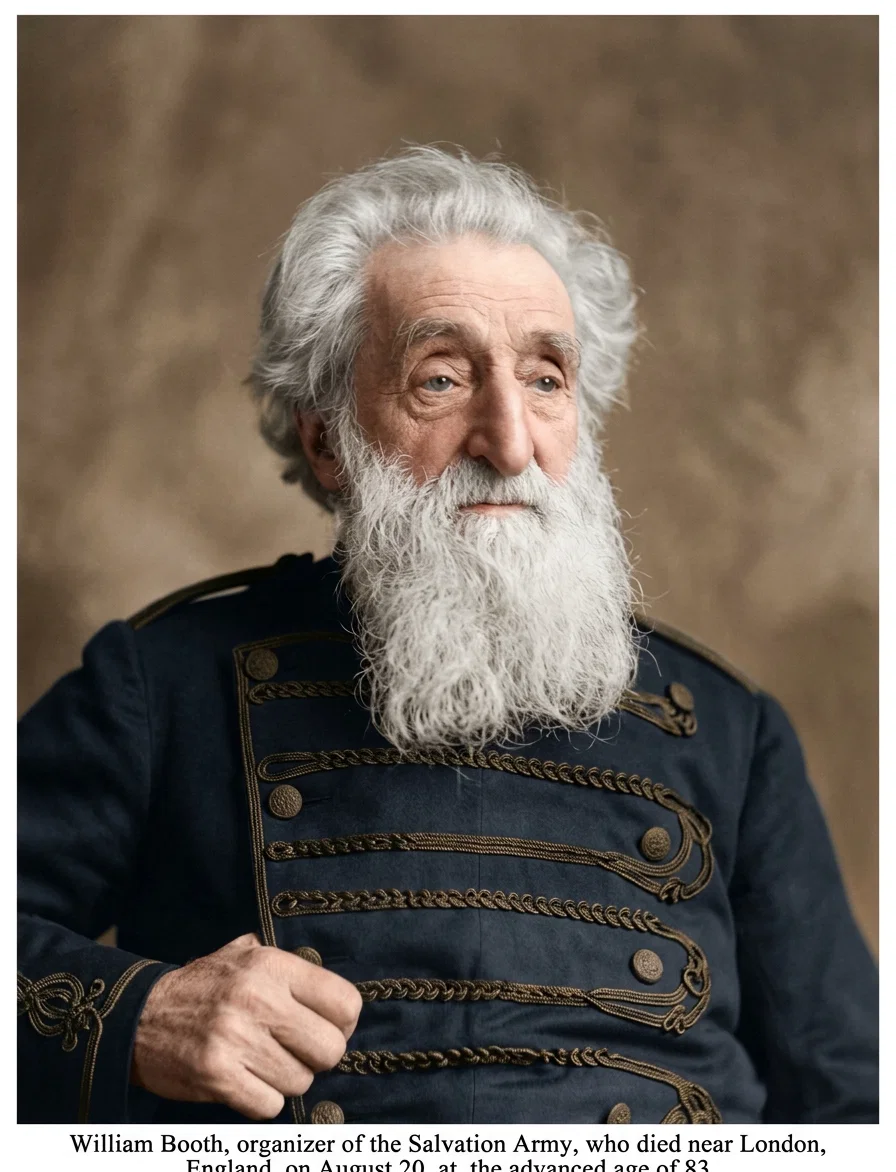
William Booth, organizer of the Salvation Army, who died near London, England, on August 20, at the advanced age of 83
but under the influence of this powerful organization, they might request the people of Massachusetts to stop selling liquor on Good Friday. It would be a new departure in legislation. But this illustrates how one demand follows another when once a state enters upon the work of passing laws which deal with religion. After legislating in regard to Good Friday, the next logical step would be to pass a law requesting all the people to attend mass and go to confessional.
The strength of this great organization, and the purposes that it has set before itself, ought to arouse the people of this country to the danger that is now threatening American institutions and American liberties. Whatever the Roman Church desires done in America, this organization has pledged itself to see accomplished; and it ought to be patent to every American citizen that the constitution of the Roman hierarchy and the Constitution of the United States of America have nothing in common. That being a fact, the dangers that are now threatening American institutions are greater and more far-reaching than any others that have ever yet confronted this nation. The hopelessness of the situation lies in the apathy of professed Protestantism, and in its willingness to be used in many instances to help that church in the accomplishment of her ambition. That Protestants are doing this, was declared many times over during this convention. When America, with her great influence, leads the world towards the Tiber, the consummation of the Christian's hope is not far off. C. M. SNOW.