Tea and Coffee Poisons

8%

Pacific Press Publishing Company · Oakland, California · Oct 1, 1896

FromSigns of the Times, Vol. 22, No. 39.

Read the full edition

Tea and Coffee Poisons

BY J. H. KELLOGG, M.D.
THE vast number of teapots in constant requisition in all civilized countries of the globe, warrants the supposition that in the estimation of the tea-drinking public, at least, the teapot is an indispensable culinary utensil, and the steaming decoction which it contains, an innocent or necessary beverage. The object of this article is to call attention to the fact that the revelations of modern scientific researches, as well as the observations of scientific physicians in various parts of the world, have found in tea and its congeners, coffee, etc., active causes of serious disease.
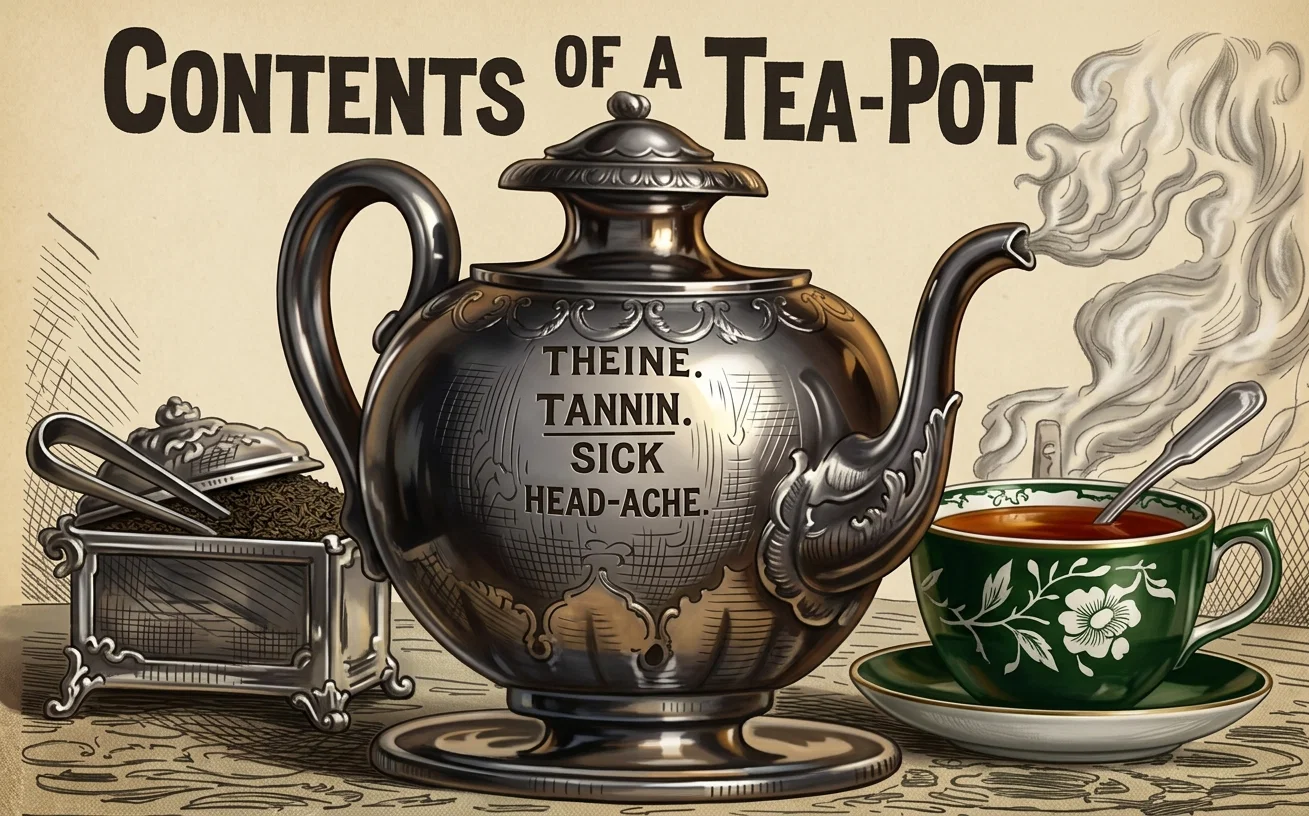
Tea contains two harmful substances, theine and tannin—from three to six per cent of theine and more than one-fourth its weight of tannin.
Coffee contains both theine and tannin, tho in less proportion than tea.
It will surprise many devotees of the cup to be told that these common beverages contain a violent poison, but such is the fact. Theine has been separated from both tea and coffee, and experiments have been made with it which show most conclusively that it is a deadly poison, capable of producing immediate death in both human beings and lower animals.
Theine belongs to the same class of poisons as strychnia, and is still more closely allied to the newly-discovered cocaine. The last-named drug is obtained from coca leaves, which are used in South America as tea is in this country, and with the same effects. The results of cocaine upon those who become habituated to its use are found to be more terrible than those of any of the numerous vice drugs which have been longer known, not excepting opium or alcohol. Theine is almost identical with cocaine, both in its chemical composition and in its effects.
Dr. H. C. Wood, and other writers on the various drugs used in medicine, describe numerous experiments with this poisonous constituent of tea. One observer found that one-seventh of a grain killed a frog in a very short time. Five grains killed a good-sized cat and also a rabbit. Death occurs in lower animals in a manner almost the same as that in which death occurs in poisoning from strychnia. Strong convulsions are produced with the arrest of respiration, and in a short time the heart ceases to beat. Tea contains about three per cent of theine, or more than fourteen grains to the ounce. Every pound of tea contains enough of this poison to kill fifteen hundred frogs or more than forty cats. One case is on record in which a fine horse belonging to an English army officer was killed by eating accidentally a small quantity of tea.
The largest dose of theine which is recorded as being taken by a human being, is twelve grains, which produced very dangerous symptoms, and with the addition of a few grains more would undoubtedly have proved fatal; yet half an ounce of tea, containing six or seven grains of the poison, is often used in making a strong cup of tea. Many persons drink half a dozen or more such cups of tea daily, thus imbibing a sufficient amount of poisonous theine to kill two or three men not accustomed to its use, if taken at one dose.
If tea contains such a poison, why does it not produce fatal results more frequently than it does? may be inquired. We answer, Simply because a tolerance of the drug is established by use, just as in the case of tobacco. One-tenth of a grain of nicotine will kill a frog, and so small a dose as one-sixteenth of a grain has produced dangerous symptoms in a man; it has also been shown that the smoke from a half ounce of tobacco contains sufficient nicotine to produce death, yet sudden death from tobacco-smoking is not a very common result of the almost universal use of this poisonous drug. The wakefulness and increased mental activity which many persons experience from the use of tea, are evidences of its poisonous character.
But the teapot sometimes contains other things besides theine and tannin. Probably there is no article in common use which has been so extensively and so harmfully adulterated as this. According to the Chicago Grocer, a reliable trade journal, not less than one-fifth of all the tea sold is adulterated more or less. Lead, Prussian blue, and many other poisonous and harmful substances are used for this purpose, and the injury done in this way, aside from the harmful effects of the drug itself, may be said to be incalculable.
The adulteration of coffee is equally notorious. It is stated by those who are authority on this subject that it is practically impossible to obtain a pound of ground coffee which is not adulterated; and it has recently been discovered that unground coffee is also skillfully adulterated by means of machinery which molds the adulterants into the exact form of the real coffee bean.
In view of the above facts, would it not be well for the thousands of tea-drinkers in this and other civilized countries to pause and consider between the sips of the steaming beverage, whether it would not be well to substitute hot water, hot milk, or some other harmless beverage for this subtle but certainly harmful drink?