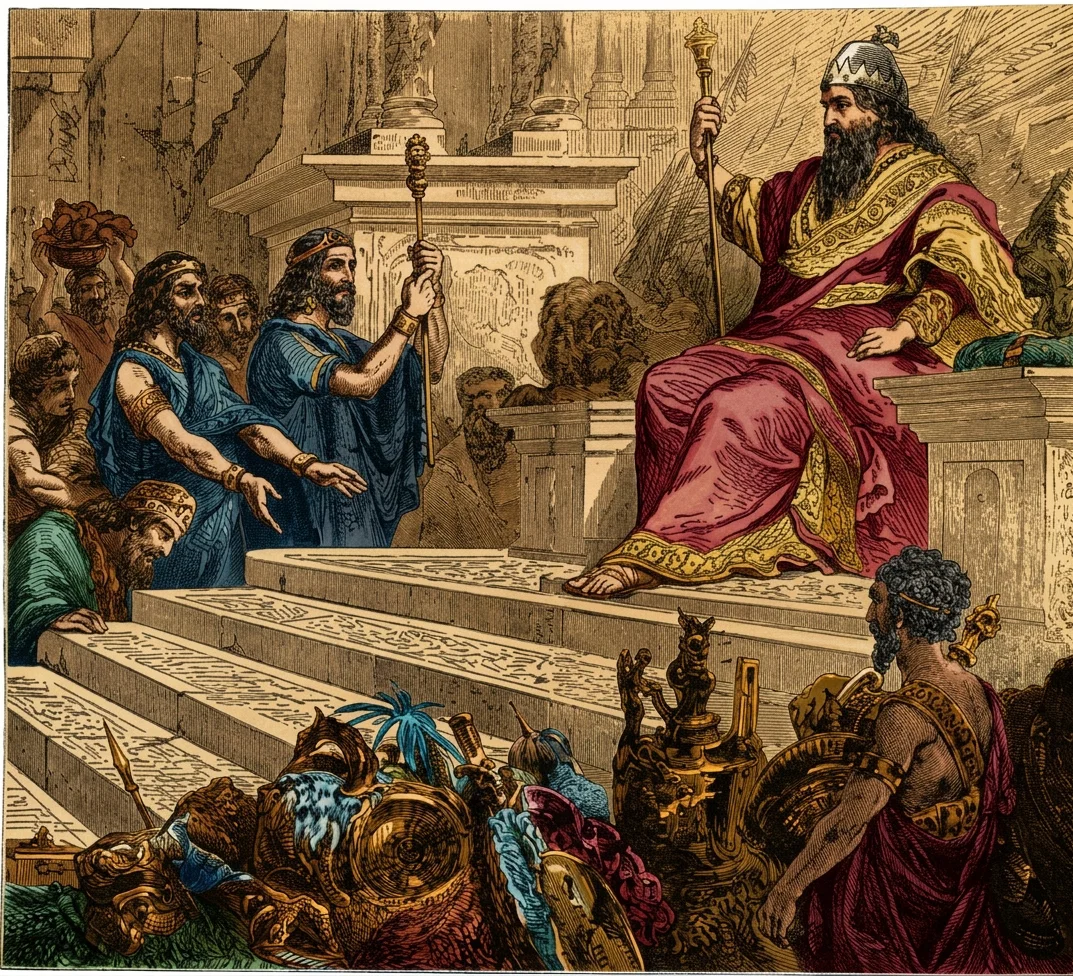
25. AND Judah and Israel dwelt safely, every man under his vine and under his fig tree, from Dan even to Beer-sheba, all the days of Solomon.
26. And Solomon had forty thousand stalls of horses for his chariots, and twelve thousand horsemen.
27. And those officers provided victuals for king Solomon, and for all that came unto king Solomon's table, every man in his month; they lacked nothing.
28. Barley also and straw for the horses and dromedaries brought they unto the place where the officers were, every man according to his charge.
29. And God gave Solomon wisdom and understanding exceeding much, and largeness of heart, even as the sand that is on the seashore.
30. And Solomon's wisdom excelled the wisdom of all the children of the east country, and all the wisdom of Egypt.
31. For he was wiser than all men; than Ethan the Ezrahite, and Heman, and Chalcol, and Darda, the sons of Mahol; and his fame was in all nations round about.
32. And he spake three thousand proverbs; and his songs were a thousand and five.
33. And he spake of trees, from the cedar tree that is in Lebanon even unto the hyssop that springeth out of the wall; he spake also of beasts, and of fowl, and of creeping things, and of fishes.
34. And there came of all people to hear the wisdom of Solomon, from all kings of the earth, which had heard of his wisdom.
Golden Text: "Them that honor Me I will honor, and they that despise Me shall be lightly esteemed." 1 Sam. 2:30.
(1) What was the condition of Judah and Israel? Verse 25.
Note 1. (2) What is said of Solomon's horses and horsemen? Verse 26. Note 2. (3) What duty was assigned certain officers? Verses 27, 28. Note 3. (4) What else did God give Solomon? Verse 29. Note 4. (5) How did his wisdom compare with that of other men? Verses 30, 31. Note 5. (6) How far did his fame extend? Verse 31. (7) How many proverbs did he speak? How many songs did he compose? Verse 32. (8) Of what else did he speak understandingly? Verse 33. (9) Who came to hear and see him? Verse 34.
NOTES.
1. Dwelt safely.—David was a man of war, and during his reign, and previous to that time also, the land was subject to invasion by its enemies. Now all was different, and fear was a stranger. The "vine" clustered about the court of the house, while the "fig tree" grew in the garden.
2. Horses.—"Smith's Bible Dictionary" renders verse twenty-six, forty thousand chariot horses and twelve thousand cavalry horses. The Lord in Deut. 17:16 enjoined that the king should "not multiply horses to himself, nor cause the people to return to Egypt," etc. This evidently means more than a physical return; it forbids Egyptian idolatry. The prohibition of horses was doubtless for a twofold purpose: (1) Horses were chiefly used for war, and the Lord did not wish his people to cherish that spirit; (2) the horse seems to have been dedicated to the sun, and was connected with sun-worship, the chief idolatrous worship, and this was expressly forbidden of God. Solomon's disobedience in this respect was one of the means of introducing sun-worship into the temple, which Josiah put away. See 2 Kings 23:11.
3. Those officers.—"Solomon had twelve officers over all Israel, which provided victuals for the king and his household, each man his month in a year made provision." Verse 7. These officers, with their men, were stationed in different parts of the country, having charge of certain regions and cities.
4. Wisdom and understanding.—The account so far has depicted Solomon's riches, his magnificence, the greatness of the kingdom, the number and condition of the people, etc., all of which is worldly and appealing to the physical senses. Many a monarch might have similar greatness. But the jewel in the crown is the wisdom from above, the understanding which comes from a fear of the Lord. Solomon was wise as a judge, as an architect, as a statesman, in literature, in science. His largeness of heart is likened to the sand on the seashore, denoting limitless field of operation.
5. Excelled.—The children of the east were the Chaldeans and Arabians, who were from early times noted for their astrological investigations, and for their wisdom. Job was of the east (Job 1:3), and so doubtless were his friends. The wise men who came to Bethlehem were from the same quarter. This may also have included the dwellers in India, who were also noted for their profound learning. Egypt was renowned as the seat of learning and the sciences; and magic, geometry, medicine, astronomy and architecture were there highly developed. The names mentioned in verse 31 referred to those skilled in music, specialists in their line. Not only was Solomon more skilled than all these and more learned, but he was a master of botany and zoology. Verse 33. This all came from a knowledge of the true God. It is sometimes asserted by the worldly wise that Christianity makes a man narrow-minded. The statement is wholly unfounded; for the true follower of Christ has for his teacher him who is wisdom itself (1 Cor. 1:30), "in whom are hid all the treasures of wisdom and knowledge" (Col. 2:3), the great Master in all branches of art and science, the Creator and Fashioner of all things, from the tiniest atom or protoplasm to the worlds on high. And this Teacher delights to instruct his students in all things of his. Here is the true wisdom, your privilege to have, even as it was Sol-