NIPPON, Land of the Day's Origin! A residence of nearly ten years in these emerald islands, has made them seem very much like home. The great natural beauty of the country has been much increased by the labors of a nature-loving people. The surface is very mountainous, only about one eighth of the area being under cultivation; but while mountains abound, there are quite extensive plains in some parts of the country. Perhaps the largest of these lies west and north from Tokyo. In taking a trip to the north from the capital, one rides for hours through a highly cultivated plain, almost as level as a floor, only the hazy outlines of the distant mountains appearing on the western horizon. Kiushiu, the most southern of the main islands, is also very mountainous; yet the old city of Saga is situated in the very midst of quite an extensive, very level plain. There is very little gently rolling land in the country; the transition from mountain to plain is usually quite abrupt.
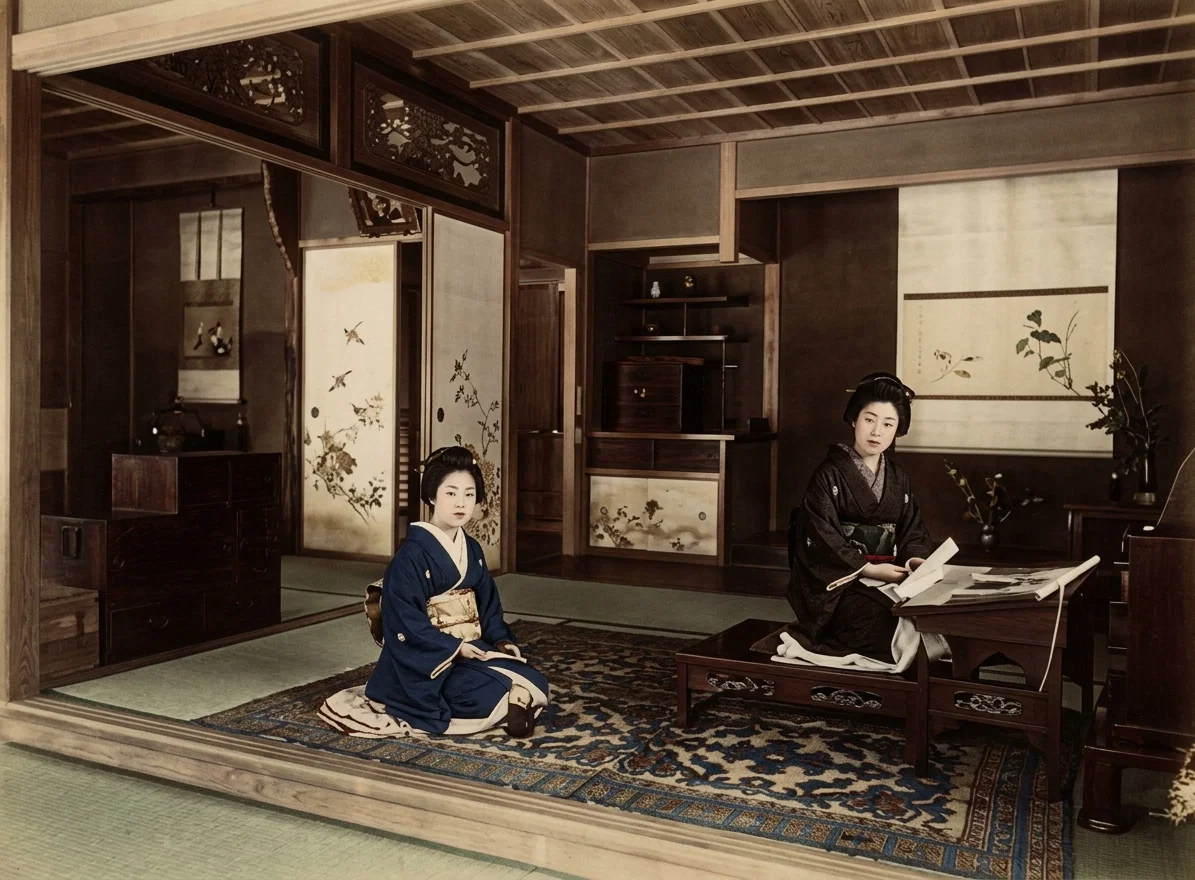
In a Japanese Home
Being surrounded by water, the country has a damp climate. This excess of moisture in the air makes the heat of summer quite trying. Another result is that the changes from heat to cold and the reverse are very gradual, so that there is not the marked transition from one season to another that one experiences in the home land. The plum-trees begin to blossom in February; but it is well along in April before the famous cherry-trees open their pink petals. The evenings are often chilly in May; and the real heat of summer is not experienced till after the "rainy season" in June.
But no country is of interest apart from the people who inhabit it. The people of Japan have been brought prominently before the world during the past generation, and much has been said and written about them. Yet it is only natural that Western people should often fail to understand and properly estimate a people differing from them so markedly in manners, customs, history, government, and religion. Hence the more that is written that is true and fair and unprejudiced, the better will be our understanding of this interesting race.
The Japanese possess two characteristics that lie very near the surface. These are, a natural love of the beautiful in nature and art, and a cultivated sense of politeness that becomes second nature. Many books and articles on Japan have been written by travellers, and some even by tourists of the kodak variety, who spend a few weeks or months in the country, and then pass on. Such writers have petted and praised and lauded these polite little people, with their gentle ways, with their "perfection of the infinitesimal" in art, from a landscape garden to a damascene button. The sterner qualities that lie beneath the surface were either not discovered or but little dwelt upon by these hasty writers.
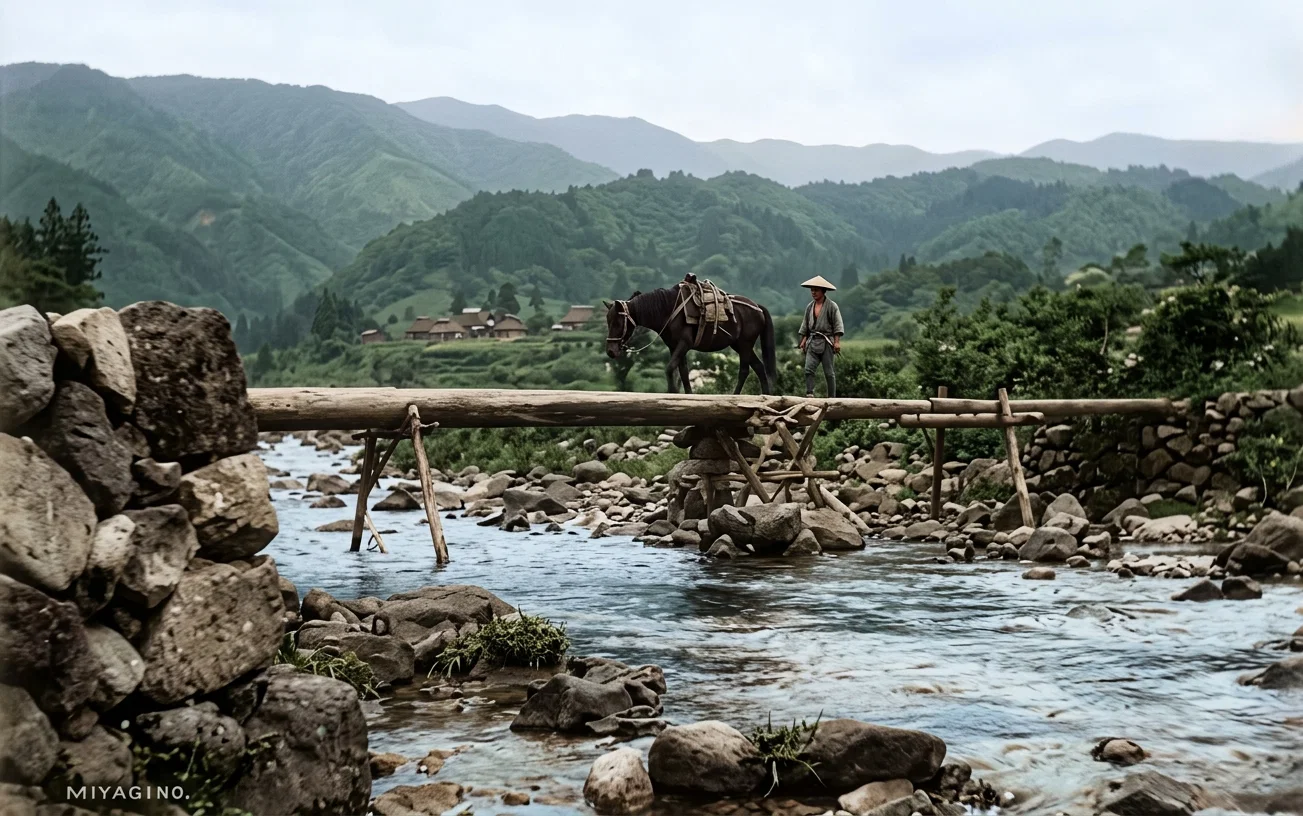
Along a Japanese Brook
The events of recent years have brought some of these more rugged characteristics to light. The Japanese have shown themselves capable of competing with the rest of the world in all that stands for modern civilization. And last of all, at Liau-Yang, Port Arthur, and Tsushima Straits, they showed that they were not to be left behind in war, any more than in peace.
And as one result of all this, the progressive Japanese of to-day desires above all things to be taken seriously. Such epithets as "Japs" and "little brown men" are especially distasteful to him. And only about a year ago I learned that Japanese who understand our language well, dislike to have the term natives applied to them by foreigners. The reason is not far to seek. We speak of the natives of benighted Africa; of China, where Europeans and Americans still live under extraterritorial rights; of India, subjugated and ruled by a foreign power. But an Englishman would not apply this term to the people of France or Germany; he says "the French," "the Germans." Then why not say "the Japanese," instead of "the natives," unless it is meant to deny them equal rank with Europeans?
Of course the Japanese are sensitive concerning their position in the world. What other nation would not be, under like circumstances? Napoleon was regarded as a vulgar upstart by the other crowned heads of Europe. While Cicero's standing as an orator was beyond question, he was sensitive and vain over his poetry, long since forgotten. It is the way of the world. If men had more of the "milk of human kindness," and less jealousy and pride, the world would be the better for it.
A certain writer has observed that the civilization of any people can be correctly estimated by the relative amount of sulfuric acid used in the country. Another more plausible theory is that the amount of soap used is a good criterion. Booker T. Washington, in his autobiography, "Up from Slavery," places the tooth-brush in the front rank of civilizing agencies. Judged by this standard, the Japanese certainly deserve to be placed among the most highly civilized peoples of the world; for it is my opinion that no other people use this little toilet article more generally or more thoroughly. In fact, the Japanese tooth-brush possesses a unique feature not found in any other brush that I ever saw or heard of. This consists of a thin, flexible attachment for scraping the tongue. An Iowa dentist to whom I showed one of these brushes a few years ago, was quite enthusiastic over its good qualities, and seriously thought of importing some for the use of his patrons. Both brushes and tooth-powders are cheap in Japan, so that even the poorest can afford them. A fairly good brush can be had for four or five cents.15
Another sure index to a people's civilization is the use of the bath. Here again the Japanese must be assigned to the front rank; for probably no other people bathe more frequently. Even in central locations in Tokyo the price of a bath at a public bath-house is one and a half cents of our money. At this price the bather furnishes his own soap and towel. Abundance of water is provided, both hot and cold. Besides the public baths, which are well patronized at all hours of the day and every day of the week, many families possess their own private bath.
The Japanese make good neighbors. Among themselves they are quiet and orderly. Neighborhood broils almost never occur, or are kept so quiet that one never hears of them. The people are respectful and obliging to the foreigner residing among them. In all the years, only one family seemed unneighborly to us, and did annoying things; and their offenses did not extend beyond interfering with our children at play under their windows, and throwing their waste paper into our yard. Give ten years of your life to the moral and spiritual uplift of any people, and you will pretty surely come to like them. Unselfish service for humanity is the best known remedy for race prejudice.