The Sabbath was made for man, and not man for the Sabbath: therefore the Son of Man is Lord also of the Sabbath. Mark 2:27, 28.
THE Sabbath was made for man — mankind. But how was it made? The record tells us that it was made by the Creator’s resting on it, and blessing and sanctifying it, or setting it apart. Since all this was done for man, it is evident that God intended it for all men, in all ages, and in all places. And all who accept it as the Creator designed, will find in it God’s rest and God’s blessing. Since Christ is the one who created all things, the one who rested, and who blessed and set apart the seventh day, He declares Himself Lord also of the Sabbath day.
The strongest possible way in which one can teach another to regard a law, is to observe it carefully in his own life. The Saviour so strictly conformed to the Sabbath law, that on every occasion when He was charged with its violation, He refuted the charge just as successfully as He refuted the charge of blasphemy or any other sin laid against Him.
Not only did He meet the demands of the Sabbath law in His own life, but on several occasions He taught the proper observance of the Sabbath, that men might find in it the blessing He had placed there for them.
In the Gospels more space is given to the Sabbath and its proper observance than is devoted to the consideration of any other commandment; and yet between Jesus and the Jews, who were ever ready to find fault and criticize His teachings, not one word of controversy is recorded as to which day had been, was then, or was to be the Sabbath, but only regarding the manner of its observance. No dispute in all Bible times ever occurred as to which day was the Sabbath. And yet the New Testament record carries us down sixty or more years this side of the death of Jesus.
In giving instruction to His disciples for their future work, He told them to teach all nations to observe all things whatsoever He had commanded them, with the promise that He would be with them even to the end of the world. Therefore what He taught was to be perpetuated in the teachings of His disciples to the end of time.
What did He teach regarding the Sabbath? In Matt. 12:1 we find Jesus and His disciples passing through a corn or grain field on the Sabbath. The disciples were hungry, and began to pluck the ears of corn, and to eat. The Pharisees, who were with them, and always lying at the catch, said to Him, "Thy disciples do that which is not lawful to do upon the Sabbath day. But He said unto them, Have ye not read what David did, when he was an hungred, and they that were with him; how he entered into the house of God, and did eat the showbread, which was not lawful for him to eat, neither for them which were with him, but only for the priests?"
Here the Saviour taught that a deed of necessity is not out of harmony with law. In David’s case it was necessary that he should have something to eat. Nothing was at hand excepting the showbread; but the law forbidding him to eat it, was set aside in the face of his need.
This principle of law giving way to deeds of necessity is recognized even in human affairs. Take as an illustration a law forbidding the killing of certain kinds of game except at stated intervals; and yet the man who kills game in violation of the letter of this law, will be acquitted as innocent if he can but show that his act was necessary in order to preserve his life or to relieve him from suffering. While such a deed seems to be in violation of law, it is in reality in harmony with it; for the primary object of all such laws is the preservation of game, that it may contribute food to sustain the life of man. But when the man’s life is in jeopardy for lack of food, to enforce the letter of the law would be to defeat the very purpose of the law.
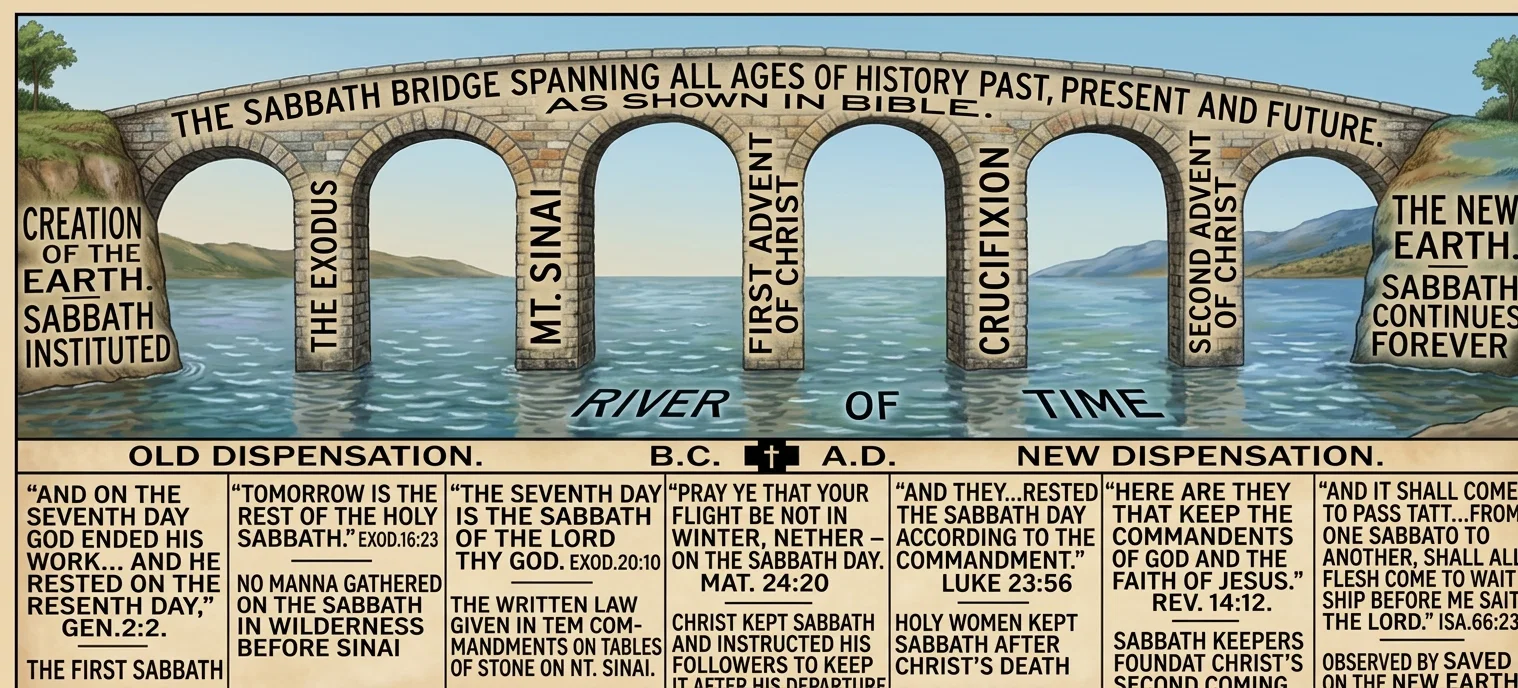
BIBLE FOUNDATIONS SUPPORTING THE PERPETUITY OF THE SEVENTH DAY SABBATH. - NOTE. MANY MORE TEXTS COULD BE GIVEN, BUT ONLY ENOUGH HAVE BEEN SELECTED TO MARK THE DIFFERENT PERIODS -
Thus when a deed is a necessity, that deed, altho seemingly a violation, is in reality an act of obedience to the law.
By this illustration, the Saviour taught that all deeds of necessity are lawful on the Sabbath day. Under this principle, if a family had no bread, it would be lawful to go and buy some or provide it in some way, even tho it involved physical labor. It is true, however, that the person who finds himself under the necessity of performing such an act on the Sabbath day, is often guilty of sin in neglecting to make proper provision the day before.
The Saviour continues: "Have ye not read in the law, how that on the Sabbath days the priests in the temple profane the Sabbath, and are blameless? But I say unto you, That in this place is One greater than the temple. But if ye had known what this meaneth, I will have mercy, and not sacrifice, ye would not have condemned the guiltless. For the Son of Man is Lord even of the Sabbath day."
The priests in the temple performed a great deal of manual labor in carrying on the work of the Lord. All that service was typical of the work of Christ, the One who was as much greater than the temple as the antitype is greater than the type, or as the substance is greater than the shadow. If the priests were blameless in laboring on the Sabbath day to carry forward a shadowy work, surely Jesus and His disciples were guiltless in prosecuting the real.
Thus Jesus taught that it is lawful to do anything which is necessary to carry on the work of the Gospel or the worship of God.
The same day, Jesus went into a synagogue. "And, behold, there was a man which had his hand withered. And they asked Him, saying, Is it lawful to heal on the Sabbath days? that they might accuse Him. And He said unto them, What man shall there be among you, that shall have one sheep, and if it fall into a pit on the Sabbath day, will he not lay hold on it, and lift it out? How much then is a man better than a sheep? Wherefore it is lawful to do well on the Sabbath days." Then He healed the man. See also Luke 13:15 and 14:3-5.
In these instances, Jesus taught that all deeds of mercy — ministering to the wants and needs of our beasts, and relieving the distress of even the dumb animals — are works which should be done on the Sabbath.
Some have suggested that we have no right to light a fire on the Sabbath day; and such cite as proof the case of the man in the wilderness who was stoned to death for gathering sticks on the Sabbath. By reading the record found in Num. 15:30-36, it will be seen that this is given as a case in which the act was a presumptuous — margin, high-handed, or defiant — one, as there was no occasion for building a fire.
But let us measure the building of a fire under ordinary circumstances, in the light of the principles laid down by the Saviour when He said, "I will have mercy, and not sacrifice." Suppose a man arises Sabbath morning and finds it cold and disagreeable. Before him lie two ways: the one, to build a fire for the comfort and convenience of his family; the other, to sacrifice comfort,5health, and possibly lives to the rigid observance of the law, by building no fire. To follow the first course would be an act of mercy; the second, an act of sacrifice. The real Christian, who wishes to please God, will build the fire, and answer the criticizing one in the words of the Master: "If ye had known what this meaneth, I will have mercy, and not sacrifice, ye would not have condemned the guiltless." And in his own heart, the Spirit will witness with his spirit again in the words of the Master, "It is lawful to do well on the Sabbath days."
Thus we find that the Saviour did not intimate that the Sabbath was soon to pass away; but on the contrary, He gave full and complete instruction as to how it was to be kept. He sought to remove from it human traditions, and teach its real purpose.
He taught that the seventh day is the Sabbath, and kept that day, being our example in all things. He taught that deeds of necessity, the work of the Lord, and all deeds of mercy, are lawful on that day.
Let us follow His example and heed His instruction.