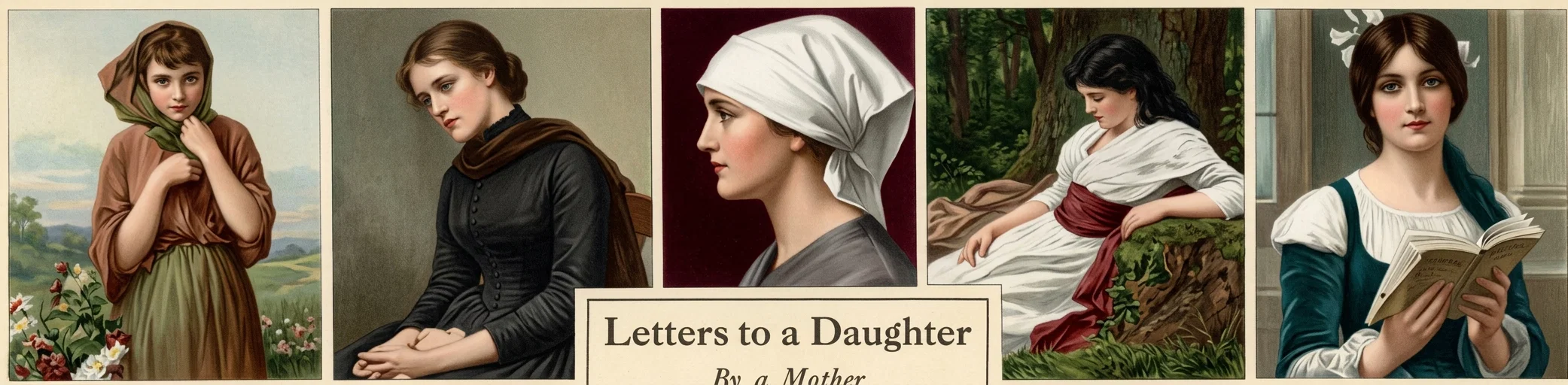
Letters to a Daughter

4%

Pacific Press Publishing Association · Mountain View, California · Jun 6, 1911

FromSigns of the Times, Vol. 38, No. 22.

Read the full edition

Letters to a Daughter

By a Mother

Economy — Self-Denial — System — Method — Accuracy

My dear Daughter,—
Your letter, so full of interesting news, is just at hand, and I hasten to write, that I may relieve your mind of what I can see is a burden to you. I can not tell you, dear one, how much we appreciate your attitude in this matter of the expense of your course. While it is true that the rest of the family must deny themselves some little luxuries, perhaps even comforts, that you may have the advantage of this opportunity, we deem it a pleasure to do so.
You remember the promise, "Cast thy bread upon the waters: for thou shalt find it after many days." You are simply receiving your own. You have made every possible sacrifice that your brothers might get a good start along the lines of their chosen life-work; and now, my dear, it is your turn, and the pleasure is ours. You know all too well that the most we can do for you in the matter of money will be very little. That little, I trust, during the years before you, will prove a factor in your training which will help you to develop right principles in the use of money.
Through this training you will doubtless get many a lesson in self-denial — an experience not least desirable, let me assure you, for by its practise the sinews of your character shall become strengthened, and your love broadened. You will find ample opportunity for it.
As I look forward along the line of your life-work, it seems to me there awaits you one long self-denial. Your time will never be your own; daily you will find it necessary to change your plans, give up cherished hopes, and in many ways deny yourself for the comfort and pleasure of others, those for whom you live and work. YOU will find this irksome indeed, except as you grow up to it in daily sacrifice in small things. In this, as in every other experience of life, we find our Father's loving plan for the happiness of His children. The law of compensation in the spiritual realm comes to our rescue, and humble self-denial is sweet. The peace, the sense of satisfaction in seeking not our own but another's good or comfort, far outweighs our pain.
Emerson says: "A man must expect no other good than the just fruit of his own labor. Let him see that as much wisdom can be expended on a private economy as upon an empire, and as much wisdom can be drawn from it."
Fortunately for us, the loving Father has not seen fit to trust us with overmuch means. Fortunately, I say. You may wonder that I say it. Money might bring us much good which we have not, but I truly feel that the constant care we must exercise in the matter of ways and means is a blessing rather than a misfortune, a good far greater than any that could be bought with money.
It is not a matter of chance that the world's best work has been done by those who have had more or less financial struggles in their youth. I want you to read the life of that remarkable woman who stood so long at the head of Wellesley College, Alice Freeman Palmer. Her influence will live on through the ages.
Your monthly allowance must be small, as you know; but even so, my dear, the way it is apportioned by you will mean very much to you in the future.
I send to you this little clipping from the pen of one who from a very humble beginning has made a great success in life. Read it carefully and ponder it well:
"Whether it be dimes, dollars, or thousands in your hands, and whether the same be earned or inherited, character is made or marred, and success largely shaped, by the way you spend it. If you are a clerk or factory hand starting on five dollars a week, it is vastly more consequence to you how you apportion that sum than it is to Mr. Rockefeller how he divides his millions of monthly income. If you are, on the other hand, a fortunate son of wealthy or of well-to-do parents and have ample funds at your disposal, the issue is the same, tho the risk is greater; for it is said that in America the distance between shirt-sleeves and shirt-sleeves is only three generations. The whole scheme of life can be centered in five dollars a week. If it is a sound and wise scheme it will not be altered much when it is ten, a hundred, or a thousand dollars a week.
"Here, again, as in the right use of time, system and method are necessary. And first in the system must be accurate records. Whether the accounting is to parents or to one's self matters little. The point is the fixing into permanent habit of principles essential to sound business. A little vest pocket blank book, a lead-pencil, and the habit of putting the two together every time there is a financial transaction, is all there is of it — except the copying of these items into a larger book for permanent record. One who, like the writer, has followed this simple practise for a lifetime, can go back over the record of boyhood, of school, of college, of small earnings in the early years, and of larger ones in the later years of business life, and trace the development of taste and habits and even of character, in a way which no formal diary can do. The forcing of balances in such a record is not essential, and if attempted often defeats the whole scheme. It is a financial diary, and not the keeping of a set of books. At the end of the year a classification of the expenses under a few general heads, will serve to show whether resolutions at the beginning of the year are working into results.
"It would be idle to lay down laws as to personal expense where the taste and surroundings of individuals differ so greatly. But two or three rules should never be lost sight of. First, expenditure within income by a margin to be fixed at the beginning, not at the end of the year. This will fail, be it observed, unless each month be treated as a unit and made to account for itself. Second, twice as much money put into articles of permanent value, such as books, pictures, and the like, as into needless indulgence. No better way can be contrived of proving how formidable are the totals of the nickels and dimes that get away for trifles. A man whose books and paintings cost $15,000, recently figured that it was only the equivalent of $1.40 a week invested and compounded for the thirty-five years in which the treasures were gathered. A friend who loved books and pictures, but had to get along without them, admitted that cigars alone had averaged him $1.40 a week during the same thirty-five years. Third, a fixed percentage of income, however small, for well-directed benevolence — not impulsive generosity. The men who pursue this rule in their humble beginnings are those who can be looked to, in their affluent years, for larger giving to the great charitable and benevolent works that lift America, in her higher life, above all the nations of the world.
"The abuse of money is the reckless, haphazard use — not necessarily a wrong use. The man who sits down on the last day of the year and wonders where his money has all gone, need not be feared much in the race of life. His feeble resolve to make a better record next year will fade out before January ends, for the habit-of-spending impulse, once fixed, is seldom broken."
Do not feel that you must treat others. I can not too strongly protest against this practise, altho I know how it will hurt. You will no doubt be thrown with many in your class who have money and spend it freelyon their friends. It will call for strong self-denial on your part not to return their favors, even with your last cent. To do this, my dear daughter, is not only not your duty, but a great weakness you are called upon to master. Could you look into the future, you would see some of these same girls wives of poor men, kept poor by their improvidence.
Your whole future success as a financier for yourself, the cause you serve, or the man for whom God may give you as a help meet, will depend upon the way you use your present small means. The less the amount you have, the more careful the thought required.
But it is not in the matter of money alone that you may practise economy. Economy of time is of great importance. So large is this subject, that I will not speak much of it in this already too lengthy letter. In a thousand ways you will be able to improvise and save, in the matter of laundry, food, and other avenues of expense, much that will add to your own exchequer, and prove most gratifying to those whose home you may be called upon to enter.
It is one of the grave charges made against trained nurses, that they are extravagant, and that besides the money they require as wages, they add heavy burdens in the way of household expenditures. I trust this will not be said of you.
There are many ways in which you can study to reduce expenses in the sick-room. Use the sunlight to cleanse and freshen the linen. Be careful of the left-overs, and materials of which you have already used a part. Do not call for the purchase of any articles you can possibly do without. Study to improvise with what you have at hand. Be careful of the furniture you have to use. All these things will be highly appreciated by your patrons, besides being of service to you in the way of recommendation. No more this time.
Your loving — MOTHER.