V. The Heavenly Sanctuary, Its Services, Its Cleansing
Now of the things which we have spoken this is the sum: We have such an High Priest, who is set on the right hand of the throne of the Majesty in the heavens; a minister of the sanctuary, and of the true tabernacle, which the Lord pitched, and not man. Heb. 8:1, 2.
WHEN studying the earthly sanctuary and its services, we were but viewing the "shadow of heavenly things;" but when the substance that casts the shadow is reached the shadow ceases, and we have the reality.
Instead of bringing an innocent lamb from the flock, and confessing over it our sins, as did the ancient Jew, we behold the spotless Lamb of God bearing our sins on Calvary's tree.
In place of the erring human priest bearing the blood of the lamb into the earthly sanctuary to make atonement for our sins, we have a High Priest "who is holy, harmless, undefiled, separate from sinners," bearing His own blood into the true tabernacle on high, where He ever lives to make intercession for us. Heb. 9:12.
As the ministration in the earthly sanctuary consisted of two great divisions, each occupying a period of time and having a distinctive place, so the antitypical ministration must consist of two divisions, and to each a department of the sanctuary be devoted; for, says Paul, "Christ is not entered into the holy places made with hands, which are the figures of the true; but into heaven itself, now to appear in the presence of God for us."
From this text it is evident that Christ ministers in both apartments of the sanctuary in heaven; and hence according to the type, or shadow, He must have begun His ministration, at His ascension, in the first apartment, or holy place.
The Sacrifice had been provided, the merit of which was sufficient to avail with God to cancel the guilt of the entire world. Here an Offering was given, upon which all who would, might lay their sins. Whether or not the Sacrifice shall be of benefit in any individual case, depends on the action of that individual himself.
Having provided the Sacrifice, Christ commences His work as Priest, and sends forth the invitation to all the world, Come unto Me for pardon and everlasting life.
The Way of Our Coming
The way of our coming is described in Acts 20:21.—"Repentance toward God, and faith toward our Lord Jesus Christ."
As in the former dispensation the penitent laid his sins upon his victim by confession over him of his transgressions, so we lay our sins upon Christ by confessing them to God through Him.
It is true that God "laid upon Him the iniquity of us all," on the cross; but that would avail us nothing unless we give up those sins, and put them where God put them. Otherwise Christ's sacrifice would also be in vain for us.
But when, by repentance and confession, we make Christ's "soul an offering for sin" (Isa. 53:10), through His ministration for us the sin is transferred to the sanctuary above. And thus there is in this dispensation, as in the former, a transfer of sins; there in figure, here in fact.
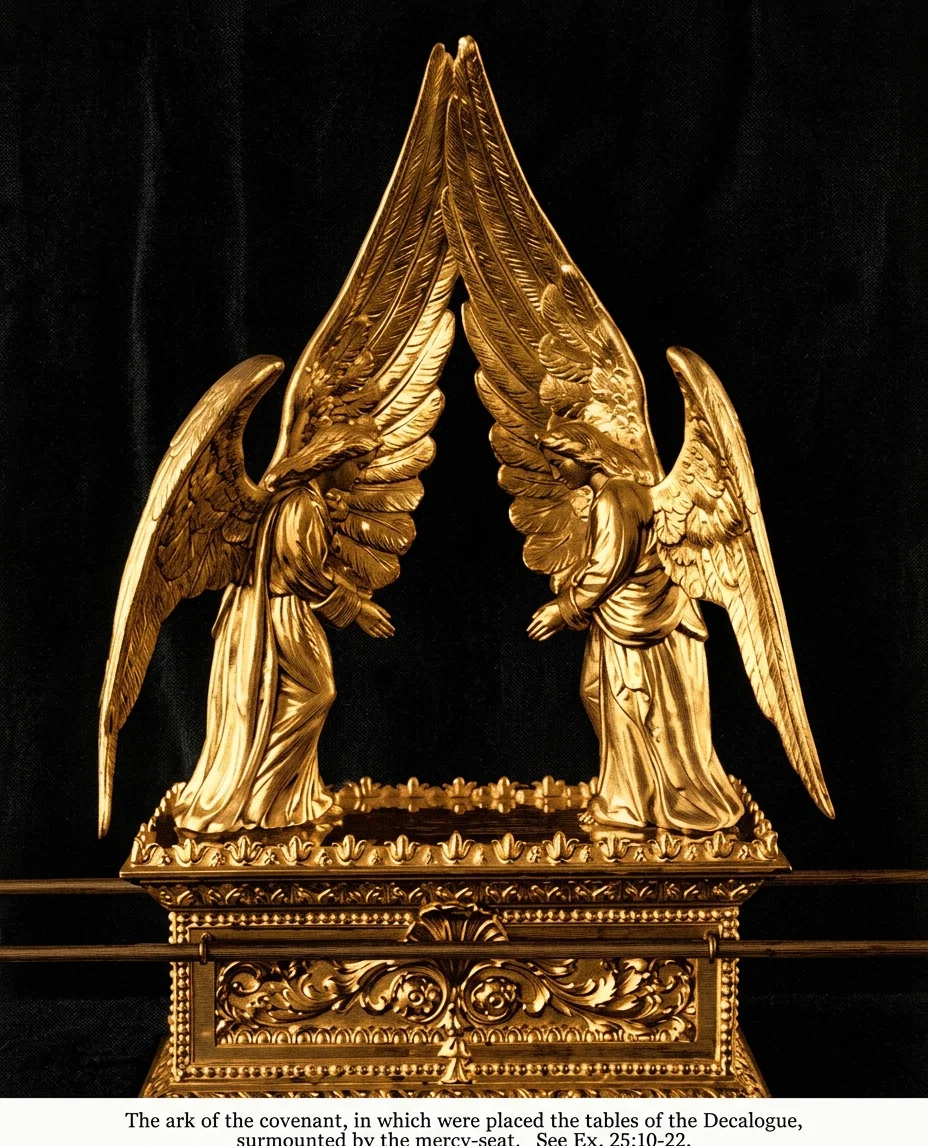
The ark of the covenant, in which were placed the tables of the Decalogue, surmounted by the mercy-seat. See Ex. 25:10-22.
The same question now confronts us as was connected with the earthly sanctuary. What final disposition is to be made of those sins? Do they remain in the sanctuary above forever? No; thank God, the plan of salvation was laid sufficiently deep to remove sin from the universe.
The Final Putting Away of Sin
As in the type the earthly sanctuary had to be cleansed, even so the heavenly.
"But I can't believe," says one, "that there is anything in heaven that needs cleansing." Let such note carefully the apostle Paul's testimony on this point: "And almost all things are by the law purged with blood; and without shedding of blood is no remission. It was therefore necessary that the patterns of things in the heavens should be purified with these; but the heavenly things themselves with better sacrifices than these." Heb. 9:22, 23.
One definition of the word "remission" is, sending back, sending away. Remission of sins is that absolute disposal of them that removes them forever; therefore "without the shedding of blood" there could be no removing of sins, or cleansing of the earthly sanctuary, which was a pattern of the things in the heavens. This cleansing was necessary, says the apostle, to be done by the blood of beasts; and the very same reason exists for the cleansing of the heavenly sanctuary, but it must be cleansed with blood that is "better" than the blood of animals, even the precious blood of Christ.
This is again positive proof that sins are transferred to the heavenly sanctuary, or there would be no necessity for its cleansing.
But what is the cleansing of the heavenly sanctuary? Again we must go back to the type. We find that on the tenth day of the seventh month, the high priest went into the most holy place with the blood of the Lord's goat, to cleanse the sanctuary.
Notice what is said of this tenth day: "It is a Day of Atonement." "Ye shall do no work in that same day." "Ye shall afflict your souls." "For whatsoever soul it be that shall not be afflicted in that same day, he shall be cut off from among his people." Lev. 23:27-29.
A Day of Judgment
This day, then, was a day of decisions, when every case was decided according to the attitude of the individual. If he was found penitent, confessing and putting away his sins, he was counted among the people of God, and was cleansed with the sanctuary.
If he was indifferent or careless that day, he was cut off from God's people. Lev. 16:29, 30.
Of what day were this day and work a type?
What do we call that day which determines the destiny of every soul? It is none other than the great judgment-day, when "we must all stand before the judgment-seat of Christ." It is the day brought to view in Rev. 20:12: "And I saw the dead, small and great, stand before God; and the books were opened: and another book was opened, which is the Book of Life: and the dead were judged out of those things which were written in the books." It is the day when Christ changes His ministration from the holy to the most holy place, as brought to view in Rev. 11:19: "And the temple of God was opened in heaven, and there was4seen in His temple the ark of His testament." The ark had its position invariably in the second apartment of the sanctuary; and in the type this apartment was not opened until the Day of Atonement, or day of judgment.
The prophet Daniel gives a vivid description of the opening scene of the judgment: "I beheld till the thrones were cast down [or placed], and the Ancient of Days did sit, whose garment was white as snow, and the hair of His head like the pure wool. His throne was like the fiery flame, and His wheels as burning fire. A fiery stream issued and came forth from before Him; thousand thousands ministered unto Him, and ten thousand times ten thousand stood before Him: the judgment was set, and the books were opened." Dan. 7:9, 10.
A Preliminary Work
But I hear some one say, "I thought the judgment took place at the second coming of Christ." Permit us to direct your attention to a few texts bearing on this point. The wise man says, "God shall judge the righteous and the wicked; for there is a time there for every purpose and for every work." Eccl. 3:17. The judgment, then, occupies a period of time sufficient for the examination of every purpose and every work, which could not be the case should the judgment take place at the coming of Christ; for when He comes, the living righteous are changed "in a moment, in the twinkling of an eye," and the righteous dead are "raised incorruptible." Again, in Luke 20:35 Jesus speaks of those who shall be "accounted worthy to obtain that world, and the resurrection from the dead." The accounting worthy, then, must take place before the resurrection.
Those living at the time of the coming of Christ have also been "accounted worthy to escape all these things that shall come to pass, and to stand before the Son of Man." Luke 21:36.
The cleansing of the sanctuary is this work of judgment.
When the sinner comes to God and confesses his sins, pardon is written against them, but the sins remain on the books of record until the day of judgment. Otherwise how could God "bring every work into judgment, with every secret thing, whether it be good, or whether it be evil"? Eccl. 12:14.
Blotting Out of Sin
The exhortation is given us to "repent, . . . and be converted, that your sins may be blotted out, when the times of refreshing shall come from the presence of the Lord; and He shall send Jesus Christ." Acts 3:19, 20. The blotting-out time is here referred to as preceding the times of refreshing that precede the coming of Christ. The Revelator speaks of it in connection with the overcomer: "He that overcometh, the same shall be clothed in white raiment; and I will not blot out his name out of the Book of Life, but I will confess his name before My Father, and before His angels." Rev. 3:5. The judgment alone will reveal who the overcomers are, and such will have their sins blotted out, and their names retained in the Book of Life; but those who are not found penitent, and clothed in the garment of Christ's righteousness, will like ancient Israel be cut off from among God's people, and their sins will come back upon themselves. Thus the heavenly sanctuary will be freed, or cleansed, from even the record of sin. And as the high priest in the type, bore out the sins of Israel and confessed them over the head of the scapegoat, which bore them away into a land not inhabited, so Christ's work for the redemption of man and the purification of the universe from sin, will close with the removal of sin from the heavenly sanctuary, and the placing of the same upon Satan, the antitypical scapegoat, who will bear the final penalty. The reason for this is evident, since he is the originator of sin, the direct instigator of all the sins that caused the death of the Son of God. "So as a vehicle he bears away the sins of the righteous, because he is guilty of them all. He planned them, and executed them as far as he was able; and therefore in being punished for them he will be punished only for his own guilt." The guilt of the righteous in connection with those sins was borne by Christ on the cross.
At the end of the thousand years Satan, with all the wicked, is cast into the lake of fire, which will burn them up, and "leave them neither root nor branch." "And in that time, saith the Lord, the iniquity of Israel shall be sought for, and there shall be none; and the sins of Judah, and they shall not be found." Jer. 50:20. O, happy day! May the reader and writer be numbered among that purified throng!
But the question now arises, When will Christ go into the most holy place, and begin this work of judgment, and cleanse the sanctuary, and finish up the work of the Gospel in the earth? Can we know the time? This will be considered in our closing article.