BURMA has been known to many as "Farther India." It is a province in India of the great British Empire. But to think of it thus is almost sure to lead one to fail to realize its size and importance. I well remember that my first geography gave to the New England States a whole page of map space, to a group of five of the large States of the West a like amount of space, and to the great continent of Asia — the largest of the continents — the same sized page. It is true that the lettering in the corner of the page showed that a different scale was used; but what did this mean to me? I grew up with the mental picture of those maps in my mind, and to the present day I must think twice before realizing that the small territory of New England is not as great as Asia.
India as a whole is some two thousand miles in greatest length, and from fifteen hundred to eighteen hundred miles in width; yet again and again have I been asked whether I knew such and such an individual in India. And some who knew that Burma is separated from the main peninsula of India, seemed much surprised that there could be any one here that I do not know. Burma is as large as France. It is more than a thousand miles in length from north to south.
The climate is tropical. In Rangun, on the coldest night that we have ever experienced, the thermometer registered almost thirty degrees above the freezing-point. Farther up country it gets a little colder; but there is no place on the plains that it ever frosts, I believe. We do not have the great heat that is experienced in some parts of the great plain in India, but for months at a time it is so hot that one is in a bath of perspiration night and day. This is exceedingly trying to the nervous system. It takes more grace to be sweet-tempered than it does in a temperate clime.
Being especially well watered, the rainfall varying from about thirty-five inches, normally, in what is known as the "dry zone," to three hundred inches per annum in the wettest parts, there has never been a famine. Rice is the principal crop. Other things can be raised; but the natives are content with this grain, for rice with fish or vegetable curry forms the bulk of the food eaten. Teak wood, especially valuable because it will not rot in water and is almost proof against the ravages of white ants, is found in abundance. The forests of Burma are second to none, unless it be those of Java; and with the wise system of conservation now prevailing, the supply will probably never be exhausted.
Minerals of many kinds are to be found. Burma produces the finest examples of the pigeon-blood ruby. Gold dredging, silver mining, and petroleum producing are carried on all the time.
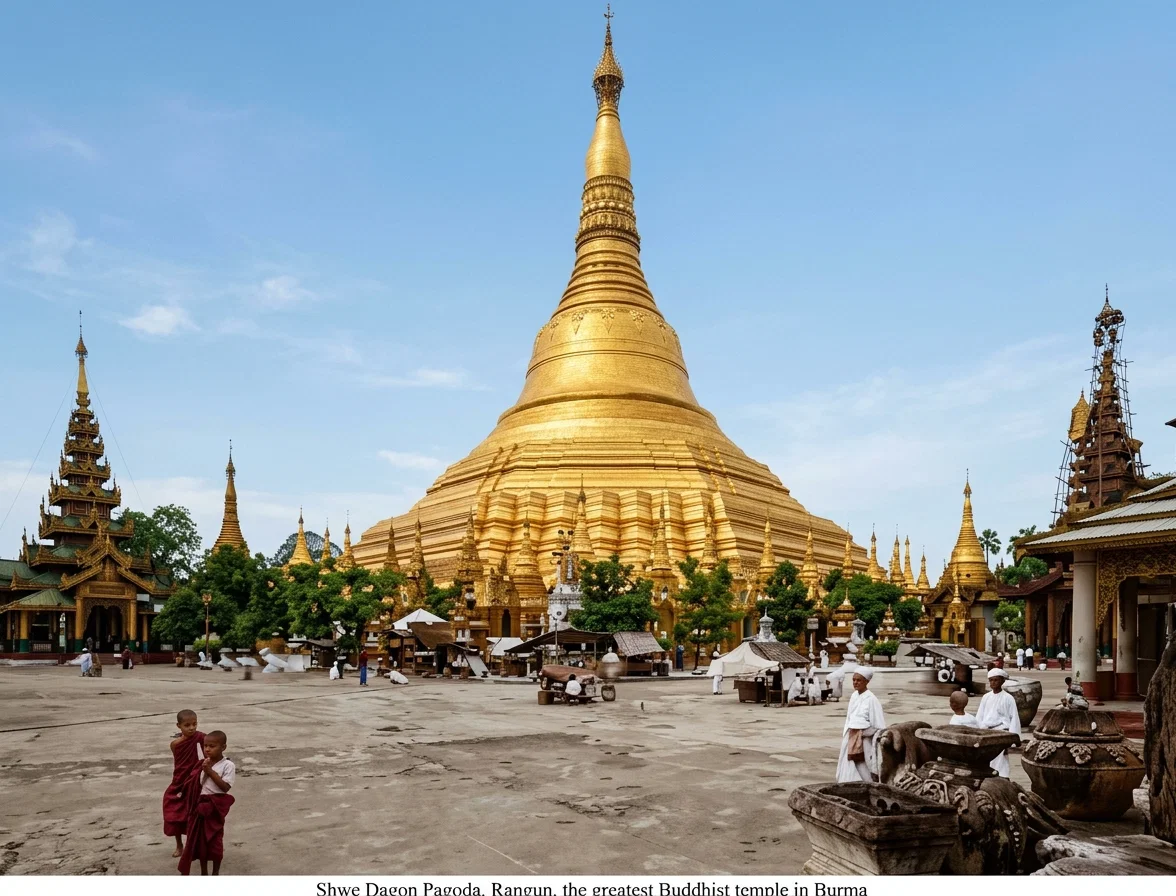
Shwe Dagon Pagoda, Rangun, the greatest Buddhist temple in Burma
Of late, wolfram has engaged the attention of many prospectors, for at the present market rates it brings large returns. Beautiful marble is quarried, the best in the empire. Jade is shipped to China, where it is especially prized.
Wild animals are numerous. It is but a few years since a large tiger was killed upon the Shwe Dagon Pagoda, right in Rangun. Now it is possible to find large game within thirty miles of this city. Elephants, water-buffaloes, wild cattle of huge size, tigers, panthers, etc., furnish sport for those who enjoy hunting. Reptiles are numerous. In our kitchen we have killed a Russell's viper, one of the most deadly of snakes; and in our yard a huge cobra, also very poisonous. Last month, while doing some leveling of the ground in front of our house, we killed nineteen scorpions within a half hour, and a little later killed four or five more. Yet we have never been stung by a scorpion, tho we have killed a number in the house at different times.
Compared with her neighbors to the east and the west, this land is sparsely settled. The average here is forty-four persons to the square mile. In Bengal there are nearly ten times as many, and in large sections of China the same congested condition prevails. Because of this, thousands of Aryans from the western neighbor, and thousands of Celestials from the eastern one, are domiciled here. These aliens exhibit such thrift that it has been necessary to pass some restrictive legislation, lest all the soil should pass out of the hands of the care-free Burmese. By the term with which they address him the Burmese recognize the Chinaman as a relative. The union of the two nations by intermarriage seems to result well. Not so much can be said in favor of the union of the Indian and the Burman.
The people of this land are the best liked of all Orientals, by travelers. They are a happy race. Nature has been kind to them. Worry concerning the morrow or a mad rush for wealth is unknown. They obey most literally the injunction to "take no thought for the morrow." Hospitality abounds. In every home enough is prepared for the stranger, and no rule of caste forbids them to let one use their dishes. We who live here know some of the things that they prepare for food, and consequently use a degree of caution. A friend of mine was offered a dog curry. Another was told that the snake curry was especially fine. Both declined the delicacies! Other meats may be preferred; but if not available, these are used. For myself I think I would prefer either of them to one of the most common articles of food. Ngappe is used by all. I almost fear to describe what I have seen and know about it, lest some might think I am exaggerating. It is, or rather was, fish. It is allowed to decompose until it is filled with maggots. I have seen a car loaded with the stuff having these larvae so numerous that the mass seemed to move. The juice was dripping from the car, and some people from the village near were catching it in sundry vessels, presumably for flavoring purposes. The stench was terrible.
Awful as this seems to you, it is a common thing for European residents to eat a preparation of this ngappe. Vinegar and cayenne pepper are added till the original taste is covered, and the whole is declared to be15delicious. Yet I have observed that those who eat such things, care but little for fruits and grains, declaring that they have no taste. Many would never think of eating any citrus-fruit at night, for fear of contracting a cold, and yet eat heartily of the thing I have described. At one time a worker was ill, and friends advised that we give no fruit, but a little "light food," such as rice and curry.
The Burman is not wanting in humor; and when we have remonstrated with him for eating ngappe, he has replied, "Europeans eat rotten milk (cheese), and we eat rotten fish; there is no difference." We thank the Lord for the principles of health reform which teach us to care for the body as well as the soul.
As the reader has likely guessed from the haughty titles of the Burmese kings, the race is a proud one. The coins of the realm bear a peacock with tail-feathers spread as the emblem of the kingdom. And the symbol is wonderfully suggestive. No matter how poor the home may be, it has some jewels kept for festive days. Sometimes we are filled with astonishment as we see some woman bedecked with diamonds come from a hovel. If but few jewels are owned, some are borrowed on special occasions.
Silk is the material used by both men and women for their lower, skirt-like garments. A cotton jacket reaches to the waist. The men wear turbans of silk, and the women wear scarfs of the same. They are adepts in blending colors. The most delicate shades are worn, and one of the most picturesque sights that can be imagined is a group of worshipers at some great shrine. It almost reminds one of a flower garden in bloom.
The Burman has excelled in the past in wood, ivory, and silver carving. His silk is surpassed by none in wearing qualities. But he is lazy. The people themselves admit this. The women are enterprising traders, and some observers have declared that they are the mainstay of the nation.
H. H. VOTAW.