FOR many years the "Signs of the Times" has continued to point out the fact that the great Protestant churches of America have been inclined to side-step from the narrow way and work of purely spiritual life and Gospel preaching and teaching, to engage in the questionable callings of reforming society and saving the State. The dangers of this course, together with the final results, have also been clearly indicated.
Certainly no one will now question that this inclination on the part of Protestants has at last crystallized into open, actual fact, and that Protestantism, so called, is now a real element of American political life.
Yes, the church of Christ has stepped down into the common arena of every-day affairs, and is now grappling with the great questions which agitate the secular world. It would seem that she has done so not only because she herself has had the unnatural longing, but because society has challenged her to broaden the sphere of her activities. Accused of cold formality, of unfeeling aristocracy, of lifeless theory, she has found it impossible to resist the temptation to popularize herself. In answer to the question, "Can any religion really live that does not apply itself frankly to every side of human life — business, industry, banking, tenement houses, land owning, in short the WHOLE of life?" she has resolved to make her personality felt at whatever cost, and demands of her ministers that they make the pulpit a power in politics, — local, State, national, world-wide.
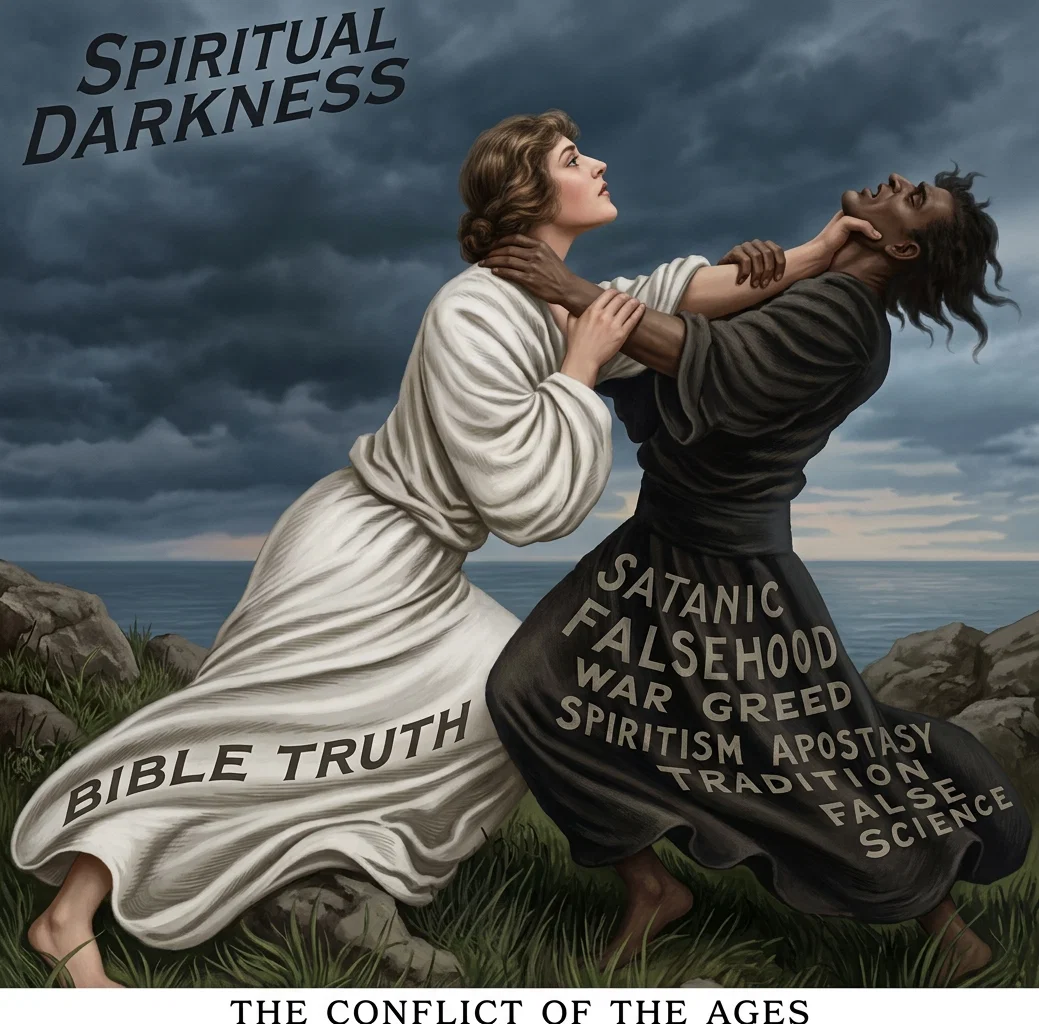
THE CONFLICT OF THE AGES
A Radical Departure
Upon this new field, upon this "new evangelism," as it is termed, the church has entered. She has accepted as axiomatic the theory advanced by one of our leading writers, that "the churches have concerned themselves too exclusively with personal salvation — the saving of individuals; they have lacked social vision." She has adopted, once more, the old page-papal teaching that "there are two great entities in human life — the human soul and the human race — and religion is to save both. The soul is to seek righteousness and eternal life; the race is to seek righteousness and the kingdom of God." She now holds that "the work of social reconstruction . . . is the fundamental purpose of Christianity." With the greatest of enthusiasm she seeks to attain the object that "the American church will be the great religious body animating the American democracy."
On a large scale this "new evangelism" has just recently been undertaken. The visible net results to date are summed up by Ray Stannard Baker as consisting of "parish houses and gymnasiums, bowling-alleys and club rooms, carpenter shops, shooting-galleries, and dance halls. . . . Never before in history, perhaps, was there such a variety of church-saving experiments going forward." One church, the Christ Presbyterian, of New York, conducts kindergartens, clubs, and classes, giving instruction in "carpentry, sewing, cooking, typewriting, and basketry. To provide for the amusement which human nature will have (in the saloon, if not in the church)," this same church provides "billiard-tables, a bowling-alley, a shooting-gallery, a gymnasium and baths, and a room for games," and "other entertainments, including social dances."
In the Field of Politics
This illustrates that the church means to put into practise her new-found faith. She is really putting forth herculean efforts to save society, to reform that imaginary entity known as "the human race." She is in the political domain, and has already won for herself the admiration and respect of the very large class of politicians whose greatest ambition is to stand well in the eyes of the multitude, and who need only the quiet threat of the lobbyist to bring them to terms.
What It Means
And now the question found at the head of this article: What will be the outcome? What does this mean to the church, and what does it mean to the nation?
It must not be forgotten that the distinctive field of operation now chosen by the Protestant bodies of America is pre-eminently the peculiar property of the Church of Rome. For many centuries she has owned and occupied the ground, and has been acknowledged by nearly all nations of earth as the originator and consistent supporter of the doctrine that the church, by divine right and call, must interest herself in all matters, both divine and human. It is well known that the Roman Church was once a temporal as well as a spiritual power, and that ever since the days of Victor Emmanuel, who wrested from her the last of her Italian possessions, she has ardently longed and labored for the restoration of her lost world dominion.
Now, when the American Protestant churches accept the dogma that they, either singly or collectively, are to step into the realm of secular affairs, and seek to reform and control society, and aim at making the American church "the great religious body animating the American democracy," they are simply approximating the Roman Catholic principles, and rob themselves of all power of defense against the workings of that church.
Roman Catholic Success
Roman Catholic principles mean Roman Catholic success, even tho they be carried out by Protestants. Every day that Protestantism takes its stand on the Roman platform, it must cherish the spirit, give the message, and do the work favorable to the Roman cause; and Rome knows it, and rejoices in it.
The fact that the attitude and general spirit of the Protestant bodies of America are peculiarly in harmony with the Roman Catholic position, gives to that church a boldness which she has never before shown. She sees that Protestantism has lost its real life and power to protest, and that, in fact, it is working along her own lines. She therefore does not hesitate to announce openly and strongly that the United States is now a Roman Catholic country. In other words, she sees that Protestants, generally speaking, are intrinsically Roman Catholic in belief and practise, and she may thus safely count them as of her fold.
Powerless to Oppose
Of course, Protestants still pride themselves on being opposed to Roman Catholicism. One writer has said (in "Watson's Magazine"), "Why not let Italy remain Roman Catholic, and Cuba remain Roman Catholic, and South America remain Roman Catholic, until we have called home all our workers, concentrated all of our energies, and put Roman Catholicism to rout in our native land?" But how shall Protestants do this when equipped only with Rome's weapons? So long as they believe in and practise the doctrine of the church in politics; so long as they make the preaching of the Gospel subservient to the work of reforming11society; so long as they cherish the false teachings of Rome concerning the Sunday sabbath; so long as they seek to interfere in purely worldly and secular affairs; so long as they continue to surrender the very positions for which the Reformers fought and died, and in defense of which they gained the NAME 'Protestant;'—so long as Protestants shall thus continue to invalidate their own claims, they have no right even to profess to oppose Roman Catholicism.
A Mistress of Diplomacy
As a system of clever, consummate diplomacy, the Roman hierarchy has no superior. For ages she has played the game of politics, and into this American contest she is introducing her most subtle powers. So-called Protestants may attempt to play an opposing part, but they will find themselves outwitted and outplayed at every point. Rome knows this so well that even now she is complacently and composedly waiting until these simpler minds have turned everything into her hands.
To illustrate, take one part of the present Protestant political program. The federated churches of America have announced their intention of securing a national law compelling all our citizens to observe the Sunday as a religious rest day. They have been and are now literally besieging our national legislature to bring this about. But in doing so, they are only doing what the Church of Rome really inspires. Sunday is the great papal holiday and false sabbath. She herself once exalted it into law in the old world, and persecuted and put to death those who denied her claims. She believes in religion by law. And what must be her rejoicing to see professed Protestants acting the Roman Catholic part and carrying through the two-fold part of exalting Sunday and enforcing religion by law! Why should she not claim all as hers, and consider our country "the favorite daughter of the church"? No wonder Cardinal Vannutelli believes that "Catholicism has here made more wonderful strides than anywhere else in the world."
What the outcome of this great apostasy of Protestants will be is easily seen. God's Word has said that "all the world wondered after the beast"—that system of Church and State found in the Papacy. The United States is heading the procession back toward the Dark Ages, and so great is its influence that nothing shall be able to stop the movement. As a matter of fact, there is so little REAL Protestantism now left that it is a question whether the procession may not already have reached the Vatican.
Here and there are to be found those who protest truly against the whole iniquitous business of Romanizing our Protestant church work. However, they are so largely in the minority that their voices are unheeded, and their messages serve only to hasten on the multitude to accomplish the final nullification of the principles for which the Protestant religion has stood.
Roman Catholic principles will one day fully and finally control the politics, the religion, the people of America, and all because Protestantism gave these into her hand. The die has been cast.