Burma — Its Religions

5%

Pacific Press Publishing Association · Mountain View, California · Jul 18, 1911

FromSigns of the Times, Vol. 38, No. 28.

Read the full edition

Burma — Its Religions

THE religion founded by Buddha is so highly extolled in these days in many places in the West, it may not be out of place to give a little attention to it as we see it in its stronghold. Many of the things commanded by this system are good.
To term it a religion is hardly correct. It is a system of philosophy. It may be fitly called a protest against the grosser forms of Hinduism, as they were practised in the Gautama. It is infinitely superior to Hinduism. Comparatively it is pure. It is tolerant. It enjoins kindness to the brute creation, but because it teaches transmigration of souls. Admitting freely all that can be said in its favor, the conviction is strengthened that it has no good thing that is not found more explicitly in the Word of God, while the religion of Jesus Christ towers above it in a multitude of ways that indicate superiority.
And one thought forces itself insistently into my mind as I study Buddhism: Much is read into the teachings of Gautama by advocates who have been reared in Christian lands and apostatized from the faith of their fathers, that is not warranted by the original writings. And, too, I see that the adage is true which says that those who have least faith are most credulous; for men who stumble at the Bible, being unable to believe it, because they think it may have been changed in translating, or parts of it have been lost and other matter inserted, yet believe implicitly all the supposed writings of Buddha, when it is known that they were not written for a century, at least, after his death, and many able scholars think that three or more centuries passed ere his teachings were reduced to writing.
In one or two points, let us compare the founders of Buddhism and Christianity.
Gautama, a prince by birth — a prince of an earthly kingdom, a son of an earthly king — was shielded from every sight of sickness or infirmity or death, till he had reached manhood. Seeing, at last, a sick man, he asked if he would become thus. Seeing a dead man, he asked if he would come to such a state. Being informed that all flesh is subject to such things, he left his heritage to seek some way to escape them. He was impelled by a desire to save self.
Jesus Christ, a Prince — not of the world or a lone kingdom of the world, but of the universe — a Son of the most high God, looked with compassion upon a fallen race, and forsook all that He possessed, that He might rescue them. He was impelled by a desire to save others.
Buddha taught that every desire is wrong, that the highest good has been attained when we lose all desire of whatever nature. He taught temperance; yet he died from eating too much pork. Jesus, taking up the fight at the very place where the first man had been defeated, overcame appetite at the beginning of His career.
In order to win salvation, Buddha taught his disciples that they must leave home and friends and become recluses. Their wives and children might starve, but it should not concern them. They should not work, but give their whole time to meditation, depending upon others for their food. Jesus shows that the best way to help ourselves is to help others, for this leads to the forgetting of self. The lazy man is not encouraged in his sloth by Christianity. “Not to be ministered unto, but to minister,” is the motto of the real follower of the Nazarene.
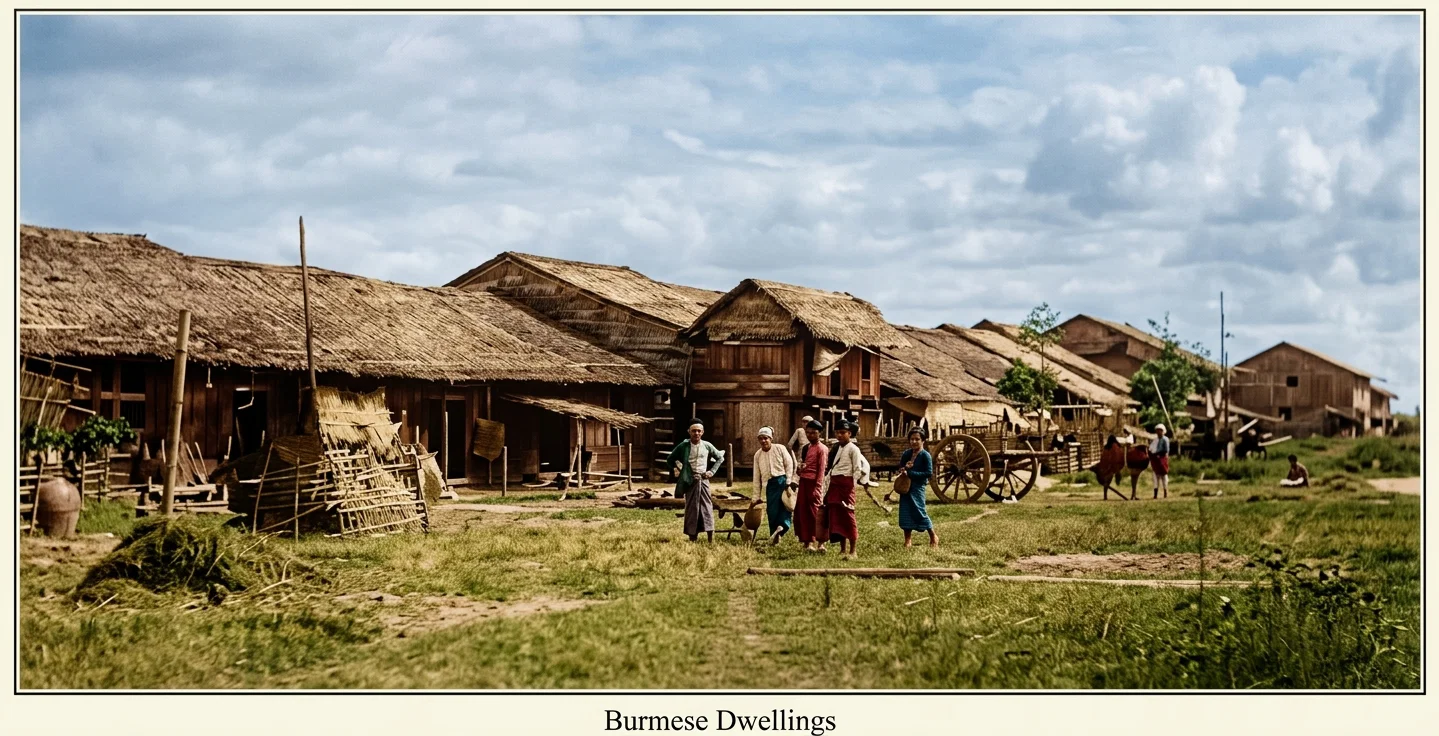
Burmese Dwellings
Burmese Dwellings
Further, mankind as a whole has far less need of more knowledge of the right, than of more power to do what we know. This power Christianity gives, while Buddhism leaves its devotees to depend upon their own feeble efforts.
In outward form the religion of Burma is like Roman Catholicism. There are priests and nuns in distinctive garb in each. There are candles and incense and images in the pagoda and in the cathedral. Rosaries aid in counting the prayers said, and merit is gained by the repetition of set phrases, according to the teaching of both.
Before the advent of the missionary, the Buddhist priests did practically all the teaching of the youth. While but little education beyond indoctrinating in the tenets of their religion was given, it taught all the boys to read. A very high percentage of the population can read some. We take advantage of this ability in giving the Gospel message.
Brother Maung Maung, my Burmese fellow laborer, and I, go to a village, bearing a tract treating upon the subject of the second coming of Christ. We pass rapidly through the streets, leaving a tract in each home. This subject always arouses an interest, for the Buddhists believe that it is almost time for another Buddha — “enlightened one,” this term means — to appear in the world. As we return through the town, we see in at least half the homes some one reading and from one to a half dozen persons listening. By the aid of that great agency for good, the British and Foreign Bible Society, we can secure a Gospel for a pice — a half cent. These Gospels we sell, usually using the Gospel of Luke for our first visit. Occasionally we get letters from interested ones asking for more literature. After having gone over the territory with reading-matter three or four times, we aim to hold preaching services.
The Buddhists are a hard people to reach with the Gospel. The Burmese race are so well content with themselves, that they seem to say, “We are rich, and increased with goods, and have need of nothing.” But there are some truth seekers. And when they become Christians, they are creditable ones. We have no “rice Christians.”
The present year we have entered the city of Mandalay, Brother and Sister R. A. Beckner have begun labor there.
Prof. R. B. Thurber and family are in Meiktilla. We have begun an industrial school. The Lord has given us the favor of the people, and about $1,500 has been given outright by those not of our faith, and most of it has come from non-Christians. We have the assurance that more will yet come. Some of the boys of the school give promise of being a great help to us in giving the warning to Burma.
In Rangun we preach to all classes. The European and Eurasian communities furnish the larger number of attendants at our preaching services; yet educated Burmans and Karens and representatives of the many tongues of India come also. Our little hall is well filled every night. Last night there was not a vacant chair. Some are now in the valley of decision. We see evidences all about us that the Lord is preparing the way for the closing of the earth’s history, and we can see how many things here will be turned to account in heralding the approach of the King.
H. H. Votaw. Rangun, Burma.