Fruit-Bearing

4%

Pacific Press Publishing Company · Oakland, California · Dec 3, 1896

FromSigns of the Times, Vol. 22, No. 48.

Read the full edition

Fruit-Bearing.

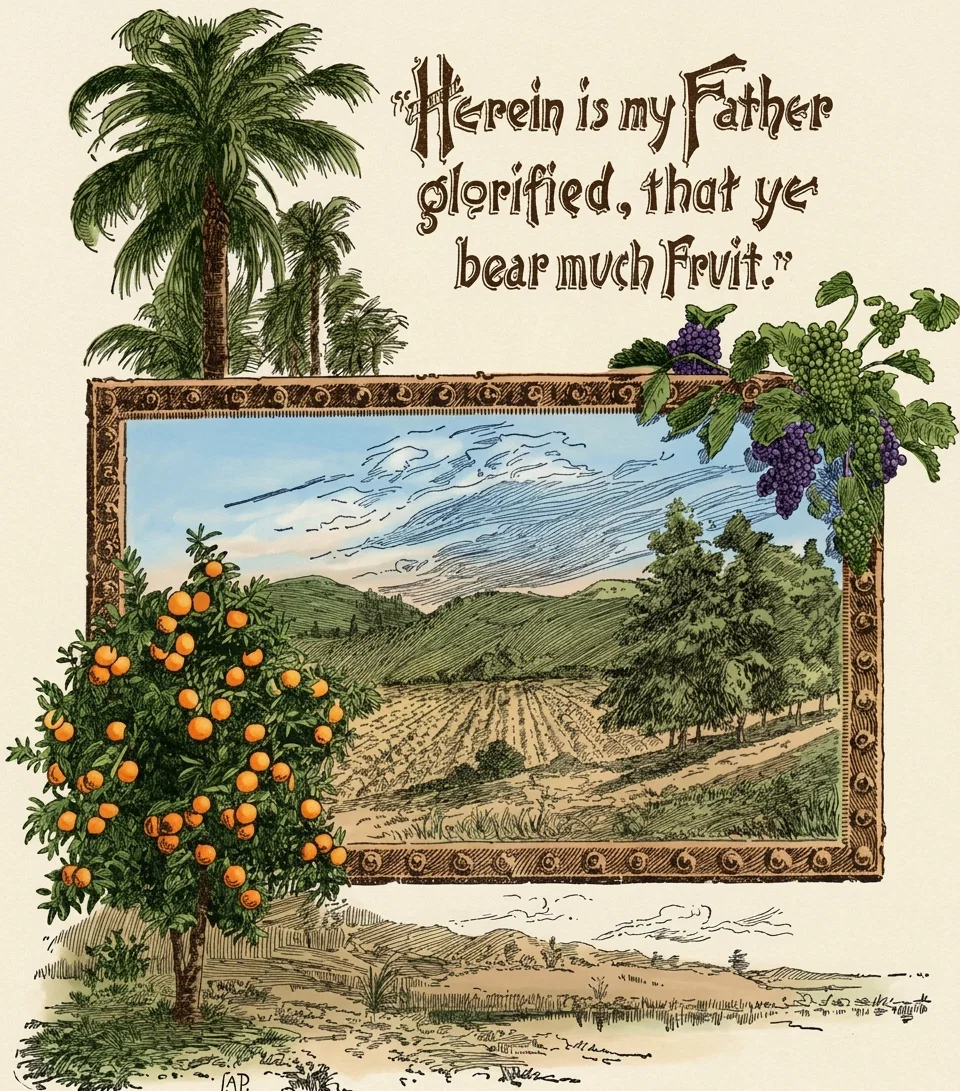
The purpose of the husbandman in planting grape-vines or almond, apple, or any other fruit trees, is that they may bear fruit. Fruit-bearing in good quality and quantity is the glory of his vineyard and orchard. The kind of tree determines the kind of fruit. The care and devotion of the husbandman affects its quality. And life in the vine or tree is absolutely necessary that there may be fruit at all.

In Human Character.

All the above is true as respects the disciples of Christ. Jesus says: "I am the True Vine, and my Father is the Husbandman;" "ye are the branches." (John 15:1, 5.) In verse 8 he declares: "Herein is my Father glorified, that ye bear much fruit; so shall ye be my disciples." By this we learn that fruit-bearing is the means by which God is glorified by us or in us. It is by fruit-bearing, and by that alone, that we may glorify him on the earth. Furthermore, it is only thus that we may be his disciples. He who bears no fruit to God's glory is not a disciple, a learner of Jesus Christ; for He could say to the Father: "I have glorified thee on the earth, I have finished the work which thou gavest me to do." (John 17:4.) Jesus was the great Fruit-bearer; the One above all others in whom God was glorified.

How Did He Bear Fruit?

It is an all-important question. For as he was the great and perfect Fruit-bearer, and perfectly glorified the Father; and as we are Christ's disciples only as we bear fruit and, like him, glorify the Father, or shew forth to the world, by the fruit we bear, what the glory of the Father is, it is important that we shall know by what means or power Christ bore fruit; for by that same means we may bear fruit. Well, in the first place, it was not the fruit of the self of Jesus, howsoever righteous that may have been. Christ's fruit-bearing did not reveal himself or his glory, but the Father and the Father's glory. He was the Medium through which the white light from the Great Central Sun could shine upon our world unperverted, unadulterated, undimmed, without aberration. Therefore he said: "Believest thou not that I am in the Father, and the Father in me? the words that I speak unto you I speak not of myself; but the Father that dwelleth in me, he doeth the works." (John 14:10.) The means, therefore, by which Jesus Christ bore fruit, the life by which the fruit was produced, the works which he did, was the presence of God in him. And God is present in his followers by his Holy Spirit. So in the prediction concerning Christ it is said:—
"Behold My Servant, whom I uphold; Mine Elect, in whom My soul delighteth; I have put My Spirit upon Him." Isa. 42:1.
"The Spirit of the Lord God is upon Me; because the Lord hath appointed Me to preach good tidings unto the meek; He hath sent Me to bind up the broken-hearted, to proclaim liberty to the captives," etc. (See Isa. 61:1-3.)
When Christ came, these predictions were thus fulfilled:—
"And Jesus, when he was baptized, went up straightway out of the water; and, lo, the heavens were opened unto him, and he saw the Spirit of God descending like a dove, and lighting upon him. And lo a voice from heaven, saying, This is My beloved Son, in whom I am well pleased." Matt. 3:16, 17.
Jesus himself witnessed to the fulfilment of Isa. 61:1, 2 in himself when in the synagogue at Nazareth. (See Luke 4:16-21.) Again we read in Acts 10:38:—
"How God anointed Jesus of Nazareth with the Holy Ghost and with power; who went about doing good, and healing all that were oppressed with the devil; for God was with him."
That Spirit was not given to Christ "by measure" (John 3:34), but in its fullness, so much so that it was his Spirit. And he implies that it was "by the Spirit of God" that he "cast out devils." (Matt. 12:28.) In fact, his works were all wrought, his life-fruit borne, by the Spirit of God which was in him.

How Obtained.

How did Jesus obtain this Spirit? This also is an all-important question; for as we are not his disciples unless we bear fruit, and as we can not bear fruit without his Spirit, and as we must obtain the Spirit in the same way as did our great "Elder Brother" and Exemplar, how important it is that we know how that Spirit is obtained! But upon this the word of God is very explicit. (1) He emptied himself and the Father filled him with his Spirit:—
"Have this mind in you which was also in Christ Jesus; who being originally in the form of God, counted it not a thing to be grasped to be on an equality with God, but emptied himself, taking the form of a bond-servant, becoming in the likeness of men; and being found in fashion as a man he humbled himself, becoming obedient even unto death, yea, the death of the cross. Wherefore God highly exalted him." Phil. 2:5-9. R. V., margin.
"For it pleased the Father that in him should all fullness dwell." Col. 1:19.
"For in him dwelleth all the fullness of the Godhead bodily." Col. 2:9.
How many times we read in the words of Jesus: "I came down from heaven, not to do mine own will, but the will of Him that sent me." "My meat is to do the will of him that sent me, and to finish his work." (John 6:38; 4:34.) Jesus therefore "emptied himself," renounced all that would have pleased self, gave up all glory and honor for the sake of the Father; and into that vacancy of heart the Father poured of his infinite fullness. The Son humbled himself to the very lowest. God exalted him to the very highest. Jesus gave up all spirit of ambition and self-seeking; the Father gave him his own Spirit without measure. "If any man have not the Spirit of Christ, he is none of his." (Rom. 8:9.) But all may have that Spirit if they will yield up all of self for Christ's sake as Christ yielded up all for our sake.
2. Again, to possess the Spirit of God means such an appreciation of the blessed boon as will lead us to seek for it earnestly. It was when Jesus was praying that the Spirit of God rested upon him and the Father's approval came. (See Luke 3:21, 22.) So Jesus tells us:—
"Ask, and it shall be given you; seek, and ye shall find; knock, and it shall be opened unto you. For every one that asketh receiveth; and he that seeketh findeth; and to him that knocketh it shall be opened. If a son shall ask bread of any of you that is a father, will he give him a stone? or if he ask a fish will he offer him a scorpion? If ye then, being evil, know how to give good gifts unto your children; how much more shall your heavenly Father give the Holy Spirit to them that ask him?" Luke 11:9-13.
"Ask, and receive, that your joy may be full." John 16:24.
3. And yet again, the Spirit comes by feeding upon God's word. "It is the Spirit that quickeneth; the flesh profiteth nothing; the words that I speak unto you, they are Spirit and they are life." (John 6:63.) God's word is breathed, or inspired, by his Spirit. It is saturated or filled by his Spirit. And he who feeds upon that word, who esteems it more than his daily food, will find in it the Spirit of God in abundant measure. By emptying of self, by earnest seeking of God, by feeding upon God's word, we may obtain his Spirit in its fullness according to our capacity.

What the Possession of the Spirit Means.

The reception of that Spirit into our hearts means power. By that Spirit God created the heavens and earth, brought cosmos out of chaos, and light out of darkness; garnished the heavens, and beautified the earth. (Gen. 1:2; Job 26:13.) By the same Spirit God renews life upon the desolated earth. (Ps. 104:30.) By that same Spirit God regenerates man, cleanses and sanctifies the sinner, upholds and keeps him, instructs him in the way, and raises those from the dead who fall asleep. (1 Cor. 6:11; 2 Thess. 2:13; 1 Peter 1:2; Ps. 51:11, 12; Neh. 9:20; Rom. 8:11.) It brings into our mortal frame the life of God, not in sentiment, or in feeling, or in hope; but in actuality, and in power. All men have life; and that life—all life—comes from God; but in the sinner and in all nature under the sinner that life is perverted by sin, and its possessor eventually dies. He possesses only a perverted life of God, perverted by the transgression of God's law, "the law of sin." But he who opens and empties his heart for the Spirit of God to come in, who yields all to God, receives the Spirit, or life, of God according to God's law; there is in it all the power of God's "endless life." Its effect is freedom; "for the law of the Spirit of life in Christ Jesus hath made me free from the law of sin and death." (Rom. 8:2.) It sets free from sin and its power. "The strength of sin is the law," the perverted law which ends in death; but the strength of righteousness is the eternal power of the Spirit of life working in harmony with the unperverted law, as manifest in Christ Jesus, and through him to all who believe. It means that new life shall actuate the mind, the intellect, the aims, the ambitions, the purposes, even the life of God's love; for the love of God is shed abroad in the heart by the Holy Spirit. (Rom. 5:5.) It means that the members of the fleshly man which before were yielded to sinful appetites, lusts, and passions, shall, under the new life, be not only held in check, but controlled and used to God's glory. (Rom. 6:19-22.) It means—the reception of God's Spirit does—separation from sin and the world, and separation unto God. It means new life, new love, new purposes. It means, in short, a fruit-bearing life to God's glory. O reader, whoever you are, professor of religion or the lowest sinner, seek for the Spirit of God. Do not be deceived. Apart from that you are nothing. The Spirit is the life which connects you with the True Vine, which unites you to Christ. "If any man have not the Spirit of Christ, he is none of his;" but if any have the Spirit of Christ he possesses that which brings all the fullness of heaven in its train; and makes the possessor a fruit-bearer to God's glory.