Editorial

5%

Pacific Press Publishing Company · OAKLAND, CALIFORNIA · May 13, 1897

FromSigns of the Times, Vol. 23, No. 19.

Read the full edition

Editorial

"Come now, and let us reason together, saith the Lord, tho your sins be as scarlet, they shall be as white as snow; tho they be red like crimson, they shall be as wool. If ye be willing and obedient, ye shall eat the good of the land." Isa. 1:18, 19.
"For God appointed us not unto wrath, but unto the obtaining of salvation through our Lord Jesus Christ." 1 Thess. 5:9, R. V.
"If we confess our sins, he is faithful and just to forgive us our sins, and to cleanse us from all unrighteousness." 1 John 1:9.

The Power of Christ.

The power which dwelt in Jesus Christ was power to save from sin; and power to save from sin is creative power. The power to save from sin is shown in the words of the angel which announced the birth of our Lord: "Thou shalt call his name JESUS; for he shall save his people from their sins." Matt. 1:21.

Doubted.

But this power was doubted then as it is to-day. Man feels that in some way he must save himself, and of himself work out his own salvation. He must devise some plan; he must adopt some device; he must build some tower to reach to heaven, and call it Bab-il, the gate of God. But, as of old, God calls it Babylon. The foundation of all false religions, and all perversions of the Christian religion, is doubt or unbelief; and unbelief is founded on self. Either man must in his imagination frame his own heaven, and mark out the way to get there, or he will pervert the true way. He will add to it or take from it; in some way will self come in in the place of God. Even thus it was when Jesus, the Son of God, was upon the earth, and even thus it is now. Men can not believe that Jesus Christ, by his word, can cleanse from sin.

His Power Demonstrated.

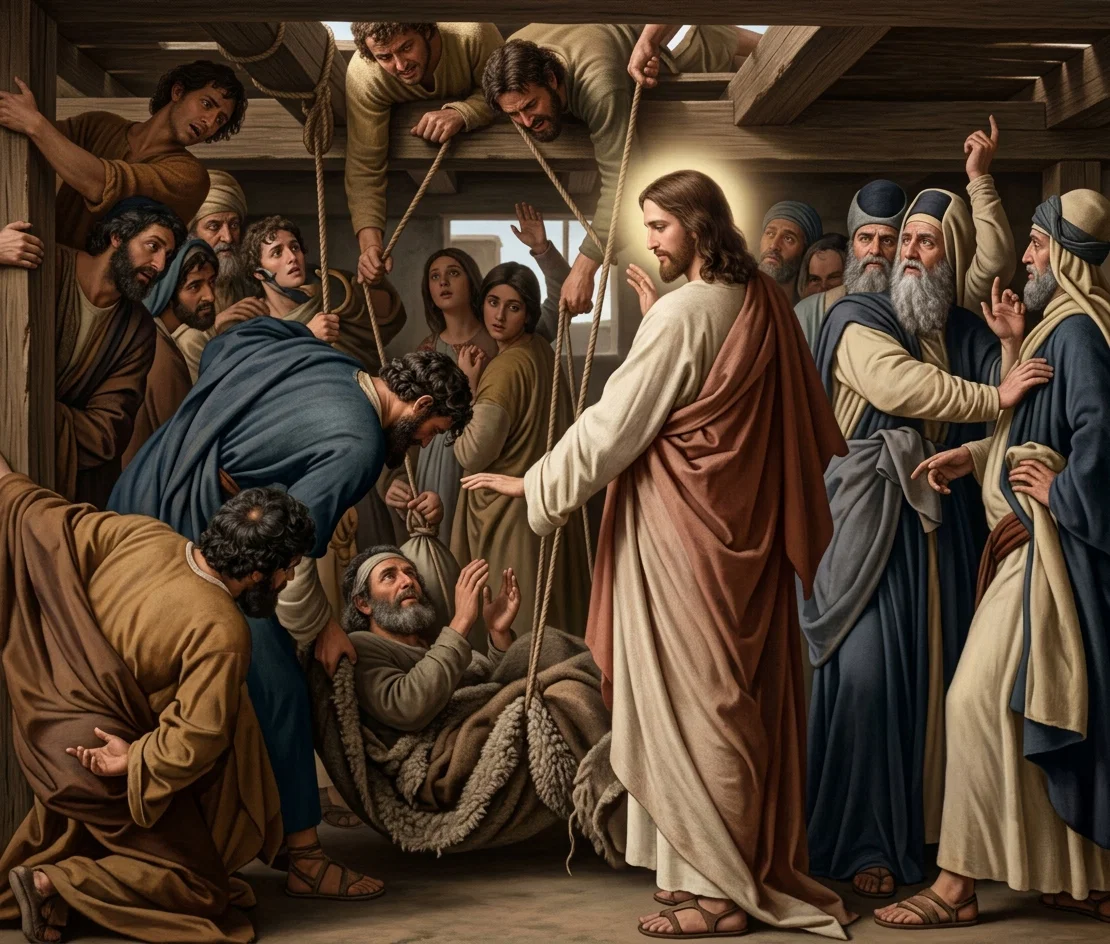
That unbelief might have no excuse, Jesus in his love for mankind frequently demonstrated his power to forgive sins. An instance of this is recorded in Mark 2:3-12. The context tells us that he had come to Capernaum from the other side of the sea, and the people flocked to hear him, insomuch that the house in which he taught was filled to overflowing with anxious and curious listeners. While thus preaching to the people, the record is:—
"They come unto him, bringing one sick of the palsy, which was borne of four. And when they could not come nigh unto him for the press, they uncovered the roof where he was; and when they had broken it up, they let down the bed wherein the sick of the palsy lay. When Jesus saw their faith, he said unto the sick of the palsy, Son, thy sins be forgiven thee. "But there were certain of the scribes sitting there, and reasoning in their hearts, Why doth this man thus speak blasphemies? who can forgive sins but God only? And immediately, when Jesus perceived in his spirit that they so reasoned within themselves, he said unto them, Why reason ye these things in your hearts? Whether is it easier to say to the sick of the palsy, Thy sins be forgiven thee; or to say, Arise, and take up thy bed, and walk? But that ye may know that the Son of man hath power on earth to forgive sins (he saith to the sick of the palsy), I say unto thee, Arise, and take up thy bed, and go thy way into thine house. And immediately he arose, took up the bed, and went forth before them all; insomuch that they were all amazed, and glorified God, saying, We never saw it on this fashion."

The Sick Man's Burden.

The palsied man had been a great sinner. This is indicated not only by his disease, doubtless brought on by excesses in living, but by his burden of soul. He wanted to be healed in body, but beyond this he desired to be made free from sin. So anxious is he that he can not wait the coming out of Jesus, and his friends can not make their way through the dense and eager crowd. But the mind of the sufferer, made active by his agony and desire, directs those who carry him to let him down through the housetop into the open court, where Jesus taught. The slight covering, to keep out the sun, is removed, and the sufferer on his mat, his body in pain, his soul in agony, is let down in the midst, before the great Teacher.

The Healing Word.

With divine and intuitive sympathy Jesus, the Friend of sinners, reads his longing heart. He will heal his body, but he will first heal the soul. The words of Jesus show the desire uppermost in the mind of the palsied, "Son, thy sins be forgiven thee." Never sweeter words came to him, and his joy was full even in his bodily pain. But the unbelievers, not seeing in Jesus the power and fulness of God, questioned in their hearts, "Why doth this man thus speak blasphemies? who can forgive sins but God only?" In their last query they were right. Only God can take away the sin from the soul. Man may forgive the special deed against himself, but Infinite Power alone removes the disposition to sin.
This demands a complete change in the affections; and this can be wrought only by the power of God by which the man is made spiritually a new creature in Christ Jesus. "A new heart also will I give you, and a new spirit will I put within you. . . . And I will put My Spirit within you, and cause you to walk in My statutes, and ye shall keep My judgments, and do them." Eze. 36:27. God alone can do this work. But Jesus Christ is God, the only-begotten Son of the Father, the One in whom it pleased the Father that all fulness should dwell.

The Demonstrated Power.

Perceiving their unbelief, and yearning to help them, Jesus asked, "Whether is it easier to say to the sick of the palsy, Thy sins be forgiven thee; or to say, Arise, and take up thy bed, and walk?" As a matter of fact, it takes the same power; but to unbelief it would be easier to say the former than it would be to raise that man who was practically dead before them. Jesus did not wait for a reply; for the only answer they could give was self-evident. He demonstrates his power to restore the spiritual man by restoring the physical. He shows that he is able to re-create the spirit, as the body. "But that ye may know that the Son of man hath power [authority, right] on earth to forgive sins (he saith to the sick of the palsy), I say unto thee, Arise, and take up thy bed, and go thy way into thine house. And immediately he arose," took up the mat or rug whereon he was lying, and went forth a strong man before them all, praising and glorifying God. The people were amazed, but acknowledged the power of God, saying, "We have seen strange things to-day;" "We never saw it on this fashion;" but they also praised God that he had given such power to men.

For Us.

For our sakes also this is written, for the sake of poor sinners, longing to be free. We are palsied with sin. In ourselves there is no power to heal, no power to cast off the dread disease which must soon paralyze every faculty of the soul, and bring to us eternal death. Jesus speaks to all who long to be free. "Son, thy sins be forgiven thee." "If we confess our sins, he is faithful and just to forgive us our sins, and to cleanse us from all unrighteousness." 1 John 1:9. You need not be kept back by the throng; you may reach him at all times by faith. Reach up your hand and grasp his; for "he is not far from every one of us." The power in the Divine Word will cleanse the sin as truly as it healed the palsied, and immediately. The power of Jesus Christ is creative power. His authority is the authority of God. And he loves the sinner. "Let us therefore come boldly unto the throne of grace, that we may obtain mercy, and find grace to help in time of need."