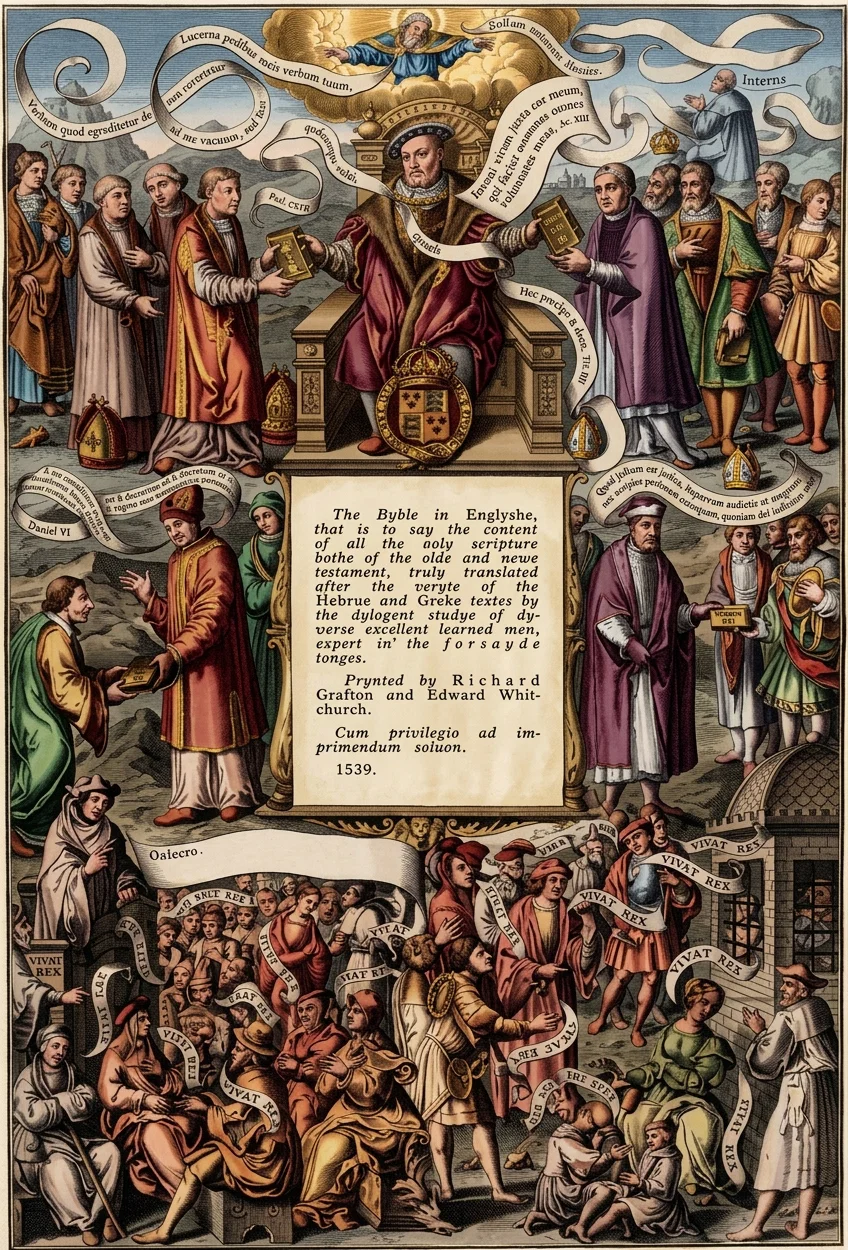
The following paragraphs describe an engraving believed to be by Hans Holbein, which occupied the title-page of the so-called "Great Bible," a revision of Coverdale's Bible, which came out in 1539
ROUND this Title, in a Border, is the following Representation finely cut in Wood, and designed, it's said, by Hans Holbein. On the Top of it is a Representation of the Almighty in the Clouds of Heaven, with both his Hands stretched out, and two Labels going from his Mouth. On that going towards his right Hand are the following Words, Verbum quod egreditetur de me non revertetur ad me vacuum, sed faciet qudcumque volui, Esa. lv. His left Hand points to the King, who is represented kneeling at some distance bare-headed, and his Hands lifted up towards Heaven, with his Crown on the Ground before him, and a Label going out of his Mouth. On the Label which comes from the Almighty is this Text, Inveni virum juxta cor meum, qui faciet omnes voluntates meas, Ac. XIII. to which answers that proceeding from the King, Lucerna pedibus meis verbum tuum, Psal. CXVII. Underneath the Almighty is the King again represented sitting in his Throne, with his Arms before him at his Feet. On his right Hand stand two Bishops bare-headed, and their Mitres on the ground, in token, as it should seem, of their Acknowledgment of the King's Supremacy. The King gives to him a Book shut, with these Words on the Cover, VERBUM DEI, and these Words on a Label going out of his Mouth, Hec precipe & doce, Tit. IIII. The Bishop receives it bending his right Knee. On the King's left hand stand several of the Lords Temporal, to one of which he delivers a Book clasp'd with VERBUM DEI on the Cover of it, and the following Words on one Label, A me constitutum est & decretum ut in universo Imperio & regno meo tremeseant & paveant deum viventem, Daniel VI. and on another Label this Text, Quod justum est judica, itaparvum audietis ut magnum, Deut. primo. The Nobleman receives the Book bending his left Knee. Underneath the Bishops stands Archbishop Cranmer, with his Mitre on his Head, and habited in his (c) Rochet or Stole over it. Before him is one kneeling with a shaven Crown, and habited in a Surplice, to whom the Archbishop delivers a Book clasp'd, with the Words VERBUM DEI on the Cover of it, and saying to him these Words as they are in a Label coming out of his Mouth, Pascite quod in vobis est gregem christi, 1 Pet. V. Behind the Archbishop seems to stand one of the Chaplains, and at his Feet are placed his (d) Coat of Arms within a Garland, the same with those before his Life by Archbishop Parker, only here distinguished by the Crescent as the Arms of a younger Family. Under the Lords Temporal stands Lord Cromwel the King's Vicegerent, as appears by his Arms plac'd at his Feet as the Archbishop's are, tho' both they and the Archbishop's are omitted by the Engraver I employ'd to take the Copy here inserted. His Lordship is represented standing with his Cap on and a Roll of Paper in his right Hand, and in his left a Book clasp'd, with VERBUM DEI on the Cover of it, which he delivers to a Nobleman, who receives it of him bare-headed, with these Words on a Label going out of his Mouth, Diverte a malo & fac bonum, inquire pacem & sequere eam, Psalms XXXIII. At the Bottom on the right Hand is represented a Priest with his square Cap on in a Pulpit, preaching to a pretty large Auditory of Persons of all Ranks and Qualities, Orders, Sexes and Ages, Men, Women, Children, Nobles, Priests, Soldiers, Tradesmen and Countrymen, who are represented some standing and others sitting on Forms, and expressing themselves very thankful. Out of the Preacher's Mouth goes a Label with these Words, Obsecro igitur primum omnium fieri obsecrationes orationes, postulationes, gratiarum actiones pro omnibus hominibus, pro regibus &c. 1 Timo. II.
On the right side of the Pulpit are the Words VIVAT REX, and in Labels coming from the Peoples and Childrens Mouth, VIVAT REX, God SAVE THE KING, to express the great and universal Joy and Satisfaction which all the King's Subjects, high and low, great and little, had, and their Thankfulness to the King, for his granting them this Privilege of having and reading the holy Scriptures in their Mother-tongue. On the left side are represented Prisoners looking out of the Prison Grates, and partaking of this great and common Joy.
We close the interesting record of the Kings this week. After leaving the northern kingdom of Samaria with its utter breaking up in the seventeenth chapter, the record hastens to the Babylonian captivity of Judah. This record of eight chapters covers the reign of seven kings, Hezekiah, Manasseh, Amon, Josiah, Jehoahaz, Jehoiakim, Jehoiachin (Jeconiah, Coniah), and Zedekiah (Mattaniah). Five of these chapters are given to the reign of the two good kings, Hezekiah and Josiah, devoted men of God notwithstanding their mistakes. Hezekiah's mistake exalted man, aroused the cupidity of Babylon, and brought to his own seed captivity. It was after his mistake that the wicked Manasseh was born, but even to him came the mercy of God. Josiah was a devoted, zealous reformer, but he could not check the downward trend of the people, who loved the low, sensual religions of sun and Baal worship. After the sad death of Josiah the kingdom of Judah soon fell before the mighty oncoming conqueror, Nebuchadnezzar.
Before repeating the history of Judah and Israel in Chronicles, let us read some of the writings and prophecies of the period that we have covered; and we begin with the Proverbs of Solomon. Very rich indeed in moral instruction, covering all phases of life, are these wise, sententious, concise sayings of Solomon; and if they were heeded we would have a crimeless, viceless world.