The Annals of the English Bible

1%

Pacific Press Publishing Association · Mountain View, California · May 9, 1911

FromSigns of the Times, Vol. 38, No. 18.

Read the full edition

The Annals of the English Bible

THE annals of the English Bible may almost be said to be those of the English race. The Gospel seed found good ground in Britain, and at a very early period in the history of the country was bearing an abundant harvest. Anglo-Saxon literature written on British soil was with unimportant exceptions of a religious character, and no small part of it consists of renderings in paraphrase or translations of parts of Holy Writ.
No doubt this gradual growing up side by side as it were of the people and the Book, accounts in large part for the singular beauty of the English Bible viewed as a piece of literature. As we read it to-day, rich in racy idioms, fresh with the dew of our language in its lusty youth, it seems to us not a translation at all, but a great original work—a divine revelation given directly to the English race. It is, in fact, not a translation in the ordinary sense; for it is not the product of any one man or group of men, but rather it represents the combined labors, extending through centuries, of many noble men, who loved the Word of God with single-hearted devotion, and were willing to yield up their lives in order that it might be given to the people.
There have been many tributes to the beauty of the English Bible, perhaps none more striking than that by the Roman Catholic priest and hymn-writer Frederick Faber, who said of its English: "It lives on the ear like a music that can never be forgotten, like the sound of church bells, which the convert hardly knows how he can forego. Its felicities often seem to be almost things rather than mere words. The memory of the dead passes into it. The potent traditions of childhood are stereotyped in its verses. The power of all the griefs and trials of man is hidden beneath its words. It is the representative of his best moments; and all that there has been about him of soft, and gentle, and pure, and penitent, and good, speaks to him forever out if his English Bible."
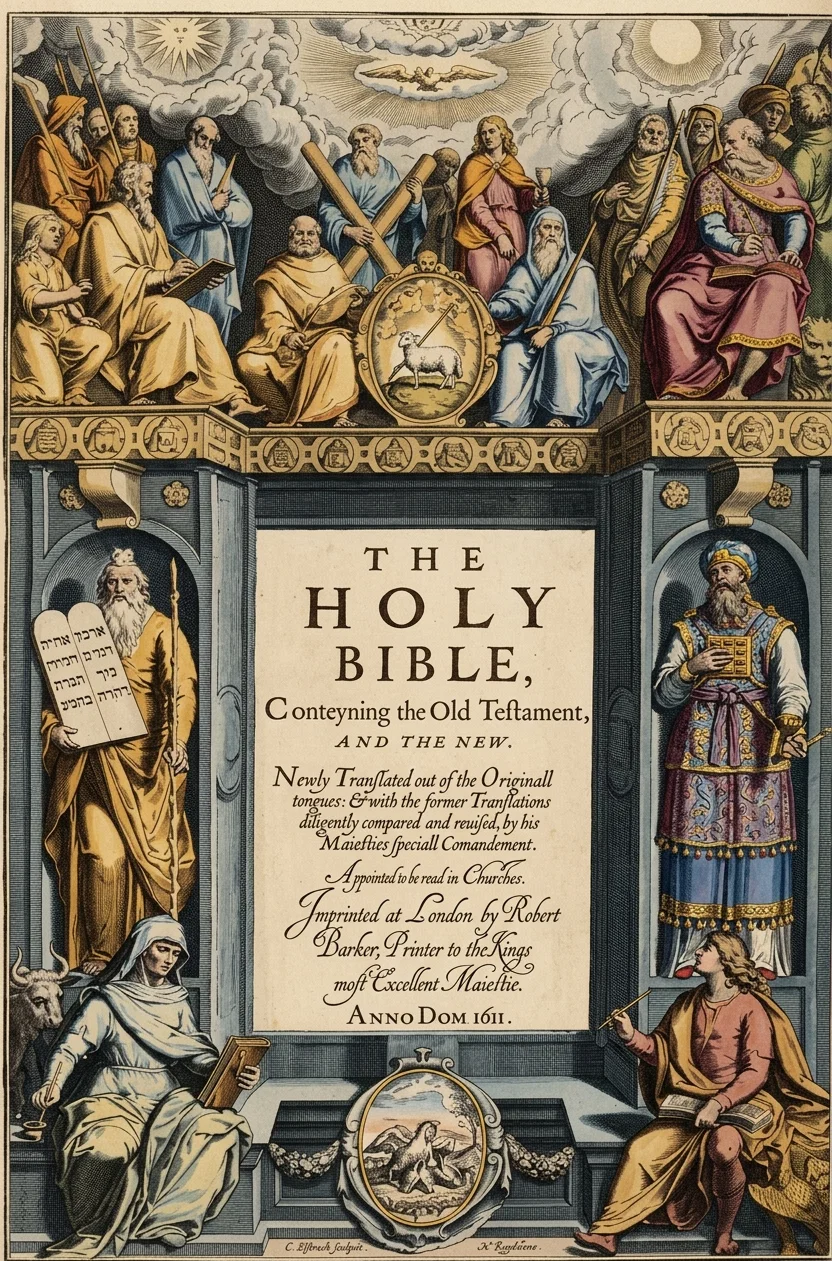
REDUCED FACSIMILE TITLE-PAGE OF 1611 BIBLE
Faber went so far as to say that England's stubborn Protestantism was chiefly owing to the strong hold that this peerless version of the Bible has upon the common people of that land. He may not have been far from the truth. Certainly there is no other nation where the principles of Bible religion have taken firmer root, or where greater activity has been manifest during the past century in the printing and circulating of the Word of God and in carrying the Gospel to heathen lands.
Let us now, in the light of these general statements, trace the history of the Bible in England. We shall have to go back a long way.

Earlier Fragments

The translation of small portions of Scripture, such as the Lord's Prayer, undoubtedly dates from still earlier times; but we know that the Venerable Bede rendered the Gospel of John into Anglo-Saxon in the year of his death, 735 A.D. His work has not been handed down to us. We have, however, an Anglo-Saxon Psalter dating from the latter part of the ninth century, interlineated with Latin. King Alfred translated certain of the Psalms, and (admirable example of the loyalty to Scripture of this most English King) prefixed his book of laws with a version of the Decalogue. We also have two interlinear translations of the Gospels, dating probably from the tenth century. About the same time Abbot Aelfric translated the Pentateuch, Joshua, Judges, Esther, Job, Kings, and some of the Apocryphal books.
There are a good many Norman-French metrical paraphrases, as well as translations of portions of Sacred Writ; but not till the fourteenth century do we have a literal translation into English of even the Psalter. One such was made by William of Shoreham, in Kent, about 1320; and another some twenty years later, by Richard Rolle, of Hampole, near Doncaster, in Yorkshire. How well the latter succeeded in his pious effort may be judged by his version of the 23d Psalm, a portion of which is here given:
Our Lord governeth me, and nothing shal defailen to me; in the stede of pasture he sett me ther. He norissed me up water of fyllynge; he turned my soule fram the fende. He lad me up the bistizes of rizfulness, for his name.
For if that ich gon amiddes of the shadowe of deth; Y shal nouzt douten iuels, for thou art wyth me. Thy discipline and thyn amendyng; comforted me. . . . And thy merci shal folwen me; all daies of mi lif. And that ich wonne in the house of our Lord; in lengthe of daies.
The careful reader will recognize in this humble effort some trace at least of those qualities of sweetness and melody which make our Authorized Version of the Psalms such delightful reading.

Wyclif's Translation

We pass on now to a far greater undertaking; namely, the translation of the whole Bible by John Wyclif, which came out about the year 1384, and accomplished much in preparing the way in England for the Reformation of the sixteenth century. Wyclif was assisted in his great work by Nicholas of Hereford, who seems to have been responsible for most of the Old Testament. Other of Wyclif's pupils and associates probably lent a hand, but the master himself is believed to have been practically alone in translating the New Testament, which contains by far the best work. A revision of the Wyclif Bible, made by John Purvey, Wyclif's pupil and successor, came out in 1388, and continued from that time to be the standard version among English-speaking people.
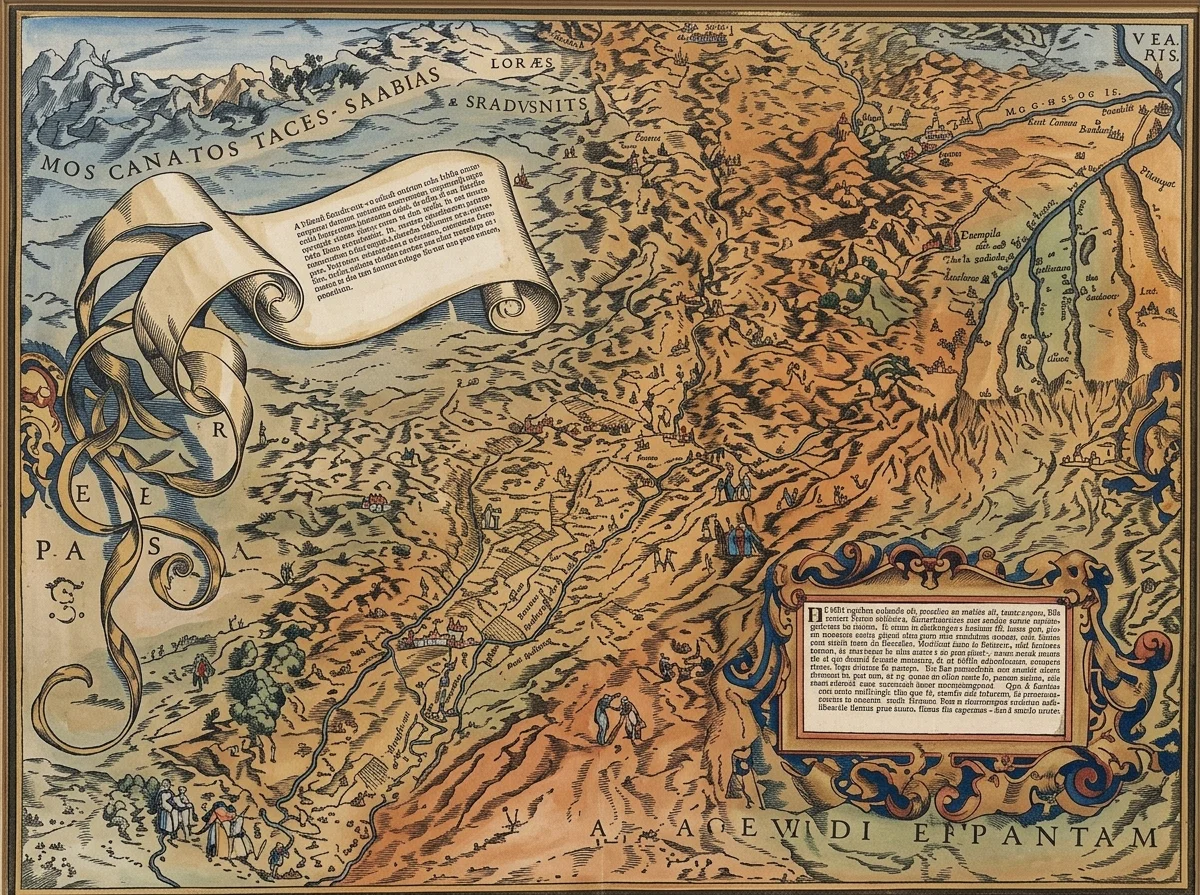
A map of Palestine at the beginning of the Old Testament of Coverdale's Bible, the first printed in English
Wyclif's translation is in many ways a remarkable piece of work. Middle English prose was just then in a state of formation, and this noble rendering of the Sacred Scriptures did more than any other writing of the time to fix the language. Many of his renderings were so felicitous that they were adopted by all succeeding translators; and in other cases where early translators rejected them, the committees responsible for our Authorized Version returned to these first phrases, because of their inherent beauty and power. Thus Wyclif first gave us the magnificent rendering, "The Spirit searcheth all things, yea, the deep things of God," the latter part of which Tyndale very unadvisedly changed to "yea, the bottom of God's secrets." "Harden not your hearts," "savourest not the things of God," "communion of the Holy Ghost," and "enter into the joy of thy Lord," are other instances of Wyclif's many felicitous renderings.
The strong tendency to concreteness which Wyclif shared with other early translators, is happily exemplified in the opening verses of the tenth chapter of Luke's Gospel:
And after these thingis, the lord ihesus ordeyned also other seuenty and tweyne, and sent hem bi tweyne and tweyne bifor his face: in to euery citee and place whidir he was to come, and he seide to hem, ther is myche ripe corne: and fewe werke men, therfor preie ze the lord of the ripe corne: that he sende werke men into his ripe corn.
There is quaintness here, but also a certain naive beauty. These and similar verses needed some softening down in the final version. Nevertheless concreteness remains one of the key-notes of our English Bible. Terseness and simplicity are other characteristic qualities in which Wyclif was usually all that could be desired. His style is terse sometimes to the extent of baldness. He also held closely to the Latin original, having all the schoolman's reverence for the Vulgate, the rich harmony and rhythms of which he to some extent catches.
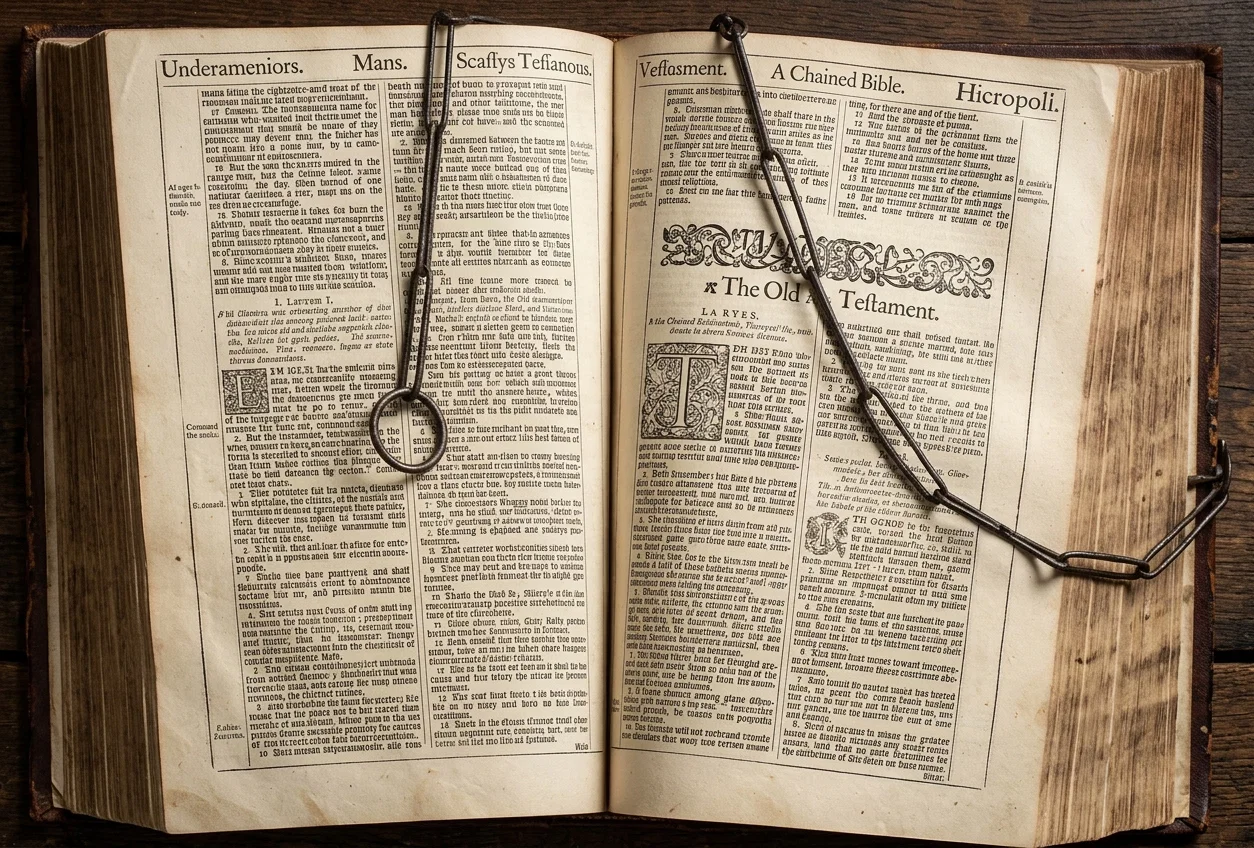
A Bible chained, that it might not be removed from the church where it was placed
Of Wyclif as a man it is hard to speak too highly. Occupying a position of honor and influence at a great seat of learning, which was at that time drawing eager students from the continent as well as from all parts of Great Britain; enjoying the friendship, too, of the most powerful nobles, and for a time of royalty itself, he had a child's simplicity of character, and worked with rare singleness of aim and untiring devotion to give the Gospel of Jesus Christ to the people of Great Britain. From the time when he had satisfied his own spiritual thirst at the fountains of living water, he was anxious that others should have the same privilege, and he wrought mightily to that end. Accused of heresy, and cited repeatedly before various tribunals, his great popularity with the people and his powerful connections shielded him from the violence of Rome. He died of paralysis while ministering to his flock at Lutterworth just after he had crowned a life of the most strenuous activity in behalf of truth and righteousness by his magnificent translation of the Bible. He was buried in peace; but some years afterward, when darkness had again closed over the land, his remains were taken from their resting-place, and burned, and the ashes thrown into the Swift, and by it carried into the Severn, and thence into the ocean, thus, in Fuller's words, typifying the extent to which the great doctrines he so clearly enunciated were to be scattered throughout the world.

Tyndale's Version

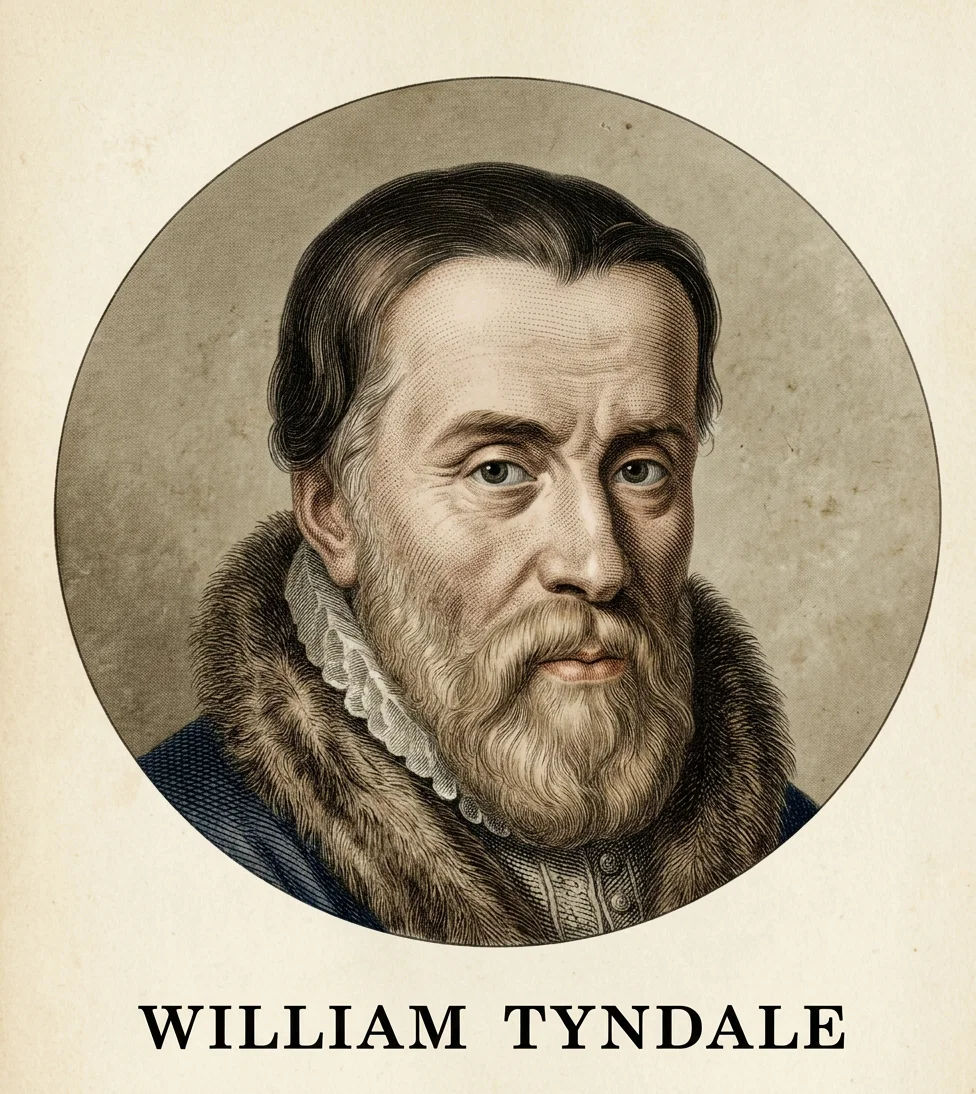
The next great Bible translator was William Tyndale, a native of Gloucestershire, who had pursued his studies at Oxford, where he took the degree of Master of Arts, and also at Cambridge. In course of time he was ordained priest, and he did some preaching; but he could not settle down to it, for he had resolved to give the people a Bible in their own tongue. In his own words he "had perceived by experience, how that it was impossible to establish the laye people in any truth, excepte ye scripture were playnly layde before their eyes in their mother tonge, that they might se the processe, ordre and meaninge of the texte."
In the simplicity of his heart he thought such an undertaking would enlist the interest of others, and tried to obtain the support of the bishop of London, but he was soon undeceived. "I . . . understode at the laste not only that there was no rowme in my lorde of london's palace to translate the new testament, but also that there was no place to do it in all englond."
He accordingly crossed over to the continent, and in Germany made the acquaintance of Luther and other Reformers. His first New Testament came out in 1525, and was probably printed at Worms, at which place a second edition also of 3,000 copies appeared about the same time. A revised edition, containing a number of important changes, appeared in 1534. Tyndale also published translations of Jonah and of the Pentateuch, and is believed to have translated the historical books from Joshua to Second Chronicles inclusive during his imprisonment at Vilvorde Castle in Flanders, where he was strangled and burned at the stake in 1536.
It was a triumphant death, for the workman had finished his work. He had made good the noble words spoken to a priest some years before: "If God spare my life, ere many years I will cause a boy that driveth the plow shall know more of the Scriptures than thou doest."
Tyndale's New Testament, and likewise his translation of the Old Testament Scriptures, so far as it extended, deserve the highest praise as the productions of consecrated scholarship. He had an easy mastery of the Greek language, and was also at home in the Hebrew. His translation was the first one made directly from the great originals, Wyclif's being made from the Vulgate. Tyndale's feeling for English idioms was also good, and many of his renderings have come down to us unchanged. In fact in narrative our present version is about nine tenths his, tho it may also be shown to be a close approximation to the Wyclif version, the chief reason in both cases being that all are largely literal renderings of the Scriptures.

The Annals of the English Bible

(Continued from page 4)
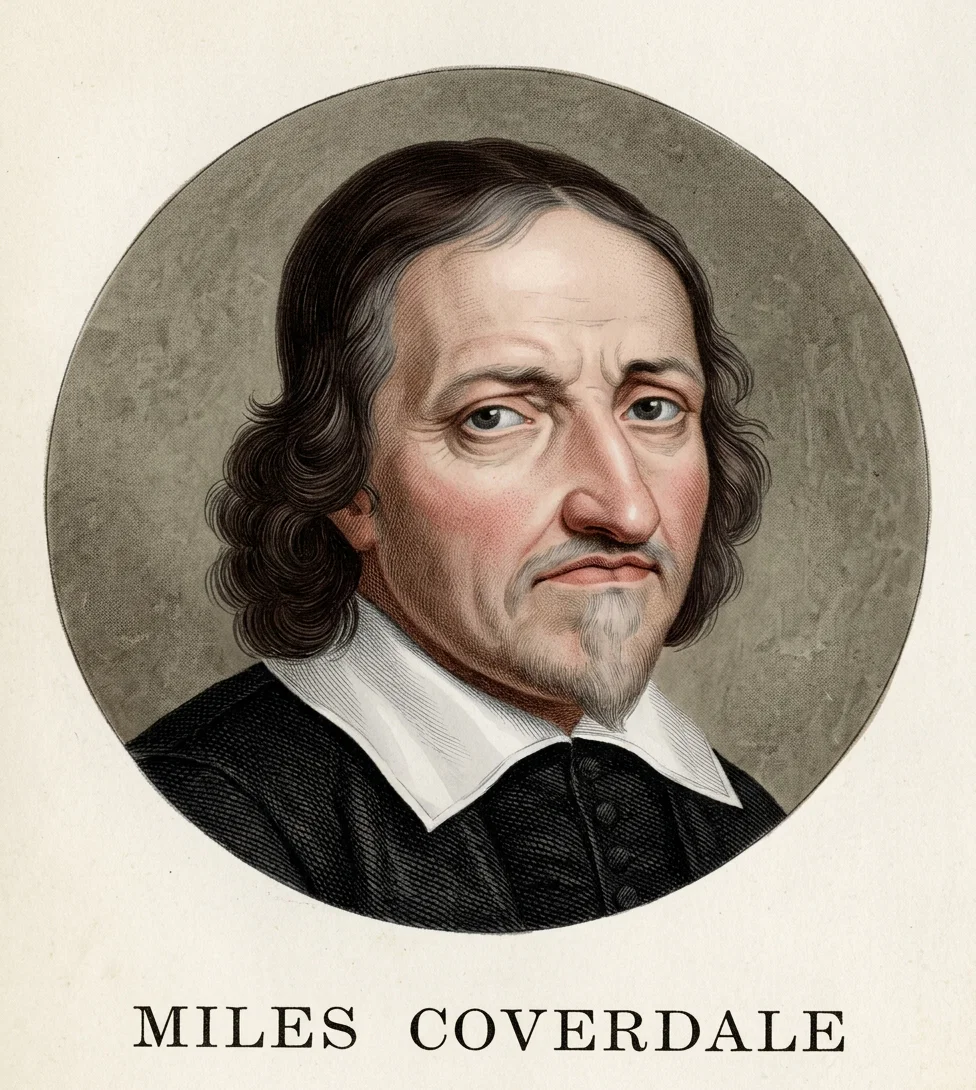
The first complete Bible in modern English came out in the year 1535, being the work of Miles Coverdale, a man in some ways less stern and uncompromising than his two great predecessors, but of equally pure motives, and gifted with a particularly fine ear for the cadences of the sacred dialect. Coverdale, not having a critical knowledge of Hebrew, was obliged to translate the Old Testament at second hand. In the New Testament he follows Tyndale pretty closely, but introduces many little improvements.

Matthew's Bible

In 1537 there came out what is known as the Matthew Bible, so called because the name Thomas Matthew, possibly a nom de plume, appears on the title-page. John Rogers, the friend and literary executor of Tyndale, was the one really responsible for this edition, which follows Coverdale in the main, but contains a fresh translation, believed to be made by Tyndale during his imprisonment, of the historical books from Joshua to Second Chronicles.

The Great Bible

Two years later, in 1539, what is known as the Great Bible came from the press, edited by Coverdale, under the patronage of Thomas Cromwell, then at the height of his power. It was intended that this edition should be printed in Paris, in order that in mechanical make-up it might represent the highest attainable standard. The work was begun under a special license from the French King, but it had not proceeded very far before the Inquisition put a stop to it. Fortunately Coverdale, half expecting this interference, had already sent some of his finished sheets to London. The confiscated ones were duly bought back from the haberdasher who had bought them for so much waste paper, and were likewise sent over to England. Furthermore Cromwell also bought up the type and presses, and had them conveyed to England, together with the staff of compositors. So in April, 1539, the Great Bible made its appearance, under the official protection of the throne. Moreover, the way was prepared for it; for an order had been issued in September, 1538, by which all the clergy were required before a certain date to provide "one boke of the whole Bible, in the largest volume, in Englyshe, sett up in summe convenyent place within the churche that ye have cure of, whereat your parishioners may most commodiously resort to the same and rede yt." Thus within three years of the death of Tyndale, the Word of God had won its way in England. First forbidden under severe penalties, then licensed, and now commanded, it was all the way along eagerly read by the common people.
One interesting feature of the Great Bible is the rather elaborate frontispiece, said to have been designed by Hans Holbein, in which, among other things, the King is represented as handing the Bible to Cranmer for the clergy and the people.

The Genevan Bible

The 1540 edition of the Great Bible contained important improvements, and slight changes were made in subsequent editions; but not till twenty years later was a thoro revision to be undertaken. Here again the wrath of man was used of God to bring blessing to His church. It was a band of refugees from England under the Marian persecutions, who met in Calvin's famous city and brought out the justly famous Genevan Version in 1560. This work far surpassed in close scholarship those that had preceded it.
Taking the Great Bible as a starting-point its authors laboriously examined every text in the light both of the original and of the proprieties of the English tongue. They made many drastic changes, the great majority of which were improvements. Beza's Latin Testament was one of the recent authorities which they found helpful in getting at the sense of the original.
The Genevan Bible exhibits several features of special interest. It was the first version to be got out by a group of men working together in collaboration. It represented a closer approach to the original than had any previous version. Moreover, altho its notes reveal a Calvinistic bias, viewed as a translation it is remarkably impartial.
The things aimed at, as Whittingham, its chief author, explains in the preface to his New Testament, were "the faithful rendering of the sentence, the propriety of the wordes, and perspicuitie of the phrase." In finding words in English, which while being intelligible, are also marked by noble restraint and dignity, the makers of this version were especially successful. We owe to them that noble rendering in Daniel, "the Ancient of Days," which Coverdale had rendered "the Old-aged."
They gave us also the beautiful phrase, "We are more than conquerors," which in earlier translations had been, "We overcome strongly." Coverdale's phrase "the Comfort of all heathen," became in their hands "the Desire of all nations." We also owe to them those words of noble dignity in Job: "Who is this that darkeneth counsel by words without knowledge?" Earlier translators had rendered the passage, "What is he that hydeth his mind with foolish wordes?" Sometimes, however, in their striving after dignity they lost color and picturesqueness. Thus Coverdale's fine rendering, "Man goeth to his long home," was changed by them to "Man goeth to the house of his age."
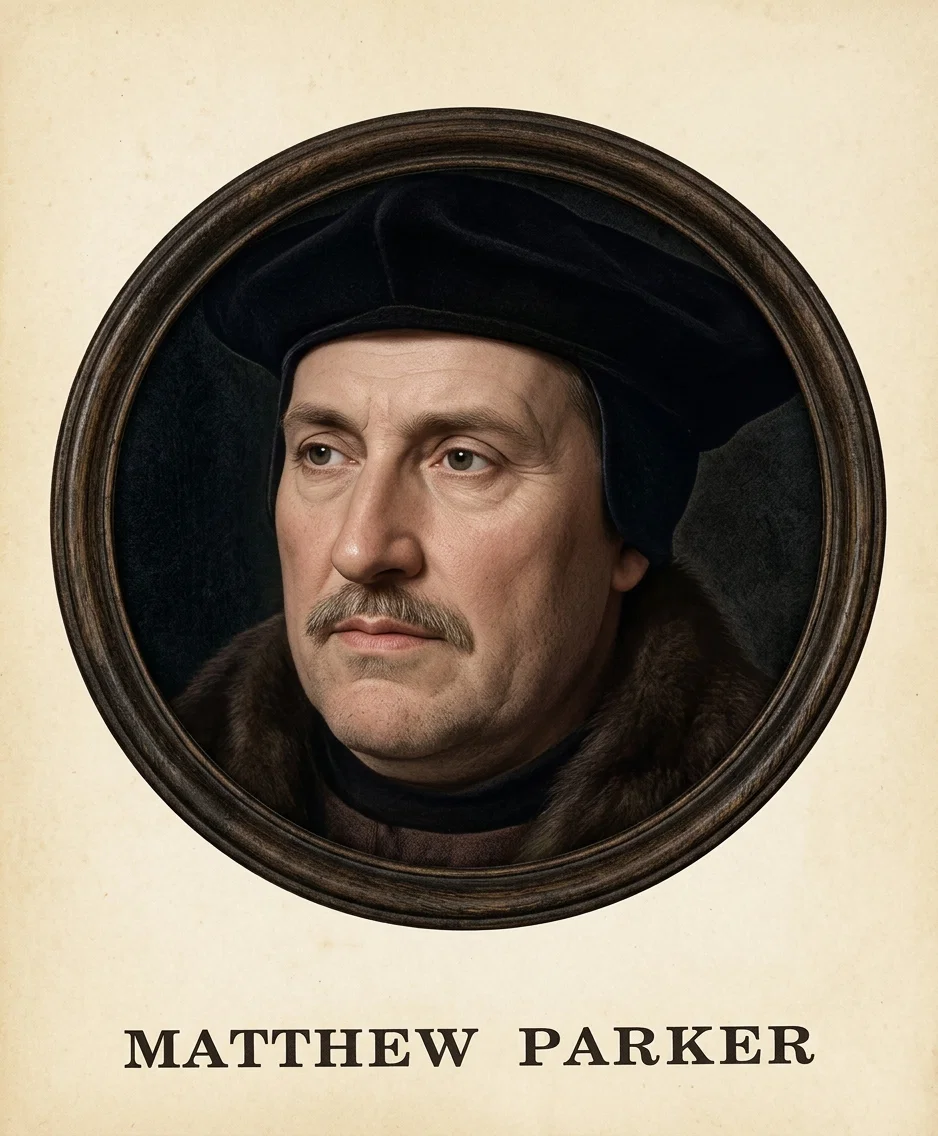
Altho the Genevan Version proved more popular in England than any of its predecessors, no less than sixty editions coming out during the reign of Elizabeth, it was not wholly satisfactory. The notes were too Calvinistic in tone, and some of the renderings were objectionable for one reason or another. Archbishop Parker accordingly set on foot plans for a new revision to be made by a committee of divines. It was published in 1568, after about four years had been given to its preparation.
The Bishops' Bible (so called because of the revisers, who can be identified with some certainty, eight were bishops) introduced some real improvements. Its translation of the New Testament especially shows critical ability and a good grasp of the problems involved. It is, however, a work of uneven merit. It was printed in large folio, and its unwieldy size contributed to hinder its general circulation.

The Reims Version

In 1582 there appeared what is known as the Reims New Testament. It is not in the regular succession of translations that we are considering, being prepared by Roman Catholic refugees at Douai, in North France, and printed at Reims. Nevertheless it is of interest to us as making a definite contribution to the style of the Authorized Version. The translation was made from the Vulgate, which was rendered word for word as far as possible. Moreover all words having any specific theological meaning were given in their original Latin form or slightly Anglicized. These are fair examples of the more unfortunate renderings: "In feare converse ye the time of your peregrination." 1 Peter 1:17. "Therefore coming into the world he saith: Host and oblation thou wouldest not: but a body thou hast fitted to me: Holocaustes and for sinne did not please thee." Heb. 10:5, 6.
In many cases, however, the translators' almost slavish adherence to the Vulgate resulted in the attainment of renderings marked by enviable conciseness as well as a certain distinction of manner, a fact duly observed by later translators, notably the men who gave us the Authorized Version, some of the finest words and phrases of which were taken direct from this Reims Testament.

The "Authorized" Version

We now come to a consideration of the crowning achievement in the history of our English Bible, the preparation of the Authorized Version. Of those hitherto noticed, each was an improvement in essentials over the one which preceded it, tho marred by some unfortunate renderings peculiar to itself. The makers of the Authorized Version not only took a long step in advance of the immediately preceding version, but they gathered up in addition many of the sacred felicities which had somehow dropped out by the way, going back in numerous instances even as far as Wyclif. They also, as has been mentioned, strengthened and enriched the sacred dialect by a judicious infusion of Latinate words from the Reims Testament.
Like many other very important undertakings, the Authorized Version had its rise in circumstances that on the face of them appear to be accidental. The conference held at Hampton Court in January, 1604, was called to consider a petition presented by the Puritan section of the church, asking among other things that the church service as outlined in the Prayer-Book might be purified by the elimination of what they considered superstitious rites and ceremonies, such as the sign of the cross in baptism, the marriage ring, etc. The need of a new version of the Bible was not broached till the second day, when, the prospects for a favorable consideration of their petition being very poor, the Puritans, according to the preface in the Authorized Version, "had recours at the last of this shift, that they could not with good conscience subscribe to the Communion book [that is, the Prayer-Book], since it maintained the Bible as it was there translated, which was, as they said, a most corrupted translation."
The examples of mistranslation cited by the Puritans' spokesman, Dr. Reynolds, of Oxford,
were taken from the Great Bible and the Bishops' Bible, the Genevan Version giving them correctly. Nevertheless the complaint met with a ready hearing. James expressed his dissatisfaction with the versions then current, and his wish that one uniform translation might be made by the most learned men in the universities, to be reviewed by the bishops and the Privy Council and finally ratified by the royal authority, and "so this whole church to be bound unto it and none other."
The time was ripe for such an undertaking. There had been many expressions of the need of a uniform Bible. A resolution on the subject had even come before the House of Lords, but had not been acted upon. The idea, moreover, made a strong appeal to James, who was nothing if not a theologian. It was accordingly not long before the new project was under way. The plan was to have fifty-four men acting on six committees, which were to meet two each at Oxford, Cambridge, and Westminster, London, respectively. Only forty-seven men actually took part in the work, and of these all but one were clergymen.
The reader will be impressed with the thoroughgoing provisions for revision. The individual translator first read his passage aloud before the members of his own committee; their approval given, it was submitted in turn to the other five committees, before whom it was also read aloud; and finally it received the consideration of the London committee of revision. No doubt these successive readings aloud in part, at least, account for the fact that in harmony and rhythm, unobtrusive alliteration and assonance, and all the subtle touches which make for sheer beauty of language, the Authorized Version is a great advance on all other versions.
The exceptional success attending this translation, which appeared in 1611, just three hundred years ago, may be attributed to these reasons: (1) The peculiar richness and vitality of the English language in the late Elizabethan period. (2) The committee in charge of the work was large and representative. (3) The work was particularly well organized, and was characterized by a rare degree of thoroughness and resource. (4) The predominant interest of the period was theological; hence, the translation may be said in a special sense to be an outgrowth of the religious thought and feeling of the English people at a time when religion, if it came short in many things, was at least vital.

The Inner History of Our English Bible

In the foregoing paragraphs we have concerned ourselves chiefly with the outward history of our Bible,—with the leading men and events connected with its appearance in successive translations. There is also what we may call an inner history of the book, which may be traced by patient comparison of texts in these successive versions. It is proposed in the following paragraphs to give at least a little introduction to this fascinating study.
Let us first try to call to mind the leading characteristics of the English of our Bible. Probably most of us would answer offhand that it is most noted for its marvelous simplicity. And yet some, at least, would feel that even stretching the meaning of the word "simplicity" to the utmost, it could not be made to tell the whole story; that something equally vital and characteristic had been left out. Yet they might hesitate to name the other
thing, lest it seem to contradict the principle of simplicity which they allow is there. If they did name it, they would probably say that the prose of the Bible is marked by a noble distinction; that it has strong aristocratic tendencies, and fairly abounds in those words of noble lineage which, judiciously used, lend weight and dignity to style. And they would be right. Biblical style is at once simple and of noble distinction. Both elements, however, have been selected and combined with admirable taste, with one overshadowing idea—to render the Sacred Scriptures in a form at once noble and dignified, and intelligible to the common people.
This quasi-ecclesiastical trend in Biblical English is fairly marked. Johan Storm has spoken of the "wonderful force and solemnity" of our Authorized Version, in which he thinks it surpasses all others, not even excepting that of Luther. "The language," he goes on to say, "is just ancient enough to give the impression of noble dignity, and yet not too old to be intelligible, . . . There is for example something extremely effective and ex-
pressive in the mere substitution of 'verily' for 'indeed' and 'truly,' or of 'unto' for 'to.' If the expression is, 'Verily I say unto you,' one is in altogether a different atmosphere than when the expression is, 'Indeed I tell you.' The latter may be earnest and forcible enough, but it is a human expression, while the former is divine."
This utterance of the German philologist brings out clearly a striking fact in English literary history, the existence, namely, of a sacred dialect, having in some measure its own vocabulary as well as its own peculiar laws and usages, and yet by reason of its identification with English religious sentiment from the start, its slow growth as it were from the very soil, retaining a strong hold upon the affections of the common people and perfectly intelligible to them.
Of course a perfect instrument of this kind is bound to be a product of slow growth. Certain words which are found suitable come to be associated with sacred things, either exclusively or in a particular signification, retaining their common meaning in the language of ordinary life. Trivial words are little by little weeded out, so also those that savor too strongly of secular business.
The growth is often in the direction of modifying expressions out of keeping with the sacred dialect. Such for instance was Coverdale's rendering: "Heare me, o ye that are of an hie stomach, but far from righteousness." The Genevan rendering is: "Hear me ye stubborn-hearted, that are fare from justice." The Authorized: "Harken unto me, ye stout-hearted, that are far from righteousness." It is interesting to note how exactly the authors of the last-named version conveyed the thought of Coverdale's spirited rendering without employing his too strongly colored language. Their substitution of "harken" for "heare" is also significant. "Harken" is one of the important words in the dialect.
Ps. 119:17, 18 reads in the Authorized Version: "Deal bountifully with thy servant, that I may live, and keep thy word. Open thou mine eyes, that I may behold wondrous things out of thy law." Coverdale translated the opening and closing clauses: "Do well unto thy servant . . . so shall I spie out wonderlous thinges in thy lawe." The Genevan: "Be beneficial unto thy servant . . . open mine eyes that I may see the wonders of thy law." "Spie out" was a little too vivid and concrete, but "behold" suited the emotion exactly. "Be beneficial" is undoubtedly inferior to "do well," but it was a valuable intermediate form leading to "deal bountifully."
Many of the finest passages in the Bible owe much of their impressiveness to their being closely modeled upon the original. Tyndale himself translated word for word to a considerable extent; but he lived too near the beginning of things to understand either the full requirements of the sacred dialect, or the possibilities of the English tongue. Thus he translated Rom. 11:33: "O the depnes of the aboundaunt wysdome and knowledge of God." The rendering is fairly accurate, but how lame compared with the more literal translation in the Authorized Version: "O the depth of the riches both of the wisdom and knowledge of God!" Again he translated Matt. 13:46, "When he had found one precious pearle, went and solde all that he had and bought it." The Authorized Version gave us the beautiful Hebraism, "one pearl of great price." How much more impressive, too, is the rendering, "I am the voice of one crying in the wilderness," than Tyndale's "a cryar in the wyldernes." "Great Babylon is fallen, is fallen," is good, but how much better, "Babylon the great is fallen, is fallen." Tyndale's rendering of Heb. 1:8 reads: "But vnto the sonne he sayth: God thy seate shalbe forever and ever. The cepter of thy kyngdome is a right cepter." The Authorized, following closely the Greek, which is in the Hebrew idiom, renders it: "Thy throne, O God, is for ever and ever: a scepter of righteousness is the scepter of thy kingdom." Needless to say, the two are very far apart in point of beauty and impressiveness. How weak, too, is "lost child" when compared with "son of perdition," and "I sitt beinge a quene" compared with "I sit a queen."
There is a certain "linked sweetness long drawn out" in such typical Bible expressions as "the valley of the shadow of death," "the light of the knowledge of the glory of God," "a pure river of water of life," and "law of the spirit of life." We have some of them in the earlier versions, but they are most typical of the Authorized Version.
There is an interesting development observable in the translations of Ps. 126:5, 6. Coverdale rendered the passage: "They that sowe in teeres shall reape in joye. He that now goeth his waye wepynge and beareth forth good seed, shall come agayne with joye, and brynge his sheaves with him."
Continue reading