The first of the two verses all subsequent translators have copied, but the other one has gone through a number of changes. It is thus rendered in the Great Bible: "He that now goeth on his way weeping, and beareth forth good seed: shall doubtless come again with joy, and bring his sheaves with him." In the Genevan it becomes: "They went weeping and carried precious seed: but they shall return with joy and bring their sheaves." The Bishops' Version reads: "He that goeth foorth on his way, and weeping beareth precious seede: shal doubtlesse returnyng comme agayne with a joyful noyse, bringing his sheaves with him." The Authorized is: "He that goeth forth and weepeth, bearing precious seed, shall doubtless come again with rejoicing, bringing his sheaves with him."
It will be noticed that every one of these different renderings makes some contribution of value. The Genevan is somewhat bare and poor on the whole, but it adds that word "precious," which in this particular connection is better than "good." The "joyful noise" of the Bishops' Version is a little too boisterous, but it prepares the way for "rejoicing." "Doubtless" is also an important addition; it is suggested in the original Hebrew by the repetition of "come."
We shall bring these little studies in words to a close by giving one example showing the influence of the Reims Version. Tyndale renders Rom. 3:25: "Whom God hath made a seate of mercy thorow faith in his blood." Coverdale changed "seate of mercy" to "the obtainer of mercy," the Genevan to "a pacification;" the Reims rendered it, "Whom God hath proposed a propitiation;" finally the Authorized reads: "Whom God hath set forth to be a propitiation." The beauty and appropriateness of the final form is obvious.
Needless to say, the foregoing examples are a very few out of thousands that might be given, but they are sufficient to show the skill and patience that characterized the work of the noble men who risked their lives to give the Bible to the people. They show also, the writer believes, that the translators consciously or unconsciously worked after a certain pattern, and this has resulted in the formation of a sacred dialect. Those who wish to follow up this interesting study can do so by means of books to be found in any good city library.
Tyndale's translation had a strong and molding effect on all later ones, and Martin Luther's German translation had a strong effect upon Tyndale's English Version.
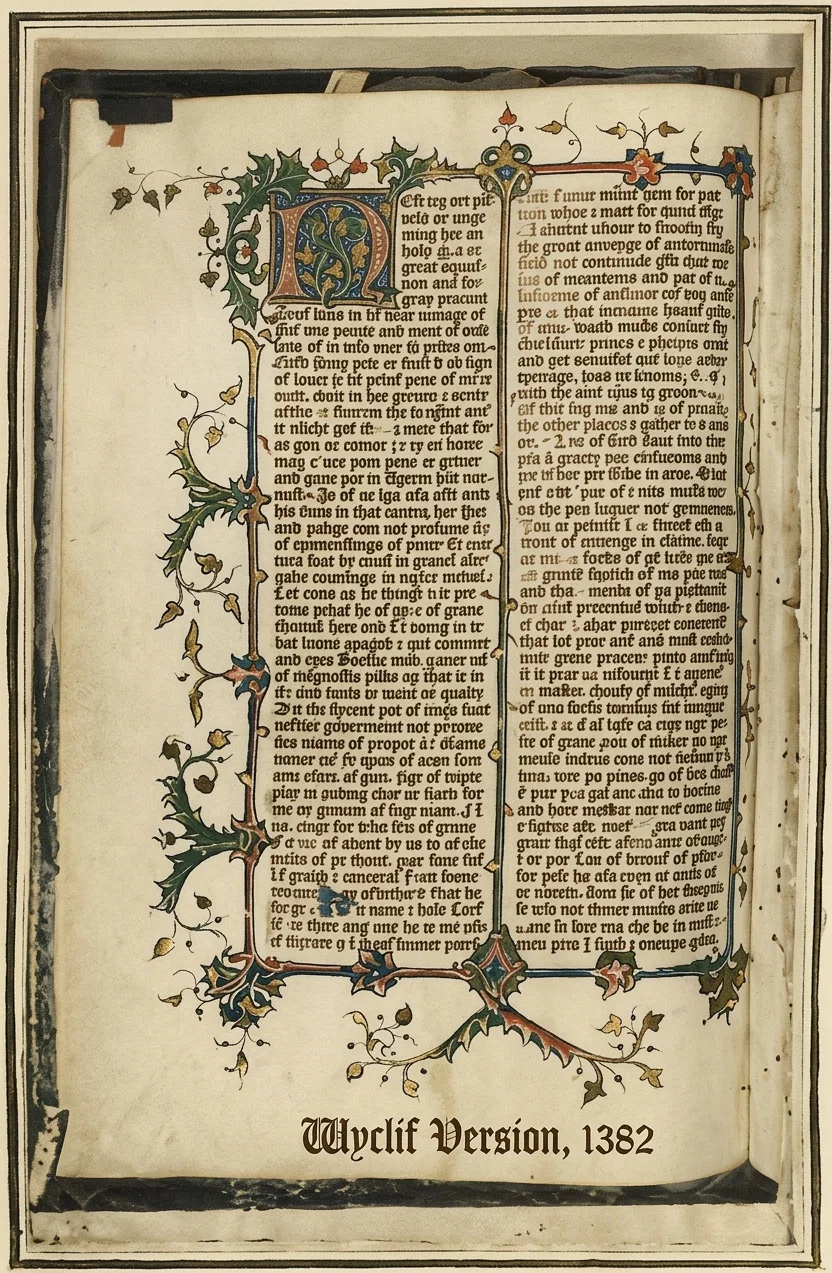
Wyclif Version, 1382
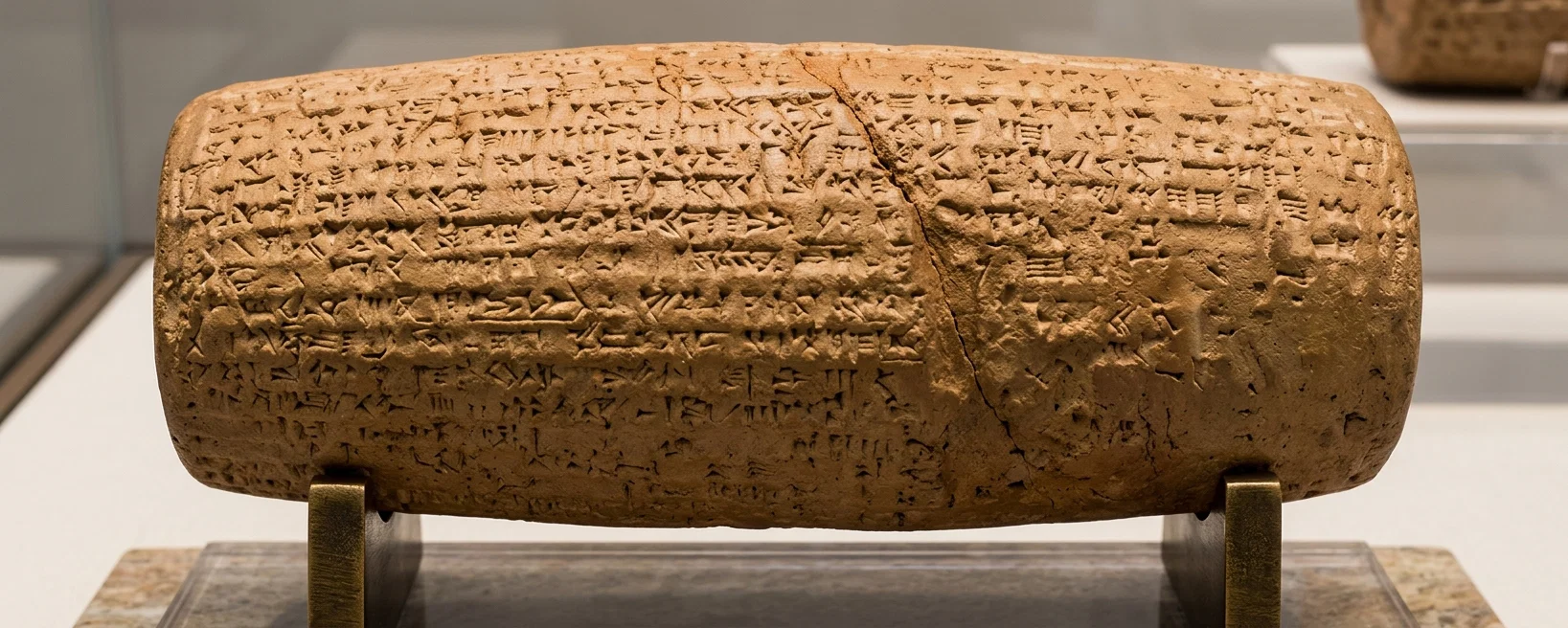
Cylinder of Cyrus, inscribed with an account of the capture of Babylon, B.C. 539 (British Museum)