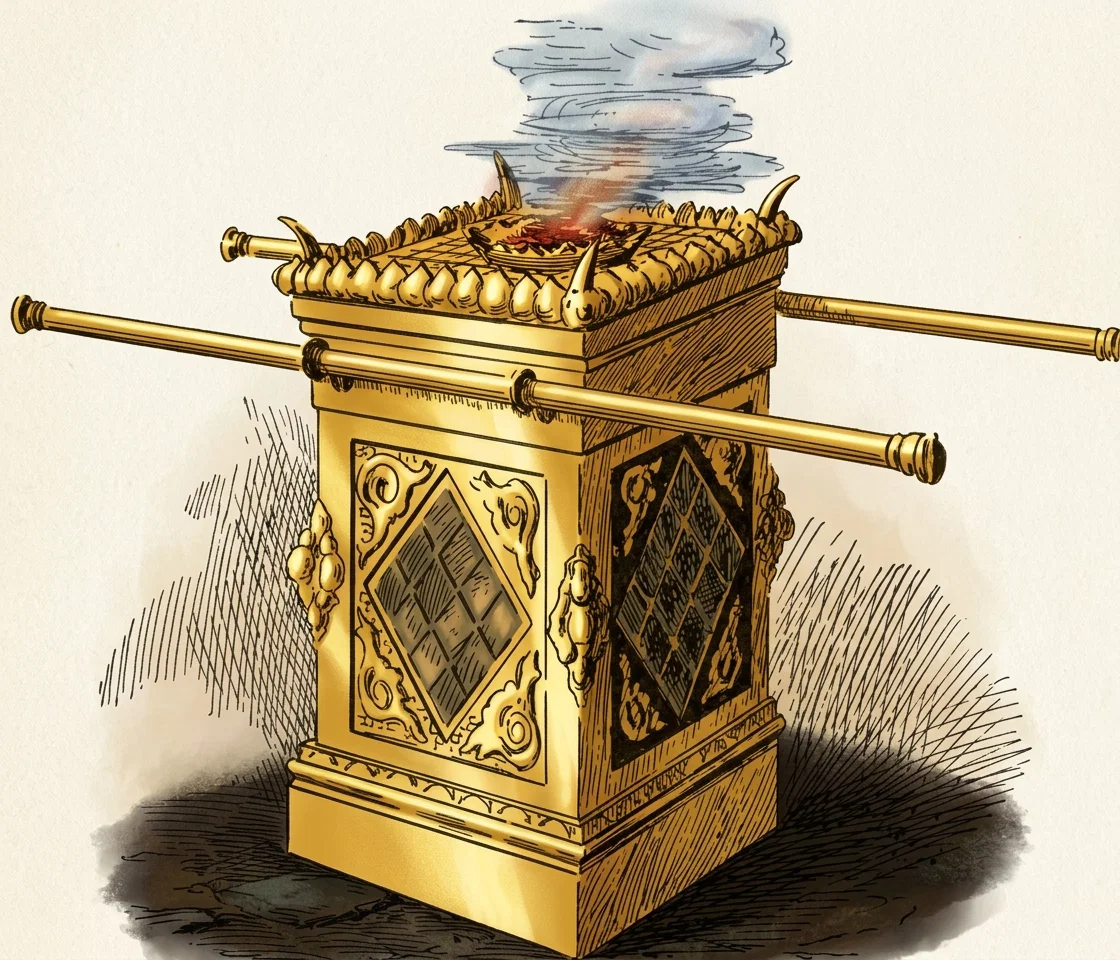
WE will now take leave of the outer part of the tabernacle, and enter into the first apartment of the holy places. What beauty and grandeur do we behold, as we get a glimpse of the articles of furniture therein! The first thing we meet is the golden altar, or the altar of incense. A description of it is found in Exodus, as follows:—
"And thou shalt make an altar to burn incense upon; of shittim wood shalt thou make it. A cubit shall be the length thereof, and a cubit the breadth thereof; foursquare shall it be; and two cubits shall be the height thereof; the horns thereof shall be of the same. And thou shalt overlay it with pure gold, the top thereof, and the sides thereof roundabout, and the horns thereof; and thou shalt make unto it a crown of gold roundabout. And two golden rings shalt thou make to it under the crown of it, by the two corners thereof, upon the two sides of it shalt thou make it; and they shall be for places for the staves to bear it withal." "And thou shalt put it before the vail that is by the ark of the testimony; before the mercy-seat that is over the testimony, where I will meet with thee."
And the use of the altar is thus described:—
"And Aaron shall burn thereon sweet incense every morning; when he dresseth the lamps, he shall burn incense upon it. And when Aaron lighteth the lamps at even, he shall burn incense upon it, a perpetual incense before the Lord throughout your generations. Ye shall offer no strange incense thereon, nor burnt sacrifice, nor meat offering; neither shall ye pour drink offering thereon." "And thou shalt set the altar of gold for the incense before the ark of the testimony." Chapter 30:1-4, 40:5.
The composition for the incense is found in chapter 30:34-38, directions for its use in chapter 30:6-9.
Thus in brief has the Lord given us a description of the altar, and the purpose it served. It was especially designed for use morning and evening; but the effect of the incense lasted the remaining interval. What a beautiful odor must have emanated from that altar as the incense ascended to God, and how fragrant must it have been before him! It not only filled the holy place, but affected the most holy also, as it filled all the space where it had opportunity to expand.
How fittingly does the incense offered upon the altar represent the prayers of God's people! David says, "Let my prayer be set forth before thee as incense; and the lifting up of my hands as the evening sacrifice." Ps. 141:2. The true prayer kindled by the fire of God's own love ascends to the throne of grace as the sweet odors from the altar. And how fragrant are the prayers of a Christian to God! His anxiety to have us pray to him is greater than our own. He loves to have us pray, and delights to send answers of peace.
What a calm and holy joy the priest must have had when he lit the lamps morning and evening! And how pleased he must have been when that time came, that he might offer the sweet incense unto the Lord.
It must be no strange fire to offer that incense; that would not be acceptable to the Lord. Aaron's sons did offer foreign fire upon the altar of incense, and the result was they lost their lives. See Lev. 10:1, 2. Prayers which arise to God, to be accepted in his sight must be inspired by his own flame of love; any other inspiration is false fire, which is not acceptable to God, and the result will be spiritual death. That is why there is so little spiritual life in Judaism to-day, and also in apostate Christianity. The prayers which are offered are either written out or else a dead formality, consequently there is no life to the soul.
The spiritual people in the days of Christ understood that this was the meaning of the offering up of the incense morning and evening,—the ascension of true prayer to the Lord. "And it came to pass, that, while he [Zacharias, the priest] executed the priest's office before God in the order of his course, according to the custom of the priest's office, his lot was to burn incense when he went into the temple of the Lord. And the whole multitude of the people were praying without at the time of incense." Luke 1:8-10.
Christ himself delighted often to pray, and we can see probably why he enjoyed so much to commune with his Father. He was a sweet savor unto the Lord, offering his prayers to God, which were always acceptable to the ears of his Father. What a privilege the Saviour thought prayer was, and how he delighted to spend whole nights in this way! And it was prayer which gave him so much strength to perform his work, and carry on his mission for which he came to the world. And as in days of old when that incense arose to the Lord there was much pleasure brought to the heart of God, so the Father took delight in having his Son approach him, regarding the prayer fragrant as incense. The incense filled all the sanctuary with its rich odor; prayer filled all the life of Christ with the fragrance of kind deeds and ministrations of mercy. God accepted the incense; he accepted also the prayers.
And, dear reader, what was true of the offering of the incense in the days of the priests in the sanctuary, and also the offering of the prayers of Jesus while on earth, is equally true of the prayers of the Christian of to-day who serves God in deed and in truth. The real ministration is carried on in heaven to-day and the Lord accepts us and our prayers. "And another angel came and stood at the altar, having a golden censer; and there was given unto him much incense, that he should offer it with the prayers of all saints upon the8golden altar which was before the throne. And the smoke of the incense, which came with the prayers of the saints, ascended up before God out of the angel's hand." "And when he had taken the book, the four beasts [living creatures] and four and twenty elders fell down before the Lamb, having every one of them harps, and golden vials full of odors [margin, incense], which are the prayers of saints." Rev. 8:3, 4; 5:8.
What a blessed thought! Jesus Christ, our great high priest, stands to-day before the throne of God, and through his precious merits, makes our prayers as acceptable to God as was the incense in days of yore. And too, they are equally as fragrant to him. Not because we offer them, but because he makes them acceptable through Jesus. And the Saviour told us he would pray for us after he went away. And we know that he never offered a prayer but what was always pleasant to the sight of God. "And Jesus lifted up his eyes, and said, Father, I thank thee that thou hast heard me. And I knew that thou hearest me always." John 11:41, 42. And if those prayers were heard while on earth, surely they will be heard for us while he is in heaven. "Let us therefore come boldly unto the throne of grace, that we may obtain mercy, and find grace to help in time of need." Heb. 4:16. Let us pray much and often; and let our petitions be inspired by the sparks of his own love; then they will be accepted before him, and he will delight to receive us. What blessings we lose because we do not come, when he is so anxiously waiting to bestow his love upon us, and make our lives fragrant with his own good works, which he has wrought for us through Jesus!
"Prayer is the breath of God in man,
Returning whence it came;
Love is the sacred fire within,
And prayer the rising flame."
F. C. GILBERT.