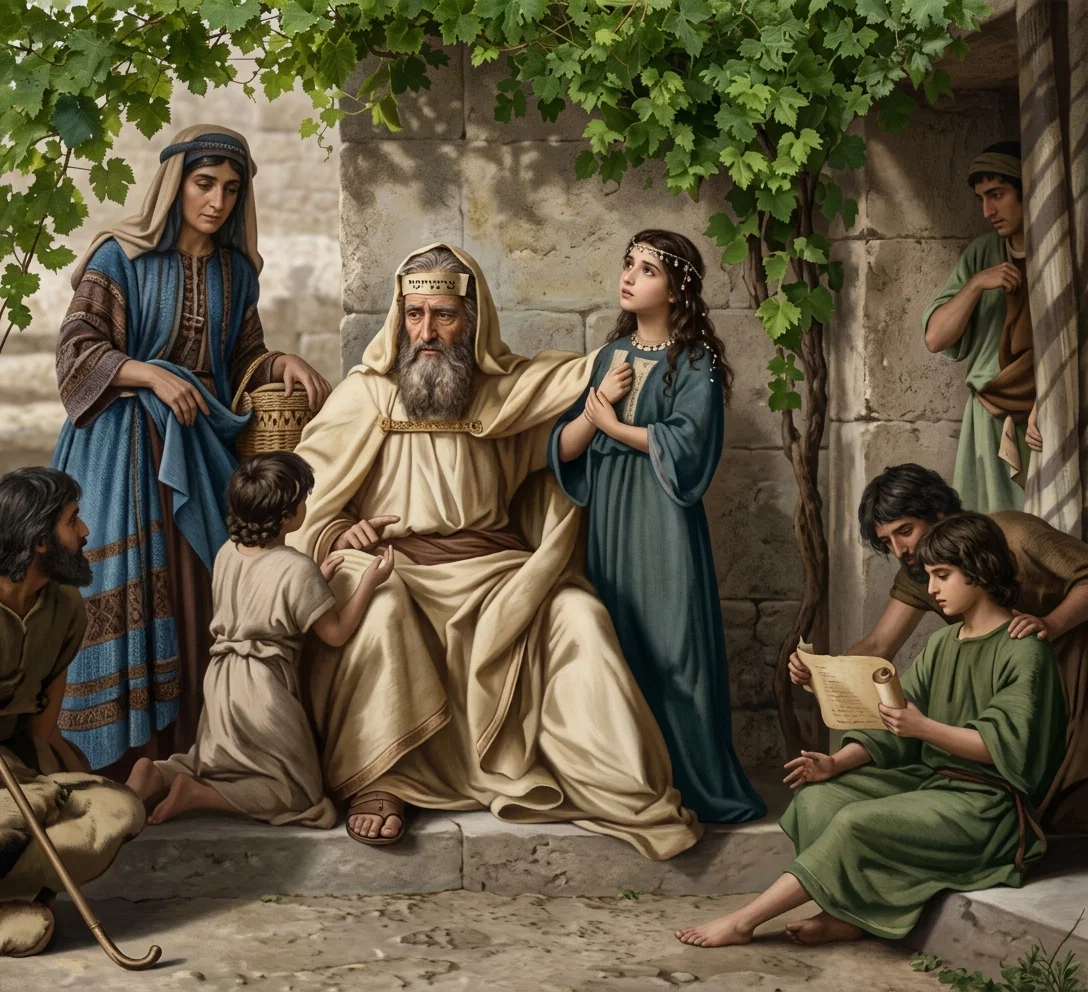
1. My son, forget not my law; but let thine heart keep my commandments:
For length of days, and long life, and peace, shall they add to thee.
Let not mercy and truth forsake thee; bind them about thy neck; write them upon the table of thine heart;
So shall thou find favor and good understanding in the sight of God and man.
Trust in the Lord with all thine heart; and lean not unto thine own understanding.
In all thy ways acknowledge him, and he shall direct thy paths.
Be not wise in thine own eyes; fear the Lord, and depart from evil;
It shall be health to thy navel, and marrow to thy bones.
Honor the Lord with thy substance, and with the first-fruits of all thine increase;
So shall thy barns be filled with plenty, and thy presses shall burst out with new wine.
My son, despise not the chastening of the Lord; neither be weary of his correction;
For whom the Lord loveth he correcteth; even as a father the son in whom he delighteth;
Happy is the man that findeth wisdom, and the man that getteth understanding.
For the merchandise of it is better than the merchandise of silver, and the gain thereof than fine gold.
She is more precious than rubies; and all the things thou canst desire are not to be compared unto her.
Length of days is in her right hand; and in her left hand riches and honor.
Her ways are ways of pleasantness; and all her paths are peace.
Golden Text: "In all thy ways acknowledge Him, and He shall direct thy paths." Prov. 3: 6.
SUGGESTIVE QUESTIONS.
(1) What admonition is given in verse 1? (2) What will be the result of following this advice? Verse 2. Note 1. (3) How is one to hold mercy and truth? Verse 3. Note 2. (4) What good result will follow? Verse 4. (5) In whom should one trust, and how fully? What caution is given? Verse 5. (6) How may one be directed? Verse 6. (7) What is the wisdom of one's own eyes? Verse 7. Note 3. (8) What blessings come by departing from evil? Verse 8. (9) In what manner may one honor the Lord? Verse 9. Note 4. (10) What blessings will the Lord give? Verse 10. (11) What further advice is given in verse 11? (12) Why does the Lord chasten and correct? Verse 12. (13) Who is said to be a happy man? Verse 13. (14) How valuable is wisdom? Verses 14, 15. (15) What does she hold in her hands? Verse 16. Note 5. (16) Into what does she lead him who finds her? Verse 17.
NOTES.
1. Shall they add to thee.—In the original the verb "add" has the masculine ending, to indicate "they add." So Professor Miller suggests that the nominative is found in "length," "years" (margin), and "peace," which are masculine, while "law" and "commandments" are feminine. This would give the idea that "length of days, and years of life, and peace" will make one greater, will add to him, if he forgets not the law, and keeps the commandments. While the long life may be logically expected from obedience, yet many wicked persons also have long life. With them length of days only adds to their load of iniquity, which is not the addition referred to, nor one to be desired. In fact, continued evil lessens one's capacity in any useful direction.
2. Table of thine heart.—Ancient Israel were commanded to bind the law upon the hand and forehead, and to love the Lord with all the heart, and soul, and might. Deut. 5: 5, 8. Portions of the law were actually bound on the wrist and forehead. These were known as phylacteries. They were outward signs that the principles of that law governed the will and the act. The heart, as used here, means the intellect, the mind, and the writing of the law there,—a complete, intelligent obedience to it,—constitutes the new covenant. The old covenant was, on the part of the people, one of broken promises. The new covenant is the covenant made with every true child of God from Adam to the end of time. See 1 John 3: 12; Gen. 15: 6, etc. This truth is taught in our lesson.
3. Depart from evil.—The tendencies of the natural heart are evil, and only evil. Men without the fear of God may think they are very wise, may think their own understanding is correct, but all these things the Lord counts as foolishness. 1 Cor. 1: 20. The law of the Lord is made very prominent in this lesson, and it is well so, for it is the standard of conduct. It is the guide, the schoolmaster, to bring us to Christ, and in him we find the perfect outworking of all its principles.
4. Substance and first-fruits.—The Lord has always asked of his people gifts for the advancement of his work. One thing he claims as his own,—the tithe of all increase, or income. Both of these are reasonable, for all the earth is the Lord's (Ps. 24: 1), altho given to man for his use. Why then should not the Lord give plenty to the man who recognizes his just claims? He not only promises to do so, but does. One of the chief reasons why his people are dried up spiritually is stated to be because they have robbed him in tithes and offerings. Mal. 3: 7-9. The blessing pronounced if they will reform is that he will "open the windows of heaven, and pour you out a blessing, that there shall not be room enough to receive it." Mal. 3: 10. Some excuse themselves from paying the tithe, on the ground that it is not required in the Christian dispensation. But this is false. Even a casual examination of Malachi 3 shows that it applies to the last days, and if at any time in the world's history the cause of God needed support, it is now, when moral darkness is so prevalent. But a direct proof that the tithing is obligatory in the Christian era is this: Abraham regarded it as a duty to pay tithes to Melchizedek, king of Salem, priest of the most high God. Gen. 14: 18-20. That priesthood continues, for Christ is a high priest after the order of Melchizedek (Heb. 7: 21), hence the requirements of that priesthood are yet in force. Read Hebrews 7. Moreover, Abraham is a type of all the faithful, and his example is ours under the same priesthood. The promises of Prov. 3: 10 and of Mal. 3: 10 are, therefore, true for you and me. Try them.14
5. Length of days may reach beyond the mere span of human life. The true wisdom will appropriate the first commandment with promise, the fifth, which includes eternal life on the earth made new. Ex. 20: 12; Isa. 65: 17, 22. The earthly riches and honor cease at death. Heavenly riches and honor are of a different kind, and endure. Which is the better, the gift of the right hand, or those of the left?