26 "They said therefore unto him, What did he to thee? how opened he thine eyes? He answered them, I told you even now, and ye did not hear; wherefore would ye hear it again? 28 would ye also become his disciples? And they reviled him, and said, Thou art his disciple; but we are disciples of 29 Moses. We know that God hath spoken unto Moses; but as for this man, we know not whence he is. The man answered and said unto them, Why, herein is the marvel, that ye know not whence he is; and yet he opened mine eyes. 31 We know that God heareth not sinners; but if any man be a worshiper of God, and do his will, him he heareth. 32 Since the world began it was never heard that any one 33 opened the eyes of a man born blind. If this man were not 34 from God, he could do nothing. They answered and said unto him, Thou wast altogether born in sins, and dost thou teach us? And they cast him out.
35 "Jesus heard that they had cast him out; and finding him, he said, Dost thou believe on the Son of God? He answered and said, And who is he, Lord, that I may believe on him? Jesus saith unto him, Thou hast both seen him, and he 38 is that speaketh with thee. And he 39 said, Lord, I believe. And he worshiped him. And Jesus said, For judgment 40 came I into this world, that they which see not may see; and that they which 41 see may become blind. Those of the Pharisees which were with him heard these things, and said unto him, Are we also blind? Jesus said unto them, If ye were blind, ye would have no sin; but now ye say, We see; your sin remaineth."
QUESTIONS.
What further inquiries did the Jews make of the man born blind?
What reference did he make to their former discussion of the matter?
What inquiry did he make of them?
What did they declare concerning him? What did they claim for themselves?
What did the man regard as a remarkable circumstance?
What admitted truth did he state concerning a man's relation to God?
Was the miracle which had been performed upon him an ordinary one?
What conclusion did he arrive at?
In what way did they meet his convincing argument?
What did they do to him?
Who heard that they had cast him out? What did he ask him?
What response did the man make to this question?
How did Jesus then declare himself to him?
How did the man receive this declaration?
How did Jesus say that his coming into the world would affect the blind? How would it affect those who had sight?
Who were listening to this teaching?
What did it lead them to ask?
How did Jesus reply to their inquiry?
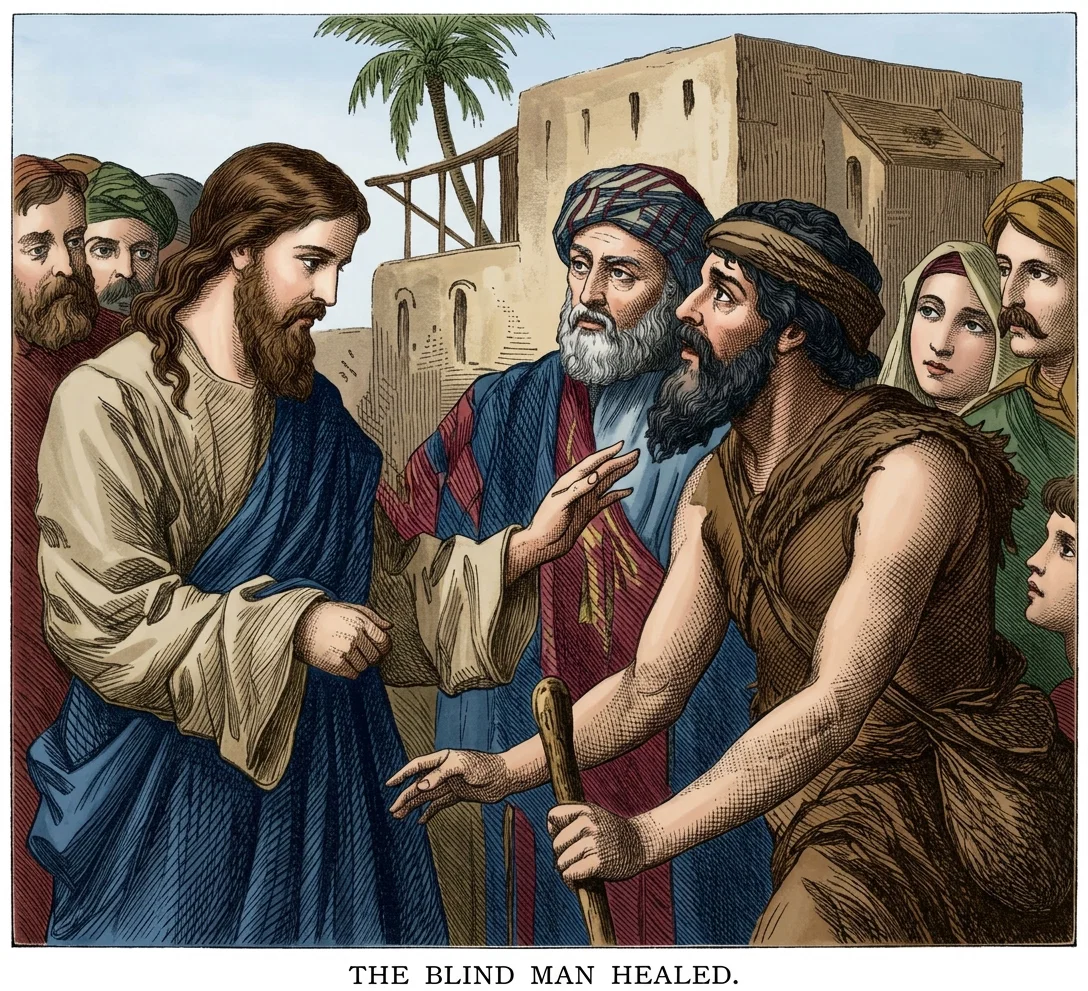
THE BLIND MAN HEALED.
NOTES.
1. It is perfectly evident even to the man whose case is being investigated, that the Pharisees are not repeating their inquiries in order to obtain more complete information. They are simply quibbling. Their continued nagging stirs up the man to ask them the question which above all others would exasperate them: "Are ye, too, wishing to become his disciples? But they reviled him, and said, Thou art a disciple of that one, but we are Moses' disciples." (Rotherham.) A disciple of that one, as if putting him far from them in disdain. A disciple is a learner, and unintentionally the Pharisees were speaking in praise of the man whom they despised. They prided themselves upon being followers of Moses, but their treatment of Jesus proved their claim a false one. Chapter 5: 46. They were right in thinking that God spake to Moses (Ex. 33: 11), but it was God in his Son who spoke, and not Moses. Although Moses was dead, yet God still lived, and had they really known him, they would have recognized that he was speaking to them "in his Son." Heb. 1: 2, R. V.
2. How these Jews contradict themselves! A little while ago they rejected Jesus because they felt too well acquainted with him (chapter 6: 41, 42), but now they reject him because they "know not from whence he is." The logic of the beggar was better than that of the Pharisees. He is not a theologian by profession, but light seems to have come into his mind as well as into his eyes. His experience illustrates a truth already taught to the Jews. Chapter 7: 17. "He does not know much, but he knows this [How is it that they do not know it?] that such a miracle is an answer to prayer, and that the prayer of the wicked is not answered."
3. The case is no ordinary one. The miracle is a "notable" one, and induces an irresistible conviction that the doer is "of God." But this the Pharisees have decided beforehand not to admit, and so no weight of evidence can compel them to change their view. Their very decision has shut out the light which would enable them to reach a right conclusion. It is the light from the sun shining into the eye which enables us to see the sun itself, and if one deliberately closes his eyes, it is no wonder if he does not see the sun. But there is still one course open to the Pharisees, and, like a dishonest lawyer when the evidence is all against him, they can abuse the witness, and this they proceed to do. They now admit what they had been inclined to deny, that he had been born blind, by taunting him with it as a proof that he was evidently a child of sin; and, with a self-sufficiency which they seem to regard as enough to settle the whole question, they scornfully inquire, "Dost thou teach us?"
4. "There are men in such repute as leaders of opinion, and so accustomed to teach rather than to learn, and to receive homage rather than to give it, that scarcely any greater humiliation could be required of them than to publicly profess themselves followers of Christ." It was the application of this principle which prevented the Pharisees from receiving instruction from the beggar. They did not have power over his mind, and so could not cast the truth out of it, as they gladly would have done if possible, but they did have power over his connection with the outward forms of worship, "and they cast him out."
5. "But Jesus heard of his punishment, and sought him out, and declared to him more fully who he himself was. He thus gave to the man assurance of a friendship outweighing in value what he had lost. He made him feel that, though cut off from the fellowship of the visible church, he was made a member of the true commonwealth of men—numbered among those who are united in friendship, and in work, and in destiny, to him who heads the real work of God, and promotes the abiding interests of men. And such is ever the reward of those who make sacrifices for Christ, who lose employment or friends by too boldly confessing their indebtedness to him. They will themselves tell you that Christ makes up to them for their losses by imparting clearer knowledge of himself, by making them conscious that they are remembered by him, and by giving them a conscience void of offense, and a spirit superior to worldly misfortunes."
6. "The blind man now saw, because he knew he was blind, and trusted that Christ could give him sight; the Pharisees were stone blind to the world Christ opened to them and carried in his person, because they thought that already they had all the knowledge they required. And wherever Christ comes, men thus form themselves round him in two groups, blind and seeing. 'For judgment,'—for testing and dividing men,—he is come. Nothing goes more searchingly into a man's character than Christ's offer to be to him the Light of life, to be his Leader to a perfect life. This offer discloses what the man is content with, and what he really sighs for."
Suggestions for Further Study.
What kind of sinners does God refuse to hear? To what kind does he lend a listening ear? Compare Ps. 66: 18; Dan. 9: 3, 23.
What connection did the Jews make in their teaching between poverty, or physical blemish and suffering, and sin?
What is taught in the statement that Jesus found him?
What is the measure of responsibility in God's sight?