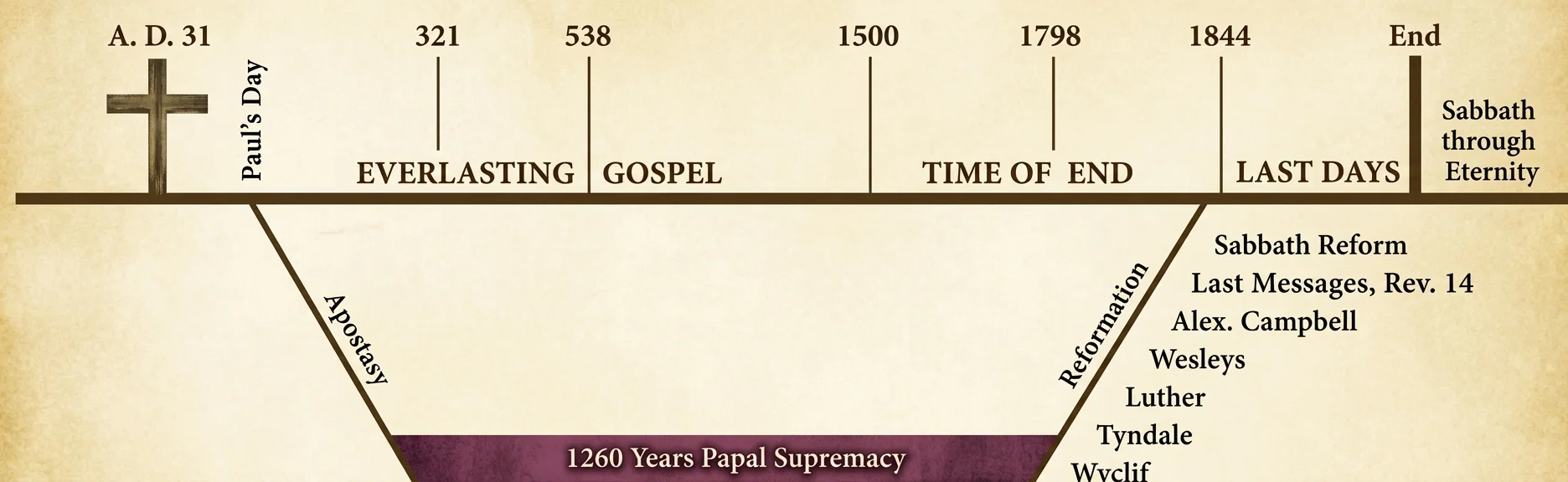
THAT we are living in the "time of the end," "the last days" spoken of repeatedly in the Bible, is believed by many Christian people of all denominations. It is proclaimed as a definite "present truth" to-day in practically all the world. "And this Gospel of the kingdom shall be preached in all the world for a witness unto all nations; and then shall the end come." Matt. 24:14. The definite signs that were to precede that event, spoken of by the Saviour in this same chapter, as well as every sign spoken of in all the Bible, and the many prophecies pointing down to the end of earth's history, are all fulfilled or fulfilling. That God should herald this event by a special warning, and the proclamation of special truths to test the loyalty of all, is but reasonable. Just such a definite message is brought to view in Rev. 14:1-14.
"The harvest is the end of the world," said Jesus. The harvest message, therefore, would be God's final message to ripen the earth for its harvest. When the Lord comes to redeem Zion (the church), His people will "see eye to eye." Preparatory to this special message given in Rev. 14:6-14, a general reformation began some centuries ago. One by one men were raised up, in the providence of God, to lead the people back step by step to "the everlasting Gospel." Why such a reformation? Evidently some time and way there has been a departure from this standard, "the everlasting Gospel." As early as the days of the apostle Paul we find that apostasy from God and His truth had already begun to work. Acts 20:28-32; 2 Thess. 2:7. As a result of false doctrines and false brethren in the church, and later by a uniting of an apostatizing Christianity and paganism, especially about the time of Constantine, and later developing into the Papacy, the world was held for many centuries in ignorance of God and the full light of the Gospel of the Son of God. But thanks be to God, a few centuries ago (about the fifteenth century) light began to spring forth; men began to arise who had the courage of their convictions, and a grand and glorious reformation dawned.
Chief among the great reformers, we mention Wyclif, Huss, Jerome, Luther, the Wesleys, Alexander Campbell, William Miller, Joseph Bates, and others. These men were each raised up in the providence of God to lead the world another step upward toward the line of the "everlasting Gospel." It would have been impossible for one man in a single lifetime to bring the world from the depths of darkness into which it had been plunged, up to the standard of the Bible, the whole Bible, and nothing but the Bible. For many generations people had not been accustomed to think and act religiously for themselves; and consequently it took a long time to lay a solid and broad foundation for the reformation. It would be interesting, had we the time and the space, to recall the great truths for which some of these men stood and fought. Wyclif led out in the separation from the mother church (Rome); Luther heralded the doctrine of justification by faith; the Wesleys preached a free grace to all men; Alexander Campbell championed the cause of Christian baptism as a burial with Christ. William Miller, the great prophetic expositor, literally "ate" the prophecies of Daniel and the Revelation. The world was stirred by his preaching. While he was mistaken in a certain event, yet it must be admitted by all who know of his work, that he stands as the peer in prophetic exposition. The time had come for the prophecies to be unfolded. Joseph Bates might be named as a leader in the final and last step in reformatory truth,—the heralding of the Sabbath reform before the end of the world and the second coming of Christ.
The Last Great Reform
One great truth that seemed to be overlooked was that "the seventh day is the Sabbath of the Lord thy God." This special truth is therefore left to the remnant church to proclaim to the world. Of the remnant church (the last church) it is said that "the dragon [the devil] was wroth with the woman [the church], and went to make war with the remnant of her seed,5which keep the commandments of God, and have the testimony of Jesus Christ." Why is it mentioned that "the remnant" will "keep the commandments of God"? Evidently the church (the people of God) have not all been keeping all of the commandments. By carefully reading the ten, we find all Christendom agreed in teaching and practise regarding all of them except the fourth, which requires the observance of the seventh day of the week. For centuries people have been observing the first day. In our previous article we have, however, shown the change to have taken place by man's and not by God's authority. How reasonable, then, that just before the end of earth's history the Lord would lead His people back to the same seventh-day Sabbath given to man before his fall in Eden! As a result of the last message to earth, a people will be developed of whom it is said, "Here is the patience of the saints: here are they that keep the commandments of God, and the faith of Jesus." Rev. 14:12. Nothing could be clearer than that before the second coming of Christ, there would be a special reformatory message relative to the commandments of God. But why should God send a message, if all were already observing all of the commandments? We must admit that according to the commandment (the fourth of the Decalogue), God requires the observance of Saturday, the seventh day, it being the only disputed commandment of the law.
Does the Bible call for just such a reformation? We answer in the affirmative. A Sabbath reform among the people of God was foretold by the prophet Isaiah, chapter 58:1, 12-14. The failure to observe the seventh day is the only breach in God's law; and the prophet plainly states that the breach to be restored is the Sabbath. What could be clearer? Listen to the exact words of the prophecy: "Cry aloud, spare not, lift up thy voice like a trumpet, and show My people their transgression, and the house of Jacob their sins. . . . And they that shall be of thee shall build the old waste places; thou shalt raise up the foundations of many generations; and thou shalt be called, The repairer of the breach, The restorer of paths to dwell in. If thou turn away thy foot from the Sabbath, from doing thy pleasure on My holy day; and call the Sabbath a delight, the holy of the Lord, honorable; and shalt honor Him, not doing thine own ways, nor finding thine own pleasure, nor speaking thine own words: then shalt thou delight thyself in the Lord." How could Inspiration make it plainer? May the Lord help every reader of these lines to take his foot off from the Lord's holy day, and from this time forth "remember the Sabbath day, to keep it holy." All the world will take sides on this great issue in this generation. May we each choose the day that the Lord has sanctified for man. Obey God. Let the world say and do as it will.