Taoism

7%

Pacific Press Publishing Association · Mountain View, California · Jun 13, 1911

FromSigns of the Times, Vol. 38, No. 23.

Read the full edition

Taoism

About the time of Confucius another man was born in China whose influence over the Chinese people has been second only to that of the greater teacher. He is called Lao-tsze. It was he who laid the foundation of the elaborate ritual still maintained in the idolatrous worship of the rulers and the people. Taoism "contains the principal elements of heathen religions generally. . . . It has a system of exorcism of devils and propitiation of gods, conducted by a priesthood with observance of a ritual highly developed, created to a great extent in imitation of Buddhism. It is a universalism which purports to render man happy by such exorcism and propitiation, and, moreover, by teaching him the discipline of securing assimilation with the Tao, or order of the universe."—"The Religion of the Chinese."
Taoism has greatly increased the number of gods worshiped by the Chinese, "owing to boundless vagaries in the domain of cosmology, astrology, and other occult sciences." Humility, self-effacement, is strictly enjoined by such teachings as these: "When your meritorious work is done, and fame is thereby gained, to retire to the background is the Tao [or in harmony with the order] of heaven."—Lao-tsze. Again Lao-tsze says: Water benefits all things, and yet occupies the lowest places, which all men dislike. The reason why the large rivers and the seas are able to act as kings of the streams which flow down into the valley, receiving tribute from them all, is their skill in taking a lower level than they.
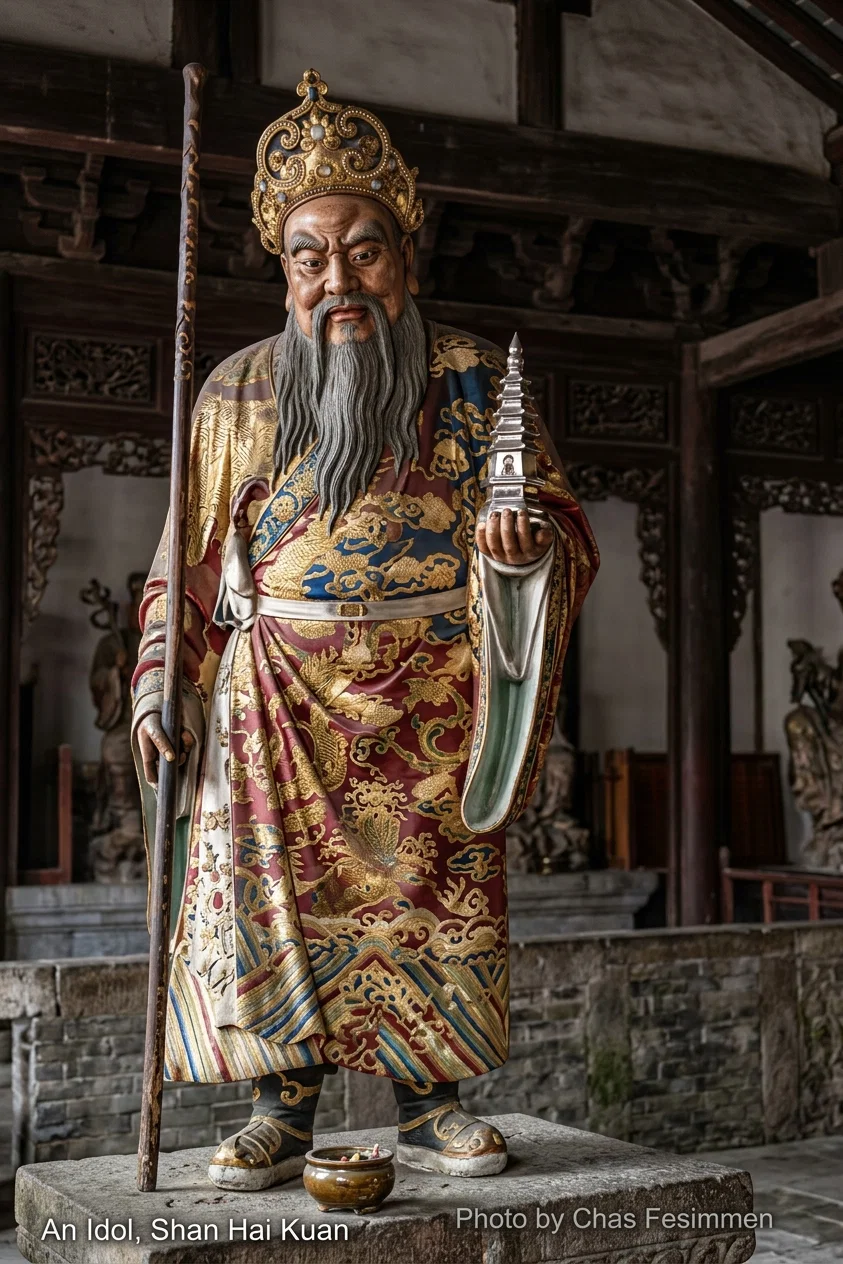
An Idol, Shan Hai Kuan
Then there is the virtue of "emptiness,"—the passive state, the absence of passion. This condition is considered ideal, as it is akin to heaven, and places its possessor above the earth, ranking him with the gods. One chief power claimed by the Taoist priest is the power of exorcism. By this craft and the funds derived from it, the priesthood receives a large measure of its support. But Taoism, like Confucianism, is nothing more nor less than a human religion, without love and without a Saviour. It has certain moral precepts, but its whole foundation is built on demon and spirit worship. "Magic has always been the central nerve of the Taoist religion, and always determined the functions of its priesthood." To promote the destruction of evil spirits and to propitiate the gods, by means of charms, spells, music, and other cunning devices, seems to be the principal work of the Taoist priest.

Buddhism

The last of the great religions of China is Buddhism. This religion seems to have come to China during the first century of the Christian era, and soon made rapid headway in all parts of the Chinese Empire. Buddhism met a want in the experience of man entirely lacking in both the other religions of the people. It promised to those who lived acceptable lives, immortality, Paradise, and a state of supreme happiness in the world to come. Speaking of the Buddhist sects in China, De Groot says:
"They possess everything pertaining to a complete religious system; founders and prophets, a hierarchy and a pantheon, initiation and consecration, religious rituals, meeting places or chapels with altars, religious festivals, sacred books and writings, even theology, a Paradise and a hell."
A system of merits and demerits is figured out, so that a ledger account can be kept and a man work out his own salvation. Buddhism approximates Catholicism in many of its forms and services. Prof. Max Müller, speaking of the Buddhist priesthood in Tibet as found there by Hue and Gabet, says there was found among the priesthood "the crozier, the miter, the dalmatic, the cope, the service with two choirs, the psalmody, exorcism, the use of censers held by five chains which shut and open by themselves, blessings given by lamas in extending their right hand over the heads of the faithful, the use of beads for saying prayers, the celibacy of the priesthood, spiritual retreats, worship of saints, fastings, processions, litanies, holy water,—enough it would seem to startle Roman Catholic missionaries."
Thus China has a triune religion—Confucianism, Taoism, and Buddhism. The State, orthodox religion is Confucianism; but so blended and so interwoven are the three, but few of the Chinese laity really know whether they are of one faith or of all. In all these religions morality is inculcated, but God is hidden from man, and man is left in total darkness concerning all that he most desires to know. The whole worship is only to procure to one's self and friends temporal benefits from the spirits and to purchase the favor of the gods, that calamity and misfortune may be warded off.

Menaced by Fear of Demons

To the Chinese, the whole world is full of demons. Trees, shrubs, and herbs, mountains, rivers, and seas,—in fact all nature, is possessed with souls determined to inflict evil on mankind. These demons must be deceived, bought, propitiated, scared, or fooled, that their evil purposes will fall on some other than the worshiper. Probably the world has never seen a more spirit-fearing people than the Chinese. Their whole lives are hedged in with fear of these evil spirits. Sickness comes because they have failed to propitiate the god of that disorder; droughts, pestilences, death, all are visitations of demoniacal or god-spirits' wrath. They hate the demons and have no love for the gods; but it is a cold business transaction to ward off the demons and to propitiate the gods so that no harm can come to them.
Thus the priests are hired to practise their exorcism over demons. Streets, walls protecting cities, entrances to houses, graves, wells, days for marriage, all are determined with respect to the spirits. The richest mines of coal ever discovered by man have lain for ages, all untouched, while untold millions of lives have been spent in the futile effort to get fuel to cook the simple food, because of the fear of these evil spirits. A man falls into the water and in vain struggles to get out; but not a helping hand is offered, because of the fear of evil spirits. The land, the sea, the air, are filled with these spirits, and they must be obeyed. More than four hundred millions of people in China live under this awful dread of demons. They never loved God, they know nothing of the Gospel of His Son Jesus Christ. Their religion, while it teaches high moral precepts, offers no mercy for sin, fills the soul with constant fear and dread of evil spirits, and lets the life go out without hope in God. The nation bows in dread terror before the religions imposed upon them by their classical literature. What it says they believe; and its teaching fills all nature with living, active spirits whom to ward off or deceive, or to purchase their favor, is an important part of a Chinese life.
China is to be pitied. An intelligent, industrious, hard-working people, so oppressed with superstitions and fears of the spirit world, are surely to be pitied. Nothing but knowledge of the Word of God can ever dispel this awful darkness resting upon the people. They need sympathy, love, and help. They can never help themselves, for they know not the way, nor have they teachers to show them the better way. Their help must come from the Christians of this generation. They need the Word of God enforced by the lives of those who have sat at the feet of the great Teacher. I. H. EVANS.