Untitled article

5%

Pacific Press Publishing Company · Oakland, California · Mar 15, 1899

FromSigns of the Times, Vol. 25, No. 11.

Read the full edition
FROM OCEAN TO OCEAN.
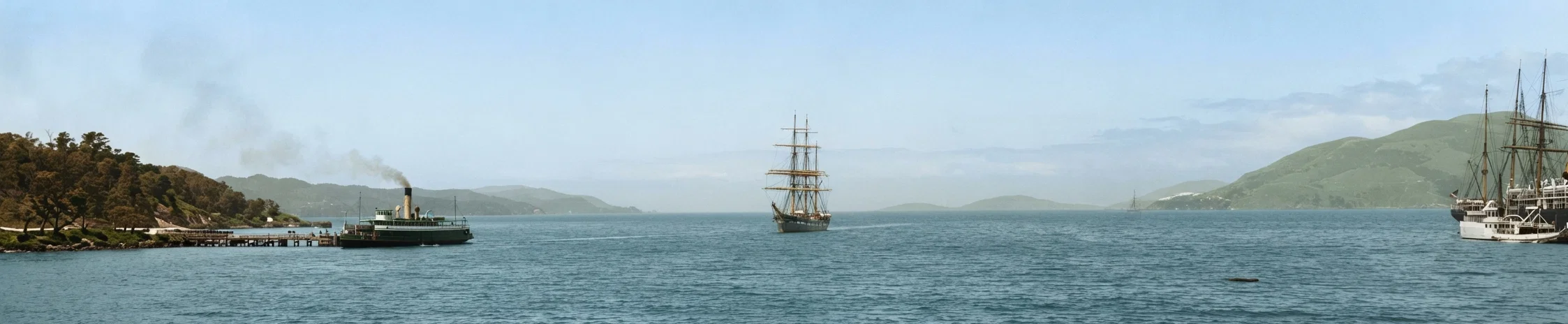
FROM the Golden Gate to Plymouth Rock; from the sea-level where the billows of the broad majestic Pacific lap the feet of the offshoots of the Sierras to the bleak wintry shores of the fiercer Atlantic; from the land of ever-blooming roses, and blossoming callas, and verdant palms, to the land enshrouded in snow and locked in the icy bands of the frost king, where the trailing arbutus, spring's earliest floral messenger, and the odorous leek of the deciduous forests, wait tardy permission to greet the warmth of the opening year; from groves of orange and lemon, laden with golden fruit, to maple sugar orchards, patiently waiting spring's proclamation of emancipation; from out-of-door picnics, and plowing, and seeding, and harvesting of root crops and fruit gathering, to lumber camps, ice harvesting, sleigh-bells, and skating, with nose and ears atingle with the frost; from 70° Fahrenheit to zero and downward; from summer land to winter land; from California to Massachusetts, we journeyed en route to General Conference, held in the quiet yet ancient little village of South Lancaster, thirty miles west of Boston.
There were seven in our party (the complete scriptural number), and we traveled by the splendid Sunset Route from San Francisco, the sentinel by the sea, to New Orleans, the "Crescent City," at the mouth of the "Father of Waters;" thence by the Piedmont Air Line to Washington, the capital of the nation; thence to New York, the metropolis of the Western World, by the well-known Pennsylvania Road; to Boston and our destination by the Fall River line of steamers and connecting railways if the ocean travel had not congealed.
Interesting! There is no transcontinental trip like it. Look upon it as outlined on some great map of the United States. Like a rough, irregular outline of an old-fashioned cradle rocker this great railway route spans the broad continent, one end at San Francisco, the other at New York, the lower part of the bend marked by a line drawn from El Paso to New Orleans, cutting in twain (for the Southern Pacific extends into Oregon, whence came two of our party) the longest way each of the two largest States in the Union, and stretching from ocean to ocean a distance of over four thousand miles, passing through every variety of soil and climate and scenery of these territories and sixteen sovereign States. So much in general.
In detail the Southern Pacific in California traverses the great Sacramento Valley north of San Francisco and the San Joaquin Valley south, the latter, extending from San Francisco Bay and its branches to the Tehachepi Mountains. This range separates Southern California, of which Los Angeles is the commercial center, from the rest of the State. "South of Tehachepi" among the political tribe sometimes suggests a separate State government, even as "west of the Sierras" used to suggest in earlier days a separate empire.
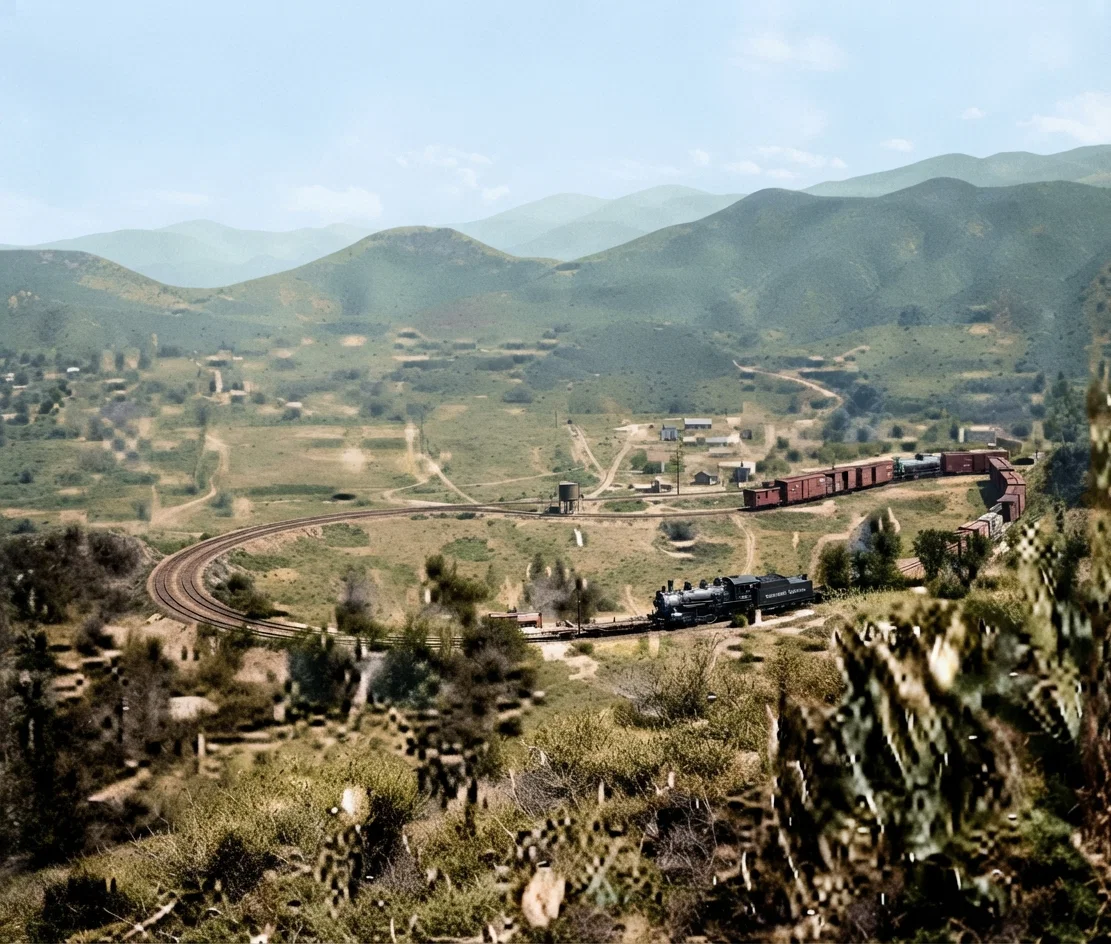
But up the Tehachepis! What a climb! New vistas of mountain and cañon and tableland and mountain brook and winding road open at every turn. And there are many turns which only skilful engineering could make. In and out, out and in, back and forth, doubling upon itself, the glistening track coils and wriggles and twists and thrusts itself up the mountain. Now it skirts the mountainside, now it bridges some frightful chasm, the next moment it plunges into the Egyptian darkness of some one of the nineteen tunnels (if memory rightly serves) which lie between Bakersfield at the foot and the summit, in and out of which the road climbs over 3,600 feet in forty-eight miles. Tantalizing to the observer are these tunnels; for they spoil many beautiful scenes; but they repay in new surprises as one emerges from their cavernous blackness. Among these tunnels is the famous "Loop," in which the road of necessity loops under itself in order to make the grade.
From Tehachepi the road descends by easy grades to Los Angeles (City of the Angels—both good and evil), the best-advertised city in the West, and perhaps worthy. It is a beautiful, enterprising town, with fine surrounding country, abundant in fruitfulness.
The Loop, Southern Pacific Railroad, Tehachepi Mountains, California.
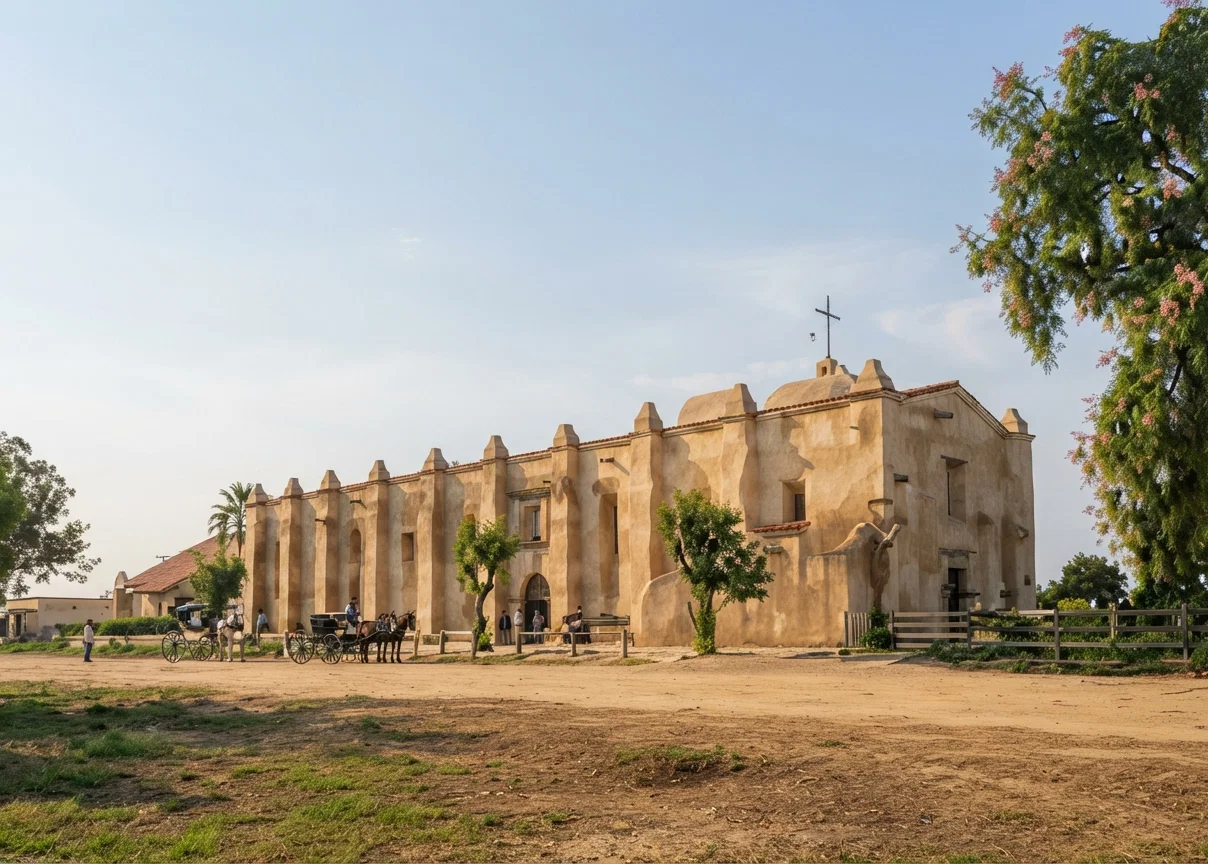
Thence past old San Gabriel Mission, built in the old Spanish days, through orange and lemon groves laden with golden fruit ready to gather, on February 2 (think of it, Eastern brother!), past palm and banana, up the mountain again, till we reach the height of 2,560 feet, at Beaumont. Then in the short distance of seventy-four miles we plunge down the mountain, over 2,800 feet, into Salton Valley, 263 feet below ocean level. Here, in tropical heat, science and patient industry compel the heavy water of this inland sea to yield its product of chloride of sodium to satisfy the saline needs of the corrupting earth. This valley was doubtless a part of the Gulf of California, separated by some convulsion of nature which upheaved the intervening mountains.
From out the Salton Sea we traverse the deserts of Southern California and Arizona, where reign supreme, each in his sphere, the rattlesnake, the Gila monster, the centipede, the tarantula, the nomad miner, the indigent and indigenous Indian, and the employee of the railway. And yet the soil is generally fertile, often exceedingly so, could it have but water, a need which the blistering sun seems to mock where, through the superheated, shimmering air, it turns desert sands and hollows into rippling lakes and bays and streams in whose depths are reflected shore and hill and mountain and cloud, and on whose bosom float ships in full sail. Such we actually saw with our own eyes. The wicked mirage; it is like the glittering, iridescent ambitions and glories of earth, which lure but to deceive, which lead on the thirsty victims till their bones lie bleaching on the deserts of oblivion and their hopes are forever perished.
But to return. This section of country once supported a noble aboriginal population; for here dwelt the cliff-dwellers and the builders of great towns and mighty fanes, relatives or ancestors of the Aztecs. The remains of these ancient people or peoples show them to have been possessed of a degree of civilization far surpassing that of their degenerate successors. Among the better specimens, perhaps, of the present natives are the Yumas, many of whom may be seen at the town of Yuma, near the mouth of the Colorado, our first entrance into Arizona. Very shrewd are these natives, equaling the Egyptian, in the gathering of "backsheesh," unwilling even that the camera shall catch their features unless paid for it; but if they could be photographed in original, picturesque, and variegated garb and pose, it would be worth while. But the light was poor and day was declining as we passed through.
Through ancient, modern, Mexican, American Arizona, where meet all extremes, our route passes, tapping the territory north and south at Maricopa, Benson, and Bowie. On we go, clipping off the southwest corner of New Mexico, the northern and central parts of which may be reached by rail from Deming, and also from El Paso (The Pass) from the extreme western end of the great State of Texas, where Mexico, New Mexico, and Texas meet. In Texas we go 950 miles through desert, waterless portions, through great grazing plains, where vast herds grow fat on the succulent grasses, through corn and cotton lands, which we believe would be equally fertile and more profitable for the tiller if a greater variety of crops was cultivated. A great State is Texas, with unlimited agricultural resources, yet waiting the key held by energy and industry.
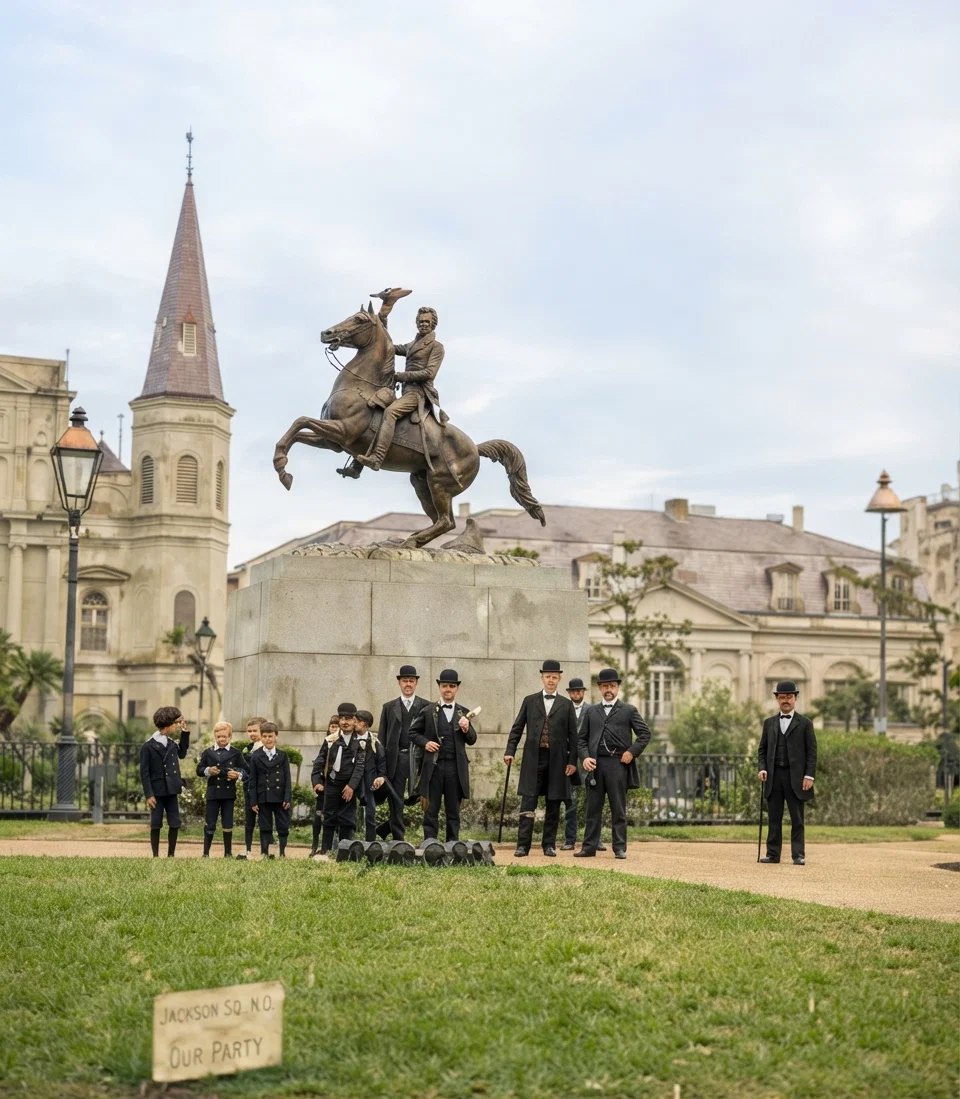
Sunday morning early brings us to New Orleans, in a thick fog. There are many things of interest to the northerner in this quaint old city. It is different from most cities. Its population is cosmopolitan,—American, French, Italian, Creole, Negro, Chinese, and others. Features worth seeing are the old French markets; the levees, by which the city is protected from the mighty Mississippi in its madness; Lake Ponchartrain, a beautiful body of water and noted summer resort; Audubon Park, where once the first sugar cane of Louisiana was grown, embracing 240 acres and containing the largest conservatory in the world; Jackson Square, the most historic spot in Louisiana, in the center of which is a fine equestrian statue of General Andrew Jackson, on one side of which are buildings in which allthe transfers of Louisiana to different nations took place; the beautiful cemeteries, most of the interments in which are made above ground; and many other attractions, which we have not space to mention. We can not forbear reference to Margaret Monument, the first erected to a woman (Margaret Haughery) in America, who, reared in poverty, accumulated a fortune in the milk and bakery business, and donated the larger part of her income in behalf of the poor. Her example ought to be a stimulant to the great city. The street-car service of New Orleans is of the very best; the chief streets are beautiful, the street-car tracks occupying the center exclusively, with green grass on either side of the track; and the employees are as uniformly accommodating and courteous as those of Oakland, and that is saying much.
San Gabriel Mission, near Los Angeles.
From New Orleans our route lay over the Piedmont Air Line to Washington, traversing several roads from the Crescent City to the capital, passing through the States of Louisiana, Mississippi, Alabama, Georgia, the Carolinas, Virginia, and Maryland. Mobile, Montgomery, Atlanta, the great railway center of the South, Spartansburg, Charlotte, Greensboro, Danville, Lynchburg, are all thriving cities and towns, strung like great beads on an iron thread, each having its special and peculiar advantages and attractions. One sees the old South and new. Opportunities offer themselves to the thriving settler all along the way. "Go South" is to our mind as opportune a cry to him seeking a home as to "go West." In some localities cotton mills are springing up, and a new aspect of affairs is presented to the traveler of olden time. Approaching Washington the foot-hills of the Appalachian Range present varied and beautiful landscape scenes, but all the way from New Orleans it is interesting. From Washington to New York we traveled through Baltimore, Wilmington, Philadelphia, Trenton, and Jersey City.
We found throughout the great four-thousand-mile journey the railway service good, and the railway employees, from general agents to porters, uniformly kind, obliging, and courteous. Especially would we mention Mr. H. G. Jones, the conductor of our car from San Francisco to Washington. As we stopped off at New Orleans, we were compelled to leave him, or he us, a matter regretted by all our party. We are sure that whenever any one of the company again comes through on the great Sunset Route and Piedmont Air Line he will inquire if he shall have Mr. Jones as car conductor.
We saw no snow, save on the mountain heights, till we reached Virginia. When we got to Philadelphia and New York, after a stop of three days by the way, the mercury was below zero, and many of the great cities of the country were suffering severely. In New York the suffering was intense, growing worse as the storm and cold continued, touching the heart-strings of the charitable and truly religious. The papers confessed man's inability, with all his scientific knowledge and facilities, to cope with nature in her angry moods.
How puny is man to meet even the fluctuations and convulsion of nature! Would that he could realize that the God who can control nature is above all, and is able to work, and will work, all things for the good of all those who are truly His.
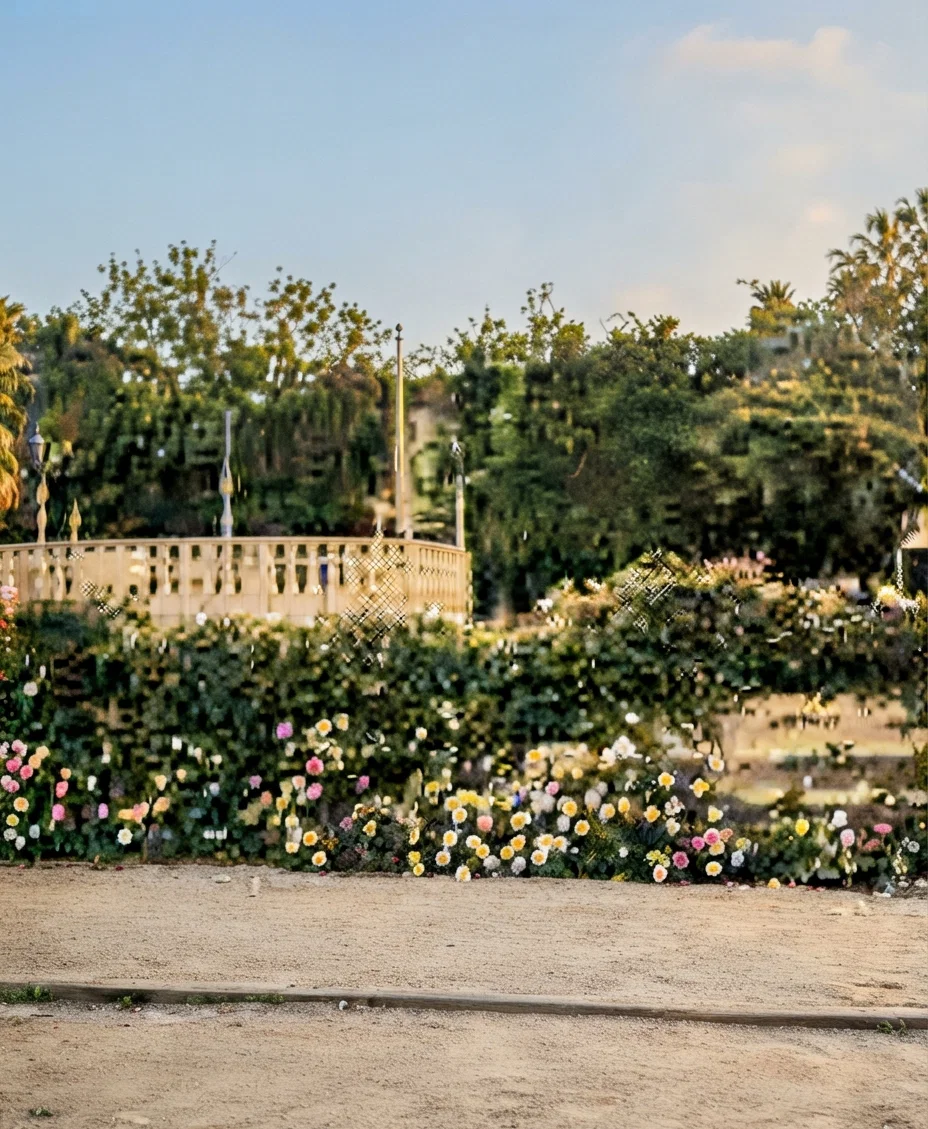
Garden, S. P. Railroad Station, Los Angeles, Cal.
Jackson Monument, New Orleans, La. Our party, with city boys in the foreground.