SOUTH AMERICA

4%

Pacific Press Publishing Company · Oakland, California · Jul 26, 1899

FromSigns of the Times, Vol. 25, No. 30.

Read the full edition

SOUTH AMERICA.

Paraguay.

PARAGUAY is a small inland republic in the south central part of South America, and has an area of 91,970 square miles and a population of 648,299. The chief industry is stock-raising. This country is appropriately called "the garden of South America." It is connected with the sea only by the rivers Paraguay, Parana, and La Plata, at Montevideo, a thousand miles directly south.
Before the war of 1864 to 1870 the population was 1,337,430, but at the close it was reduced to 221,080, and two-thirds of these were women and children. This war was fought with Brazil, Uruguay, and Argentina on one side and Paraguay alone on the other. Immigration has greatly increased the population of late years.
The capital city has a population of forty thousand. San Pedro, Villa Rica, and Concepcion are the only other towns that have more than ten thousand inhabitants. There are eight others that have more than four thousand. There are several colonies, and among these are three German and German-Swiss, and one small English-Australian colony. The resources of the country are only beginning to be developed. The climate is healthful, and the government offers free passage to immigrants from Buenos Ayres.
The chief products are yerba-mate, or Paraguayan tea, corn, rice, coffee, manioc, tobacco, oranges, and bananas. There is much good land for pasture. The language of the interior is the Guarani, and the only portion of the Bible translated into it is the Sermon on the Mount. The differences in the dialect make it of no practical value.
From 1608 to 1767 the Jesuit missionaries labored successfully among the Guarani Indians, and for more than a century and a half they had absolute control over Paraguay and Missiones. All that marks their sojourn are the ruins of houses that they built and the orange groves they planted. The Indians were not benefited spiritually, morally, or intellectually. There are none that can read. The Spanish language is the legal language, but religious and civil liberty is enjoyed there by all classes. The financial system is defective. One dollar of gold is worth six of the national paper, which is also fluctuating. The country is open for immigrants, and therefore they are welcome.

Uruguay.

This republic is the smallest of all the South American countries. Its area is 72,110 square miles, and it has a population of 648,299. In point of development, industry, and products, this country is much on a par with the province of Buenos Ayres. It supports some 5,250,000 head of cattle and 13,000,000 sheep. The soil is rich and fertile, producing in abundance every kind of grain or fruit known in temperate and sub-tropical climes.
There are numerous settlements of Canary Islanders in the departments Canelones and San Jose, who raise large quantities of grain, chiefly wheat, and keep 100 steam and water mills constantly busy.
The country is divided into nineteen departments. It has a republican form of administration, and liberty of worship is granted. Brother Vuilleumier is now laboring in the colony of the Vaudois of Piemonte, which was founded by 55 families in 1857, and now numbers 2,200 souls. These speak the French language as well as the Spanish. The Nueva Helvacia, or German-Swiss colony, is bordering on it, and there is where the Nueva Helvacia Seventh-day Adventist Church is located.
Montevideo is the capital city of Uruguay, and has about 175,000 inhabitants. It has a very attractive appearance, whether seen from a vessel entering port or on the land side. It stands on a tongue of land between the bay and the Atlantic. Its streets are enlivened by the cool sea-breezes and showers of rain. The climate is exceedingly pleasant. It is the best-built city in South America. The commerce is most remarkable. In geographical position it exceeds any other city in South America.
The people of Uruguay are generally kind. Revolutions have often shaken them up, and it should not be hard to show them that greater interests should be sought than this world can offer. The country being so small, such revolutions could not help but affect the peace of families. For an example, the revolution of 1896-7 was a party strife, and therefore son fought against father, brother against brother, and too often sister against sister. O, the cruelty of this world! When will it learn the way of peace and life and happiness? The Gospel of love and peace ought to be proclaimed by thousands of voices everywhere.

Argentina.

Aside from Brazil the Argentine Republic is the largest and most important country in South America. The area is 1,125,086 square miles, or a little over one-third as large as all of the United States. The population is 4,086,492. The increase is 400 per cent. every 42 years, and since immigration is increasing still more rapidly, the population is much greater than the statistics show.
The country is divided into fourteen provinces and nine territories, after the model of the United States. It lies nearly all in the temperate zone, and has a good climate, varying according to latitude and elevation.
Milkmen of Buenos Ayres.
The exports during the year 1897 amounted to over 62,000,000 dollars, gold. The immigration during the same time was over 100,000 Europeans. Many nations are largely represented, and some of the principal ones as follows: Italians, 492,636; Spaniards, 198,685; French, 94,098; Germans, 17,143; Austrians, 12,803; German and Jewish Russians, 15,047; German, French, and Italian Swiss, 14,789; North Americans, 1,381; and English, 22,000.
Buenos Ayres, the capital, is the largest and most important city of South America, and has a population of over 700,000. It is the center of Spanish influence in South America. The government is taking an interest in educating the children. It has established schools, and there are 365,841 scholars. For every student the government spends $11, which will amount to a tax of 75 cents for each individual. The United States spends $16.50 for every student. The number of children of school age are 720,000 in Argentina, and thus it will be seen that not one-half yet attend school in spite of what the government has done to provide primary education. There is not schoolroom enough to accommodate all the children, not even in the city of Buenos Ayres.
There is an extensive railroad system and many boat lines, so that not only all the principal parts of the country can easily be reached, but other countries as well. Electric trainways and lights have been introduced. Modern warships have been secured and soldiers are being trained. In agriculture the modern machinery is employed. Beautiful scenery, mineral springs, and rich soil for cultivation are abundant. Much to promote happiness and prosperity is provided both by nature and the government.
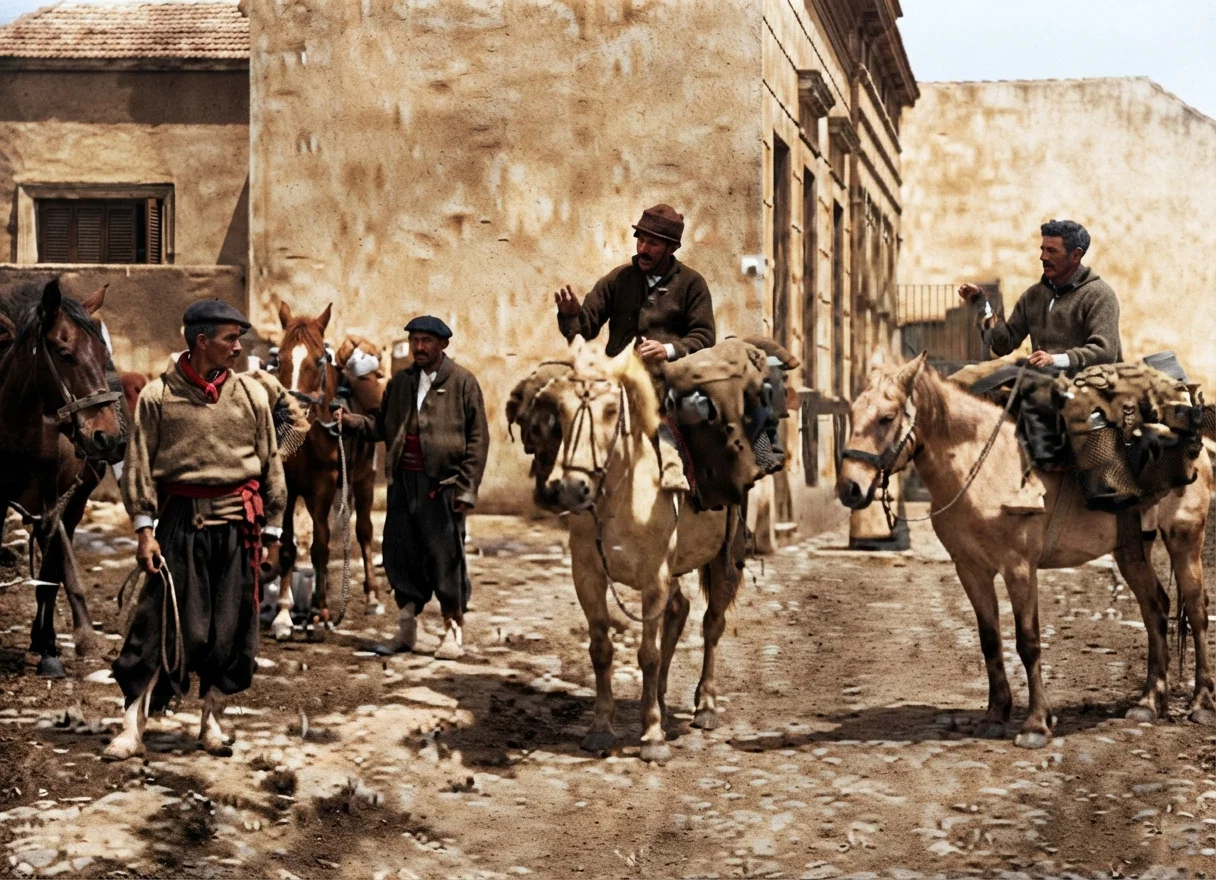
Religious toleration is granted to all denominations alike. Generally the Argentinian people are friendly and hospitable. The people are vivacious in conversation, talking with the head, shoulders, feet, and hands. This may be the result of the influence of priesthood for so many years—that their gestures have fixed themselves on the people. Argentina, with Paraguay and Uruguay, offers an extensive field for families to come and live the Gospel truth among the people.
Immigrants are boarded five days in Buenos Ayres on government expense, provided they come second or third class on the steamers. They are then transferred to the place they choose to live in, and at the end of the journey, if necessary, boarded ten days at the expense of the government.
The work of the Lord is also progressing in this country. About four hundred have united with us in church fellowship. The tithe and donations of the past year amounted to about two thousand dollars. We have four ordained ministers and one Bible worker in the field, and two colporters. A colporter school has been conducted and four or five trained. The crops have been better, and we expect to see the colporter's work prosper. One young man has entered the work, and is preaching the truth at his own expense. Twelve souls have been converted under his labors. The workers are all of good courage and good cheer, and we hope to see many souls in the kingdom of God from Argentina.
The work has nevertheless but just begun, as some of the provinces have as yet not been visited by our workers. Much of the field is just as much unworked as Paraguay.
F. H. WESTPHAL.