Untitled article

6%

Pacific Press Publishing Company · Oakland, California · Dec 16, 1897

FromSigns of the Times, Vol. 23, No. 49.

Read the full edition

"THE MOST HIGH RULETH." NO. 8.

WHEN Daniel told King Nebuchadnezzar his dream and showed him the interpretation, the king acknowledged that Daniel's God was "a God of gods, and a Lord of kings." He made Daniel ruler over the whole province of Babylon, and chief of the governors over all the wise men of Babylon. Daniel's three friends, Shadrach, Meshach, and Abed-nego, were also given prominent positions. But, notwithstanding his acknowledgment of the superiority of the God of heaven, the king was not satisfied with the prophecy that his dynasty was to be overthrown. So he thought to thwart the purpose of the Almighty as foreshadowed in the great image.
With this purpose in mind, Nebuchadnezzar made a material image, and set it up on a high pedestal. Remembering that his kingdom was represented by the head of gold in the dream-image, he made his image all gold. Then he "sent to gather together the princes, the governors, and the captains, the judges, the treasures, the counselors, the sheriffs, and all the rulers of the provinces, to come to the dedication of the image." Dan. 3:2.
"Then an herald cried aloud, To you it is commanded, O people, nations, and languages, that at what time ye hear the sound of the cornet, flute, harp, sackbut, psaltery, dulcimer, and all kinds of music, ye fall down and worship the golden image that Nebuchadnezzar the king hath set up; and whoso falleth not down and worshipeth shall the same hour be cast into the midst of a burning fiery furnace." Verses 4-6. Now that the king had set up an image all gold, indicating the continued supremacy of his dynasty until the end of time, he proposed to add to its security by having the image dedicated as a universal deity.
But when the signal was given for all to bow down and worship the image, three men remained standing, in defiance of the king's command. These were Shadrach, Meshach, and Abed-nego, the three captive companions of Daniel. As Daniel is not mentioned in this connection, it is supposed that he was absent from the city. Then some of those Chaldean wise men, who were no doubt jealous of these Hebrews who had proved to be so superior to them in every qualification for preëminence, were quick to tell the king of this disregard of his command. Of course Nebuchadnezzar was furious, and immediately called the dissenting officers before him. He then repeated the order, and the penalty of disobedience, adding, "And who is that God that shall deliver you out of my hands?" He evidently thought that the God who had placed the Hebrews in his hand would not take them from him, and that no other god could do so.
But Shadrach, Meshach, and Abed-nego could neither be swayed by the multitude nor coerced by the wrath of the king. Knowing Him in whom they trusted, they answered: "O Nebuchadnezzar, we are not careful to answer thee in this matter. If it be so, our God whom
we serve is able to deliver us from the burning fiery furnace, and he will deliver us out of thine hand, O king. But if not, be it known unto thee, O king, that we will not serve thy gods, nor worship the golden image which thou hast set up." This was very plain speech to be addressed to one who was monarch of the world, and already angry because of wounded dignity. But the speakers were full of faith in Him who is able to remove and to set up kings. With such the commandment of God is always held above any civil law, no matter what the penalty may be.
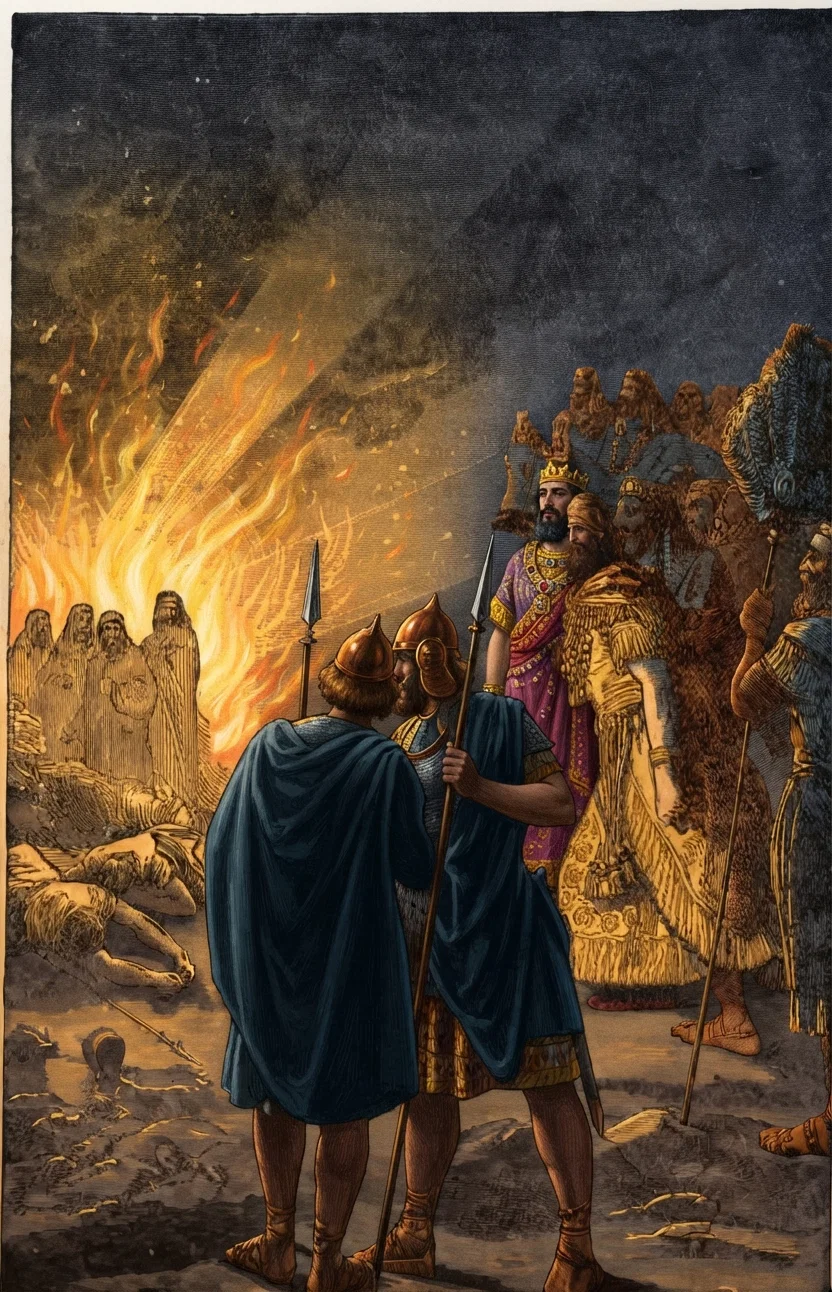
Then the king was "full of fury;" his wrath knew no bounds. He commanded strong men to cast Shadrach, Meshach, and Abed-nego into the fiery furnace, which was heated seven times hotter than ever before. They were cast into the fire bound in all their clothing. The fire was so hot that it immediately slew the strong men who cast the condemned ones into it. Then, to all human expectation, the doomed men would be instantly killed by the heat, and quickly consumed. Soon, however, the king "rose up in haste, and spake, and said unto his counselors, Did not we cast three men bound into the midst of the fire? They answered and said unto the king, True, O king. He answered and said, Lo, I see four men loose, walking in the midst of the fire, and they have no hurt; and the form of the fourth is like the Son of God." The Revised Version reads, "a son of the gods," and as the king knew nothing of the Son of God as Christians know him, the latter rendering is no doubt the true one.
THREE HEBREW WORTHIES AND FIERY FURNACE.
However, the fourth person walking in the midst of the fire was the Son of God.
Then the king called to Shadrach, Meshach, and Abed-nego to come out to him, and they came forth from the fire. And all the king's officers "saw these men, upon whose bodies the fire had no power, nor was an hair of their head singed, neither were their coats changed, nor the smell of fire had passed on them." This remarkable deliverance drew from King Nebuchadnezzar another acknowledgment of the true God, and of the faithfulness of his servants: "Blessed be the God of Shadrach, Meshach, and Abed-nego, who hath sent his angel, and delivered his servants that trusted in him, and have changed the king's word, and yielded their bodies, that they might not serve nor worship any god, except their own God."
Thus easily and ingloriously came to naught the great Nebuchadnezzar's pompous effort to override the purpose of the Most High, who "ruleth in the kingdom of men." All that was necessary to do this was for the Lord to send his angel at the critical moment when the greatest power on earth had thought to overrule the commandment, "Thou shalt have no other gods before me." And God is just as jealous of any other commandment of his when antichrist in any form shall think to change it. The time will come when his Sabbath commandment, just as he gave it, will find as signal vindication as has any other.
But almost in the same breath with which Nebuchadnezzar acknowledged the supremacy of the "Most High God," he went to the other extreme, and issued the following edict: "Therefore I make a decree, That every people, nation, and language, which speak anything amiss against the God of Shadrach, Meshach, and Abed-nego, shall be cut in pieces, and their houses shall be made a dunghill; because there is no other god that can deliver after this sort." Verse 29.
This was a characteristic National Reform (or Church-and-State) decree, inasmuch as it was designed to annihilate as far as possible the memory of the offender. See also chapter 2:5. Under the rule of Papal Rome, under whose sway the Church-and-State principle reached the climax of cruel penalty, the remains of
John Wycliffe were disinterred forty years after his death, and burned, and the ashes cast into the river Swift, to be carried to the sea. Under this régime, for hundreds of years, burning and other modes designed to effect as far as possible utter obliteration from the minds of men, were in vogue. And in our day, in our own United States, certain National Reformers, in their advocacy of Sunday laws and other forms of State religion, have held up the same principle. One prominent leader openly suggests banishment for opponents of national religion. He classes all such opponents, Christian or unchristian, as atheists, and emphasizes the statement that "atheism and Christianity are contradictory terms. They are incompatible systems. They can not dwell on the same continent." Other expressions from the samesource indicate in very positive terms which party would have to go or be coerced were the State religion party in power. In this mania of human nature to rule or ruin, not only in secular but in religious matters, is made clear the ground of the oft interposition of the providence of God in removing kings and setting up kings. In 'man's inhumanity to man' we find the necessity to 'overturn, overturn, overturn' (Eze. 21:27), in the empire of the world, till the God of heaven shall set up a kingdom that will 'fill the whole earth,' and that 'will never be destroyed' (Dan. 2:35, 44).
"He which testifieth these things saith, Surely I come quickly. Amen. Even so, come, Lord Jesus." Rev. 22:20.