The Candlestick and the Table

6%

Pacific Press Publishing Association · Mountain View, California · Nov 19, 1912

FromSigns of the Times, Vol. 39, No. 45.

Read the full edition

The Candlestick and the Table

The Golden Candlestick
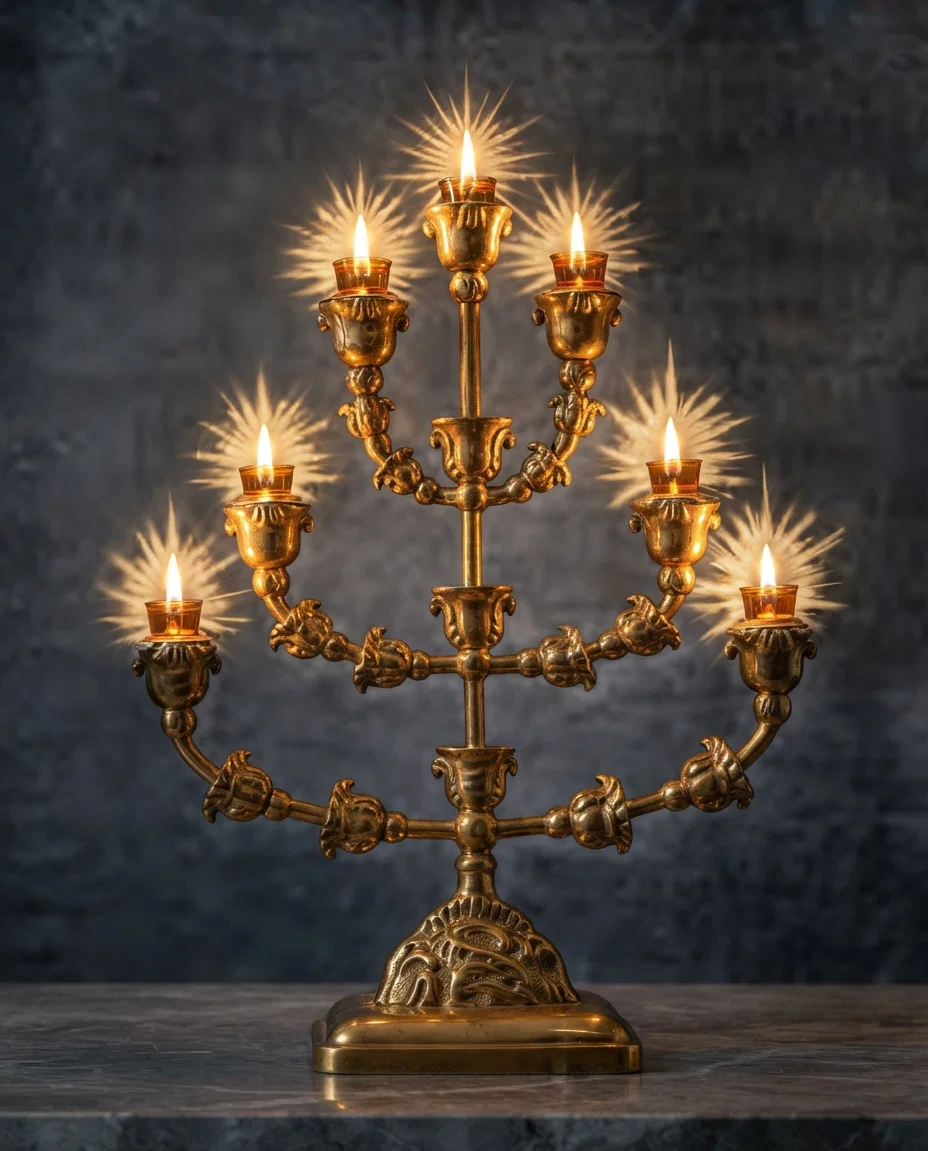
THE golden candlestick with its seven golden lamps was on the south side of the first apartment of the sanctuary. It was made of gold beaten into shape by the workman's hammer. Ex. 25:31-37. It took many skilful, molding blows to form the flowers and bowls of the candlestick; but the candlestick was to be made after the heavenly model, to teach heavenly lessons to mankind. Ex. 25:40. John the beloved disciple was permitted to look into the first apartment of the heavenly sanctuary, where he beheld the seven golden candlesticks. He also beheld the Saviour in the midst of the glorious golden candlesticks of which the earthly one was a shadow. The Saviour, in explaining to John the meaning of what he had seen, said, "The seven candlesticks which thou sawest are the seven churches." Rev. 1:12-20. Seven is a number denoting completeness. The candlestick of beaten gold, with its seven bowls for the lamps, was an "example and shadow of heavenly things." Heb. 8:5. Its seven branches, each holding aloft a lamp, represented the church of God. The individual that forms a part of the "church of the First-born, which are enrolled in heaven" (Heb. 12:23, margin), will often feel the workman's hammer; "for we are His [God's] workmanship, created in Christ Jesus unto good works." Eph. 2:10. Then, "beloved, think it not strange concerning the fiery trial which is to try you, as tho some strange thing happened unto you." 1 Peter 4:12. It is only the Master Workman fashioning you to become a part of the great church enrolled in heaven.
The candlestick in the type held seven lamps. The beloved disciple had also a view of the heavenly lamps, of which the earthly ones were models. Before the throne of God in heaven, he saw seven lamps of fire, "which are the seven Spirits of God." Rev. 4:2, 5. The church of Christ is the candlestick to hold up the light in the midst of moral darkness. The Saviour says, "Ye are the light of the world." Matt. 5:14. The Spirit of the Lord is said to be the eyes of the Lord, which "run to and fro throughout the whole earth, strongly to hold with them whose heart is perfect toward Him." 2 Chron. 16:9, margin; Zech. 4:10. Then the brightness of our light depends upon the condition of our heart. The Spirit is searching throughout the earth for those whose hearts are perfect toward God, and it will strongly hold with such ones; their light will not burn dim. The lamps in the earthly sanctuary were to burn continually. Lev. 24:2. So the Christian is ever to let the Spirit of God rule his life, and thus shed its light abroad.
None but the high priest could perform the sacred work of lighting the lamps in the earthly sanctuary. The high priest trimmed and lighted them each morning and evening. Ex. 30:7, 8. So none but our High Priest, that was "in all points tempted like as we are," can give us the help we need. In the morning, we need His Spirit to direct us during the day; and at evening, we need it to enlighten our minds as we review the work of the day, that we may detect the flaws and dropped threads in the warp of our lives. The trimming and lighting of the lamps was a beautiful type, with a daily lesson for us at the present time. It was a link in that wonderful threefold typical service, celebrated each morning and evening, while the "multitude of the people were praying without" the sanctuary. Luke 1:10. The whole burnt offering in the court, the incense and burning lamps within the sanctuary,—it was a wonderful type, which will never lose its beauty. Whenever an individual will fulfil in his very soul the antitype of the typical "whole" burnt offering—that is, wholly surrender himself to God, place himself and all he has upon the altar, to be consumed in God's service, as He directs—that individual, whether he be rich or poor, learned or ignorant, will be covered with the fragrant incense of Christ's righteousness, and his name will be enrolled with the church of the First-born in heaven; and here in this sin-cursed earth, as he goes to and fro, he will be a part of the great candlestick, and from his life will shine out the bright rays of the Spirit of God.
The question may arise in many hearts, How may I become a light-bearer in the earth? When Zerubbabel was trying, under very adverse circumstances, to rebuild the temple in Jerusalem, he came where the difficulties appeared like mountains before him. Then the Lord sent His prophet with a message to help and encourage him. The prophet Zechariah was given a view of the golden candlesticks, and also shown whence the oil came that supplied the lamps. He saw two olive-trees, one on the right side of the bowl, and the other on the left side, which through golden pipes kept the lamps supplied with oil, that the lamps burned brightly. Zech. 4:1-10. The prophet asked the angel the meaning of what he saw. In reply, the angel said, "This is the word of the Lord unto Zerubbabel, saying, Not by might, nor by power, but by My Spirit, saith the Lord of Hosts." Then he gave a message to Zerubbabel to go forward, and the mountain of difficulties would become a plain before him; and that as surely as his hands had laid the foundations of the house of the Lord, so surely would he finish it.
Zerubbabel was walking by faith in the words of the prophets who had told how and when Jerusalem would be rebuilt (2 Chron. 36:20-23; Jer. 25:12; Hosea 1:7); but they were dead, and he now faced difficulties he might be tempted to think the prophets had not expected would arise. Then God sends a living prophet with a message of encouragement to keep the light burning, and enable Zerubbabel to press forward and complete the work he had begun.
TYPE ANTITYPE
Ex. 40:24. Golden candlestick in the first apartment of earthly sanctuary. Rev. 1:12. John saw the seven golden candlesticks.
Ex. 25:37; 40:25. There were seven lamps upon the candlestick. Rev. 4:2, 5. John saw seven lamps of fire before the throne of God in heaven.
Ex. 30:7, 8. The high priest trimmed and lighted the lamps in the earthly sanctuary. Rev. 1:12-18. John saw Christ our High Priest in the midst of the candlesticks.
Lev. 24:2. The lamps were burning continually, always shedding forth light. John 1:9. The light of God's Holy Spirit through Christ lightens every soul.

The Table of Showbread

The table of showbread was placed on the north side of the first apartment of the sanctuary. The table was two cubits long, a cubit in width, and a cubit and a half in height. It was overlaid with pure gold, and like the golden altar, was ornamented with a crown of gold around the top.
On the Sabbath day, the Levites made twelve loaves or cakes of unleavened bread. 1 Chron. 9:32; Lev. 24:5. These cakes were placed on the table hot, each Sabbath day (Lev. 24:8; 1 Sam. 21:3, 4, 6; Matt. 12:3, 4), arranged in two rows, six in a row, with pure frankincense on each row. Lev. 24:6, 7.
During the entire week the bread lay on the table. By some translators it is called "the bread of the presence." At the end of the week it was removed and eaten by the priests. Lev. 24:9. This explains why Ahimelech the priest had no common bread on the Sabbath to give to David, as the priests were accustomed to eat the "hallowed bread" on that day. 1 Sam. 21:4. It was not lawful to bake common bread upon the Sabbath. The command was very plain that all bread for Sabbath use in the homes should be baked upon the sixth day. Ex. 16:22, 23. But the Lord directed that the Levites should prepare the showbread every Sabbath. 1 Chron. 9:32.
All the service connected with the table of showbread was done upon the Sabbath. The priests served "unto the example and shadow of heavenly things." Therefore there is a heavenly lesson for us in the antitype of the showbread. It was a continual offering before the Lord. It taught that man was wholly dependent upon God for both temporal and spiritual food, and that both alike came to us through the One who "ever liveth to make intercession" for us before the Father.
It, like all other types of the sanctuary service, met its fulfilment in Christ. Christ is the true bread of which the showbread was a type. He said, "I am the living bread which came down from heaven: if any man eat of this bread, he shall live forever: andthe bread that I will give is My flesh." Then He added, "Except ye eat the flesh of the Son of Man, . . . ye have no life in you." John 6:51, 53. Even His disciples could not comprehend His words, and murmured. Jesus read their thoughts, and said to them, "It is the spirit that quickeneth; the flesh profiteth nothing: the words that I speak unto you, they are spirit, and they are life." John 6:63. His Word is the true bread of which we are to eat. As the bread in the presence of God was taken out from the sanctuary and eaten, so Jesus said, "The word which ye hear is not Mine, but the Father's which sent Me." John 14:24. The Bible came from God. God Himself gave it to Christ. Christ signified it by His angel to the prophets. The prophets gave it to the people. Rev. 1:1.
We often read the Bible as a mere form of godliness, or to get something to give to others; but if we would receive its life-giving power into our own souls, we must have it "hot," warm from heaven. There is no more appropriate time to let God speak to our own souls through His Word than on the Sabbath day, when we lay aside our worldly cares and business, and take time to study the Holy Word, and let it come into our inmost hearts until we hear God speak to us, not to another. The priests were not only to set the hot bread upon the table on the Sabbath day, but later that same bread was to be eaten, and become a part of their very being. God designed that each Sabbath day, His people should gain a fresh experience in divine things, which would make them better fitted to meet the temptations of the week. The soul that never gains a deeper experience on the Sabbath than on any other day, fails to keep the Sabbath as God would have him. We may have a few minutes of quiet study of the Word on the Sabbath day, when we hear the Lord speaking to us individually; but if the words are not incorporated into our lives, they give us no abiding strength. Each Sabbath day, in the type, the priests set hot bread on the table before the Lord, and also ate the bread prepared the Sabbath before; and as they assimilated it, they received strength from it for daily duties.
Peter evidently understood this truth when he admonished the church to desire the sincere milk of the Word, that they might grow thereby, and if they did this, they would be "a royal priesthood." Here is the secret of true Christian living. Eternal life does not come to the soul through forms and ceremonies. They are all right in their place; but eternal life comes from feeding upon the true bread which comes from the presence of God, God's Holy Word, the blessed Bible.
TYPE ANTITYPE
Ex. 25:30. Showbread always before the Lord. John 6:48. Christ said, "I am that bread of life."
Lev. 24:5. There were twelve cakes of showbread, the number of the tribes of all Israel. 1 Cor. 10:17. In speaking of the church, Paul says, "We being many are one bread, and one body."