NOTWITHSTANDING I had found abundant Biblical evidence—much more than I gave in my last article—to convince me of the perfection of the Decalogue, the same question remained concerning the whole ceremonial law. Did God ever give an imperfect law of any sort?
When a person begins to study the subject of the law in the Bible, he is very soon impressed with the fact that the time of technical definitions and distinctions had not arrived when the Bible was written. The term "ceremonial law" does not appear in Scripture. Neither does the term "moral law."
The word "law" is found with almost every shade of meaning, in the Bible; but the meaning has to be determined by the context. In no place does a Bible author designate whether he is speaking of moral law, ceremonial law, or of law in general. Paul uses the word in still other senses than these. For lack of space, the various uses of the word can not be here illustrated.
It is of course clear that the Old Testament contains a ceremonial law. But was not that law moral? The answer to this question depends on our definition of "moral." If we define it as "pertaining to duty or obligation," the law of ceremonies was certainly moral. If it was not, then God was guilty of the inconsistency of giving a law to which no obligation was attached. Further, to say that the whole Mosaic code, exclusive of the Decalogue, was ceremonial, would be to include many laws quite as "moral" as anything in the Ten Commandment code, as the law of tithes, of marriage, of slavery, etc. And again, in a theocracy, where God Himself is king, does not even the civil law become moral? After much thought and study, I concluded that to attempt to convince a prospective convert that only the law of the two tables is moral, and that the ceremonial law was non-moral or unmoral, would be difficult to do with an array of texts. Neither is it possible to give to the former law exclusively the title "law of the Lord," or "law of God." Such texts as Luke 2: 21-24, 39; Neh. 10: 29; 8: 8, 18; Ezra 7: 21 (compare verse 6), 10, 26; 2 Kings 18: 6, make this distinction of the two laws Scripturally impossible. Better to attempt to diminish nothing of the moral obligation attached to any command or law of God. If God commands baptism, or the Lord’s Supper, or foot-washing, it can not be neglected without sin.
What, then, are the facts with reference to the two laws?
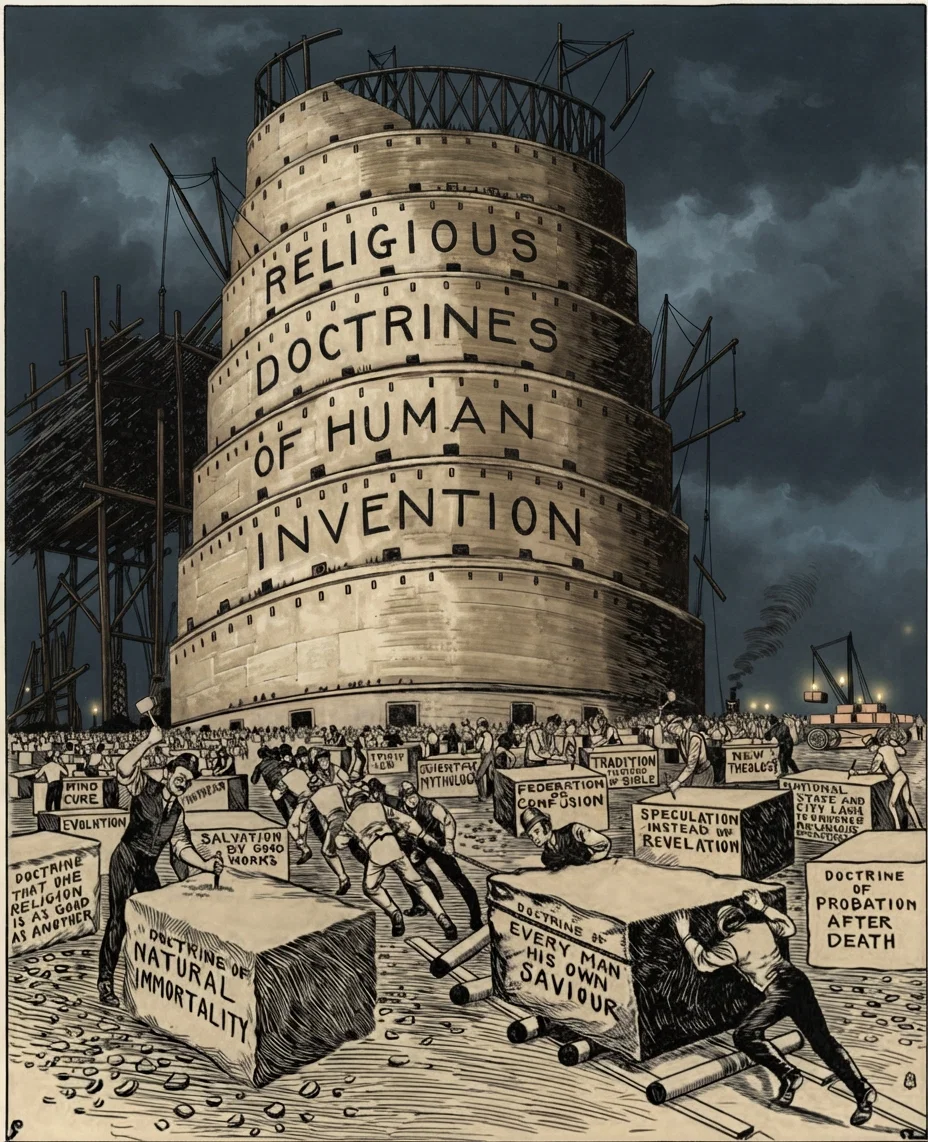
“LET US” Building the modern Tower of Babel. “And they said, . . . Let us build us . . . a tower, whose top may reach unto heaven.” Gen. 11: 4.
1. On the side of similarity:
(a) They are both the law of God, both moral;
(b) They were both unchangeable.
2. On the side of dissimilarity:
(a) God Himself made a clear and evident distinction between them by such facts as, that His own voice proclaimed the Decalogue from Horeb with a display of His glory most sublime and awful; that He wrote it with His own hand on tables of rock; and that He commanded a golden chest to be made for its preservation, invested this chest with the utmost sacredness, requiring for it reverence on pain of death; but the remainder of the law was given through Moses, written by him in a book, which book never attained the dignity of a place beside the tables of stone inside the golden chest. There were other things about the chest—called in the Bible the "ark of His testimony"—such as the "mercy-seat" and the cherubim, of a highly figurative character, but easy of interpretation.
(b) Much of the Mosaic law was typical. This fact is so well understood by every Bible reader that it need not be explained here.
(c) The typical law, tho immutable while it lasted, was TEMPORAL, limited to a certain time. The Decalogue is eternal. This last distinction is the one I desire to make clear in the present article.
Unchangeable but Not Eternal
A law expirable by limitation is not necessarily a changeable law. That God made many laws which were to cease to be in force when, being types, they met their antitype, was no indication whatever that, while they were in force, He would either change them Himself or permit any one else to change them. That no such power was delegated to kings or prophets after the time of Moses, will become evident by a mere reading of the Old Testament. The kings of Israel were executives; they were not legislators. In any way to alter the laws given by God and Moses was wholly beyond their authority. Even as late as the time of Stephen, death was considered to be the only fit punishment for one who should think to "change the customs which Moses delivered us." Acts 6: 11-14. Stephen himself was martyred on this charge.
It would seem that if any conditions would warrant alteration of the ancient law, such were afforded by the chaotic state of affairs after the return under Ezra from the Babylonian captivity. Yet no hint is given that he imagined such a thing possible. On the other hand, let us listen: "They clave to their brethren, their nobles, and entered into a curse, and into an oath, to walk in God’s law, which was given by Moses the servant of God, and to observe and do all the commandments of the Lord our Lord, and His judgments and His statutes." Neh. 10: 29.7
Not to Be Altered
We might quote here Ps. 89:34: "My covenant will I not break, nor alter the thing that is gone out of My lips." The third and fourth verses of this psalm read thus: "I have made a covenant with My chosen, I have sworn unto David My servant, Thy seed will I establish forever, and build up Thy throne to all generations." This makes clear what covenant is here referred to, as do also verses 35-37. It is not the one made with Abraham, or the one made with Israel at Sinai, or the Ten Commandments. The text can be available for our purpose only as it reveals the fact that what God does is never tentative, never a mere experiment. All His acts are final, conclusive. Which, we must remember, is a very different thing from saying they are unconditional, or absolute. It is precisely the failure to distinguish between "final" and "absolute" that has made the confusion in the matter of predestination. God has one unalterable, final plan of salvation. He has never had any other from the creation. But salvation is conditional. It is conditioned on faith.
All the words, statutes, commands, of God are final. He utters all with full knowledge of every relation, obstruction, and contingency that may arise through time or eternity. He does not have to try methods, plans, or schemes, to see how they will turn out. He has never made an experiment. Therefore every law He has ever given was a perfect law.
The text we have just quoted from the 89th Psalm evidently refers primarily to words spoken either through David himself or to David by a prophet, possibly Nathan. Yet God calls them words "gone out of My lips." This principle therefore applies as clearly to the law spoken through Moses as to the law uttered from Sinai. What is the purpose of all the law Heaven ever gave?—To keep His created beings in the way of life, and if they left it, to restore them. To this testifies the Scripture: "The law of the Lord is perfect, restoring [margin] the soul." Ps. 19:7.
When I had traced these truths out in the Scriptures, I saw conclusively that so long as the Decalogue remains, it is unalterable. It is final. It is not an experiment. It was not a type. It was not intended for a symbol. It is the condition of eternal life. If God broke it, He would destroy Himself—die. It is as eternal as the Eternal.
Whose is the impious hand that shall attempt to tear from the Decalogue a single precept?
Free-Will Beings
Not only men, but angels, are free-will beings. It is perfectly obvious that God could get no glory, no honor, and could experience no pleasure, from the servile worship of machines. Neither would a system of reward be other, in that case, than a ridiculous dumb show and pretense.
Both men and angels will be free moral agents to eternity. From this arises the possibility of their refusing obedience to the King of the universe, as Lucifer and a third part of heaven's host did once in heaven. Eternally, therefore, must stand the "royal" law, as a warning of the dire results of such a course. Sin will be sin a billion years from now, the same as it is to-day. God knows what is best for the universe, its peace and happiness. O that these six thousand years of wo, of the sad triumph of death, were enough to convince us of the results of disregarding the divine law! Brother, have we not seen and had enough of disease and strife, unhappiness and despair?
The law of God is a law of love, and liberty, and happiness, and life. Only obedience to this, by help of the Spirit from on high, can bring lasting peace and satisfaction. "This is a faithful saying, and worthy of all acceptation, that Christ Jesus came into the world to save sinners." "For God so loved the world, that He gave His only-begotten Son, that whosoever believeth in Him should not perish, but have everlasting life. For God sent not His Son into the world to condemn the world; but that the world through Him might be saved." Yes, Jesus came and died—died to take your place and mine under the violated law of Heaven; died—the King of the universe died—because His law could not be changed; died as the propitiation for our sins—to bring us to obedience. Shall we not avail ourselves of the wondrous plan?