WAITING FOR THE SIGNAL

6%

Pacific Press Publishing Company · Oakland, California · Apr 12, 1899

FromSigns of the Times, Vol. 25, No. 15.

Read the full edition

"WAITING FOR THE SIGNAL."

NEVER was there a time in all earth's history when the minds and hearts of men were so unsettled as now; never a time when the future of earthly plans and purposes and projects was so uncertain. What is the future of the capital-and-labor question? How will the ever-growing chasm between the "classes" and the "masses" be filled or bridged? When will the money question be settled so that the shekel shall no longer be growing greater and the ephah smaller? When will the tremendous power of corporate wealth cease to control congress and court, and buy and sell men? When will come the climax of the seething discontent everywhere heard like the low rumble of distant thunder before the approaching storm? Will the longings of the poor and oppressed and enslaved be satisfied? or will the oppression increase till the discontented rise up and overthrow or revolutionize the government? Will the revolution be peaceful by the means of moral suasion and the ballot-box? or will it be by war and bloodshed? These are vital questions, asked everywhere in conversation, sometimes by the press and pulpit. Of course the man who loves to have these things so will not admit the evil results. To him there is no oppression. He is growing wealthy, and therefore there is no increasing poverty, no muttering discontent, no danger of revolution; and the thoughtful man who sees and suggests its possibility, or who warns of its sure approach, is counted an Anarchist, or at least a fomenter of discontent.
But the patent fact is that the discontent is here, whatever its cause. Men are dissatisfied. The brows of myriads grow dark, their jaws set, and their tones are harsher when they speak of the rich, and the power of wealth. Revolution which would have once been considered treason is now discussed as feasible.
Many works in late years have appeared upon various phases of this subject treated in novel form. Among the latest is a book of over 400 pages, bearing the striking title which stands at the head of this article, written by Henry O. Morris published by the Schutte Publishing Co., Chicago.
The book does not mince matters. It uses the names of great men freely, too freely at times, putting into their mouth sentiments which they would never utter, even tho they believed them. But it shows the sure result of the present tendencies now operating in the social and political world—greater poverty, oppression, misery, and revolution. It holds as object lessons of the wicked extravagance of wealth the notorious Seely dinner and the Bradley-Martin ball; it points out that political changes have not affected for the better the laboring class; and the climax of the plot of the story is laid in a national revolution which reaches its culmination in May, 1899. The workingmen are represented as organizing in secret in every phase of life until they control army and navy, railway and telegraph service. Before the fatal day a signal is distributed everywhere throughout the country. Men are alarmed. The police are powerless. The men of wealth unite and hire armed companies to protect them, especially in New York City, who afterward turn against their employees, and burn and rob the city of its untold wealth. The organized revolutionists who endeavor to prevent bloodshed are outnumbered, and fearful destruction of property and life follows the fiendish work of the thugs and villains armed by the rich. New York is utterly laid in ruins. Elsewhere the revolutionists control, and the revolution is effected peaceably. Following this comes a new Declaration of Independence, and a new Constitution, better
adapted, it is thought, to existing conditions, especially as regards the control of corporate interests, and of the means of transportation and communication, and of all mines, etc. A graduated income tax is inaugurated, and the country is once more prosperous. A double thread of romance runs through it all. The book is written in a fairly good style and is clear and forcible. The author has the pitiable condition of thousands at heart, and we sympathize with him and thousands of others who feel with him. The book has been received with delight and malediction.
We believe, with the author, that the revolution is coming, not alone from the inevitable logic of the premises before us as taught in past histories of Rome and France, but we believe it because it is declared by the "more sure word of prophecy." We see as he sees, as declared by one of his characters, "the decrease in the sum total of American [and all other] manhood," but we know it because the Word of God has assured us of these things. We know the revolution will come, sudden, terrible, world-wide, because Infinite Mercy has so warned.
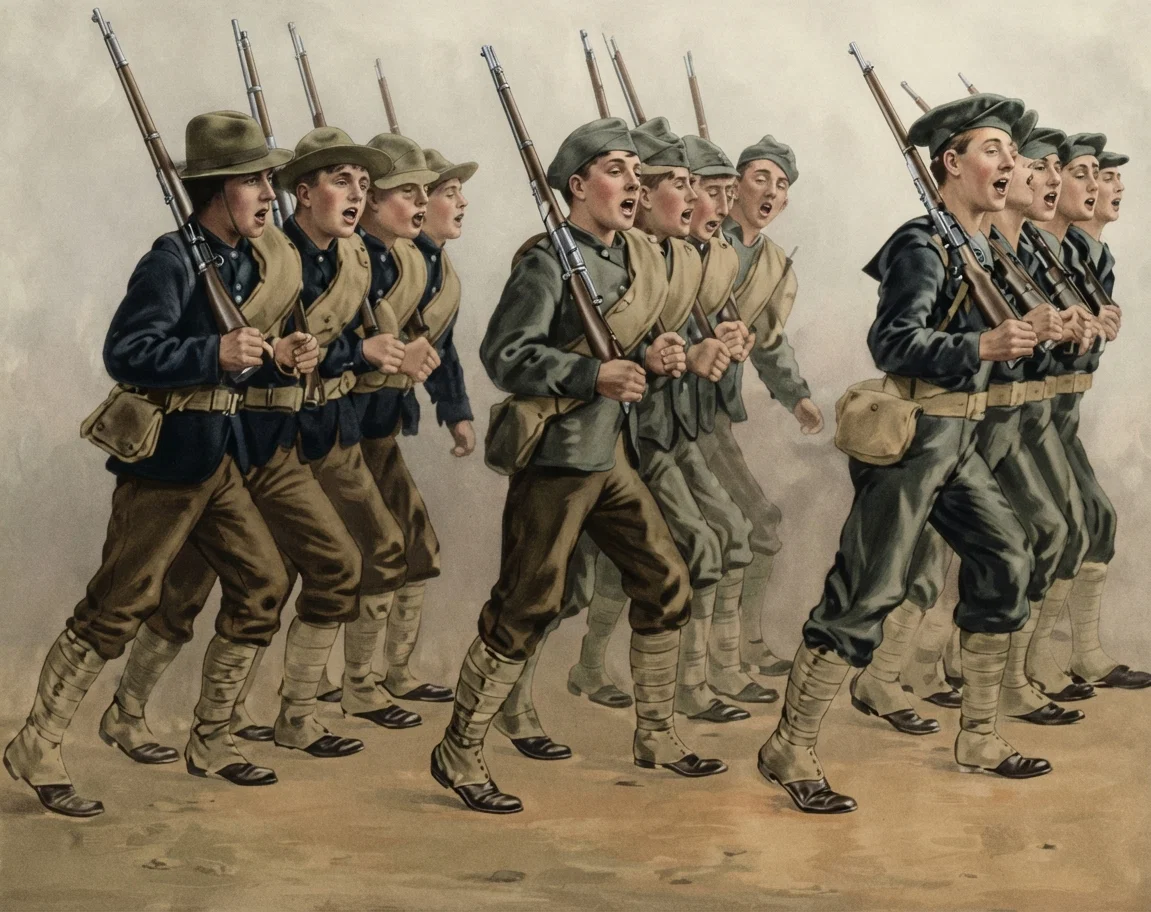
Concerning this cut see "The Anthem of the Free," on last page.
In this, apart from the how—the manner—of the coming, the author has spoken truly.
But as to the roseate future, the hopeful outcome, the regeneration by new Declarations of Independence and Constitutions, we know that this author, as well as many others, speaks not according to truth; for in this also we have the Word of God. That Word in portraying the conditions of these times declares that "the songs of the palace shall be howlings in that day, saith the Lord God; the dead bodies shall be many; in every place shall they cast them forth with silence. Hear this, O ye that would swallow up the needy, and cause the poor of the land to fail."
Another prophet of God refers to the last-day oppression of the poor as making "men as the fishes of the sea, as the creeping things, that have no ruler over them," as taking them "with the angle," and catching "them in his net," and that by this treatment of the people "his portion is fat, and his meat plenteous." He "gathereth unto him all nations, and heapeth unto him all peoples." But there comes a reaction. The oppressed rise; the crushed worm turns. The muttering, "Wo to him that increaseth that which is not his!" is heard. And this is the result, as stated by the prophet: "Shall they not rise up suddenly that shall bite thee, and awake that shall vex thee, and thou shalt be for booties unto them? Because thou hast spoiled many nations, all the remnant of the peoples shall spoil thee; because of men's blood, and for the violence done to the land, to the city and to all that dwell therein. Wo to him that getteth an evil gain for his house, that he may set his nest on high, that he may be delivered from the hand of evil!"
The New Testament prophet voices the same solemn warning: "Go to now, ye rich, weep and howl for your miseries that are coming upon you. Your riches are corrupted, and your garments are moth-eaten. Your gold and your silver are rusted; and their rust shall be for a testimony against you, and shall eat your flesh as fire. Ye have laid up your treasure in the last days. Behold, the hire of the laborers who mowed your fields, which is of you kept back by fraud, crieth out; and the cries of them that reaped have entered into the ears of the Lord of Sabaoth. Ye have lived delicately on the earth, and taken your pleasure; ye have nourished your hearts in a day of slaughter. Ye have condemned, ye have killed the righteous one; he doth not resist you. Be patient therefore, brethren, until the coming of the Lord. Behold, the husbandman waiteth for the precious fruit of the earth, being patient over it, until it receive the early and latter rain." And what beyond this? Is it a new political régime, made up of men equally selfish and erring because equally unregenerated? May we hope for peace and love to prevail? May we look for justice to be done? To all these we reply, No. God's Word holds no such future before us. "Evil men and seducers shall wax worse and worse, deceiving, and being deceived." There is but one adequate remedy for the ills of men, and that is the Gospel of Jesus Christ. There is but one way in which the overwhelming evils of earth shall be put down, and that is by the coming and presence of Jesus Christ, before whose glory sin will forever be destroyed.
The Lord would be glad to do it by the conversion of mankind, each individual by himself regenerated by the creative power of God's Word received by faith in Jesus Christ. That would bring Christ's presence, Christ's Spirit, into the heart of every one. It would unite mankind in one, in which the one would not be some selfish scheme or cabal controlled by one mind; but it would unite men by uniting each man with Christ; "for the head of every man is Christ." The bond of the true human brotherhood is Christ Jesus; but He must be received by faith if we enter it. Each one and all thus receiving Him would regenerate the world in the only way it can be regenerated.
But will not this come about?—No; for (1) God declares that it will not be; and (2) the professed church of Christ, which controls and moulds the minds of the multitudes, holds principles which makes it impossible that she should be used to bring it about. These principles are those of evolution, a practical denial of the direct creative power of God manifest in all miracles, in all true conversion.
The hope of the oppressed lies not in revolution, which may promise everything, but has not the power to fulfil. Men are selfish. The best laws will be perverted by selfish men; and there is in human law no power to make men better. It may prevent and restrain, but it can not re-create. Jesus Christ alone can do this; and He will do it only in the lives of those who by faith yield to His law of love.
The hope of the oppressed lies in His coming. "Be patient therefore, brethren, unto the coming of the Lord. . . . Stablish your hearts; for the coming of the Lord draweth nigh." His glorious presence will sweep away sin forever and establish the rule of universal righteousness. Men will not die hopeless for themselves, yet hopeful for coming generations; the citizens of that kingdom will reap not only the fruit of their own labors which have been wrought in Christ, but also the glorious, infinite fruition of Christ's everlasting sacrifice.
"Waiting for the signal," but whose?—Shall it be hosts led of Satan and selfishness? or shall it be the sign of the coming of our King? And shall we not prepare for that event in God's acceptable time—now?