A JAPANESE funeral procession is a very attractive spectacle, and it is especially so when the deceased has been a person of distinction. Floral offerings are sent in by friends of the family, oftentimes in great numbers and most beautiful designs. Huge spikes formed by fastening flowers of various colors to bamboo poles are carried at the head of the procession by coolies hired for the occasion.
In winter, when flowers are scarce, young evergreen trees are often used instead. Sometimes as many as thirty or forty of these floral pieces are carried in one procession, indicating that the deceased had many friends. In some cases the procession is headed by a number of coolies carrying long poles with streamers covered with Chinese characters, and these are followed by the floral display.
Priests, dressed in white or cream-colored robes, curious-looking caps, and other insignia of their office, and riding in jinrikishas, follow next in order. In some processions one or more cages of birds are carried by young men, who also ride in jinrikishas. Following next to these is the bier, which is often a miniature Japanese house very beautifully carved and decorated. The coffin rests upon two beams of timber, and by these, which project in front and rear, it is borne by coolies, dressed in blue in case the procession is Buddhist, or white if the procession is Shinto.
The Shinto coffin resembles that used by Europeans, and the body is placed in a horizontal position; but the Buddhist coffin is a square box, in which the body is placed in a squatting position, with the head bent forward, and the palms of the hands placed together before the face, as in an attitude of prayer. Immediately after the bier follow the female relatives and near friends, dressed in white and riding in jinrikishas; these are succeeded by the male relatives and friends without any badge of mourning as far as the writer's observations have extended.
Some of the Buddhist sects cremate their dead, but the Shintos always bury theirs.
The writer saw one of the funeral processions of the empress dowager, who died in January of last year, at the royal palace in Tokyo. Her interment was at Kyoto, the former capital of the country, where the funeral ceremonies were most elaborate. The expense, which was no less than $700,000, was paid out of the national treasury. The following description of the concluding ceremonies is taken from a published account of it:—
Never perhaps was funeral pomp more elaborate than on this occasion, which from first to last occupied several weeks; for the actual interment was only the last scene in an extraordinarily complicated set of observances.
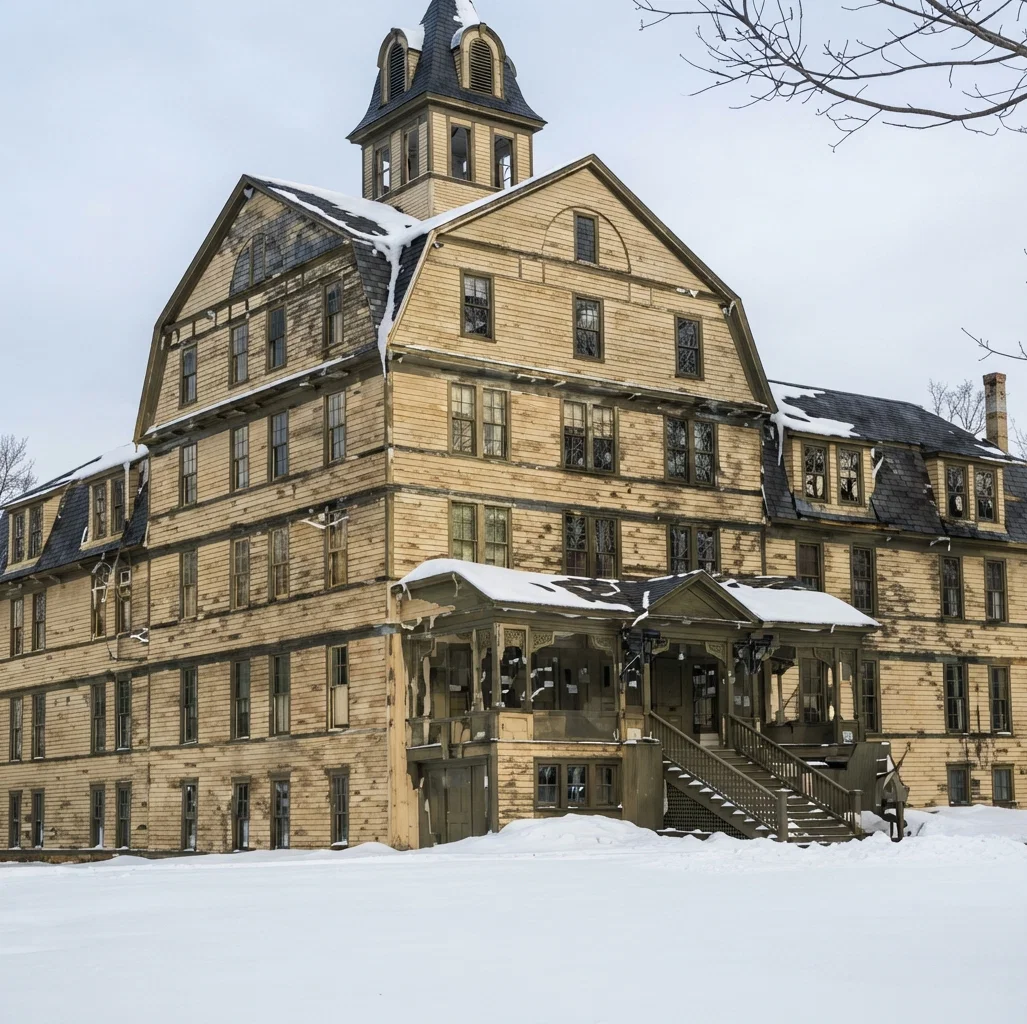
The above is the cut of a new Sanitarium building to be opened in Massachusetts, to be known as the South Lancaster Sanitarium, managed by the South Lancaster Sanitarium and Medical Missionary and Benevolent Association. It is beautifully situated in a country town, surrounded with shade trees. The water and climate are excellent. Mr. and Mrs. Doctors Nicola will be in charge, we believe. The electors have been chosen, but the board of directors and physicians are not yet fully made up. We wish it prosperity.
The procession was two miles in length, and the final ceremony lasted over twenty-two hours, during all of which time imperial princes stood or walked almost barefoot in the snow without eating a morsel of food. An ox-wagon, with wheels purposely built so as to creak mournfully, bore the elaborate coffin in which the body lay, preserved in vermilion. Three oxen drew it, harnessed in single file; the leader was jet black, the next dun-colored with black flecks, the third spotted black and white with a white star in his forehead, and four white stockings; all this was in accordance with ancient usage.
The actual grave-diggers were habited as birds with black wings, because for these, beings devoid of reason, there could be no sacrilege in perching upon an empress' tomb.
The proclamation announcing her death commanded that all schools be closed for one week, and that no sound of music should be heard in the land for one month. This did not lead us to change our practise in the least. All court festivities were suspended for one year.
This was the emperor's mother. What will take place when the emperor dies it is difficult to imagine.
Great sums of money are expended on funerals by those who have the means to gratify their pride in this direction. The mania for public display on such occasions seems to be as great here as it is in our own country.
The exercises at the grave ordinarily consist of a weird squeaking called music, accompanied by the beating of drums; a prayer by the priest, who, rubbing his hands together, mumbles over a few words which no one understands; and the leave-taking of the friends. As these march by the grave in single file, each in turn faces the grave, places the palms of his hands together before his face, mutters a few words, and passes on. The bird-cages are opened, and the frightened little inmates are allowed to go free. Inquiry among the natives has failed to reveal a satisfactory explanation of the bird ceremony. The best received is that it represents the benevolent character of the departed, and indicates that his spirit will ever be on hand to assist his friends in time of need. On the occasion of the empress dowager's funeral, more than a thousand criminals were liberated, as evidence of her benevolent character.
In case the family of the deceased are well to do, they are expected, a few days after the funeral, to send a present, usually a box of fancy cake and other confections, to all friends. The expense for such things often amounts to hundreds of dollars.
Periodical visits to the grave of the deceased are a very important part of Japanese mourning. Custom has established certain days as the proper time to make these pilgrimages, the most important of which are the seventh and thirty-fifth days after death, and the first and third anniversaries. Food is usually left on the grave for the health of the departed one, the black crow usually acting as his proxy.
The deceased immediately becomes an object of worship. A shrine is erected in a convenient corner of the house, and daily prayers are offered before it. Food is also placed before it whenever the family meals are served.
Mourning, in its outward manifestation, consists of two things,—wearing mourning dress, which is always white, and abstaining from flesh foods. The length of the mourning period depends upon the relation of the mourners to the departed. For a husband or parents (real or adopted) one is required to wear mourning thirteen months and abstain from flesh meats fifty days; for a wife, brother, sister, or eldest son, ninety and twenty days respectively. Infants under three months of age are never mourned for. Other children are honored with thirty days' mourning, and ten days' abstinence from flesh-eating.
Sometimes when a man who has rendered valuable service to his country, dies, his death is not made public until the emperor has been notified, who in such cases frequently promotes the deceased to a more honorable distinction, after which his death is made known. But his death is always given a date subsequent to his promotion; that is, if he died on the first, he was promoted on the second, and his death was announced as having taken place on the third day of the month. In many things the Japanese are a peculiar people.