The Long Record Broken

2%

Pacific Press Publishing Association · Mountain View, California · Sep 24, 1912

FromSigns of the Times, Vol. 39, No. 37.

Read the full edition

The Long Record Broken

Congress Enacts a Law Closing Post-Offices on Sunday

From Our Washington Correspondent
SATURDAY, August 24, 1912, near the close of its recent session, Congress reversed its long record of over one hundred years, and enacted a law prohibiting the opening of first- and second-class post-offices on Sunday. The law, which was agreed to by the conference report and approved by the President on this day, reads:
"That hereafter post-offices of the first and second classes shall not be open on Sundays for the purpose of delivering mail to the general public, but this provision shall not prevent the prompt delivery of special delivery mail."

Movement Began in 1811

The agitation for the closing of the mails in the United States on Sunday began in 1811, and, as the records show, was of distinctly religious origin and character. The earliest mention of this agitation in Congress appears to be the following from the record of the proceedings of Friday, January 4, 1811:
"Mr. Findley presented a petition from the Synod of Pittsburg, in the State of Pennsylvania, praying that the laws and regulations for the government of the Post-office Establishment may be so altered or amended as to prohibit mail-stages and post-riders from traveling, and post-offices being kept open, on Sunday."—"Annals of Congress," page 487.
Friday, January 25, 1811, a petition from "sundry inhabitants of Philadelphia" was likewise presented, in which Congress was asked to amend the postal laws so as to "prohibit the delivery of letters, papers, and packets on the first day of the week, commonly called the Lord's day," upon the ground that the handling of the mails on Sunday had "a tendency to justify every species of breach of the laws made for the strict observance of the first day of the week, as set apart by the command of God for His more immediate service."
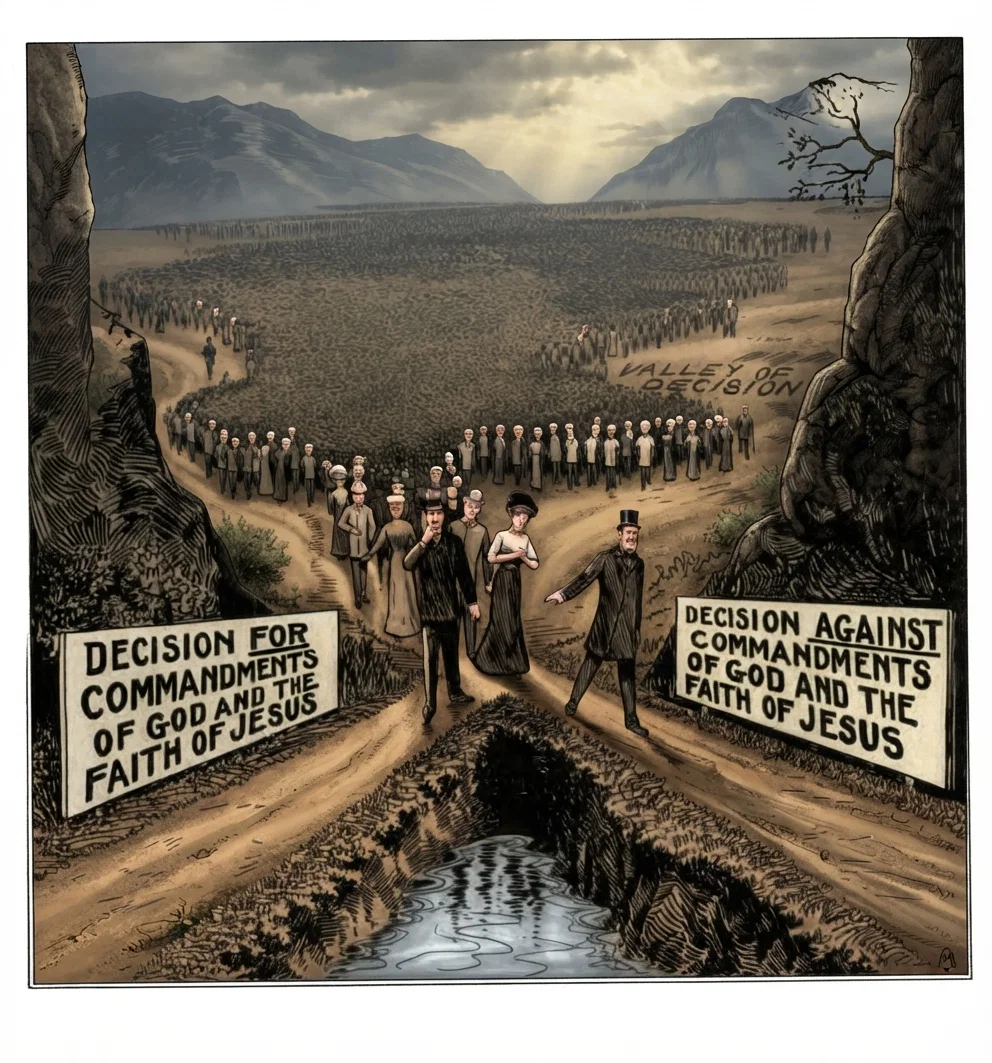
Multitudes, multitudes in the valley of decision: for the day of the Lord is near in the valley of decision.
It requires no astute mind to discover the character and object of such petitions. They were religious and for religious ends upon the face of them.

Congress Refused to Act

January 3, 1812, the committee in the House on post-offices and post-roads presented a report on these and other like petitions, refusing to recommend "any alterations in the law regulating the Post-office Establishment," and closing with the following significant suggestion:
"Resolved, That the petitioners have leave to withdraw their petitions."
And the record says, "The resolution was concurred in."
This was in 1812, and was the first of a series of adverse reports adopted by Congress upon this subject.

The Agitation Renewed in 1815

After the close of the war of 1812, the agitation for the closing of the mails by law on Sunday broke out again in 1815; but Congress once more refused to act, and through the adoption of another report upon the subject, declared it inexpedient to "pass any laws on the subject-matter of the petitions" which had been sent in.

The Great Agitation of 1828-1830

Then came the great agitation of 1828-1830, in which Congress was besieged with hundreds of petitions sent in by religious bodies from more than twenty states, and which called forth those masterly famous Sunday Mail Reports presented by Col. Richard M. Johnson, and adopted by Congress (the Senate in 1829, and the House in 1830), the sound, cogent, and convincing arguments of which not only put the matter to rest for many years, but drew forth from various state legislatures and numerous bodies of citizens throughout the country expressions of highest approval. As a sample of the latter, the following from a memorial to Congress in 1831, from citizens of Windham County, Vermont, may be cited:
"Your memorialists consider the proposed law as inconsistent with those principles, and a clear deviation from the established course of government which reason dictates, and the experience of more than fifty years has sanctioned by the happiest results. They are not, indeed, insensible of the many artful pretexts by which the petitioners have endeavored to conceal their object, for the purpose of escaping from the odium which would justly attach to any request for the legal confirmation of a religious tenet. And while your memorialists condemn the pious fraud which would deceive and mislead the public mind in order to aggrandize a sect, they do not fail to recognize in that fraud a reluctant tribute to the truth of those principles for which they are contending. But, stripped of the disguise in which it is enveloped, and reduced to a plain and intelligible proposition, the request of the petitioners amounts, in the opinion of your memorialists, to nothing less than a prayer to your honorable bodies to incorporate a sectarian dogma into the statutes of the land."—"American State Papers," pages 305, 306.
Both reports adopted by Congress as the result of this wide-spread agitation, opposed the legislation called for, upon the ground that it would be religious legislation, and therefore unconstitutional; that it would establish a dangerous precedent; and that it would constitute "a legislative decision of a religious controversy, in which even Christians themselves are at issue." The Senate report said:
"Our government is a civil, and not a religious institution. . . . Should Congress in legislative capacity adopt the sentiment, it would establish the principle that the legislature is a proper tribunal to determine what are the laws of God. It would involve a legislative decision on a religious controversy, and on a point in which good citizens may honestly differ in opinion, without disturbing the peace of society or endangering its liberties. If this principle is once introduced, it will be impossible to define its bounds."—Ibid., page 237.

The Law Unnecessary

The same report further said:
"Congress has never legislated upon the subject. It rests, as it ever has done, in the legal discretion of the postmaster-general, under the repeated refusals of Congress to discontinue the sabbath mails."—Ibid., page 240.
This, and the fact that under the supervision of the Post-office Department, Sunday work has already recently been curtailed and eliminated to a considerable extent WITHOUT LEGISLATION ON THE PART OF CONGRESS, is proof that no such legislation was needed, not even for the accomplishment of the alleged object for which it was passed, — the giving of rest to post-office employees.

For Religious Reasons

That this legislation has been called for all along for religious reasons is susceptible of the clearest proof. At the hearing on the Blair National Sunday Rest Bill before the Senate Committee on Education and Labor, December 13, 1888, the Rev. W. F. Crafts, its chief agitator and supporter, speaking against the existing postal law, said:"The law allows the post-office to be kept open through the church hours, unless the first mail of the day comes during those hours. If it comes five minutes or more before the church service begins, the post-office can run, and is run, in many cases, all through church hours, as the rival and antagonist and the competitor of the churches. . . . A law forbidding the opening the United States post-offices during the usual hours of public worship would remedy this difficulty, and would be better than nothing; but we desire more than this. The law should also take from the local postmaster the power to keep his employees at work at such hours as would prevent them from going to church."—50th Congress, 2d Session, Senate Min. Doc. No. 43, page 6.
The reasons given here why such legislation was desired are too plain to need comment. Church attendance stands out in bold relief.
The Hon. James R. Mann, minority leader of the House, and author of the measure just passed by Congress, seemed conscious of its religious character, and in his argument favoring its passage, he feebly sought for a moment to disentangle it from such connection. He said:
"For years I have declined to receive or open mail on Sunday, not from a religious standpoint, but because I thought there was one day in the week when I was entitled to be free from any requests coming through the mail."
But the fact that during the past hundred years this very legislation has persistently been urged upon Congress by the churches and by such religious organizations as the National Reform Association, the International Reform Bureau, and the Lord's Day Alliance, "from a religious standpoint," is too potent for any successful denial now of the fact that the legislation itself is religious.

Not Recommended by the Post-Office Department

Announcing the passage of this law, an article in the Washington "Post" of August 27, 1912, contained the following:
"It was said last night by post-office officials that this provision was not recommended by Mr. Hitchcock, postmaster-general, but was tacked onto the bill [the annual post-office appropriation bill] in the House and escaped notice in the Senate. It likewise seemed to escape notice in the Post-office Department until the bill had been passed. . . . Mr. Hitchcock has never supported the idea of suspending Sunday work altogether, as it has always been manifestly necessary to keep mail moving in the country, necessitating the despatching of trains, assorting, and making connections so that the flow of mail en route would not be delayed."
And, as reported in the same paper the next day, Mr. Hitchcock himself said:
"The department was not prepared to recommend the wholesale cessation of Sunday work. The truth of the matter is that I have been giving so much of my time and attention to the development of the 'parcel-post' portion of the recent post-office act that I have overlooked the other questions."

Little Opposition Before Passage

Few seemed to know of the existence of the measure while it was pending; and of those who did know, few seemed to realize what its passage would mean. There was no general stir made over it throughout the country, as in 1829 and 1830, and no one aroused in either house of Congress to make earnest protest against it as was done then. Both country and Congress were caught napping. Commenting upon this, the Philadelphia "Public Ledger" of August 28, 1912, says:
"The author of the provision is Representative James R. Mann, of Illinois, minority leader of the House, and the prohibition, which has been in the post-office appropriation act since the middle of last April, in full view of everybody who cared to read the bill, attracted no attention until yesterday, when it was announced that, beginning Sunday, the Sunday-closing provision, which is mandatory, would be put into effect."
A few resolutions from the Washington Secular League, and one or two other communications addressed to the Senate, it seems were about the only protests made against the measure. It thus appears that there was very little opposition to it prior to its passage, and that it came as a surprise even to the post-office authorities, and "like a bolt from the blue" to the country at large. Previously, when measures of this kind, involving the question of religious legislation and the union of church and state, have been before Congress, petitions have been circulated against them, mass-meetings held, articles written for the public press, and friends of religious freedom set to watch them to the very hour of adjournment; but in this case it seems that little attention was given to the measure, and as a consequence, it was slipped through, with little or no public opposition, near the very close of the session.
Emory R. Buckner, the young assistant district attorney who has been secured to assist in the prosecution of the grafting policemen in New York City. The corruption in the police force of New York seemed in a fair way to be the center of attraction, but the same thing has broken out in so many other cities that New York can only be one of a number. The league that is formed by so large a part of the police force, and in so many different cities, is a constantly growing menace. Some men will persist in telling us that things are getting better all the time. But the text of God's Word which tells us that "evil men and seducers shall wax worse and worse, deceiving, and being deceived," unquestionably has the right of it. It is well to have our theories in harmony with the good old Book if we want to be sure of their being right.

The Postmaster-General's Liberal Construction of the Law

As soon as the fact of the passage of the law became generally known, the whole country was aroused, and many protests began to be made against it. The meaning of the law seemed plain. Henceforth, it said, post-offices of the first and second classes "shall not be open on Sundays for the purpose of delivering mail to the general public." To any ordinary mind this would mean the closing of the post-offices named on Sunday; and such seemed to be the general understanding of the intent of the measure as it came from the halls of Congress. The papers announced its passage under such headings as, "Stops Sunday Mail;" "Sunday Delivery of Mail Stopped;" "New Ruling Prohibits Delivery Even from Lock Boxes;" "Mail on Order Only."
But so general, so immediate, and so loud began to be the protest against the measure, that the kind-hearted postmaster-general at once began to put a very liberal construction upon it. Under the caption, "Just a Little Mail—Hitchcock Decides to Permit Partial Delivery on Sunday Through Lock Boxes," the Washington "Post" of August 28 reported this official as saying:
"This provision does not require the closing of post-offices on Sundays, which would be quite impossible, owing to the fact that the transit mail has to be sorted and also the mail collected in cities for despatch to other destinations. To stop the movement of this mail would mean a serious clogging of the whole system of mail transportation, and consequent inconvenience to the public. . . . In short, the only mail that will be affected under a reasonable construction of the new law is that received at the post-offices on Sunday and hitherto sorted on that day for distribution to lock boxes. . . . The work of distributing Sunday mail to lock boxes will be limited to certain classes of mail that can not be held until Monday morning without serious inconvenience to the addressees. This mail will include that for newspapers and hotel guests."
Mr. Mann, the author of the measure, after conference with the postal authorities, came to the rescue, and said:
"There was no intent upon the part of Congress so to restrict the activities of the Post-office Department as to inconvenience seriously the business public. It is absurd for anybody to assume that Congress meant to close post-offices as tight as a wedge on Sunday."—Washington "Post," August 28, 1912.

What Then Has Been Accomplished?

The public, under this "liberal construction" of the law, having been assured that matters in the Post-office Department were to go on very much the same as usual, the agitation over the question has very naturally quite materially subsided from its first violent outburst. What, therefore, has been accomplished by the passage of this Sunday-mail closing law?—This, and chiefly this: Congress has now, and in a new way, been committed to Sunday legislation. Its long record in refusing to enact such a law has been broken. Altho the law is only a small item tacked onto a piece of annual legislation, it establishes a precedent for all time to come. "Nothing that the Congress just ended has done or left undone," says the Washington "Herald," "has turned back the dial of progress more" than this. The act is "class legislation in more than one respect," it adds, and "oppression of the people by paid servants of the people." And what is still worse, it is not at all likely that the misstep will be retraced.
This law was not a mere proviso attached to the post-office appropriation bill, making the appropriation conditional upon the closing of post-offices on Sunday, as in the case of appropriations made by Congress in the past to certain expositions. The government would not strike a bargain thus in dealing with its own institutions. The legislation is mandatory. It says that the post-offices named "shall not be open on Sundays" for the delivery of mail to the general public. It is the very legislation so strongly inveighed against in the Sunday Mail Reports adopted by Congress eighty years ago, and in which those who framed these reports saw all the evils of the union of church and state and the pernicious principles which had wrought "the catastrophe of other nations." In this, not an individual, but a government institution employing individuals, is compelled by law to respect and observe Sunday.
W. A. COLCORD. Washington, D. C.