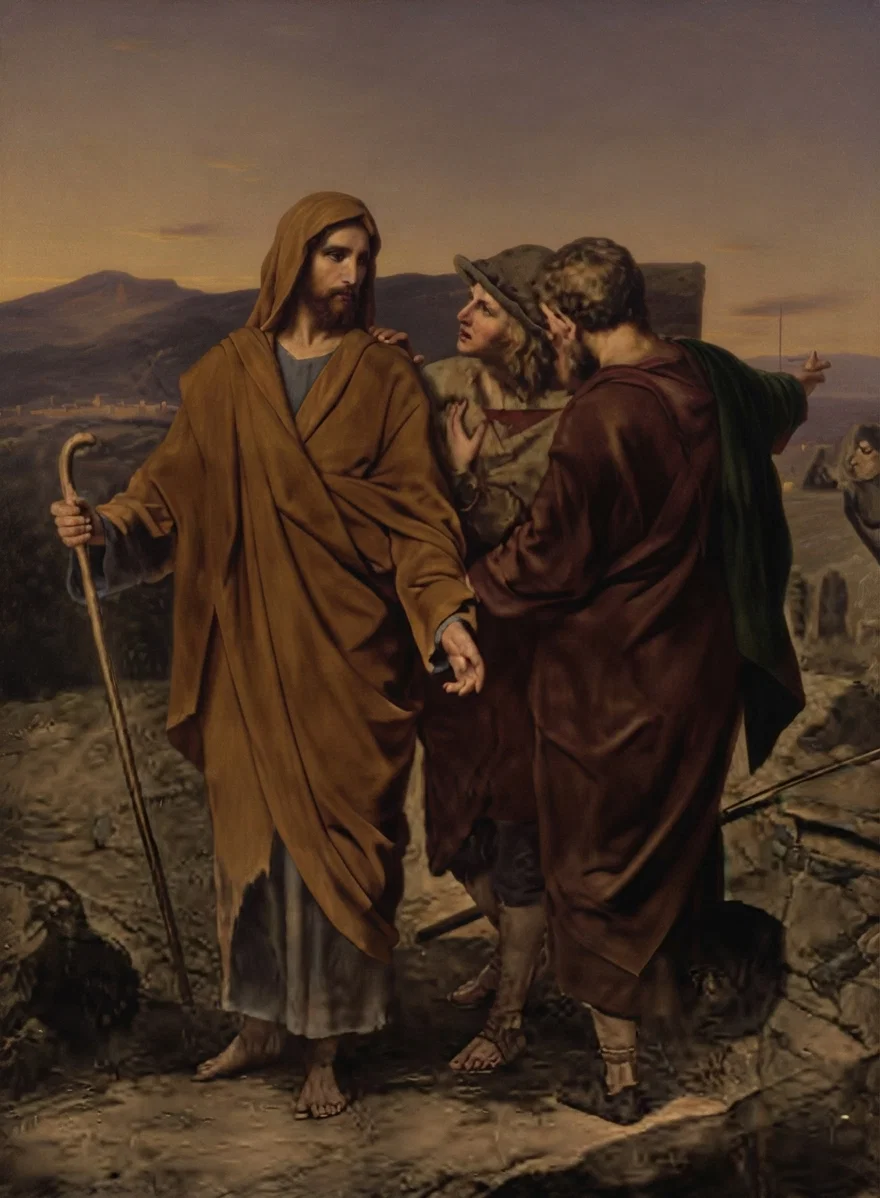
THE WALK TO EMMAUS

4%

Pacific Press Publishing Company · OAKLAND, CALIFORNIA · Feb 22, 1899

FromSigns of the Times, Vol. 25, No. 8.

Read the full edition

THE WALK TO EMMAUS.

In a little village about eight miles northwest of Jerusalem, there lived two disciples of Jesus. They had become His followers because they had seen some of the mighty acts that He did, and had heard of His renown. His fame had extended far and wide. More than once His disciples had publicly expressed a desire that He take His rightful place on David's throne. They entertained the hope that this was the promised Deliverer who was to break off the Roman yoke, and restore their nation to the position it once occupied.
They did not recognize in Jesus the Immanuel (i.e., God with us), the Saviour from their sins, but rather a man by the name of Jesus, like Joshua of old, who was the captain of the hosts of Israel. In this they felt they could not be mistaken. Could a more capable person arise? Besides, does Jesus not meet every particular of Holy Writ? Every specification of every line of prophecy meets its fulfilment in Him. His appearance upon the scene of action at the right time, His humble birth, His noble and dignified mien, His magic words and mighty deeds, all go to prove that the Deliverer of Israel had come. Had any man opened the eyes of a man who was born blind? Had any one ever spoken the word and the palsied limb received strength, or the dumb tongue been loosed, or the deaf ears unstopped, or the putrefying flesh of the leper made like the tender flesh of a child? Had any ever witnessed the devils cast out, and held in abeyance at a word? Who had ever before heard of the proud and tempestuous waves of the sea settling down to a calm at the command, "Peace, be still"? Time and space are eliminated by His all-powerful word. The command is given and the thing is done. Even the dead are made alive at His word. No tomb is strong enough to hold its prisoner. Lazarus had been dead until decomposition had set in, yet he arises at the command, "Lazarus, come forth."
The ears of the disciples had listened to the words of One "who spake as never man spake." Their own hearts had been thrilled by an inspiration that they had not experienced from any other being. Their own eyes had often witnessed the healing balm that He had poured into many weary, sin-sick, and burdened hearts. Surely the Redeemer of Israel had come.
THE WALK TO EMMAUS.
THE WALK TO EMMAUS.
Notwithstanding all this, it was difficult for the two from Emmaus to see in Jesus a personal Saviour. They did not see in Him the culmination of every rite and ceremony of the Levitical priesthood. To them, the annual convocations were celebrations of past experiences of the children of Israel, rather than of something in the future.
The temple service had degenerated so that there was nothing in it to indicate that the priesthood was soon to close and another and different order of things to be established.
All this is hid from their eyes. They are walking in the shadow of the cross, and perceive it not.
But let us not be too harsh. They were on the shadow side of the cross, and the nearer they came to it, the denser the shade. They only knew Jesus as a very good man, not as a Saviour. They did not recognize in Him the true Passover Lamb that was slain from the foundation of the world. Yet even in this deepest shadow they might have known the truth had they given diligent heed to the words of the Messiah.
Vainly had they hoped that possibly at some Passover Jesus would assert His rightful place as Israel's king; for like a death-knell the news of the cruel crucifixion of Jesus has come to their ears. It strikes bewilderment to their hearts. Amid their confusion they repair to Jerusalem to attend the Passover. It is that memorable "third day" when all Jerusalem is astir. Conflicting stories concerning Jesus come from every quarter. The name of Jesus is on every tongue. From the priests that ministered at the altar, to the most humble worshiper, were heard words of condemnation or of praise. Even the scoffing soldiers acted their part in the scenes of that day.
The priests and Pharisees were saying, "We remember that that Deceiver said, while He was yet alive, after three days I will rise again," and the soldiers were peddling the lie which the chief priests and elders had framed, viz., "His disciples came by night, and stole Him away while we slept."
There was yet another company of poor, blind, and sick, who had come from a distance to see Jesus. They had heard of what He had done only a few days prior, when He had cleansed the temple. Blessing and healing had come to this class in the sacred precincts of the temple. But now the way is barred. No sympathizing Jesus is there to receive them. The news of His death fills their hearts with sadness.
To them, Ichabod is written on every beam and every pillar; for truly the glory is departed, and the place is enshrouded in gloom. Many of them do not know that the vail separating the holy from the most holy has been rent in twain from top to bottom since the hour of the death of Jesus, thereby indicating that the services therein no longer have any significance in God's plan of redemption.But what are these reports which certain women bear? They had been to the sepulcher to embalm their Lord, but two men in shining garments met them and asked them: "Why seek ye the living among the dead? He is not here, but is risen; remember how He spake unto you when He was yet in Galilee, saying, The Son of man must be delivered into the hands of sinful men, and be crucified, and the third day rise again. And they remembered His words, and returned from the sepulcher, and told all these things unto the eleven, and to all the rest. It was Mary Magdalene, and Joanna, and Mary the mother of James, and other women that were with them, which told these things unto the apostles."
Mary declared that she had seen and conversed with her risen Saviour. Peter and John rush to the tomb to see if these tidings can be confirmed, and add their testimony by saying that He is not in the tomb. All these reports only add confusion to their troubled hearts. Everything seems to be enshrouded in mystery. The disciples know that Jesus was crucified and buried, and now they are just as confident that He is not in Joseph's new tomb. But how did He get out? Which story will they believe, the one told by the priests, that "His disciples came by night, and stole Him away," or the testimony of Mary that "He is risen"?
Saddened by the events of the past few days, two of the disciples, discouraged and almost heart-broken, started for their mountain home. It did not seem to them that they had celebrated a deliverance from Egyptian bondage, but rather the smoking furnace of Abraham's dream seemed about to be realized.
Their hearts were in strong sympathy with Jesus, and the news of His crucifixion crushes them and blasts all their hopes. As these two strong men wend their way over the rough and dangerous road, they talk of the recent events, and begin to weep. "We had hoped that it was He who would redeem Israel," was their cry. They could not unravel the mystery which enshrouded them.
The pitying eye of Jesus saw it all. His ear heard their cries. His great heart of love yearned for them. He notes every indication of every child of His who is searching for light and truth. The two from Emmaus are no exception. The promise to Jacob, "I will never leave thee, nor forsake thee," is about to be demonstrated to these two disciples. Jesus joins their company in the appearance of a wayfarer. He does not at first reveal to them who He is. However, He does reveal how humanity can come in close touch with humanity and be a powerful exponent of the truth.
Christ joined their company to unfold to them the dark mystery that enshrouded them. The Scriptures, which are able to make them wise unto salvation, must be placed in a different setting from what the priests and Jewish teachers had taught. He would have them understand that the Word of God was sufficient to explain all the dark deeds which had so recently occurred. The followers of Christ must know that that Word is to be depended upon more than any earthly thing. They must come to the point where they can say with Peter, "We have also a more sure word of prophecy; whereunto ye do well that ye take heed, as unto a light that shineth in a dark place, until the day dawn, and the day star arise in your hearts." Peter had been in the holy mount, and with his own eyes beheld the transfigured condition of Jesus, together with Moses and Elijah, and heard with his own ears the words from the most excellent glory, "This is my beloved Son;" yet he says we have a more sure word of prophecy.
Jesus began with the prophecies concerning Himself, and clearly outlined how all that was written of Him must surely come to pass. They must know that "whatsoever was written aforetime was written for our learning, that we through patience and comfort of the Scriptures might have hope."
The simplicity with which the Master unfolded the hidden mysteries is a grand object lesson for every one who would be a witness for Him. Christ was there as an exponent of the power of an endless life enthroned in humanity. The disciples could only see a wayfarer; but there was divinity clothed with humanity. In just such a manner He would have every son and daughter of His be exponents of what God can do with a soul. We are the human, He the divine. He enthroned in us, the hope of glory, is to be the incomprehensible mystery, yet the simple Gospel, the power of God unto salvation that we are to preach wherever we go. Let that be a fact in us, and then the heart of every earnest seeker after light with whom we come in contact, will burn within them as did the hearts of the disciples of Emmaus.
The scene at the humble home is so full of meaning! Every item of faith, of godly courtesy, that is in the disciples, is fully tested. They could have let their Stranger Companion pass on, and they never have known that it was Jesus, and they would have lost the blessing too. But they bade Him come in, and He responded to their invitation.
The evening meal is ready, and Jesus takes His place at the head of the table. That is His place in every home. How many homes there are that do not recognize that that is the place of Jesus!
It was not until Jesus raised His hands to bless the bread that the disciples recognized who had been their companion along the rough road. They look in amazement and see the hands that were pierced. With mingled fear and joy and astonishment, they exclaim, "It is the Lord," and start to worship Him. At this, humanity vanishes out of their sight, and nothing but the divine impressions are left on their minds.
It is now dark; the moon has not yet risen; but these two disciples have something that they will lose if they try to keep it to themselves. Besides, the disciples at Jerusalem must be comforted with the glad tidings. Not waiting to finish their meal, they hasten to the city. Altho it is dark, they do not think the road long, neither do they mind the many falls they take over the rough places. They have good news to tell, and nothing seems to impede them in their desire to get where they can tell it. They have the light that will dispel the gloom that has so recently come upon the disciples. Their testimony henceforth is that "He is risen," for they are witnesses to this fact. Just so must be the testimony of every Christian.
L. A. HOOPES.