Your ShelfYour Projects

Signs of the Times, Vol. 25, No. 8.

THE WALK TO EMMAUS

Signs of the Times

Feb 22, 1899

Pacific Press Publishing Company · OAKLAND, CALIFORNIA · Feb 22, 1899

THE WALK TO EMMAUS.
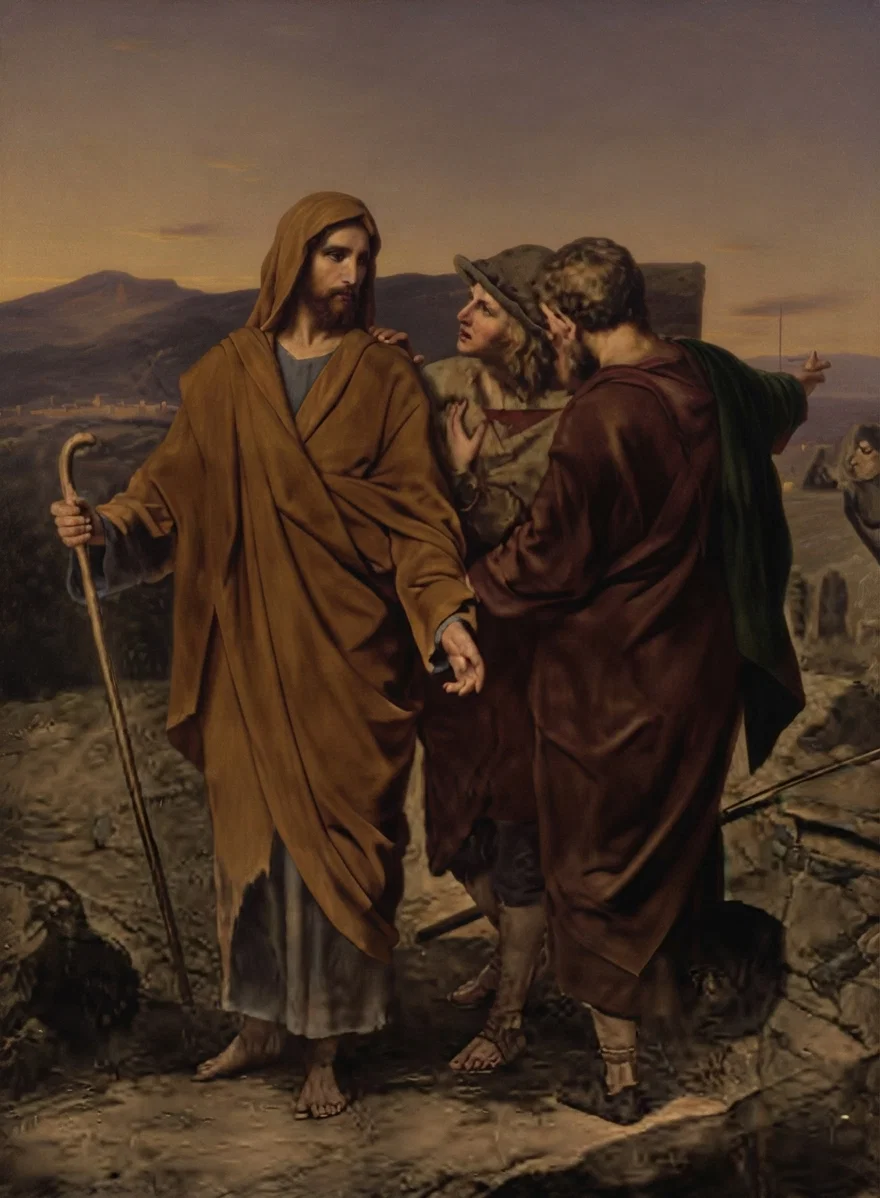
In a little village about eight miles northwest of Jerusalem, there lived two disciples of Jesus. They had become His followers because they had seen some of the mighty acts that He did, and had heard of His renown. His fame had extended far and wide. More than once His disciples had publicly expressed a desire that He take His rightful place on David's throne. They entertained the hope that this was the promised Deliverer who was to break off the Roman yoke, and restore their nation to the position it once occupied.
They did not recognize in Jesus the Immanuel (i.e., God with us), the Saviour from their sins, but rather a man by the name of Jesus, like Joshua of old, who was the captain of the hosts of Israel. In this they felt they could not be mistaken. Could a more capable person arise? Besides, does Jesus not meet every particular of Holy Writ? Every specification of every line of prophecy meets its fulfilment in Him. His appearance upon the scene of action at the right time, His humble birth, His noble and dignified mien, His magic words and mighty deeds, all go to prove that the Deliverer of Israel had come. Had any man opened the eyes of a man who was born blind? Had any one ever spoken the word and the palsied limb received strength, or the dumb tongue been loosed, or the deaf ears unstopped, or the putrefying flesh of the leper made like the tender flesh of a child? Had any ever witnessed the devils cast out, and held in abeyance at a word? Who had ever before heard of the proud and tempestuous waves of the sea settling down to a calm at the command, "Peace, be still"? Time and space are eliminated by His all-powerful word. The command is given and the thing is done. Even the dead are made alive at His word. No tomb is strong enough to hold its prisoner. Lazarus had been dead until decomposition had set in, yet he arises at the command, "Lazarus, come forth."
The ears of the disciples had listened to the words of One "who spake as never man spake." Their own hearts had been thrilled by an inspiration that they had not experienced from any other being. Their own eyes had often witnessed the healing balm that He had poured into many weary, sin-sick, and burdened hearts. Surely the Redeemer of Israel had come.
THE WALK TO EMMAUS.
THE WALK TO EMMAUS.
Notwithstanding all this, it was difficult for the two from Emmaus to see in Jesus a personal Saviour. They did not see in Him the culmination of every rite and ceremony of the Levitical priesthood. To them, the annual convocations were celebrations of past experiences of the children of Israel, rather than of something in the future.
The temple service had degenerated so that there was nothing in it to indicate that the priesthood was soon to close and another and different order of things to be established.
All this is hid from their eyes. They are walking in the shadow of the cross, and perceive it not.
But let us not be too harsh. They were on the shadow side of the cross, and the nearer they came to it, the denser the shade. They only knew Jesus as a very good man, not as a Saviour. They did not recognize in Him the true Passover Lamb that was slain from the foundation of the world. Yet even in this deepest shadow they might have known the truth had they given diligent heed to the words of the Messiah.
Vainly had they hoped that possibly at some Passover Jesus would assert His rightful place as Israel's king; for like a death-knell the news of the cruel crucifixion of Jesus has come to their ears. It strikes bewilderment to their hearts. Amid their confusion they repair to Jerusalem to attend the Passover. It is that memorable "third day" when all Jerusalem is astir. Conflicting stories concerning Jesus come from every quarter. The name of Jesus is on every tongue. From the priests that ministered at the altar, to the most humble worshiper, were heard words of condemnation or of praise. Even the scoffing soldiers acted their part in the scenes of that day.
The priests and Pharisees were saying, "We remember that that Deceiver said, while He was yet alive, after three days I will rise again," and the soldiers were peddling the lie which the chief priests and elders had framed, viz., "His disciples came by night, and stole Him away while we slept."
There was yet another company of poor, blind, and sick, who had come from a distance to see Jesus. They had heard of what He had done only a few days prior, when He had cleansed the temple. Blessing and healing had come to this class in the sacred precincts of the temple. But now the way is barred. No sympathizing Jesus is there to receive them. The news of His death fills their hearts with sadness.
To them, Ichabod is written on every beam and every pillar; for truly the glory is departed, and the place is enshrouded in gloom. Many of them do not know that the vail separating the holy from the most holy has been rent in twain from top to bottom since the hour of the death of Jesus, thereby indicating that the services therein no longer have any significance in God's plan of redemption.But what are these reports which certain women bear? They had been to the sepulcher to embalm their Lord, but two men in shining garments met them and asked them: "Why seek ye the living among the dead? He is not here, but is risen; remember how He spake unto you when He was yet in Galilee, saying, The Son of man must be delivered into the hands of sinful men, and be crucified, and the third day rise again. And they remembered His words, and returned from the sepulcher, and told all these things unto the eleven, and to all the rest. It was Mary Magdalene, and Joanna, and Mary the mother of James, and other women that were with them, which told these things unto the apostles."
Mary declared that she had seen and conversed with her risen Saviour. Peter and John rush to the tomb to see if these tidings can be confirmed, and add their testimony by saying that He is not in the tomb. All these reports only add confusion to their troubled hearts. Everything seems to be enshrouded in mystery. The disciples know that Jesus was crucified and buried, and now they are just as confident that He is not in Joseph's new tomb. But how did He get out? Which story will they believe, the one told by the priests, that "His disciples came by night, and stole Him away," or the testimony of Mary that "He is risen"?
Saddened by the events of the past few days, two of the disciples, discouraged and almost heart-broken, started for their mountain home. It did not seem to them that they had celebrated a deliverance from Egyptian bondage, but rather the smoking furnace of Abraham's dream seemed about to be realized.
Their hearts were in strong sympathy with Jesus, and the news of His crucifixion crushes them and blasts all their hopes. As these two strong men wend their way over the rough and dangerous road, they talk of the recent events, and begin to weep. "We had hoped that it was He who would redeem Israel," was their cry. They could not unravel the mystery which enshrouded them.
The pitying eye of Jesus saw it all. His ear heard their cries. His great heart of love yearned for them. He notes every indication of every child of His who is searching for light and truth. The two from Emmaus are no exception. The promise to Jacob, "I will never leave thee, nor forsake thee," is about to be demonstrated to these two disciples. Jesus joins their company in the appearance of a wayfarer. He does not at first reveal to them who He is. However, He does reveal how humanity can come in close touch with humanity and be a powerful exponent of the truth.
Christ joined their company to unfold to them the dark mystery that enshrouded them. The Scriptures, which are able to make them wise unto salvation, must be placed in a different setting from what the priests and Jewish teachers had taught. He would have them understand that the Word of God was sufficient to explain all the dark deeds which had so recently occurred. The followers of Christ must know that that Word is to be depended upon more than any earthly thing. They must come to the point where they can say with Peter, "We have also a more sure word of prophecy; whereunto ye do well that ye take heed, as unto a light that shineth in a dark place, until the day dawn, and the day star arise in your hearts." Peter had been in the holy mount, and with his own eyes beheld the transfigured condition of Jesus, together with Moses and Elijah, and heard with his own ears the words from the most excellent glory, "This is my beloved Son;" yet he says we have a more sure word of prophecy.
Jesus began with the prophecies concerning Himself, and clearly outlined how all that was written of Him must surely come to pass. They must know that "whatsoever was written aforetime was written for our learning, that we through patience and comfort of the Scriptures might have hope."
The simplicity with which the Master unfolded the hidden mysteries is a grand object lesson for every one who would be a witness for Him. Christ was there as an exponent of the power of an endless life enthroned in humanity. The disciples could only see a wayfarer; but there was divinity clothed with humanity. In just such a manner He would have every son and daughter of His be exponents of what God can do with a soul. We are the human, He the divine. He enthroned in us, the hope of glory, is to be the incomprehensible mystery, yet the simple Gospel, the power of God unto salvation that we are to preach wherever we go. Let that be a fact in us, and then the heart of every earnest seeker after light with whom we come in contact, will burn within them as did the hearts of the disciples of Emmaus.
The scene at the humble home is so full of meaning! Every item of faith, of godly courtesy, that is in the disciples, is fully tested. They could have let their Stranger Companion pass on, and they never have known that it was Jesus, and they would have lost the blessing too. But they bade Him come in, and He responded to their invitation.
The evening meal is ready, and Jesus takes His place at the head of the table. That is His place in every home. How many homes there are that do not recognize that that is the place of Jesus!
It was not until Jesus raised His hands to bless the bread that the disciples recognized who had been their companion along the rough road. They look in amazement and see the hands that were pierced. With mingled fear and joy and astonishment, they exclaim, "It is the Lord," and start to worship Him. At this, humanity vanishes out of their sight, and nothing but the divine impressions are left on their minds.
It is now dark; the moon has not yet risen; but these two disciples have something that they will lose if they try to keep it to themselves. Besides, the disciples at Jerusalem must be comforted with the glad tidings. Not waiting to finish their meal, they hasten to the city. Altho it is dark, they do not think the road long, neither do they mind the many falls they take over the rough places. They have good news to tell, and nothing seems to impede them in their desire to get where they can tell it. They have the light that will dispel the gloom that has so recently come upon the disciples. Their testimony henceforth is that "He is risen," for they are witnesses to this fact. Just so must be the testimony of every Christian.
L. A. HOOPES.

JESUS WANTS TO TRADE WITH YOU.

DEAR unconverted friends, Jesus wants to trade with you. He wants to give you a heart of love, purity, and holiness, in exchange for your heart of sin. Haven't you felt many times that you ought to do better; that you ought to give up your reckless ways and be a Christian? If so, then Jesus was asking you to trade with Him. Dear reader, don't put this trade off any longer. Jesus is waiting for you to ask Him to take away your sins, and fill your heart with His holiness and love. The prophecies of the Bible are fast fulfilling, and men are looking and watching for something to transpire, they know not what. Give your heart to Jesus before it is too late.
MRS. A. DIXON.

THE MEASURE OF GOD'S LOVE.

"YE have heard how I said unto you, I go away, and come again unto you. If ye loved Me, ye would rejoice, because I said, I go unto the Father; for My Father is greater than I." "If ye love Me, keep My commandments. . . . He that hath My commandments, and keepeth them, he it is that loveth Me; and he that loveth Me shall be loved of My Father, and I will love him, and will manifest Myself to him. . . . If a man love Me, he will keep My words; and My Father will love him, and We will come unto him, and make Our abode with him."
This is an expression of God's love for fallen man. By these words our Saviour places in our hands a line enabling us to sound something of the depths of His infinite love, and prove the sincerity of our love for Him. The finite mind can not comprehend this love in all its depth and magnitude. As we study the sufferings of Christ, the results of sin are so distressing to us that we cry out to the Lord to take away our sins. As we continue to look, we become more capable of enduring the sight of what Christ suffered, and we realize more and more clearly His love for us. The cross of Christ is invested with a wonderful attraction and unlimited power; for in the suffering connected with the crucifixion scene, God's love becomes to us more and more impressive.
Through disobedience to God's command Adam fell from his loyalty. Thus he opened the flood-gates of wo upon our world. His posterity perpetuated his sin, while they found fault with their first parents. The depth to which men fell justified the employment of great means to procure a ransom. God saw that man could never rescue and restore himself. Therefore He exercised His divine benevolence to the fullest extent to redeem those who had lost their connection with Him. He "so loved the world, that He gave His only-begotten Son, that whosoever believeth in Him should not perish, but have everlasting life." God's love exceeds the love of an earthly father. It can be measured only by the power and strength of His character. Proportionate to His power was His infinite compassion for fallen men, and His desire to restore in them His image. The high and holy One, who inhabiteth eternity, travailed in the greatness of His power and in His immeasurable love to rescue fallen man.
Only by the gift of God's Son could the ransom of the human race be obtained. Without this sacrifice, all that remained for man was death in his sins. But by giving His life for the life of the world, Christ bridged the gulf that sin had made, joining this sin-cursed earth to the universe of heaven as a province. God chose this world to be the theater of His mighty work of grace. While the sentence of condemnation was suspended over it because of the rebellion of its inhabitants, while the clouds of wrath were accumulating because of transgression of God's law, a strange and mysterious voice was heard in heaven: "Lo, I come . . . to do Thy will, O God." "Sacrifice and offering Thou wouldest not, but a body hast Thou prepared me.""The Lord possessed Me in the beginning of His way, before His works of old," Christ says. "When He gave to the sea His decree, that the waters should not pass His commandment; when He appointed the foundations of the earth; then I was by Him, as one brought up with Him; and I was daily His delight, rejoicing always before Him." But the only-begotten Son of God humbled Himself to come to this earth. He took the sinner's place; the guiltless suffered for the guilty. This was the hiding of His glory. "Forasmuch then as the children are partakers of flesh and blood, He also Himself likewise took part of the same; that through death He might destroy him that had the power of death."
God accepted the death of His Son to save a rebellious race. But in this was there no sacrifice made by the Father? The Creator Himself, the Omnipotent God, suffered with His Son. Abraham was permitted to know something of the meaning of this great sacrifice. He is called the father of the faithful, because he carried out in heart purpose the fearful test, as fully as if he had by his own hand taken the life of his son.
Our Substitute and Surety came from heaven, declaring that He had brought with Him the vast and inestimable donation of eternal life. Pardon is offered to all who will return to their allegiance to the law of God. But Satan has called this world his territory. Here his seat is, and he holds in allegiance to himself all who refuse to keep God's commandments, who reject a plain "Thus saith the Lord." There are but two parties in this world. All rank either under the banner of the obedient or the banner of the disobedient. Those who have given their allegiance to Satan make rigorous human enactments, in opposition to God's commands, and by precept and example strive to lead their fellow-beings into sin. They exalt the laws of men above the divine law. Over them the condemnation of God is suspended. The clouds of His justice are gathering. The material of destruction has been piling up for ages; and apostasy, rebellion, and disloyalty are continually increasing. The remnant people of God will understand the word spoken by Daniel, "Many shall be purified, and made white, and tried; but the wicked shall do wickedly; and none of the wicked shall understand; but the wise shall understand."
The Lord made the richest gift He could make in giving His only-begotten Son to the world. Why then are not more grace and power given to the church? Man by his own choice has severed himself from God. His mind and soul are so bound up in Satan's plans that he is palsied. He is incapable of appreciating, appropriating, or imparting the elements of divine life. A connection with the deceiver, who was so long in the heavenly courts, makes him ingenious to pervert the blessings given him, and to employ them as weapons against God. Therefore the Lord can not venture to bestow upon man the blessings that He otherwise would.
Jesus is now sending His message to a fallen world. He delights to take apparently hopeless material, those through whom Satan has worked, and make them the subjects of His grace. He rejoices to deliver them from the wrath that is to fall upon the disobedient. He has committed Himself to the work of our redemption. He resolved that He would spare nothing, however costly, withhold nothing, however dear, which would restore the moral image of God in man. And He holds in store gift upon gift, waiting for the proper channels through which He can communicate the treasures of eternal life. MRS. E. G. WHITE.

The Text for the Next Week

STUDIES IN GALATIANS

FROM PRISON TO A PALACE.

BEFORE proceeding to the close of this wonderful third chapter of Galatians, let us take a brief survey of the ground thus far covered in the chapter, that we may see just where we are.
Beginning with an expression of astonishment that the Galatians should be so foolish as to suppose that they themselves could perfect the mighty work which only the Spirit could begin, and that they could be induced to depart from the truth after they had seen Christ crucified among them, the apostle at once brings them to the case of Abraham, which at once settles the whole question of the method of salvation, and that for all people. They themselves had received the Spirit of righteousness by faith, "even as Abraham believed God, and it was accounted to him for righteousness." "And the Scripture, foreseeing that God would justify the heathen through faith, preached before the Gospel unto Abraham, saying, In thee shall all nations be blessed. So then they which be of faith are blessed with faithful Abraham."
The blessing, we have seen, is the blessing of freedom from sin; but "as many as are of the works of the law are under the curse," since the curse is upon all who do not continue in all things that are written in the book of the law, to do them, and "there is none that doeth good." So all are in sin; but "Christ hath redeemed us from the curse of the law, being made a curse for us," in hanging on the cross. He has redeemed us from the curse, that is, from the transgression of the law, in order that the blessing of Abraham might come on us, as upon all Gentiles, through faith. Faith in Christ crucified brings us into relationship with Abraham, and makes us sharers of his blessing, and no soul can ever get or hope for anything more. The blessing of Abraham is freedom from sin, through the Spirit of truth, who convinces the world of sin and of righteousness; and he who is free from sin is an heir of the sinless inheritance, even the "new earth, wherein dwelleth righteousness." This is the promise of the Spirit.
How sure is this promise?—It is as sure as God's existence, for it was confirmed by an oath of God in Christ, and even a man's covenant, when it is once confirmed, can not be changed in any particular, or added to; much less then can God's covenant, confirmed by His oath, be changed.
When was it confirmed?—It was confirmed to Abraham 430 years before the Exodus from Egypt and the giving of the law from Sinai. Moreover, it was made sure in Christ, who is the Seed of Abraham. Therefore the speaking of the law 430 years later can not in any way affect the covenant, which was that righteousness and the everlasting inheritance of righteousness should be given to Abraham and his seed. The inheritance is not at all through the law, but solely by promise, "through the righteousness of faith."
What, then, is the use of the law?—It was given because of transgression, of lack of faith, as a witness to the fact that the seed of Abraham were in danger of losing the inheritance, and to show them the measure of the righteousness which they must have by faith. But it was in no sense against the promise of God to give them righteousness, since it was "in the hand of a Mediator," even "the Man Christ Jesus," who is the "one Mediator between God and men." The promise contained the law, and does still contain it, so that the law, however loudly it thunders its infinite demands, simply shows us the greatness of the righteousness which God freely gives us in Christ. This office the law performs until the Seed comes to whom the promise was made. This last fact, however, belongs to our present study. We come now to

The Text for the Next Week.

"But the Scripture hath concluded all under sin, that the promise by faith of Jesus Christ might be given to them that believe. But before faith came, we were kept under the law, shut up unto the faith which should afterwards be revealed. Wherefore the law was our schoolmaster to bring us unto Christ, that we might be justified by faith. But after that faith is come, we are no longer under a schoolmaster. For ye are all the children of God by faith in Christ Jesus. For as many of you as have been baptized into Christ have put on Christ. There is neither Jew nor Greek, there is neither bond nor free, there is neither male nor female; for ye are all one in Christ Jesus. And if ye be Christ's, then are ye Abraham's seed, and heirs according to the promise." Gal. 3:22-29.
All Shut up in Prison.—Note the similarity between verses 8 and 22. "The Scripture hath concluded [that is, shut up] all under sin, that the promise by faith of Jesus Christ might be given to them that believe." "The Scripture, foreseeing that God would justify the heathen through faith, preached before the Gospel unto Abraham, saying, In thee shall all nations be blessed." We see that the Gospel is preached by the same thing—the Scripture—that shuts men up under sin. The word "conclude" means literally "shut up," just as is given in verse 23. Of course a person who is shut up by the law is in prison. In human governments a criminal is shut up as soon as the law can get hold of him; God's law is everywhere present, and always active, and therefore the instant a man sins he is shut up. This is the condition of all the world, "for all have sinned," and "there is none righteous, no, not one."
"Under the Law."—"Before faith came, we were kept under the law, shut up unto the faith which should afterwards be revealed." We know that "whatsoever is not of faith is sin" (Rom. 14:23); therefore to be "under the law" is identical with being "under sin." Let us get this clearly in mind. The Scripture hath shut up all under sin. What for?—"That the promise by faith of Jesus Christ might be given to them that believe." Thus we see that those who are shut up under sin are those who are not of faith. But until faith comes, we are kept shut up under the law. Now since we are under the law until faith comes, and whatsoever is not of faith is sin, it is evident that to be under the law means to be under sin. Those who are under the law, therefore, are those who are transgressing it.
The Law a Jailer.—"So that the law hath been our tutor unto Christ, that we might be justified by faith." Verse 24, R.V. The words "to bring us" are marked both in the old version and the new as having been added to the text, so that we have dropped them out. It really makes no material difference with thesense whether they are retained or omitted. It will be noticed also that the new version has "tutor" in the place of "schoolmaster." The sense is much better conveyed by the word that is used in the German and Scandinavian translations, which signifies "master of a house of correction." The single word in our language corresponding to it would be jailer. The Greek word is the word which transliterated is "pedagog." The word has come to be used as meaning "schoolmaster," altho the Greek word has not at all the idea of a schoolmaster. "Taskmaster" would be better. The idea here is rather that of a guard who accompanies a prisoner who is allowed to walk about outside the prison walls. The prisoner, altho nominally at large, is really deprived of his liberty just the same as tho he were actually in a cell. But without stopping longer over words, we have the fact stated that all who do not believe are "under sin," "shut up" "under the law," and that therefore the law acts as their jailer. It is that that shuts them in, and will not let them off; the guilty can not escape in their guilt. God is merciful and gracious, but He will not clear the guilty. Ex 34:6, 7. That is, He will not lie, by calling evil good.
Only One Door.—Christ says, "I am the door." John 10:7, 9. He is also the Sheepfold and the Shepherd. Men fancy that when they are outside the Fold they are free, and that to come into the Fold would mean a curtailing of their liberty; but it is exactly the reverse. Outside of Christ is bondage, in Him alone is there freedom. Outside of Christ the man is in prison, "holden with the cords of his sins." Prov. 5:22. "The strength of sin is the law." It is the law that declares him to be a sinner, and makes him conscious of his condition. "By the law is the knowledge of sin;" and "sin is not imputed when there is no law." Rom. 3:20; 5:13. The law really forms the sinner's prison walls. They close in on him, making him feel uncomfortable, oppressing him with a sense of sin, as tho they would press his life out. In vain he makes frantic efforts to escape. Those commandments stand as firm as the everlasting hills. Whichever way he turns he finds a commandment which says to him, "You can find no freedom by me, for you have sinned." If he seeks to make friends with the law, and promises to keep it, he is no better off, for his sin still remains. It goads him and drives him to the only way of escape,—"the promise by faith of Jesus Christ." In Christ he is made "free indeed," for in Christ he is made the righteousness of God.
(Concluded next week.)

JOSEPH AND HIS DREAMS.

At the time that the chief butler and the chief baker told Joseph their dreams he was reduced to the condition of a culprit. Long before that he had had dreams of being elevated to a superior position, exalted among his brethren. But instead of realizing the fulfilment of his dreams, the very opposite experience had been his to encounter.
Under these circumstances we might have expected him to lose all confidence in dreams. Judging by his own experience, dreaming of glory, but brought down to degradation and imprisonment, what would have been more natural than for him to have said to these men who related their dreams to him: 'There is no dependence to put in dreams; I myself have had lovely dreams, and felt very much elated over them, but instead of their being fulfilled according to my confident expectation and interpretation, the most decided reverse has happened to me. I would not pay any attention to those dreams; they are uncertain and deceptive. I dreamed of being exalted in the midst of my brethren, but, alas, I am greatly humbled, and an exile among strangers and enemies!'
Why did he not take this view of the matter, instead of still retaining his confidence in dreams?—Because his trust was in God, the interpreter of dreams. He was looking at the invisible, and he knew his dreams would some time be fulfilled, tho outward and present appearances seemed so forbidding.
F. D. STARR.

THE KING'S INSURANCE COMPANY.

Greatest, Oldest, and Only Absolutely Reliable Fire, Marine, and Life Insurance Company in the World.
Cash Capital.
"THE unsearchable riches of Christ." Eph. 3:8.
Assets.
Real Estate—"An inheritance incorruptible, and undefiled, and that fadeth not away." 1 Peter 1:4.
Cash in Bank—"Gold tried in the fire." Rev. 3:18.
Liabilities.
Whosoever will may come. Rev. 22:17.
Surplus over All Liabilities.
"Able to do exceeding abundantly above all that we ask or think." Eph. 3:20.
President.
Jesus Christ, the King of kings. Rev. 19:16.
Home Offices and Branches.
"I dwell in the high and holy place, with him also that is of a contrite and humble spirit." Isa. 57:15.
Condition of Policy.
"Repentance toward God, and faith toward our Lord Jesus Christ." Acts 20:21.
The time to insure is now. 2 Cor. 6:2.
Are you insured? 1 Sam. 20:3: "But a step between me and death."
Reasons Why You Ought to Insure at Once in This Company.
1. It is the oldest company in the world, having been in successful operation for thousands of years. Heb. 7:25.
2. Its endowments are a hundred per cent. of its face value, paid daily, then, after this, life eternal. Mark 10:29, 30.
3. It is the only company insuring against loss in the great judgment-day fire. 2 Peter 3:10; Dan. 12:1.
4. It is the only company insuring against shipwreck in the river of death and the grave. Eze. 37:12; John 5:28, 29.
5. The policies never expire, if the holder is faithful. Rev. 2:10.
6. This company has never changed its management. Heb. 13:8.
7. It insures a man for more than he is worth. Isa. 40:6.
Applicants come direct to the President, just as they are. John 6:37.
Persons claiming to have no soul, need not apply.
All companies offering to issue policies after death or give eternal life are frauds. John 10:1. For there is no other name whereby we must be saved but Jesus. Acts 4:12. "He that hath the Son hath life; and he that hath not the Son of God hath not life." 1 John 5:12.
LEWIS C. SHEAFE.
Continue reading: WHAT IS DEATH?
