Your ShelfYour Projects

Signs of the Times, Vol. 25, No. 8.

THE WALK TO EMMAUS
Earlier text: THE WALK TO EMMAUS

WHAT IS DEATH?

To this question various answers are returned by different creeds; but what the believer in the divine inspiration of the Word of God wants to know is, What does the Bible mean by death as applied to man?
The first mention of death in the Bible is in Gen. 2:17. "In the day that thou eatest thereof thou shalt surely die," said the Creator to our first parents. There is certainly no room for question as to the meaning of the word "die" in this text, for in chapter 3:19 the Lord Himself tells just what He meant by it: "In the sweat of thy face shalt thou eat bread, till thou return unto the ground; for out of it wast thou taken; for dust thou art, and unto dust shalt thou return."
To die, then, as applied to man in the Bible, means to return to the original elements from which man was created, and this process commenced with Adam the very day he sinned, and continued until death was finished in him, at the age of 930 years. The human body is constantly dying. The excretory organs are kept busy throwing off dead matter, and that this is part of the sentence of death pronounced upon man in the beginning is evident from the expression, "In the sweat of thy face shalt thou eat bread, till thou return unto the ground."
Following the sentence of death, which, as we have seen, was explained by the Lord Himself to mean that man should turn again to dust, we read of Adam and his immediate descendants: "And all the days that Adam lived were nine hundred and thirty years; and he died." "And all the days of Seth were nine hundred and twelve years; and he died." "And all the days of Enos were nine hundred and five years; and he died." And from the days of Adam to the present time death, with only two exceptions, has been the lot of all mankind. Every man's record ends with the words, "And he died."
It may be said, however, and it is so said by some, that only the body dies. But let us see how this view harmonizes with the Word of God. What was the sentence?--"Thou shalt surely die." To whom was this spoken?--To man. Then man was to die. "And all the days that Adam [the man, for that is the meaning of Adam] lived were nine hundred and thirty years; and he died." Gen. 5:5. Then the man died, not simply a part of him, but the whole man, for so saith the Scriptures: "Man dieth, and wasteth away; yea, man giveth up the ghost, and where is he?" Job 14:10.
We find, then, that death is something which is asserted, not of a part of man but of man, and that this death is not a spiritual change that takes place when man sins, but a physical change which is completed at the close of his earthly pilgrimage, for it is written of antediluvians, patriarchs, and prophets, that they lived so many years and then died.But it may be said that the death which Adam and his descendants died is not the wages of sin; that this death is still future, and differs from what we call "natural death" in that it is a "death that never dies," that it is not like the death that comes alike to all, the return of man to the original elements from which he was made in the beginning, but is, in fact, eternal existence in misery.
It is indeed true that "natural death" is not the wages of sin; for it is written, "As in Adam all die, even so in Christ shall all be made alive." All lose physical life in Adam and all are raised again to physical life through Christ; for the Scriptures plainly teach a resurrection both of the just and of the unjust. So then what would be otherwise the wages of sin becomes a temporary instead of an eternal cessation of existence, described in the Scriptures as a "sleep." But to those who are out of Christ, and who so remain until their probation closes, death comes the second time, for thus saith the Scriptures: "The soul that sinneth, it shall die." "When a righteous man turneth away from his righteousness, and committeth iniquity, and dieth in them; for his iniquity that he hath done shall he die." Eze. 18:20, 26. Here is a plain reference to two deaths, namely, the first or "natural" death, and the second death, the wages of sin. We have seen that the first death, the death that comes to all alike, is because of the resurrection, only temporary cessation of existence, a return for a time only to the original elements from which man was made in the beginning. Let us now inquire what is the nature of the second death.
The use of the expression "second death" implies a similarity between the two deaths. Indeed, we shall find that the second death differs from the first death only in the fact that in general the death which we call "natural" comes from a gradual wearing out of the vital forces by disease or exhaustion, while the second death comes as a visible manifestation of the wrath of God against sin. But that the result will be the same, namely, a return to the original elements from which man was made in the beginning is made very clear in the Scriptures.
In Obadiah 16 we read of the heathen that "they shall be as though they had not been," and in Mal. 4:1 it is declared that "the day cometh, that shall burn as an oven; and all the proud, yea, and all that do wickedly, shall be stubble; and the day that cometh shall burn them up, saith the Lord of hosts, that it shall leave them neither root nor branch."
The New Testament is equally clear upon this important subject. Says our Saviour: "Fear not them which kill the body, but are not able to kill the soul; but rather fear Him which is able to destroy both soul and body in hell." Matt. 10:28. The necessary inference is that He will thus destroy the finally impenitent.
The apostle Paul testifies that "the wages of sin is death" (Rom. 6:23), and again, as touching the nature of this death, he says of the wicked that they "shall be punished with everlasting destruction." Everlasting destruction is destruction from which there is no return, no recovery. A city may be destroyed and rebuilt; and man is destroyed by the first death, but in the resurrection he is "rebuilt;" but the destruction of the second death is final, or everlasting.
Many other texts might be cited all testifying the same thing, namely, that the second death results in the utter and everlasting destruction of those who are its unhappy subjects; but one more must suffice, Rev. 20:9, where of the wicked it is said prophetically, "And they went up on the breadth of the earth, and compassed the camp of the saints about, and the beloved city; and fire came down from God out of heaven, and devoured them."
Truly, "blessed and holy is he that hath part in the first resurrection; on such the second death hath no power." C. P. B.

GOD SPEED THE TRUE.

God speed the true, wherever they may be, God speed the true, Near and afar, in huts of poverty, Where friends are few, In lofty domes, afield and on the main, In halls of law and lore, in mart and fane, In lordly courts where state and splendor reign, Where shines a crown— God speed the true, and let the false go down. —M. A. Maitland.

IN HEAVEN ABOVE.

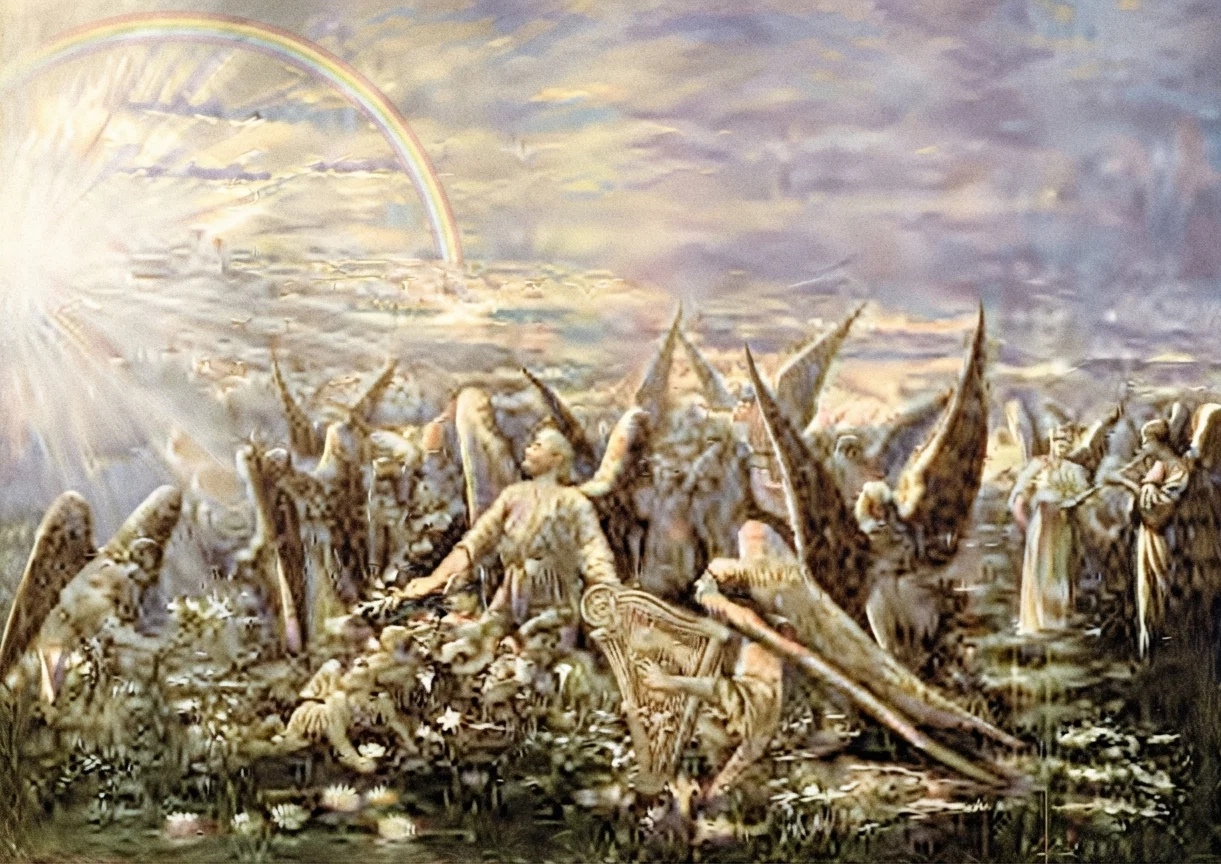
In heaven above there shines the eternal splendor, And every cloud that doubt of love hath brewed Is silver-lined, and rainbow-tinted tender By love's divine auroreal glory hued. In radiant light the Father, Son, and Spirit Shed forth such brightness through the ambient air That angels the vast blaze of love's full merit Do not unvailed its marvelous lightnings dare.
“In Heaven above There Sweeps the Eternal Chorus.”
In heaven above there sweeps the eternal chorus, And every discord doubt of love hath wrought Melts into sweetness intricate before us, Touched by some infinite tenderness of thought, Till harps sweep up with sweeter notes of rapture, And angel eyes grow dim with untold praise, And yet the note's too deep for any creature, And far too high for any tongue to raise.
In heaven above great pictures claim the vision, And every cross of thorn that sin hath brought Becomes a gateway to a new Elysium, Crowned by the great Redeemer's master thought, And sin makes background dark for love's bright blazings, What meets its utmost, worst emergency, Before which angels veil their gazings And look to earth its sequel fair to see.
In heaven above, Love, the great Eternal, waiteth, Sending the beams of power from His side, For one whom doubt of Him so long belated— A captive when she's destined for a bride.
Awake, my soul, that song they sing in heaven Is for thy wooing, and those visions shine For thee, and all thy sin's forgiven, And Love waits on for that lost soul of thine.
In heaven above the last cloud will be over; When thou art there, the last discord will cease, And, through the cross of thy divine soul Lover, Thou shalt with angels gather flowers of peace.
Wake from the dust, O captive daughter, wake! Put on thy garments beautiful for Love, And let Love love thee, that will ne'er forsake, And heaven be all that heaven may be above.
FRANCES E. BOLTON.

THE LOST TEN TRIBES.

“THERE are no lost tribes,” is Mr. L. N. Demlitz’ verdict in The Andover Review. The ten tribes were never bodily deported to Assyria. Most of the Israelites were left behind in the country they always occupied. At the fall of Jerusalem, Titus carried off only the inhabitants of Judea, who were sent across the Mediterranean to Italy and Spain. Hadrian afterward led the Galileans into captivity, and located them on the lower Rhine. From them—the “ten tribes”—the bulk of the Jews of Germany, Austria, Hungary, Poland, Russia, and Roumania are sprung; and these have in very modern times sent offshoots to Northern France, Holland, and the United States. Between Israel and Judah there has always been a rooted antipathy, and in America the Jewish families will not associate or intermarry with those of Israelitish descent. But the latter form more than nine-tenths of the Hebrew nation to-day.—Religious Intelligencer.

WHAT ARE WE AIMING AT?

If righteousness be attainable here and now, then here and now we may at least enter in the kingdom of heaven. Is our conception of happiness identified with righteousness? Is that the thing which we desire? Is that our ideal? Is that the one goal to which we are stretching forward in the heavenly race? If so, then for us, even here and now, "the path to heaven lies through heaven, and all the way to heaven is heaven." What sort of condition answers to the heaven of which you dream, for which you sigh? Is it a state of things which you vaguely call glory? Is it a starry crown—the symbol of supreme self-aggrandizement? Is it a golden throne, the summit of individual exaltation? Is it the rest of an untroubled indolence? If so, our heaven may prove to be indeed a chimera both now and hereafter. Such notions of heaven betray the unsuspected fact that, after all, our high spiritual hopes resolve themselves into mere earthliness—into an ill-concealed amalgam of vanity and selfishness. The true conception of heaven is holiness. It is the elimination of baseness and sin.
—Dean Farrar, D.D.

PRAISE OF THE APPLE.

THE old Scandinavians believed that the gods subsisted wholly upon apples, and that it was through the peculiar properties communicated by this queen of fruits that they acquired the wisdom which they imparted to men.
The acids of apples are exceedingly useful through their stimulating influence upon the kidneys, whereby poisons are removed from the body, and the blood and tissues purified. The acids of apples are all highly useful as a means of disinfecting the stomach, since the ordinary germs that grow in the stomach, producing biliousness, headache, and other troubles, will not grow in fruit juice or fruit pulp. —Good Health.

Telling Others’ Faults

The man who tells you the faults of others will tell others of your faults.

KNOWLEDGE, FALSE AND TRUE.

A MAXIM of Bacon reads, "Knowledge is power." It depends on the kind of knowledge. Here is a knowledge that is of infinite value: "And this is life eternal, that they might know Thee the only true God, and Jesus Christ, whom Thou hast sent." John 17:3. However, before we consider the knowledge of the text, let us view for a little space the knowledge of the world.

"Science Falsely So Called."

Much that is called knowledge, or science, nowadays, and in fact through all human ages, is mere guesswork. The "science" of to-day knows that much of the "science" of the past was myth or fable, but it follows in the same old path of vain conjecture. The highest among the devotees of human science are, at the best, but—
"On the lowest benches of Truth's great college, To guess at what grown-up angels know."
Much of the knowledge of to-day is the "science falsely so called" ("knowledge" in the R.V.), which seeks to interest the receptive student, as it has intoxicated its devotees, in "profane and vain babbling," "old wives' fables," "endless genealogies," "empty jangling," "foolish questions," "strivings about law," and "commandments of men," which "turn from the truth" and minister to vanity.
This guesswork or hypothetical sort of knowledge is to a great extent the basis of nearly all the various sciences and arts. How much of conjecture and mere hypothesis is found in natural philosophy, psychology, astronomy, geology, medicine, and theology! Certain phenomena are witnessed, certain effects seem to follow certain causes, but apart from a higher revelation, how little man knows of the real origin of these phenomena or manifestations!
Let a practical physician speak for the science of medicine, and in speaking for that speak for all. I quote from the November Arena for 1896:—
Practical medicine is an old hulk out on the professional sea, without sail, oar, rudder, compass, or north star. It has no head. It has no body, unless we accept as such the conglomerate mass of discordant elements seen in the opposing schools—the allopaths, eclectics, homeopaths, hydropaths, etc. Its reliance is on its voluminous tail, a prehensile tail, by which it clings tenaciously to old-time theories and dogmas. . . . Practical medicine . . . has not even the impulse center of the starfish. It looks to its prehensile tail, with its old theories, dogmas, and traditions, for impulse and guidance. . . . The physician is the only man in the wide world who has charge of a machine without having been taught what its power is, and how it is secured, applied, and controlled—and this machine the acme of all mechanism! What a burning shame that this machine, man, while thrilled with life and its aspirations that are human, can only live at the sufferance of blind chance, while for the management and maintenance of the inanimate machine the highest degree of skill that is known to the science of progress is at command.
In the pillory of the condemned, medicine does not stand alone.
It is a frequent thing to find in our leading periodicals and reviews sweeping condemnation by leading men of the whole popular system of education. The theories of astronomy, geology, and theology as sciences, are undergoing constant change according as the little fires kindled by human investigators set new areas of scientific atmosphere in motion, and the great result is that the minds of thousands are unsettled, but the great world is moved no nearer the stars of God, nor is man more of an ideal character.
And yet this uncertain theorizing on the part of learned, energetic men is not unfruitful of results. It brings bread and butter from the ignorant to the equally ignorant. It gets gold. Its favorites acquire fame. It soothes into self-satisfaction its egotistical and more indolent devotees. It heaps up sunshine friends. It fosters pride. "Knowledge puffeth up."

A False Base.

All purely worldly knowledge is in its getting based on a wrong conception, a false notion. It reverses true processes. It builds the pyramid on its apex in shifting desert sands and wonders that it is not more stable. This wrong notion is education from the standpoint of the imperfect human. It is heathen in its cradling, and satanic in its origin. It is set forth in a maxim attributed to Solon, and inscribed over the portal to the temple of the old Delphic oracle, "Know thyself." Alexander Pope enlarges the thought thus:—
"Know well thyself, presume not God to scan, The proper study of mankind is man."
The thought has been enshrined in so-called Christian literature and education. In one of the latest books, "What a Young Man Should Know," by an esteemed Eastern clergyman, we read: "The only proper study of man is man. The only way to arrive at the correct knowledge of human nature is by a study of human nature."
This is the repetition of the same old falsehood, continuing the same old system of search and guess, and ignorance, the more refined, is as colossal as ever. As of old Inspiration may unchallenged make the same statement, and ask the same question: "The heart is deceitful above all things, and desperately wicked; who can know it?" And the true student will find response in the words of the ancient prophet: "O Lord, I know that the way of man is not in himself; it is not in man that walketh to direct his steps."
What is the end of all this worldly knowledge?—Apart from its few days of despairing pleasure, it is death. It leads men to hope, but it disappoints. It blinds where it can not instruct. If we prize knowledge by what it brings, surely we should estimate lightly the knowledge of the world. Like beautiful soap bubbles, its results vanish while we gaze upon them. All knowledge of all worldly languages, sciences, arts, and ologies will sometime be locked in the archives of oblivion. Man's earthly tenure of stay at the longest is but a little while, and he enters the tabernacle whose door never outward swings. His life here is as a shadow which appeareth for a little time and vanisheth away. Like a flower he blooms in the morning; at evening it is withered and fallen. His existence is as the grass, and his glory as its fleeting flower. His fame perishes in eclipse, oftentimes of a meaner body. His riches take to themselves wings and fly away. His great strength of body or mind enfeebles with fast-approaching age. Earthly friends leave him for some newer and more favored child of fortune or fame. Changing theories crowd his knowledge out of fashion or stigmatize it ignorance. Death ends all. Well said the prophet, "Let not the wise man glory in his wisdom, neither let the mighty man glory in his might, let not the rich man glory in his riches." There is no ground for glory. Using one of the coveted objects of earth for a type of all, our Lord presents us this picture lesson of the emptiness of human life:—
"And He said unto them, Take heed, and beware of covetousness; for a man's life consisteth not in the abundance of the things which he possesseth. And He spake a parable unto them, saying, The ground of a certain rich man brought forth plentifully; and he thought within himself, saying, What shall I do, because I have no room where to bestow my fruits? And he said, This will I do; I will pull down my barns, and build greater; and there will I bestow all my fruits and my goods. And I will say to my soul, Soul, thou hast much goods laid up for many years; take thine ease, eat, drink, and be merry. But God said unto him, Thou fool, this night thy soul shall be required of thee; then whose shall those things be, which thou hast provided? So is he that layeth up treasure for himself, and is not rich toward God." Luke 12:15-21.
(Concluded next week.)

"THE LAW AND THE PROPHETS."

"THEREFORE all things whatsoever ye would that men should do to you, do ye even so to them; for this is the law and the prophets." Matt. 7:12. The foregoing scripture is called the "Golden Rule," and by many it is supposed to be purely and solely a New Testament precept. But in repeating this "golden" truth to the multitude in His Sermon on the Mount, the Master said, "This is the law and the prophets."
Men may not have been able, because of their narrowness and prejudices, to see the "Golden Rule" in "the law and the prophets,"—the Old Testament Scriptures,—but the Lord could see it there clearly. He announces it, not as some new truth that had never been discovered before, but as the sum and substance of "the law and the prophets."
Now since the Saviour can find such wonderful and helpful truth in the Old Testament, is it not highly important that we should study it diligently; for He has given us the promise of His Spirit to guide us into all truth? And as we study His entire Word, not merely the New Testament, but the Old Testament as well, the Spirit which searcheth the deep things of God will bring to our minds the gems of truth.
The Old Testament presents the coming of the great Sacrifice for sin. It gives the types and shadows of the life, and work, and efficacy of Heaven's priceless gift to humanity. The New Testament spreads before us the life of the Master in all the perfection in which He lived it. The significance of the prophecies that were fulfilled in the life of Jesus can not be seen except as we study those prophecies themselves in the Old Testament Scriptures. And since theSaviour studied the "law and the prophets," is it not pleasant to think of following Him in the same studies? T.

A DOUBLE WARNING.

THE rich men of this time have the most ringingly clear warnings to be found in the Word of God. They are told in literal language that "miseries" shall come upon them that will cause them to "weep and howl." But if they will not hear God's Word, the voice of history speaks to them in language that should stir the blood in their veins.
The language of God's Word is:—
"Go to now, ye rich men, weep and howl for your miseries that shall come upon you. Your riches are corrupted, and your garments are moth-eaten. Your gold and silver is cankered; and the rust of them shall be a witness against you, and shall eat your flesh as it were fire. Ye have heaped treasure together for the last days. Behold, the hire of the laborers who have reaped down your fields, which is of you kept back by fraud, crieth; and the cries of them which have reaped are entered into the ears of the Lord of sabaoth. Ye have lived in pleasure on the earth, and been wanton; ye have nourished your hearts, as in a day of slaughter. Ye have condemned and killed the just; and he doth not resist you. Be patient therefore, brethren, unto the coming of the Lord. Behold, the husbandman waiteth for the precious fruit of the earth, and hath long patience for it, until he receive the early and latter rain. Be ye also patient; stablish your hearts; for the coming of the Lord draweth nigh. Grudge not one against another, brethren, lest ye be condemned; behold, the Judge standeth before the door." James 5:1-9.
The foregoing scripture brings us face to face with the time when "the Judge standeth before the door,"—when "the coming of the Lord draweth nigh." And in that awfully solemn time when the great judgment day of God is at hand, and when the Lord's coming is near, it is said to the rich, "Ye have lived in pleasure on the earth, and been wanton; ye have nourished your hearts, as in a day of slaughter."
And while the finger of God, as if from the throne of His final judgment, is pointing to the rich who are reveling in their wanton pleasures, He also directs attention to the "laborers" who have reaped down their fields, and says, "The cries of them which have reaped are entered into the ears of the Lord of sabaoth." Thus, on the one hand, are seen the rich, living in reckless, wanton pleasure, and, on the other hand, are the laborers whose hire is fraudulently kept back, and their cries reach to high heaven.
If James had lived in the last years of this last decade of the nineteenth century, and had written his account from the personal observation of his literal eyes, instead of through the prophetic vision over eighteen hundred years ago, he could not have described the conditions of to-day more accurately or more vividly. And in this wonderful address to the rich men he says, "Ye have heaped treasure together for the last days." Then this scripture not only gives a warning to the rich, but incidentally tells us that the "last days" have come.
Now listen attentively to the inspired warning, of terrible import to the rich. The text says: "Go to now, ye rich men, weep and howl for your miseries that shall come upon you." Men may treat this message lightly. They may disbelieve it, and even seek to set it aside with contempt. But, nevertheless, it is the Word of God to the rich men. Yes, it is the divine Father speaking to the rich men of to-day.
These riches that men are running after and grasping to themselves as the idols of their deluded minds, will soon be cast aside. For in that great day that is almost breaking upon the earth, "a man shall cast his idols of silver, and his idols of gold, which they made each one for himself to worship, to the moles and to the bats; to go into the clefts of the rocks, and into the tops of the ragged rocks, for fear of the Lord, and for the glory of His majesty, when He ariseth to shake terribly the earth." Isa. 2:20, 21.
The scriptures presented in the foregoing paragraphs are among the warnings that God has sent to the rich through His written Word. Will they be heeded? If they are, then may the dire calamities that are foretold be avoided. Otherwise, they will surely come.
But if the rich men will not listen to the Word of God, there is a wonderful object lesson for them in history—and in history, too, that is so recent that the last of the living witnesses to it are scarcely more than passed from the stage of action.
The reign of Louis XIV. in France was one of great splendor, particularly toward its close. He was the patron of art, architecture, and letters. And in his reign the gathering of wealth into the hands of the few was greatly augmented. Consequently, great society affairs became the order of the day, and the people of wealth and position plunged themselves into all the exciting and luxuriant pleasures that money could procure, and that, too, with wanton and abandoned recklessness. Increased burdens had to be borne by the great mass of the people, in order that the privileged and wealthy class could continue their revels in vice and the pleasures of folly. And, as might have been expected, France was soon filled with an undercurrent of discontent. Tracts, pamphlets, and books were written against the nobility and lord bishops who were holding the wealth of the country while they reveled in profligate luxury. The cause of the poor, who did not always have the bare necessities of life, was strongly advocated. And it can readily be seen that a trenchant pen would find rich subject matter for tracts and pamphlets in the wide contrasts that the extravagant display of wealth on the one hand, and the sufferings of poverty on the other, presented.
While Louis XIV. gathered to his court and palace all the so-called refinements of wealth and culture, he also gathered its worst vices, its follies, and its intrigues. But his iron hand held all these elements in obedience to his despotic will. His immediate successors, however, had a greater task; for the seeds of discontent that had been germinating for so long began to produce a most prolific harvest. The cry against the nobility, both of the State and the church, kept growing in volume until it became a tumultuous and implacable uproar. There was no hand now, no matter if it possessed the iron strength of Louis XIV., that could stay the maddened torrent of revolution. The people demanded a redress of their grievances, but the dignitaries of the church and the nobility of the State buried themselves still deeper in their carousals, and these privileged sons and daughters of rank and wealth made sport of the clamors of the populace.
Louis XV., who succeeded Louis XIV., died May 10, 1774. And about all that he, in reality, bequeathed to his grandson and immediate successor, Louis XVI., was the French Revolution and its Reign of Terror. It is said of Louis XVI. that he "had just views, and amiable dispositions." And we know that he did all in his power to awaken the wealthy nobility of France to a realizing sense of the important necessity of removing the burdensome taxes from the poor. He urged that the great wealth of the nobles and lord bishops would enable them to meet the necessary expense of the State without feeling the burden, but that the poor could not endure the pressure. All warnings and admonitions, however, no matter from what source they came, were haughtily rejected, and the worst, the most cruel, the most terror-inspiring revolution that is found in the annals of time, was the result.
America has her discontent. Yes, we may say the whole world, for that matter, for the conditions are the same all over the earth. The tracts, pamphlets, and books discussing the situation have been for a long time pouring from the press. The lines are drawing tighter every day, and the tension is growing stronger and stronger. But in the face of every admonition, corporations and trusts are reaching out farther and farther, and controlling more and more of the world's wealth. The conditions all over the world to-day are not only similar, but are strikingly identical with what they were in France on the eve of her horrible revolution. And just so surely as effect must of necessity follow the producing cause, just so sure may we be that a world-wide revolution is imminent. All that is lacking is an opportune time and the tiniest spark to be applied to the explosive material, and who will dare to prophesy the frightful results?
Thus we see the twofold warning that has been given to the rich. Will they give heed, and work the needed reforms that will enable them to escape the impending calamities? Or will they continue to dream of their expanding resources of wealth, and drown every conviction and warning in pleasures and vices until the awful storm breaks over their unsheltered heads? T.

Note

NOTE.—We wish those who ask questions to take particular notice: (1) Only such questions will be answered here as we believe to be of general interest and information. (2) We can not undertake to explain from four to a dozen scriptures, as in one sentence we are often requested to do. (3) Do not ask to “explain” a certain text or passage. State clearly the point in question. (4) Give full name and address, not for publication unless desired, but as evidence of good faith, and to give us the privilege of replying by letter if deemed best. (5) Unsigned communications of any kind find the quickest way to the waste-basket. (6) It is always well to inclose stamp. (7) “Foolish and unlearned questions avoid,” also those that minister to mere curiosity. (8) Study the Scriptures yourselves.

915. Baptized for the Dead.

PLEASE explain 1 Cor. 15: 29. M. J. O.
What we see in that verse is this: The wages of sin is death. Man, being a sinner, is doomed to death. Christ took our sins and died for us. When we believe on Him, we show our faith in His death, burial, and resurrection by baptism. We are “baptized into His death,” “buried with Him by baptism into death.” Rom. 6: 3, 4. We are to reckon ourselves “to be dead indeed unto sin.” Our hope is in Christ and His resurrection. So they are baptized unto this death in the hope of the resurrection in Christ.
Continue reading: A HEARING ON THE CALIFORNIA SUNDAY BILL