THE readers of the SIGNS have been made aware of the Sunday Bill that is before the California Legislature. The bill when introduced in the Senate was referred to the Committee on Education and Public Morals, and on February 10 that committee granted a hearing to those who might desire to speak either for or against it.
The principal speaker in favor of the bill, a well-known clergyman of California, presented no new argument but placed particular stress upon the idea that this proposed Sunday law is in the interest of the laborer. He presented the oft-repeated statements that employers are very exacting of those they employ, requiring them in many instances to work full seven days in the week. And what is wanted, so he said, is a law that will compel these employers of labor to give their hands one day of rest in seven.
Another point he made quite prominent is the fact that California is the only State in the Union without a Sunday law, and he thought that this State should follow the example of the others.
When he was concluding his remarks the chairman asked him if it was intended that this law would stop the railroads and street-cars on Sunday. "O, no," replied the speaker "it is a settled fact that the railroads, the street-cars, and many large manufacturing and mining establishments have to run seven days in the week! These things would come under the works of necessity that must be done on all days of the week alike."
A few reflections upon the foregoing statements will be in place. If Sunday laws work such good for the States that have them, why are not the conditions in those States much better than they are in California? Why do we not find labor enjoying freedom from the oppressions of despotic employers in all the other States, and California standing alone in the so-called enslavement of the toiler who is compelled to work seven days in the week? As a matter of fact, California, without a Sunday law, gives just as great freedom to those who toil as is given by any of the States where the Sunday law exists. For there is no State in which the railroads, street-cars, and other corporations that employ large numbers of men may not be found quite as busy on Sunday as on any other day.
But the minister who was delegated to appear before the Senate Committee to urge the claims for a Sunday law said that it was not the intention to stop the railroads, street-cars, and large manufacturing and mining establishments. He classed these among the works of necessity that have to run every day in the week. Now if these are to be exempted, what will be left for a Sunday law to operate upon? The railroads, street-cars, manufactories, and mines cover nearly all the places where men labor for wages. And by what laws or basic principles can it be shown that large manufacturing plants should be allowed to run on Sunday and the smaller ones be required to close down? And what tribunal will decide just where the line should be drawn between the large and the small factories? The very fact that the advocates of Sunday laws are continually involved in so many contradictory and absurd positions should open the eyes of those who think, and who desire to be on the right side.
And, again, what right has even a minister to state what is the intent of a Sunday law? If a law is good, the intent of it is stated in plain language. It is as open as the day. It does not require any one to tell what it means, for it says what it means and means what it says. Now if the proposed Sunday law for California is intended to exempt railroads, street-cars, and large factories and mines, why not say it in just so many words in the law itself? One section of this law before the California Legislature reads as follows:—
"Nothing in this act contained shall be so construed as to prohibit, or render unlawful, on the first day of the week, ordinary manual labor performed by a member of the denomination called Seventh day Adventists, or Seventh-day Baptists, or Hebrews, who conscientiously and religiously observe and keep the seventh day of the week, or Saturday, as sacred to rest and to religious worship; provided, they do not by such work disturb Christian assemblies in their religious services or other religious duties on the first day, sabbath."
But if the railroads, etc., are to be among the things that can be kept running on Sundays, the above section should be amended. Another clause should be added, saying:—
"Neither shall anything contained in this act be construed to prohibit, or render unlawful, on the first day of the week, the running of railroads, street-cars, or large manufacturing or mining establishments."
If the law is not intended to stop these lines of industry on Sunday, it should say it plainly. And those who are asked to pass the law should be careful to consider that once a law is passed, the ministers who drew it up can not always be present to tell what it means. And then they are not sure to agree upon the subject anyway. It is indeed to be doubted whether all the ministers in California would have said, "Amen," when their brother clergyman told the Senate Committee that their Sunday law was not intended to apply to railroads, and so on.
Any law that is right needs to exempt no one. And when ambiguous and indefinite exemption clauses have to be added to a statute, else it will work oppression and hardship upon some, it is quite substantial evidence that such a law is not needed.
T.
THE FRENCH CRISIS AND WHAT IT MEANS.
By C. M. S.
THE present condition of the French nation has been described as that of "a boiler with a roaring fire under it, no safety-valve, and no way to work off steam." The latest developments in the Dreyfus case have accentuated, if possible, the precarious condition of the French republic. The Court of Cassation has completed its work upon the Dreyfus case, but continues to postpone its verdict. Here is a case of simple justice submitted to the highest court. The question is, Was Dreyfus convicted according to law, or was he not? This court of last resort has reached its decision, but dares not pronounce judgment, for fear of the overthrow of the republic. The inference is that the court decides he was convicted contrary to law; but the fear of the army and its power in the government prevent the legitimate working of the judicial system. It is now stated that the army organization has its plans all laid for the overthrow of the republic and the establishment of a military despotism in its place. The cry of the Bonapartists is: "The vigil is over, the hour of combat is about to sound. The moment has come when Napoleon will be in our midst, and the tri-color flag will be crowned with the imperial eagle." The emissaries of Prince Victor are in England endeavoring to raise funds with which to carry on the contemplated revolution. A French correspondent, well versed in the affairs of the nation, has the following to say in a letter to the press:—
"The revolution would be a bloodless one. The magazine rifle and the automatic gun have made civilian revolutions impossible forever. The days of street barricades are past. What would happen if the revolution really occurs would be the declaration of a state of siege by General Zurlinden, and a proclamation to the country that as a republican government no longer is able either to cause France to be respected abroad or to preserve the army from outrage and the people from disorder at home, the army takes charge of the safety and honor of France until the people decide for themselves what form the future government shall take. The principal revisionists would be arrested and certain newspapers suppressed, while the troops occupied the Elysee, the Chamber, and the telegraph offices. Prince Victor would immediately cross the frontier."
The influence of the military power in France has been steadily growing, at the expense of the civil power, until the republic is at the very verge of dissolution. Thus is France at the mercy of her protectors. The mighty army which she raised to protect her from foreign foes has turned against her institutions, her established government, in all but the overt act that is bound to be accompanied with calamity to the French people.
And America can in this thing find for herself an all-important lesson, especially applicable at this time when demand is made for a large standing army. We have seen the wisdom of our forefathers in many things connected with the establishing of this nation, principally in the matter of freedom from the domination of the church and the military in civil matters. Great efforts are continually being put forth in various quarters toward a union of the civil and religious in legislation, than which nothing could be more subversive of our liberties and the principles upon which the nation was founded. So it is not at all strange that there should be a cropping out of an inclination on the part of many to do for the military what is already being done for the religious element in the affairs of the civil power. It may begin with the increase of the standing army to 100,000 men, and it may end as France's experiment is ending now. The farther we get from the fundamental principles of this government, the surer is our course shaped toward an unhappy end.
C. M. S.
INAUSPICIOUS.
By William N. Glenn
It is argued in support of the expansion of American jurisdiction, that it means the spread of civilization, of peace, of Christian principles. But the query naturally arises, Why is it that, as the domain widens, there is such a demand for an increased standing army—from 30,000 to 100,000 men—in time of peace. The peace that has to be thus enforced and thus sustained can not be a Christian peace. The civilization that annihilates the uncivilized is not a Christian civilization. When the Prince of Peace came to bring "peace on earth, good-will to men," He did not come with an army equipped with carnal weapons. He came "not to destroy men's lives, but to save them." It is decidedly inauspicious for our pretension of Christian civilization when we have to force our institutions upon others with shot and shell, and maintain them at the point of the bayonet.
It seems not a little strange that a hundred years ago so-called "American institutions" were established at immense sacrifice by the American colonies cutting loose from the "mother country," while to-day the popular idea of perpetuating those institutions is to return to the methods of the Old World, from which revolt was necessary in order to establish civil and religious liberty. The man who, of all others, is now receiving the most glory for the extension of the jurisdiction of the American flag is Admiral Dewey, and his latest utterance in regard to the best policy of maintaining our claim as a civilizing power is in these words: "After many years of wandering I have come to the conclusion that the mightiest factor in the civilization of the world is the imperial policy of England."
Have the principles of civil and religious liberty, upon which the United States Government was originally founded, proven a failure as a governmental policy, a civilizing influence? or are the people departing from those principles in the mad rush for external glory?
W. N. G.
HOW IT IS.
By H. Hansen
[From the standpoint of a "Salvation Army" man.]
SOUL-SAVING revivals do not seem to be the order of the day now in Southern California, but rather church entertainments and church shows and church concerts, which are not productive of saved souls. And yet this is the special season of the year for soul-saving, one would naturally think. O, that the churches would be wide-awake to their duties, as the devil is to his holiday amusements, drunken brawls, prize-fighting, and other gambling games!
H. HANSEN.
Pasadena, Cal.
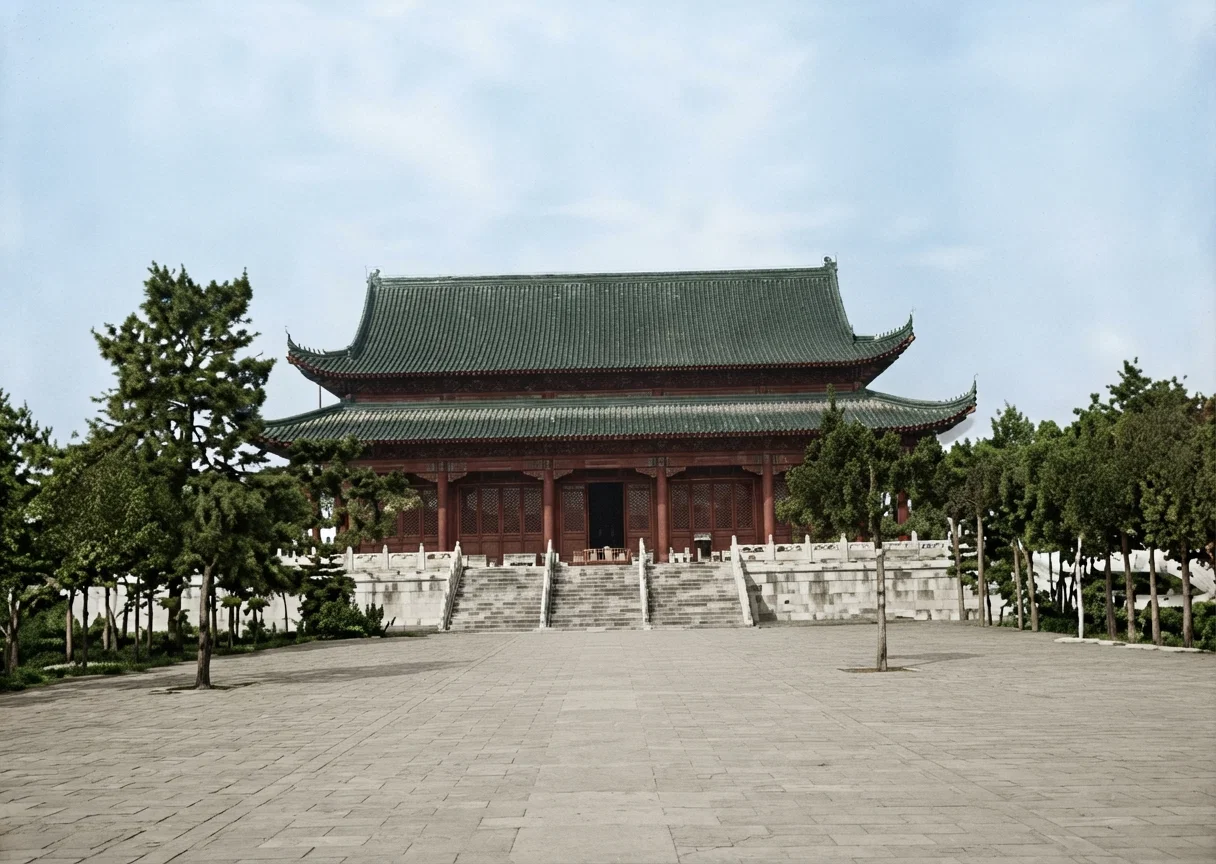
A CONFUCIAN TEMPLE.
CHINA—ITS NEEDS.
By Lizzie Nelson Fryer
NEARLY four hundred millions of people—our brothers and sisters—endowed as ourselves with many possibilities for growth and expansion into upright, moral, and spiritual lives, living without hope and without God; taught from early childhood to pray to heathen deities represented by hideous idols, and to look to them for aid and guidance; living for no object beyond the gratification of self; their good deeds done only with the idea of bettering their condition here and gaining merit in the other world; bound down by a constant and heavy draft upon their time and means by their obligations to keep up the worship of their ancestors; enduring all manner of privations in order to continue this tremendous expenditure, which affects nearly every family over the whole empire—this in part is a picture of the people in China. Priest-ridden are they, with millions of Buddhists and Taoists who, like wolves, prey upon the people and rob them of their hard-earned money because of boasted powers to ward off evil and threatening influences.
The people are everywhere oppressed by a corrupt officialdom and an iniquitous government. Their women are degraded and kept in an ignorance that is but little better than slavery. Naturally bright and active, but having learned to accommodate themselves to their conditions, their minds remain undeveloped, and they become superstitious in the extreme. In order to be married into respectable and influential families little girls are made to undergo the tortures of having their feet bandaged and cramped until they are unable to walk naturally, and are restricted in their work because of the inconvenience and suffering which they must bear all their lives. Foot-binding is practised in nearly all parts of the Empire and among all classes. The high and low, rich and poor, old women of seventy as well as young girls of six, are deprived of the natural use of their feet because of this atrocious custom. Among the higher classes each official usually has two or more wives and several concubines, so that the lives of the women are most neglected and unhappy, and their dispositions are trained to jealousy and depression. "No cheer in this life and no hope for the next," have I often thought after talking with them.
Add to all these things the curse of the opium habit, which is increasing its power over men, women, and children of all classes, deadening the voice of conscience within them, causing them to kill time and forget their responsibility in its stupefying fumes, and the China of to-day reveals a picture of an immense downtrodden mass of humanity which unaided human help can never relieve or lift to a higher plane. The victims of this habit gradually lose all self-respect, ambition, and the power to speak the truth. They become unfitted to gain a livelihood or live respectably. The people themselves see the ravages, and denounce it, but are helpless to stay its progress. Like a canker it is threatening the vitality of the very nation itself.
What Has Been Done for China?
It is now more than fifty years since a little band of noble Protestant men and women began their life-work in this empire. They were strong in the faith that God had a people there and that they were called to bring them out of darkness into the light of God's truth, else they could not have had the courage to endure the trials, hardships, and privations of those early years of missionary life. The work was slow and discouraging and oftentimes disheartening, but by perseverance, obstacles were overcome, schools established, and the work carried on. From such small beginnings the work has extended till now the Christian portion of China has become composed of intelligent men and women who are prosperous and thrifty and in many stations are sending out laborers from their own numbers into the neighboring towns and cities, bearing the whole burden of their support. In the country may often be found churches and schools which are entirely carried on by the native Christians.
A FARMHOUSE IN A BAMBOO FOREST.
Within the last five years there has come a great change over mission work in China. Where the people were difficult of access and turned deaf ears to the Gospel message, they are now crying out for more help to be sent from the home lands. Their schools are crowded as never before. The Bible has been translated into the many different dialects and taught in the schools of the various missions and portions of it scattered by native colporters, until the "Jesus doctrine" has been heard of in nearly all parts of the empire. The people are coming, in this time of unrest, to feel their need of something they do not possess, and are gaining the courage to approach the missionaries and talk over their needs.
The attention of the whole world is now turned toward China, and more information about that country can be gained from the periodicals and newspapers in one month now than in all the years of the past. The day of her long-talked-of and prayed-for awakening has, in the providence of God, arrived. The burden of those who have her best interests at heart will no longer be in regard to her conservatism, but will be about the influences which shall direct her progress as she enters into a freer intercourse with the rest of the world. Just at this time, when the demands of other powers bear heavily upon her, seems the hour for Christianity with a new impetus to press her advanced civilization and true and pure religion upon the people of this whole empire. While there is special encouragement among the different workers in China, still the seventy thousand Christians scattered here and there are only as a handful compared with those who have never been in the least influenced by Christianity.
But the greatest need of all is for many more consecrated men and women to come to her assistance—men and women who will be willing to give up home and country and friends and devote their whole lives for the help of that people, for the chiefest influence one can have among such a people is that which is exerted by a consistent, true, earnest, every-day life. This counts far more than do all the sermons and talk of a lifetime. I speak what I do know of this matter. Those are wanted who will not fear sickness or the trying climate, who have a knowledge of the laws of our physical being, and obey them as far as possible, and will leave all the rest to Him who careth for such and will sustain and guide in their labors. And, above all, Bible teachers are needed, for it is the entrance of the Word which giveth light.
LIZZIE NELSON FRYER.
GOD'S PLANS.
By Gilbert J. Embree
SOMETIMES I've planned a thing so grand
I thought the world should bow in reverence,
I thought the Lord would fall in line
And work it in my own good time,
And praise me for my great benevolence.
But plans of man are ropes of sand
That do but take a breath to break them;
While plans of God
Deep-root earth's sod,
Nor men nor demons e'er can shake them.
GILBERT J. EMBREE.
San Pasqual, Cal.
THE WOMEN OF ASIA.
By Isabella Bird Bishop
BY MRS. ISABELLA BIRD BISHOP.
IN Asiatic countries the birth of a girl is at the best a subject for condolence with parents, and none who have heard it can ever forget the wail of the Chinese mother for sorrow that a woman is born into the world. The birth of a girl is a token that the gods are displeased with the mother, and both parents regard them as a bitter wellspring of anxiety and expense. At a very early age the girl is secluded in the women's apartments, and at her marriage at twelve or thirteen is removed to the seclusion of those of her mother-in-law, where she spends her time in menial offices. She prepares her husband's food, but he does not demean himself by eating with her.
Faithfulness in the marriage relation is not incumbent upon men, and is believed to be impossible for women without the protection of the harem walls. It would not be possible to put into words the deep distrust which all orientals, especially Moslems, have of women. Woman is regarded as of no account, not destined to immortality; motherhood is her only title to a species of respect. In China to teach her to read is counted the height of folly, and she is habitually spoken of as "the mean one within the gates." Polygamy, facilities for divorce, the disgrace which attaches to widowhood in India, and child marriage, enhance the degradation of the lot of our Eastern sisters.
The woman's house has none of the sanctity of home. In rich men's houses there are often as many as 200 inmates. Privacy is unknown and impossible. There are legitimate wives, and wives who have few legal rights; slave wives, discarded wives who are practically slaves, female slaves, aged women who act as spies and duennas, girl children, daughters-in-law, and women of several colors and races. They are totally illiterate; the favorite wives in rich men's houses are precluded by rigid custom even from such a light occupation as embroidery; they are without any possible outgoings in the direction of philanthropy or kindness, and never cross the threshold of their dwellings except in closed chairs. Their chief occupations are playing with their children, counting their jewels, changing their dresses, eating sweetmeats, dressing their hair, painting their faces, staining their finger nails, smoking, sleeping, and practising petty tyrannies and cruelties upon their slaves. Their recreations are the performances of singing and dancing girls and fortune-tellers, shopping at home, and small dramas acted by their servants, full of a vileness of language and suggestion perfectly astounding.
In intellect these secluded women are not higher than children, but their circumstances foster an early and gigantic growth of the worst passions which deform humanity,—envy, hatred, malignity, unbridled jealousy, "strong as death and cruel as the grave," revenge, slander, greed, impurity—a leprosy of unholiness which affects well-nigh every home and heart, a foul atmosphere in which every generation receives its earliest impulses. There are no ideals, no examples of goodness to be studied, nothing to raise the thoughts. Influence is represented by intrigue. There are no duties in life other than those to children and parents-in-law, and no true companionship can exist between husband and wife. To be the mother of boys is a woman's highest aspiration.
In all the countries of continental Asia, girlhood, with its charms, its brightness and sweetness, its aspirations and enthusiasms; its frequent alacrity of service, and the bright possibilities for the future, is altogether unknown. There is no middle platform between childhood and the loveless seclusion of wifehood. All that is good in a woman's nature is undeveloped and blighted; all that is evil is developed as in a forcing-house.
To give anything like a correct idea of oriental womanhood, this sketch ought to have its details filled in and to be painted in much darker colors. The imperfect picture I have given represents womanhood under Hinduism, Islam, Buddhism, Demonism, and is a purely oriental one.—Women's Work for Women.
OUR WORK AND WORKERS.
By Editor
The church at Oakland, Wis., has opened a school.
Seven members were recently added to the church at Grand Junction, Colo.
Brother S. H. Lane notes in the Recorder the organization of a church at Elgin, Ill.
At Salem, Ind., twenty were added to the church recently, after a day's meeting conducted by Brother S. S. Davis.
Brother H. H. Graf, missionary in Brazil, reports having baptized sixty persons during a two months' tour.
The mission in Salt Lake City has been presented with a new organ by a Chicago firm whose name we have not learned.
Meetings held at Knapp, Wis., by Brother Swin Swinson, in the interest of the Scandinavians, resulted in the conversion of three persons.
In South Sioux City, Iowa, January 28, a Sabbath-school of thirteen members was organized by Brother V. Thompson. A missionary Sunday-school is also in progress.
At the last quarterly meeting of the church at Missoula, Mont., ten members were added. Four others were observing the Sabbath who had not yet united with the church.
Six persons have accepted the doctrine of the "commandments of God and the faith of Jesus," as presented by Brethren Wm. Guthrie and W. E. Frederick at Hedrick, Iowa.
On the 4th of December last Brother F. M. Burg baptized eight candidates at Rohnerville, Cal., and his report in the California Missionary notes that a half dozen more are awaiting an opportunity to follow the example of the Lord.
Brother J. P. Covert writes that at Milton Junction, Wis., January 28, twenty-five persons went forward and signified their desire to join the church. This was the result of a revival during the general meeting which was held there.
A letter from Sister Lena E. Howe, of Honolulu, dated February 1, says: "The work is prospering here, and we are much encouraged; are just finishing fitting up a little chapel. It is very neat and pleasant, and all seem pleased with it."
Our church in Kingston, Jamaica, has a membership of 250. Kingston is an excellent missionary center, having 50,000 inhabitants, and being a stopping-place for steamers running from Europe and the East coast of the United States to South America and return. It is also becoming quite a resort for tourists.
Of the mission at Butte, Mont., Brother C. N. Martin writes to the Bivouac as follows: "Our work at the mission is onward. A number of very interesting cases have been developed since last report. Seven have professed conversion since January 1. Our attendance and interest are increasing. It does our hearts good as we see the softening, subduing influence of the Gospel of Christ taking effect on the lives of those who come under its influence."
Our Colorado Conference organ, Echoes from the Field, says: "The prospects are that after the General Conference we will organize a Medical Mission at Cripple Creek. . . . Our Medical Mission in Denver is still crowded with poor invalids who come for treatment. There are no vacancies at the lunch counter, and the hall is full every evening with those hungering for the Gospel."
Of the Helping Hand Mission in Indianapolis, Brother O. S. Hadley says in the Reporter: "The neatest and cleanest mission in the State, and the best penny-lunch counter, is at the Helping Hand Mission, operated by our people in this city, at 43-47 East South Street. Just think how the neglected will now relish a good spray bath, hot and cold water, and a good new spring bed for the night for only ten cents, and then a good breakfast for five cents! Many an impoverished man is there made happy, and the outcast is made to rejoice by reason of the Helping Hand Mission."
From the Minnesota Worker of the 1st inst. we cull this item: "Success is still attending the efforts of the brethren in Minneapolis in selling that million-copy edition of the Signs. They relate some very interesting experiences. The Minneapolis society is doing some good work also in this line. Over one thousand copies have been distributed by the members besides those sold by the canvassers. Brother Burgess sells about 175 copies per week of five days; thus his profits would be $8.75 for five days' work; but this is the smallest part of the consideration. There are at least thirty good sermons in the paper."
Brother C. A. Hall, writing to the Foreign Mission Board from Balaclava, Jamaica, concerning the work there, says: "Thirty names already are down, and many more have promised to obey the truth. I am now alone, and can not reach out far among the almost inaccessible mountain peaks with which I am surrounded. A little beyond me is heathenism complete. In a great range of country there are only three married couples, and the conditions are so vile that the colored people here beg me not to venture among them. I have seen but two white men here since I came, in September. The people are crying for a church in this place. We are planning to erect one, which I may have to assist in building. This is several miles beyond any church; and beyond this there is neither church nor schoolhouse for a long distance, some say twenty miles; not much difference between this and Matabeleland, Africa, save that some of the people here can partially understand the English language, and are somewhat civilized."
In the Cook Islands the people never have taken any account of the day-line change in the reckoning of days. They naturally knew nothing about it, and the missionaries have heretofore taken no notice of it. So the day that they have kept as the first day of the week, or Sunday, is really the seventh day. Our missionaries, therefore, have observed the Sabbath on the same day that the people do, while teaching that the seventh day is the Sabbath, and there is no need of changing the popular Sabbath practise as far as the day is concerned. A year or so ago, however, the Catholics endeavored to have the day changed by the Parliament. The British resident would not accede to the proposition, when first made, but he has been removed, and the matter is likely to become a live issue. In one of the Islands the London Missionary Society's agent has started a monthly periodical which is advocating the change, thus uniting with the Catholics in the issue. Our missionaries feel the need of a small press with which to advocate the Sabbath truth more extensively at this critical moment.
In a recent report of Brother C. L. Emmerson, of the St. Paul, Minn., Helping Hand Mission, we find the following stirring detail: "The work at the mission is going on as usual. Never did I realize the terrible condition of society as I do to-day; and never was I so thankful for the blessings of home and friends as I am now. The cases that come under our observation here are of the most heart-rending character. Here we find men of good talent, able to be useful in the world, and anxious to get work, in the most destitute condition. Here perhaps is a dentist or an oculist or a doctor who has not been favored by fortune. Do what they can, they can not get work. One man of noble principles came in the other night just as the door was being closed for the night. He had traveled eight miles begging for the price of a bed. He was no beggar by nature, and it cut him to the heart to beg. It took me some time to quiet him down, his feelings were so wrought up. By inquiry I found he had had a little piece of bread, and that was all during the whole day, yet I knew him to be a rustler, and willing to work at anything."
W A R.
By James Russell Lowell
WHENE'ER contending princes fight,
For private pique or public right,
Armies are raised, the fleets are manned,
They combat both by sea and land.
When, after many battles past,
Both, tired with blows, make peace at last,
What is it, after all, the people get?
Why, taxes, widows, wooden legs, and debt.
—James Russell Lowell.