THE MOST HIGH RULETH

7%

Pacific Press Publishing Company · Oakland, California · Dec 23, 1897

FromSigns of the Times, Vol. 23, No. 50.

Read the full edition

"THE MOST HIGH RULETH."

NO. 9.
ALTHO Nebuchadnezzar had twice been compelled by overwhelming evidence to publicly acknowledge that "the Most High ruleth in the kingdom of men," his pride of heart would not permit a full surrender. It was not until he was brought under the chastening hand of the Lord that he really learned the lesson that his loving Superior in authority would teach him. "Whom the Lord loveth he chasteneth, and scourgeth every son whom he receiveth." Heb. 12:6.
In the fourth chapter of Daniel we read the king's statement of a dream, which he said made him afraid and troubled him. He called in the wise men of Babylon—the magicians, the astrologers, the Chaldeans, and the soothsayers—to learn of them the interpretation of the dream. Notwithstanding their former failures, he still kept this retinue of impostors. Notwithstanding his acknowledgments of the inferiority of the gods from which they claimed to receive their inspiration, he still clung to them. He still called Daniel by the name of Belteshazzar, as he said, "according to the name of my god." When the king had his former dream (chapter 2) these "wise men" had assured him that if he would tell them the dream they would show the interpretation. So this time he told them the dream, but they were just as powerless to give the interpretation as they had been before to tell the dream. Then Daniel was called and the dream was repeated to him, as follows:—
"Thus were the visions of mine head in my bed: I saw, and behold a tree in the midst of the earth, and the height thereof was great. The tree grew, and was strong, and the height thereof reached unto heaven, and the sight thereof to the end of all the earth; the leaves thereof were fair, and the fruit thereof much, and in it was meat for all; the beasts of the field had shadow under it, and the fowls of the heaven dwelt in the boughs thereof, and all flesh was fed of it. I saw in the visions of my head upon my bed, and, behold, a watcher and an holy one came down from heaven; he cried aloud, and said thus, Hew down the tree, and cut off his branches, shake off his leaves, and scatter his fruit: let the beasts get away from under it, and the fowls from his branches; Nevertheless leave the stump of his roots in the earth, even with a band of iron and brass, in the tender grass of the field; and let it be wet with the dew of heaven, and let his portion be with the beasts in the grass of the earth; let his heart be changed from man's, and let a beast's heart be given unto him; and let seven times pass over him. This matter is by the decree of the watchers, and the demand by the word of the holy ones; to the intent that the living may know that the Most High ruleth in the kingdom of men, and giveth it to whomsoever he will, and setteth up over it the basest of men."
Daniel understood the dream at once, but he was loath to acquaint the king with its terrible import. He "was astonied for one hour, and his thoughts troubled him." The king evidently suspected the cause of Daniel's hesitancy, so he said, "Let not the dream, or the interpretation thereof, trouble thee." Daniel then went on with the interpretation:—
"The tree that thou sawest, which grew, and was strong, whose height reached unto the heaven, and the sight thereof to all the earth; whose leaves were fair, and the fruit thereof much, and in it was meat for all; under which the beasts of the field dwelt, and upon whose branches the fowls of the heaven had their habitation; it is thou, O king, that art grown and become strong; for thy greatness is grown, and reached unto heaven, and thy dominion to the end of the earth. And whereas the king saw a watcher and an holy one coming down from heaven, and saying, Hew the tree down; and destroy it; yet leave the stump of the roots thereof in the earth, even with a band of iron and brass, in the tender grass of the field; and let it be wet with the dew of heaven, and let his portion be with the beasts of the field, till seven times pass over him; this is the interpretation, O king, and this is the decree of the Most High, which is come upon my lord the king: that they shall drive thee from men, and thy dwelling shall be with the beasts of the field, and they shall make thee to eat grass as oxen, and they shall wet thee with the dew of heaven, and seven times shall pass over thee, till thou know that the Most High ruleth in the kingdom of men, and giveth it to whomsoever he will. And whereas they commanded to leave the stump of the tree roots; thy kingdom shall be sure unto thee, after that thou shalt have known that the heavens do rule. Wherefore, O king, let my counsel be acceptable unto thee, and break off thy sins by righteousness, and thine iniquities by showing mercy to the poor; if it may be a lengthening of thy tranquillity."
Nebuchadnezzar was a servant of God (Jer. 27:6); that is, God had chosen him to carry out a certain purpose in the "kingdom of men." This being the case, he desired that the king might himself be benefited by the high privilege bestowed upon him. God would give him even more than the high temporal honors that fell to his lot; he would have him enjoy the spiritual blessings which are in store for all who will heartily yield themselves to his authority. But before attaining these, he must know that "the heavens do rule." His high position (he having received authority such as no man had enjoyed since Noah) could not give him any prestige over the poorest subject in the enjoyment of spiritual blessings. We are also reminded here that "showing mercy to the poor" stands high in the sight of God as a work of righteousness. This is also especially emphasized in Matt. 25:31-46; Luke 14:21-23.
But Nebuchadnezzar did not heed the warning sent to him in this remarkable dream. A year afterward we find him still filled with worldly ambition and puffed up with pride because of his great achievements. But for his own welfare, as well as for the honor of Heaven's authority, God could withhold his chastening hand no longer.
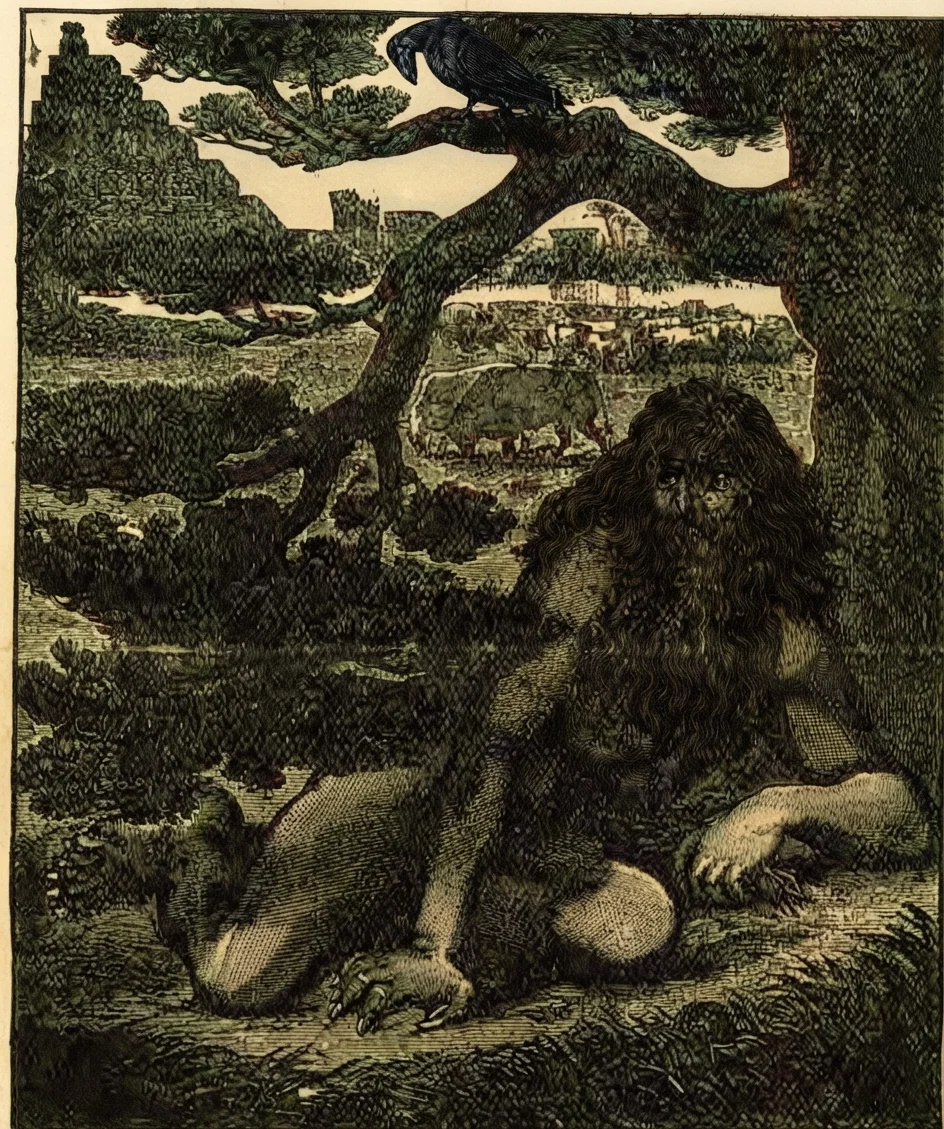
"At the end of twelve months he walked in the palace of the kingdom of Babylon. The king spake, and said, Is not this great Babylon, that I have built for the house of the kingdom by the might of my power, and for the honor of my majesty? While the word was in the king's mouth, there fell a voice from heaven, saying, O king Nebuchadnezzar, to thee it is spoken: The kingdom is departed from thee. And they shall drive thee from men, and thy dwelling shall be with the beasts of the field; they shall make thee to eat grass as oxen, and seven times shall pass over thee, until thou know that the Most High ruleth in the kingdom of men, and giveth it to whomsoever he will. The same hour was the thing fulfilled upon Nebuchadnezzar; and he was driven from men, and did eat grass as oxen, and his body was wet with the dew of heaven, till his hairs were grown like eagles' feathers, and his nails like birds' claws."
"Seven times," as is shown from other scriptures, and so reckoned in Josephus' "Antiquities," means seven years. The humiliation of Nebuchadnezzar consisted of his being deprived of his reason, and his mania was to act like a beast. This affliction came upon him the same hour in which the voice from heaven announced the decree. But the kingdom was preserved for him during all the years of his affliction, as indicated by the "stump" of the tree in the dream. He tells the story of his restoration, and of his entire submission to God, in the following graphic language:—
"And at the end of the days I Nebuchadnezzar lifted up mine eyes unto heaven, and mine understanding returned unto me, and I blessed the Most High, and I praised and honored him that liveth forever, whose dominion is an everlasting dominion, and his kingdom is from generation to generation; and all the inhabitants of the earth are reputed as nothing; and he doeth according to his will in the army of heaven, and among the inhabitants of the earth; and none can stay his hand, or say unto him, What doest thou? At the same time my reason returned unto me; and for the glory of my kingdom, mine honor and brightness returned unto me; and my counselors and my lords sought unto me; and I was established in my kingdom, and excellent majesty was added unto me. Now I Nebuchadnezzar praise and extol and honor the King of heaven, all whose works are truth, and his ways judgment; and those that walk in pride he is able to abase." Dan. 4:34-37.
It will be noted that the king did not make any more decrees of extermination against those who did not acknowledge the God of heaven.He had at last seen the necessity of humbling himself before God, and the man who does this will not make or advocate laws to coerce the consciences of others. The man who has a heart to truly "praise and extol and honor the King of heaven," will love his neighbor as himself. And none but the most deluded fanatic will think of inflicting bodily punishment upon himself as a means of securing peace with God. There is a wide difference between the acknowledgment of God on the part of Nebuchadnezzar actuated by policy and Nebuchadnezzar converted.