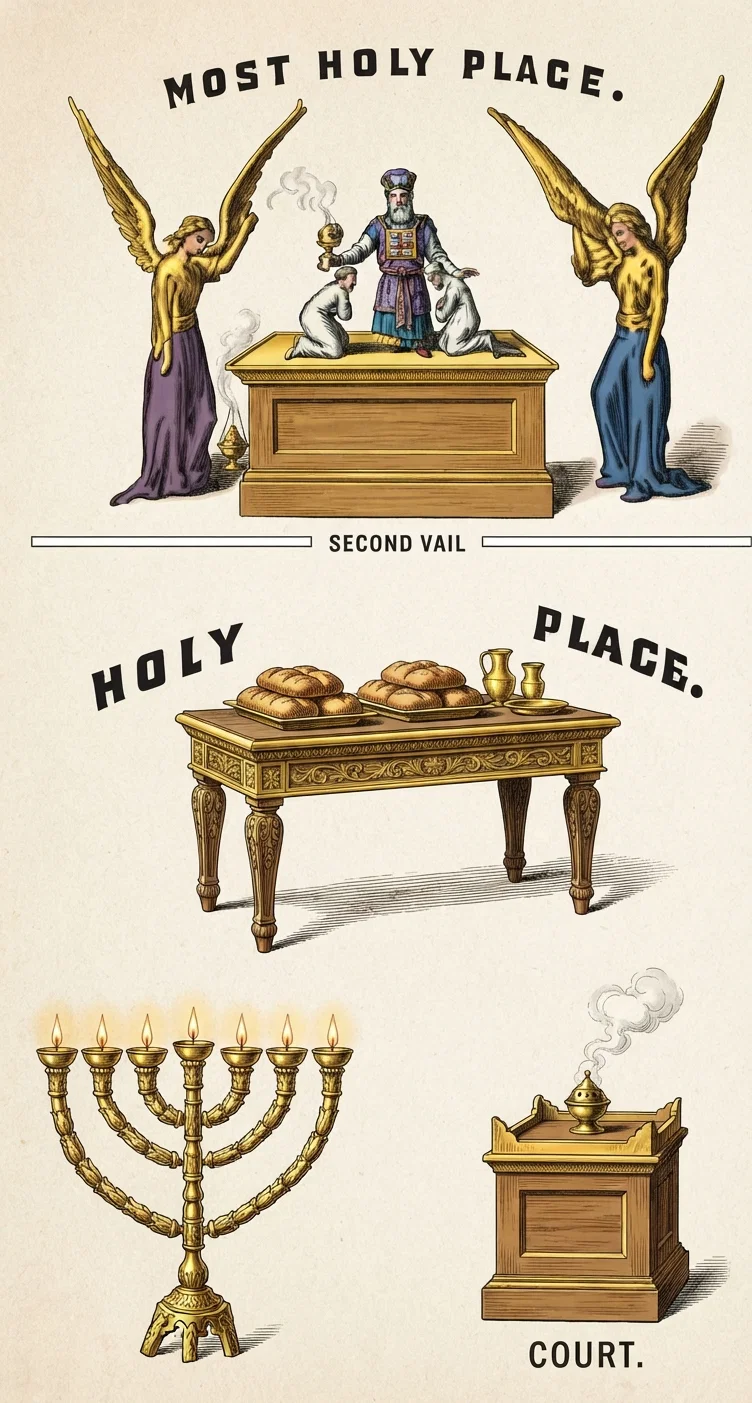
Third Proposition.—The Ten Commandments, spoken by God upon Mount Sinai, written upon two tables of stone with the finger of God, and delivered to the children of Israel, is the law of the universal government of God. In other words, the law delivered to Israel was only a duplicate of the one which is the foundation of God's throne.
This is a very important proposition, and, if true, should forever settle the question as to which day is the Sabbath in this dispensation. To substantiate the above proposition, we call attention to the sanctuary built by the children of Israel, and the one in which Christ now ministers. The sanctuary built by the children of Israel was "patterned" after one in heaven. Ex. 25:8, 9; Acts 7:44. "We have such an high priest, who is set on the right hand of the throne of the majesty in the heavens; a minister of the sanctuary, and of the true tabernacle, which the Lord pitched, and not man." Heb. 8:1, 2. "It was therefore necessary that the patterns of things in the heavens [the earthly sanctuary] should be purified with these; but the heavenly things themselves [sanctuary above] with better sacrifices than these." Heb. 9:23. In this text, the sanctuary of the old dispensation is called a pattern of things in heaven. We now wish to show that both sanctuaries had two apartments: "And thou shalt hang up the vail under the taches, that thou mayest bring in thither within the vail the ark of the testimony; and the vail shall divide unto you between the holy place and the most holy." Ex. 26:33.
These holy places were "figures" of the holy places in heaven. "For Christ is not entered into the holy places made with hands [made by the children of Israel], which are the figures of the true [pitched by God, Heb. 8:2]; but into heaven itself, now to appear in the presence of God for us." Heb. 9:24.
A vail hung between the two apartments of the earthly sanctuary, and we also read of a vail connected with the sanctuary of heaven. "Which hope we have as an anchor of the soul, both sure and steadfast, and which entereth into that within the vail; whither the forerunner is for us entered, even Jesus, made an high priest for ever after the order of Melchizedek." Heb. 6:19, 20.
Not only was the sanctuary patterned after the one in which Christ ministers, but the instruments, or articles of furniture, used in the sanctuary, were "patterned" after those of the sanctuary of heaven. Ex. 25:9, 40. If this be true, and we find certain articles in the sanctuary built by Israel, we shall find corresponding articles in the sanctuary pitched by God. In the earthly sanctuary they had a candlestick of pure gold, with seven lamps. Ex. 25:31-40. In the heavenly temple there are seven lamps of fire burning before the throne. Rev. 4:1-5. A description of the altar of incense is given in Ex. 30:1-8. That there is an altar of incense in the heavenly sanctuary, see Rev. 8:1-5. In the first apartment of the sanctuary were the candlestick and the table of showbread and the altar of incense.
In the most holy place of the sanctuary was the ark and that which pertained to it, to which7we now call attention. "And thou shalt make an ark of shittim wood," "and thou shalt make a mercy-seat of pure gold," "and thou shalt put the mercy-seat above upon the ark." "And thou shalt make two cherubims of gold," "and make one cherub on the one end, and the other cherub on the other end; even of the mercy-seat shall ye make the cherubims on the two ends thereof." "And there I will meet with thee, and I will commune with thee from above the mercy-seat, from between the two cherubims which are upon the ark of the testimony, of all things which I will give thee in commandments unto the children of Israel." "And in the ark thou shalt put the testimony that I shall give thee." Ex. 25:10-22. "And he gave unto Moses, when he had made an end of communing with him upon Mount Sinai, two tables of testimony, tables of stone, written with the finger of God." Ex. 31:18. "And I turned myself and came down from the mount, and put the tables in the ark which I had made; and there they be, as the Lord commanded me." Deut. 10:5.
We have mentioned above the "ark," "mercy-seat," "cherubim," the Ruler of Israel "between the cherubim," and the "testimony," or the Ten Commandments. We shall find the same in the sanctuary of heaven, where Christ ministers.
Whatever we find in the sanctuary of heaven belongs to the universal government of God. If we can find an ark in heaven, and upon the ark cherubim, and between the cherubim, God as ruler, and in the ark the testimony, or Ten Commandments, then the "testimony" must be the law of the universal government. "And the temple [sanctuary] was opened in heaven, and there was seen in his temple the ark of his testament." Rev. 11:19. "The Lord reigneth; let the people tremble; he sitteth between the cherubims; let the earth be moved." Ps. 99:1. "O Lord of hosts, God of Israel, that dwellest between the cherubims, thou art the God, even thou alone, of all the kingdoms of the earth; thou hast made heaven and earth." Isa. 37:16.
In the above texts we have the "ark," "his testament," or his testimony, "the cherubim," and God the ruler, and all in heaven, belonging to the universal government. We can therefore come to no other conclusion than that the Ten Commandments given at Sinai were only a duplicate of the testimony in the ark of heaven, and of that which is the habitation of his throne. Ps. 89:14.
When we accept of Christ we become citizens of the universal government of God, we belong to the household of God. Our citizenship is in heaven. We are fellow-citizens with the saints. We belong to the "family" of God, of which some members are in heaven, and some upon earth. Eph. 3:15. Shall we obey the laws of the government to which we belong? If we do, and we have accepted of Christ, we will keep the law, which is the foundation of God's government, and the habitation of the throne upon which Christ sits as priest. This law embraces a Sabbath command, which says, "The seventh day is the Sabbath of the Lord thy God."
The Ruler of Israel communed with Israel, and gave commandment unto them, from between the cherubim, upon the mercy-seat, beneath which was the law of God. It would seem from this statement that the Ten Commandments was the constitution of that government. Any law or commandment given to Israel that conflicts with the Ten Commandments, would be unconstitutional. The constitution of God's universal government is the Ten Commandments. Satan's studied purpose has been to get some command in the church that conflicts with the law of God. The Sunday institution has for its authority the commandments of men, and, as it conflicts with God's law, or the constitution of his government, it is unconstitutional.
Those who framed the Constitution of the United States were not perfect in wisdom and knowledge, and so in the development of the government, amendments had to be made. God, being all-wise and having all knowledge, knew what would develop in his government, and will never need to make any amendments, to meet the demands of his government. The Ten Commandments are so perfect that God will never need to alter them, or add to them, tho some of his subjects should rebel against him. If God should alter his constitution because of sin, then God compromises with sin.