In a previous paper on “Socialism” contributed to “The Outlook” department of this journal, we saw that the spread of Socialism is one of the phenomenal facts of recent years. Twenty years ago the Socialist propaganda seemed like a mere dream. To-day vast numbers of thoughtful persons of all classes of society regard Socialism as the goal toward which society is inevitably moving. The progress of conviction in this direction has doubtless been quickened by the enormous growth of combinations, both of capital and of labor.
Very few of those, however, who cherish the conviction that Socialism is destined to become the ultimate form of human society, have ever clearly worked out in their own minds the program of Socialism. In truth, the ideas of many Socialists themselves are nebulous and indefinite. As to the program of actual procedure there are almost endless differences of opinion among them. Many intelligent Socialists decidedly oppose the adoption of violent or revolutionary schemes. They would bring about successive reforms just as rapidly as public opinion would warrant. Again, other leaders of the movement — for example, Jack London and Eugene V. Debs — would, as early as practicable, change the existing order radically and violently.
It looks as if the Socialist PROPAGANDA at least has come to stay. It is therefore imperatively urgent that we all should acquire a fair understanding of the goal to which the movement would conduct us. Socialism is not a system merely of amendment or reform. On the contrary, it declares every system of that sort to be wofully inadequate, and seeks to effect an entire renovation of the body social, to compass an economic and political revolution of momentous magnitude. It holds that the present condition of our industrial and social life is radically wrong, essentially unjust; and therefore demands that its whole character be revolutionized.
Socialism aims fundamentally to displace private capital by collective capital; that is, the substitution of collective ownership of all the means of production and distribution for the private ownership of such means. “The nationalization or municipalization of capital — that is the shortest phrase in which the scheme of Socialism can be expressed,” says Dr. Washington Gladden. The railways, the steamships, the factories, the furnaces, the machinery, the goods in warehouses and in transit, the mines, etc., would all be owned by the State. There would be no more private business or enterprise except, perhaps, on a very petty scale. Socialism does not seek to abolish capital, but capitalists. It would seek to accumulate vast stores of capital, but it would make it the common property of the whole people. All industry would thus be under government control. The civil service would include all of the population that would be engaged in the production and distribution of wealth.
As to the expediency of abolishing money as well as private capital, Socialists are not agreed. M. Schaeffle, a noted French Socialist writer, asserts that “it is a matter of history that money was never used in any closed economic circle; it would therefore have to disappear in any close economic community, such as that of Socialism.” The able German propagandist Hertzka, in his stirring little work “Freiland,” contends that money would be retained. Professor Graham thinks that it would be banished, and labor checks substituted for it. How, without a medium of exchange, any foreign trade could be carried on, is not easy to understand.
All staple commodities would be produced, then, under the direction of government officials. “The amount produced,” says Dr. Gladden, “would be determined by government statisticians and actuaries. The goods so produced would be transported by government conveyances to government warehouses, and would there be exchanged for labor checks, presented by those who had received them for services rendered in some department of State-managed industry.” Socialist authorities vary widely as to the basis of distribution. There is no agreement among them; and many of them refuse to commit themselves definitely on the question. One of the first things that would have to be determined under a Socialist régime would be the proportion in which the various classes of workers should share in the wealth produced. Schaeffle assumes that the distribution will be proportioned “to the amount and social utility of the productive labor of each.” Would it not, however, require more than human wisdom to calculate this in such a manner as to satisfy all classes of workers? Who could determine how many days’ work of a street-sweeper equal in “social utility” six days’ work of a music teacher or a civil engineer or a mineralogist? In a coöperative commonwealth these things would obviously have to be determined by a majority vote. The very nature of such a task seems quixotic. At any rate, it is easy to foresee that insuperable perplexities would arise in an effort to fix a schedule of wages.
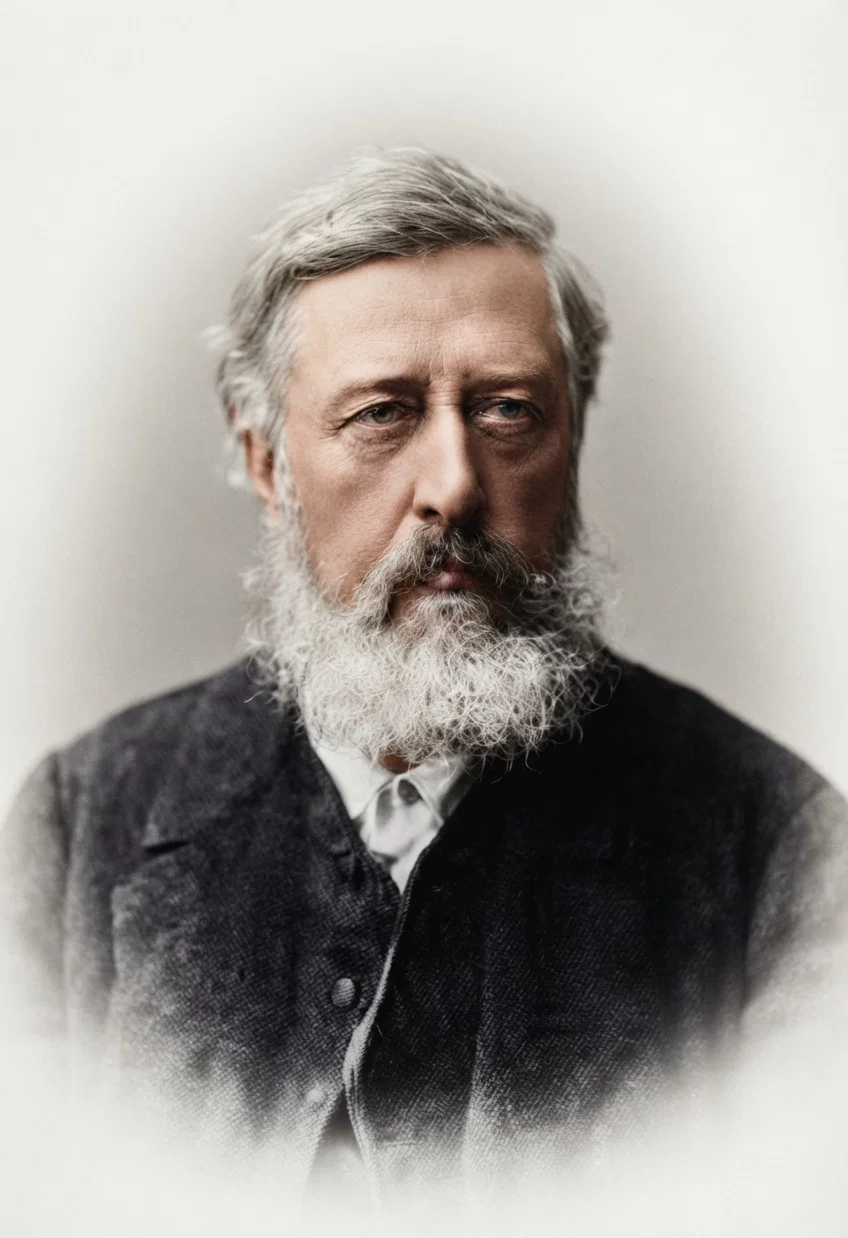
The late W. Liebknecht, said to have been the founder of German Socialism
Mr. Bellamy and not a few other Socialists would simplify the task by adopting a communistic distribution — equal incomes to all, without regard to their social utility or inutility. Such an “equal” distribution would be far from an EQUITABLE distribution. A German statesman has said that “nothing can be more unequal than the equal treatment of unequals.” By their industry, intelligence, disinterestedness, and skill, some persons would make a vastly larger contribution to this common fund than would a multitude of shirkers and spongers. Equal compensation to each of all these classes would be a travesty on justice.
Professor Ely, of Johns Hopkins University, aptly says: “If we take men as they are now, or as they are likely to be for a long time, we have every reason to believe that an assignment of nearly equal income would not enlist in Socialistic production the most capable members of the community in such a manner that they would give their best energies to the Socialistic State; but unless we could secure from the most talented members of the community willing service, Socialism would inevitably prove a serious failure. . . . It is much to be feared that men can not be socialized to that extent that they will generally accept the principle of equal reward for their services, even could it be shown that it were desirable. And it is impossible to show this, for quite the contrary is true.”
Every student of human nature knows, too, that large masses of the community can never be socialized enough to make them willing to work at all, if they could by any means escape the necessity of work. “The unemployed,” says Dr. Gladden, “are many, but a large percentage of these are not merely unemployed — they are unemployable.” How many, likewise, make it the chief end of life to get something for nothing — by scheming and plotting, contrive to wheedle their living out of society without giving anything serviceable in return for it! There is no prospect that the parasites of industry in this world will ever become extinct. No new arrangement of economic conditions would help this class of persons to subdue their chronic indisposition to apply themselves to methodical and patient industry. The difficulty here is one of character, and only God can change that.
Under the Socialistic régime, we are told, all will be compelled to labor except the invalids and the aged. The question of age is easily determined. But it is so easy for the lazy and the shiftless to feign invalidism! Skilled physicians might readily determine the presence or non-presence of physical infirmities, so that there would be no trouble on that score. On the other hand, there are manifold and painful affections of the nervous system which are not outwardly perceptible. How could the truth be ascertained in these cases? Should the naked word of all alleged sufferers be accepted as true, hosts of do-nothings would soon be living at the expense of honest workers; but should the claims of all of this class be rejected as unworthy of credence, how many innocent sufferers would be compelled to work or starve!
Again, Socialists are hopelessly divided as to the solution of the question of compensation to the expropriated class. There are those who would cut the Gordian knot by simply confiscating existing property for the benefit of the socialized commonwealth. But the more generous insist that some compensation be given to the dispossessed. Many of the latter seriously propose the plan of putting such compensation on the basis of a terminable annuity, “by which an amount equal to the interest on the capital expropriated should be allowed for a certain number of years, after which the ex-capitalists and their descendants must take their places in the ranks and work for their living like other people.” But, as Dr. Gladden points out, such a compensation would, in some cases, enable the expropriated to spend profusely.
By way of illustration, Dr. Gladden says: “Let us suppose that our friend Mr. Carnegie were thus relieved of his burdens; let us imagine that in return for his estate of three hundred millions, an annuity equivalent to three per cent upon that sum were guaranteed11to him and his heirs for thirty years. Labor checks supposed to be equal in value to this interest of nine million dollars would then be handed over to him annually. It is evident that he would be able to get all the groceries and dry-goods and millinery and drugs and medicines that he would need out of that annual income; and he might even build several libraries and a yacht or two, and own several automobiles, and employ a great many servants.” The doctor goes on to show that Mr. Carnegie, if he were so determined, could conjure up some way of GAINFULLY employing his surplus income. In all ages there have been governments that made the taking of interest a crime. The socialized State might do this. But the thrifty and avaricious have always been able to circumvent such laws. There are not a few ways by which the practise of illicit usury is made easy. It is seen that our expropriated millionaires would under even the most radical Socialist régime be equipped for luxury and even for hoarding. Hence not only a leisure class but even an oppressive capitalist class could be perpetuated.
Prof. Robert Flint, head of the department of sociology at the University of Glasgow, is the author of this suggestive antithesis: “Socialism is the exaggeration of the rights and claims of society, just as Individualism is the exaggeration of the rights and claims of individuals.” Both Socialism and Individualism comprise truths and errors. A true doctrine of society must obviously include the truths, while excluding the errors, of both. The writer believes that here, as in all things, there is a golden mean. The Scylla of out-and-out Individualism is to be shunned equally with the Charybdis of out-and-out Socialism. Individualism would exclude all legitimate coöperation. Socialism would retard if not estop the development of such admirable qualities as self-reliance, personal courage, aspiration, and individual initiative. The French Socialist leader, M. Leroux, frankly says, “Socialism is a political organization in which the individual is sacrificed to society.” If this admission is true, how long could society endure under such a scheme, since the individual is the unit of society? Mr. Bradlaugh, the widely-read English Socialist, boldly avows, “Socialism denies individual private property, and affirms that society, organized as the State, should own all wealth, direct all labor, and compel the equal distribution of all produce.” This would mean, of course, the extinction of private enterprise.
But is not private enterprise essential to the production of independent, clear-thinking, self-reliant men, who can stand alone, speak their own minds, and each make his own “contribution to the sum of human welfare”? It will never do to make a man a mere cog in a wheel, a part of a machine. If a man is to make the most of himself, he must have his own footing, not only in the moral and spiritual realm, but in the material and economic as well. Is it not true that a man derives much of his intellectual and ethical discipline in the proper handling and using of property? True it is that he is seriously injured in the misuse of it; but this is true of the misuse of any other kind of responsibility. One's complete manhood depends on “knowing how to use every kind of power.”
We would not deny that there are many industries that can most advantageously be carried on coöperatively; in which the body politic furnishes the capital and directs the work. It is probable that every business or industry that is actually a monopoly would best be owned and managed by all the people through their government. Yet I am convinced that collective industry and enterprise could not long endure where individual industry and enterprise are not found. Training in exercising individual responsibility and initiative are indispensable in preparing men and women to take leading places in coöperative enterprise. We can never make men happy, contented, and thrifty by act of Congress.