IN our last issue it was shown, as generally agreed by all students of prophecy, that the four beasts of Daniel 7 refer to the empires of Babylon, Medo-Persia, Grecia, and Rome. The ten horns of the fourth beast are symbols of the ten kingdoms which were developed in
Western Rome between the years of A.D. 351 and 476. The prophet saw come up among these ten horns another little horn, which increased in power above any of the other horns. We noted that the prophecy points out not less than eleven distinct specifications concerning the work and nature of that little horn, as follows:—
It was to arise out of the Roman Empire at the time of its division into ten kingdoms. Verse 8.
Three horns, or three kings, should be plucked up before it. Verses 8, 24.
It would start small and manifest great strength and assumption; it "spake very great things," and its "look was more stout than his fellows." Verse 20.
It should be "diverse" from the ten kingdoms; it would possess a different form of government. Verse 24.
It should be shrewd and far-seeing. The other kingdoms are represented by blind horns of a beast; but the little horn had "eyes like the eyes of a man," showing its superior, far-seeing shrewdness. Verses 8, 20.
It should be a blasphemous power, speaking words against God. Verses 11, 20, 25.
It should "wear out the saints of the Most High;" that is, it would be a persecuting power. Verses 20, 21, 25.
It should think to change the times and law of a power whose law it could only think to change, namely, God's times and law. Verse 25.
The saints and the times and the law should be given into the hand of this power for a certain definite time, called "time and times and the dividing of time." Verse 25.
Its power as a persecutor would be destroyed at the end of that time, and following that its dominion should be taken away. Verses 25, 26.
11. Yet it would at the very end of the age be a persecutor, showing that its power to persecute would be restored. Verses 21, 22.
Reader, note these specifications carefully. That power is remarkable indeed in which all of them could be fulfilled, and it is not in the least degree probable that they ever could be fulfilled in more than one. But the prophet declared that in one power should be manifest all these particulars, and the Word of God can not fail. What power or system is represented by this "little horn," this shrewd, crafty opposer of the truth of God. It is not men for which we are seeking in this, but systems, governments.
1. It was to arise out of a ten-divisioned (the Roman) empire. The ten kingdoms—Allemani, Franks, Burgundians, Vandals, Suevi, Visigoths, Saxons, Ostrogoths, Lombards, Heruli—were fully developed with the rise of the kingdom of the Heruli in A.D. 475-6. From that time to 493 there were just ten kingdoms in Western Rome, no more, no less. It was during this period that the little horn was to arise; and it is a truth well known by all familiar with history that during this very period that system known as the Papacy, centering around the bishop of Rome, had its rise. The Roman Catholic Church was fully developed as an organized body, somewhat after the fashion of the Roman State, in the beginning of the fourth century, especially under the influence of Constantine. And while the bishops of Rome assumed to be the head, their assumptions were not wholly recognized, nor had that see the power to enforce its assumptions. One writer (C. Gore, "Leo the Great," chapters 6 and 7) tells us that in the early centuries the bishops of Rome had been comparatively obscure persons; indeed, Leo [the Great, 440-461] was the first really great man who occupied the see, but he occupied it under circumstances which tended without exception to put power in his hand. . . . Circumstances were thrusting greatness upon the see of St. Peter; the glory of the empire was passing into her hands, the distracted churches of Spain and Africa, harassed and torn in pieces by barbarian hordes and wearied with heresies, were in no position to assert independence in any matter, and were only too glad to look to any center whence a measure of organization and strength seemed to radiate; and the popes had not been slow in rising to welcome and promote the greatness with which the current and tendency of the age was investing them. . . . The rule which governed Leo's conduct as pope was a very simple one; it was to take every opportunity which offered itself for asserting and enforcing the authority of his see; he was not troubled with historical or scriptural doubts or scruples which might cast a shadow of indecision . . . on his resolutions and actions. To him the papal authority had come down as the great inheritance of his position; it was identified in his mind with the order, the authority, the discipline, the orthodoxy which he loved so dearly; it suited exactly his imperial ambition, in a word, his "Roman" disposition and character, and he took it as his single great weapon against heresy and social confusion.—Quoted by Larned, History for Ready Reference, vol. IV., p. 2422.
As Leo the Great gathered up in himself the ambition of his predecessors, who aspired to rule, so the successors to Leo builded on his ambition and foundation. He was hailed as the "Deliverer of the Empire." It was during this very period that the little horn was rising to power.
“A FRIGHTFUL STORM.”
Three Kingdoms Fall.
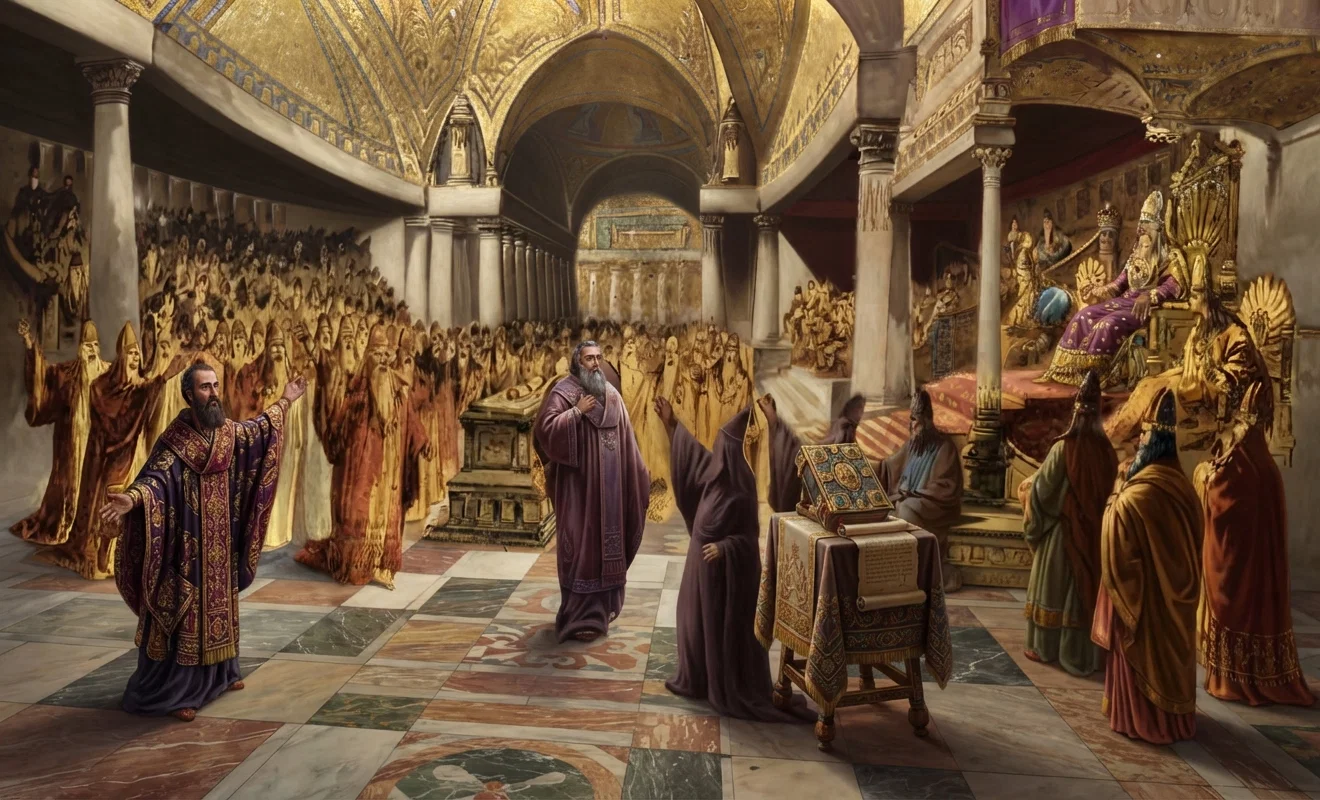
2. "Before whom there were three of the first horns plucked up by the roots." Dan. 7:8. "Before whom three fell." Verse 20. "Shall subdue three kings." Verse 24. Not all the divisions of the Roman Empire were favorable to the assumptions of the Roman Catholic Church and the see of Rome. Three of these fell, the Heruli (493), the Vandals (534), the Ostrogoths (538). The see of Rome was Trinitarian; these powers were Arian; and their destruction became necessary to the establishment of the little horn as a dominant power in the world in religious matters. The fall of the last of these powers came in connection with a remarkable act on the part of Justinian. In the endeavor to settle the religious controversy, he declared that Jesus Christ was "in the strictest sense one of the Trinity," and that Mary was "truly the Mother of God," and appealed to the pope against the recalcitrant ecclesiastics, to confirm his opinion. In the letter of his appeal, which has the force of a decree as regards the position of the emperor, the civil power, are the following statements:—
Justinian, pious, fortunate, renowned, triumphant; emperor, consul, etc., to John the most holy archbishop of our city of Rome, and patriarch: . . .
Rendering honor to the apostolic chair, and to your Holiness, . . . we have hastened to bring to the knowledge of your Holiness all matters relating to the state of the churches. It having been at all times our great desire to preserve the unity of your apostolic chair, and the constitution of the holy churches of God which has obtained hitherto, and still obtains.
Therefore we have made no delay in subjecting and uniting to your Holiness all the priests of the whole east. . . . We can not suffer that anything which relates to the state of the church, however manifest and unquestionable, should be moved without the knowledge of your Holiness, who are the
Head of all the Holy Churches.—Croly on the Apocalypse, pp. 167-171, second edition, 1828, London.
The above letter was written in 533. The same year, March 25, in a letter to Epiphanius, Justinian refers to his letter to the bishop of Rome, and, says Croly, "repeats his decision that all affairs touching the church shall be referred to the pope, 'Head of all Bishops, and the true and effective Corrector of Heretics.'"
In the same month of the following year, the pope returned an answer repeating the language of the emperor, applauding homage to the see, and adopting the titles of the imperial mandate. He observes that among the virtues of Justinian, "one shines as a star, his reverence for the apostolic chair, to which he has subjected and united all the churches, it being truly the Head of all; as was testified by the rules of the Fathers, the laws of princes, and the declarations of the emperor's piety."
But this letter of Justinian is not all the evidence of this action concerning the see of Rome. The 131st edict of the "Novellae" of the Justinian code, on ecclesiastical titles and
privileges, chapter 2, states: "We therefore decree that the most holy pope of the elder Rome is the first of all the priesthood." The archbishop of Constantinople was given second rank. The 9th edict states that in Rome "was the supremacy of the pontificate."—Croly.
But the supremacy of the bishop of Rome as Head over all the Churches and Corrector of Heretics could not take place while Arian and opposing powers dominated Rome. The Arian Ostrogoths stood in the way of the papal supremacy and its spiritual domination. Justinian sent his general Belisarius to suppress them, and they fell in 538, the last of the three kingdoms plucked up to make place for the "Corrector of Heretics." Here began the time, times, and half a time, or 1,260 years, of Dan. 7:25; Rev. 12:6, 14; and 13:5. (For a fuller discussion of this matter see chapter 22 of "The Two Republics," by Alonzo T. Jones, published at this office.)
3. The little horn would manifest great
strength and assumption, altho its beginning was small. It spake "very great things;" its "look was more stout than his fellows." Dan. 7:8, 20. This has been true of the Papacy. Whether its claims as the vicegerent of the Son of God on earth, and similar claims, are true or not, all will agree that they are very great. As regards the strength of that system, it has certainly been greater than any of its fellows. Its stout looks did not belie it as a symbol of the Papacy. Nation and kingdom have fallen; some seemingly stronger to the natural man than the little horn have been blotted out and live only in history; the very strongest have been turned and overturned, but the Papacy exists still, and will exist as long as the prophetic word declares.
A Diverse Power.
4. It should be a "diverse" power from the other kingdoms among which it rose. "He shall be diverse from the first." Dan 7:24.
The other horns represented civil governments, with civil functions, in which religion had little concern. If established it was subject to the State. But the little horn symbolized a different power, a religio-political one, as shown by the fact that it is a persecutor. Its power was especially exercised in the wearing out of a certain class, considered by itself "Heretics." This was the very power implied in Justinian's letter and code—Head over all the churches and true and effective Corrector of Heretics. This must include authority to rule in spiritual things, to define heresy, and power to execute the sentence imposed upon the heretic. This we will denominate the spiritual domination of the Papacy. It came into exercise in the light of the prophecy when the authority to rule in spiritual things and3define heresy was recognized by the State, and opposition brought under control. The recognition of the authority implies the furnishing of the power to make it effective. This power has been furnished by the various governments which have owned the papal sway. The Papacy has defined heresy, adjudged the punishment, and handed the culprit over to the civil power to be punished. This spiritual domination of the Papacy began in 538. It did possess temporal power as ruler over the States of the Church, but this was a rule of a different character, and given at a later date, 735. While this temporal dominion as a civil ruler over one State added prestige to the spiritual domination over the Roman world, which began in 538, the spiritual domination was not dependent upon it. Bearing in mind this distinction will save us from confusion.
5. The little horn represents a power which should be shrewd and far-seeing. "In this
horn were eyes like the eyes of man." Dan. 7:8, 20. The civil divisions of Rome were represented by blind, insensate horns on the head of a beast. A beast looks only to the present—present desire, pleasure, passion, rage. But man plots and plans for the future. The little horn had the eyes of man, connected with the brute force of the beast. What striking symbols are these of the kingdoms of the earth and the Papacy! Like the beasts, the governments of earth have contented themselves with present contest, defense, security; but, as no power that ever before existed, the papal system, in her scheme of education, in her methods of working, in her theology, in every phase of her operations, has planned for future conquest, dominion, glory. How could the blind kingdoms of earth hope to cope with such a power?
6. The little horn symbolizes a blasphemous power. "He shall speak great words against the Most High." Dan. 7:25. And the Papacy has fulfilled this. Vicegerent of the Son of God, King of kings, Lord God the Pope, the Head of the Church, the Arbiter of the destinies of men, having power to save or to destroy, and infallibility of teaching, are among the claims which this system has assumed, things which Deity holds in its own power. Pope Nicholas said to the emperor Michael, "The pope who is called God by Constantine, can never be bound or released by man; for God can not be judged by man."—Daniel and the Revelation, p. 136.
Persecution, and Why?
7. The little horn symbolizes a power that should "wear out the saints of the Most High." Dan. 7:25. "It was given unto him to make war with the saints." Rev. 13:7. Has the Papacy done this?—Indeed it has. The millennium of her supremacy has been one great field of war and strife and persecution and bloodshed, lighted by the auto da fé of many a Christian martyr. It is estimated by some that fifty millions or more died on account of "heresy" during the time of papal supremacy.
And yet the persecutors felt justified in doing it. To-day Roman Catholics defend the Inquisition as necessary to purge "the church" of heresy and the State of treason. They felt that they were doing God service. It was to them a duty to rid the church of the enemies of "the church." Yet the church does not hold herself responsible for those who were put to death by the civil power. These she claims were enemies of the State. But what are the facts?—Simply these: The State was induced to enact religious dogmas into civil law, and then to maintain her own standing her rulers were forced to proceed against those adjudged by the church as heretics. But it was religious persecution pure and simple.
But do not think, reader, that these men who persecuted during the Dark Ages were worse than men of to-day. They were not. Many of them were honest, warm-hearted men. Why then did they persecute?—Because they did not know Jesus Christ and his Gospel, and had connected themselves with a system and committed themselves to principles, which put man in the place of God, made his children ministers of the law instead of the Gospel, and hence it became a part of their duty to judge and execute punishment. The evil lies in the principles, the system, which bound its followers in slavery and blindness. Like the Jews of old, had they known the wisdom of the Gospel, they would not have persecuted the followers of Christ, nor any one else. They did these things because they did not know God. See 1 Cor. 2:8; John 16:1-3.
We regret that we have not space to finish this subject in this issue; we will conclude it, the Lord willing, next week.