PORTO RICO

6%

Pacific Press Publishing Company · Oakland, California · Jan 11, 1899

FromSigns of the Times, Vol. 25, No. 2.

Read the full edition

PORTO RICO.

As this newly-acquired possession of the United States is now a mission field toward which all Protestants are looking with interest, a few points about the country and people may be deemed profitable information. The following is from an article in The Outlook, by Col. W. Winthrop, U. S. A.:—
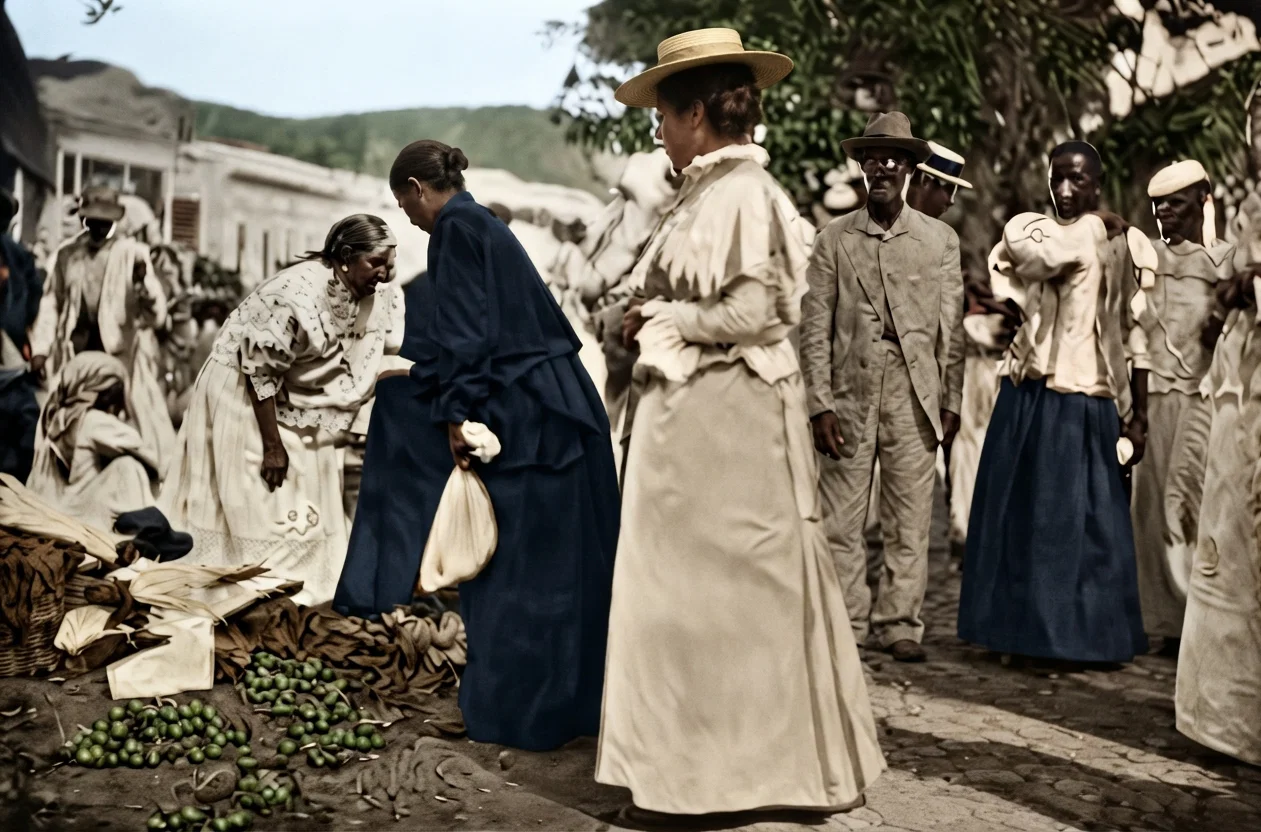
A MARKET SCENE IN PORTO RICO.
The island of Porto Rico, or Puerto Rico (Rich Port), is the fourth in size of the Greater Antilles, being exceeded by Cuba, San Domingo, and Jamaica. It is situated nearly in the center of the Archipelago of the West Indies, between the seventeenth and nineteenth parallels of north latitude, and the sixty-sixth and sixty-seventh meridians of longitude. The island, in shape, is an irregular parallelogram, being a little under 100 miles long by about one-third of that distance broad. It is some 270 miles in circumference, and contains about 3,600 square miles. (Somewhat less than the area of Connecticut.)
Unlike its neighbors, this fortunate island has scarcely been disturbed by internal disorders. The movement in favor of a republic, which began in 1820, was checked, without bloodshed, through the vigorous and judicious action of the able Governor de la Torre. When, more recently, in 1867, an insurrection, in sympathy with that of Cuba, was initiated against the Spanish Government, its projectors were so terrified by an earthquake that they were induced to postpone their adventure, and a fresh rising in the following year was easily suppressed.
The surface of the island is broken and hilly. A low mountain ridge traverses it from east to west, ranging nearer the southern than the northern coast, with spurs extending northward. . . .
The climate is healthful for the tropics. The constant running streams, with the absence of stagnant water, doubtless contribute to purify the atmosphere. The island, well aerated throughout, is appreciably cooler and more salubrious than are the larger of the Antilles, or than the majority of the lesser Windward Islands, which have been termed the graves of foreigners. The mountain valleys, especially from November to April, enjoy a delightful climate, which has been likened to a perpetual spring.
In the rainy season at the north of the island a sea breeze blows from 8 A.M. to 4 P.M., in the absence of which life would hardly be tolerable near the coast. The rains, which are frequent and plentiful in May and June, come down in August and September "with the fury of a deluge." On the Southern coast there is much less rain, sometimes none at all even for ten or twelve months.
It is in August and September that the climate at the North is least healthful, especially for foreigners. Fever, dysentery, and scorbutic diarrhea are then to be guarded against, and a change to the mountains is desirable. These are also the months of the hurricanes, which have in some years proved so destructive and ruinous in their effects. "This dreadful scourge," writes Colonel Flinter, "which often visits the West Indies, may be considered as a great drawback to the planter, and is a great deduction from the value of West Indian property." . . .
The population of this densely-peopled island is about 800,000 (three-eighths of them negroes). Eves states it, under date of 1897, at 813,937. A series of fortunate circumstances, in combination with a sagacious government, has contributed to impart to the people a quality superior to any other of the West India Islands. In the first place, they have always been a purely agricultural people. Then, at an early period, the crown lands of the island were divided among the natives, who thus became a community of small proprietors, to which was given a new consistency and stability on their being formed into a body of disciplined militia.
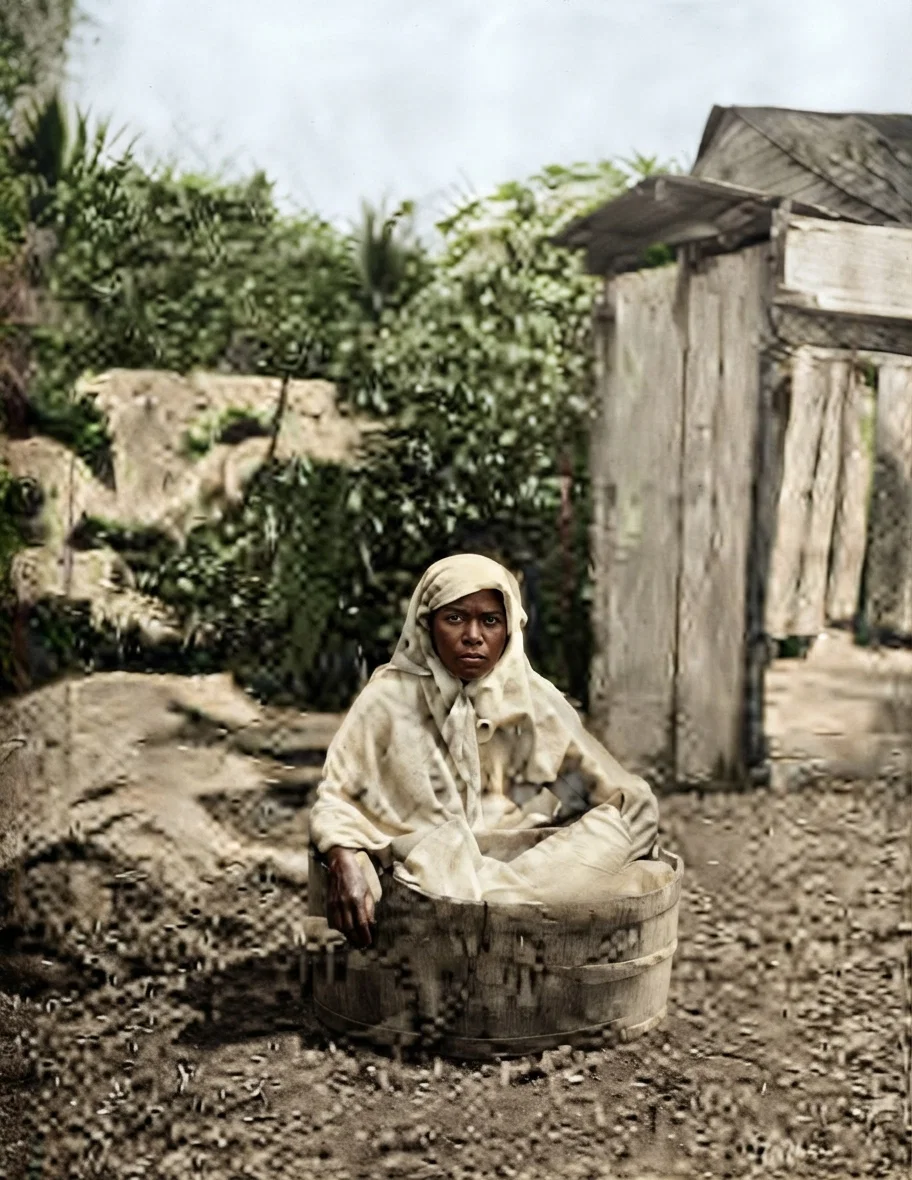
A Porto Rico Washer-woman.
Further, the island has not suffered to the same extent as its neighbors from the curse of slavery. The slaves were permitted to purchase their freedom on easy terms, and they have borne but a small proportion to the mass of the inhabitants. Thus, in 1873, when slavery was finally abolished, there were but few unemancipated persons left in the province. Valuable settlers have also come from San Domingo, Venezuela, and elsewhere. As a result, Porto Rico is one of the few countries of tropical America where the whites outnumber the blacks, and, it may be added, where the males outnumber the females.
There has thus been insured for Porto Rico a peasantry of free laborers—an industrious and self-sustaining population. Even the poor white Xivaro of the mountains or the interior is no burden upon the government, but, with his cow and horse, his acre of corn or sweet potatoes, his few coffee plants and plantain trees, he lives, with his family, an independent and happy existence. All the rural laboring classes, with entire simplicity of manners, unite in a frank cordiality and genuine hospitality to travelers and strangers.
The most popular vice appears to be gambling, especially in the form of cock-fighting. There are no beasts of prey, no noxious birds or insects, no venomous snakes or reptiles, to disturb the life of the inhabitants. There are no indigenous reptiles, no monkeys, and few birds. Rats are numerous and destructive, especially on the sugar plantations. . . .
Besides the capital, there are some sixty or seventy towns and considerable villages in the island. Of these the most important are Ponce and Arecibo (each with a larger population than San Juan, that of Ponce being about 35,000 to 40,000, while that of San Juan is estimated at 25,000), Mayaguez (also larger than the capital), and Aquadilla, on the west coast; Fajardo and Humacao, on the east coast; Guanica and Aroyo, on the south; and Pepino and Cayey, in the interior. Aquadilla is especially important as a rendezvous for communication and trade with Havana. Its extensiveand safe harbor has a depth of 11-15 fathoms. The best harbor, however, which is, moreover, readily defensible, is that of Guanica. Jobos, also on the south coast, has a good harbor, available as an outlet to the rich agricultural sugar district of Guayama. Other ports furnishing a shelter during a large part of the year are those of Mayaguez, Salinas de Coamo, Anasco, Cabo Rojo, and Bahia Honda.
Among the more attractive villages or smaller towns may be specified Yubacao, at the East, Toabago, in an "extensive and beautiful valley on the North coast, fronting the capital on the opposite side of the harbor," and Aybonito, on a table-land of the Southern mountains, "enjoying a cool and delightful climate." In the country near Ponce are thermal baths serviceable for invalids.