EDITORIAL

6%

Pacific Press Publishing Association · Mountain View, California · Oct 1, 1912

FromSigns of the Times, Vol. 39, No. 38.

Read the full edition

EDITORIAL

The Sabbath and the Creator

OUR English Bible begins with the statement of the work of the Creator in forming this earth. The steps in creation are followed through six successive days, and then we reach this declaration: "And the heavens and the earth were finished, and all the host of them. And on the seventh day God finished His work which He had made; and He rested on the seventh day from all His work which He had made. And God blessed the seventh day, and hallowed it; because that in it He rested from all His work which God had created and made." Gen. 2:1-3.
If we ask the foregoing text what God did after finishing the work of creation, it will tell us that He "rested." If we ask it again on what day He rested, it is equally plain in saying that He rested on "the seventh day." If we ask the text to tell us still further what He did with the seventh day after resting upon it, it will say that "God blessed the seventh day, and hallowed it." And do we ask the text why He blessed the seventh day and hallowed it, the answer is, "Because that in it He rested from all His work which God had created and made." Do we come to the text with the theory that one seventh part of time was blessed, and that it was no day in particular, we can get no support for our assumption; the words "the seventh day" are so definite and specific that the blessing and the hallowing of the sacred hours of time can not be made to apply to any day but the one that is definitely set apart by the act of the infinite Jehovah. It would seem that truths so plain would be above controversy, and that all could see them.
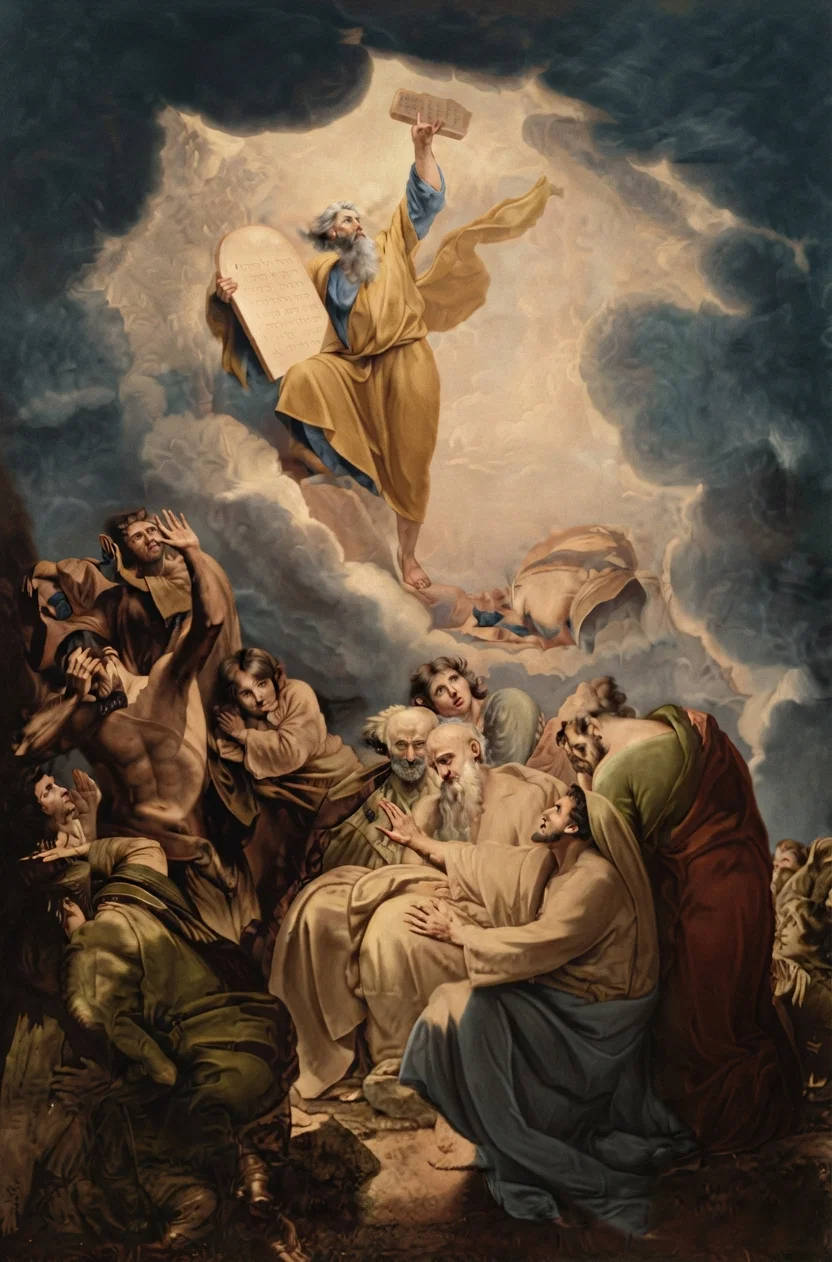
Benjamin West MOSES RECEIVING THE LAW AND COMMANDMENTS ON MOUNT SINAI
This first statement concerning the blessing and hallowing of the seventh day does not come in the form of a law. It comes rather in the form of a history of the institution of the day that God blessed and sanctified. But to show that there was a law concerning the seventh-day Sabbath before we come to Sinai, we have only to read the record in Exodus:
"Then said Jehovah unto Moses, Behold, I will rain bread from heaven for you; and the people shall go out and gather a day's portion every day, that I may prove them, whether they will walk in My law, or not. And it shall come to pass on the sixth day, that they shall prepare that which they bring in, and it shall be twice as much as they gather daily. . . . And when the dew that lay was gone up, behold, upon the face of the wilderness a small round thing, small as the hoar frost on the ground. And when the children of Israel saw it, they said one to another, What is it? for they knew not what it was. And Moses said unto them, It is the bread which Jehovah hath given you to eat. This is the thing which Jehovah hath commanded. Gather ye of it every man according to his eating; an omer a head, according to the number of your persons, shall ye take it, every man for them that are in his tent. And the children of Israel did so, and gathered some more, some less. And when they measured it with an omer, he that gathered much had nothing over, and he that gathered little had no lack; they gathered every man according to his eating. And Moses said unto them, Let no man leave of it till the morning. Notwithstanding they harkened not unto Moses; but some of them left of it until the morning, and it bred worms, and became foul: and Moses was wroth with them."
"And they gathered it morning by morning, every man according to his eating: and when the sun waxed hot, it melted. And it came to pass, that on the sixth day they gathered twice as much bread, two omers for each one: and all the rulers of the congregation came and told Moses. And he said unto them, This is that which Jehovah hath spoken, To-morrow is a solemn rest, a holy Sabbath unto Jehovah: bake that which ye will bake, and boil that which ye will boil; and all that remaineth over lay up for you to be kept until the morning. And they laid it up till the morning, as Moses bade: and it did not become foul, neither was there any worm therein. And Moses said, Eat that to-day; for to-day is a Sabbath unto Jehovah: to-day ye shall not find it in the field. Six days ye shall gather it; but on the seventh day is the Sabbath, in it there shall be none. And it came to pass on the seventh day, that there went out some of the people to gather, and they found none. And Jehovah said unto Moses, How long refuse ye to keep My commandments and My laws? See, for that Jehovah hath given you the Sabbath, therefore He giveth you on the sixth day the bread of two days; abide ye every man in his place, let no man go out of his place on the seventh day. So the people rested on the seventh day." Ex. 16:4-30.
The first part of the foregoing text affirms that the Lord will give the manna a day's portion at a time, that He "may prove them, whether they will walk in My law, or not." Thus it is shown that God had a law in that time. Otherwise how could He prove whether they would walk in it or not? Then we find that this law had the Sabbath commandment in it, for it was the Sabbath over which He proved them. They tried to keep the bread on the six working-days, but could not, for it became foul and bred worms; but it kept through the seventh day all right. And when some of the people went out on the seventh day to find the manna, they found none. Then it was that Jehovah, according to the text, "said unto Moses, How long refuse ye to keep My commandments and My laws? See, for that Jehovah hath given you the Sabbath, therefore He giveth you on the sixth day the bread of two days; abide ye every man in his place, let no man go out of his place on the seventh day."
Thus we see that the text affirms that Jehovah had given them the Sabbath. And it was by a constantly occurring miracle every day, and that right over the Sabbath itself, that He proved them, whether they would walk in His law or not. Nothing could be made plainer than the Scriptures make this truth. For forty years the children of Israel wandered in the wilderness, and for forty years there was a constant miracle every day to impress them with the Sabbath truth, and they could not make the seventh day in that time come anywhere in the week except on the seventh day. Some of them tried it by trying to keep the food on other days, but it would not keep. Andsome of them went out on the seventh day, but they could not find anything. It would seem that a scripture given in such plain language ought to be clear enough to satisfy any one. The individual who thinks to tell the Lord in the judgment-day that he could not understand such plain words, will hardly have power to open his mouth; he will be speechless.
In a few weeks after the giving of the manna, and this test of Sabbath observance, to see whether they would keep God's law or not, the Ten Commandments were proclaimed from Sinai. And in the very center of those commandments we find the command of the Sabbath. But when we read that commandment, we do not find it more definite than these texts that we have already examined. Indeed, it is in strict accord with the texts already given, thus showing conclusively that God required the observance of the Sabbath all through the ages before, as one of His great moral precepts. The Sabbath command reads:
"Remember the Sabbath day, to keep it holy. Six days shalt thou labor, and do all thy work; but the seventh day is a Sabbath unto Jehovah thy God: in it thou shalt not do any work, thou, nor thy son, nor thy daughter, thy man servant, nor thy maid servant, nor thy cattle, nor thy stranger that is within thy gates: for in six days Jehovah made heaven and earth, the sea, and all that in them is, and rested the seventh day: wherefore Jehovah blessed the Sabbath day, and hallowed it." Ex. 20:8-11.
It is easy for any one to see that this commandment points right back to creation. It refers directly to the same creative facts that are pointed out in the text quoted from the second chapter of Genesis. The testimony is unmistakably clear that the Sabbath is a memorial of creation, and thus points to Jehovah as the Creator of all things. The Sabbath, then, serves a great purpose. It is not given that men may merely have physical rest; but it is that they may have the seventh day of each and every week to devote exclusively to communing with their Creator, and to keeping alive in their minds that they worship a living God, that can create, and not a dead idol, that can do nothing. If men would take time to learn the real purpose and character of the Sabbath, they would not have so much trouble concerning it. They would certainly see that it is of such a nature that it could not be changed without blotting out all the past and doing all the work of creation over again.
When God gave that Sabbath law to Moses on Sinai, He wrote it on tables of stone. It is the only part of the Bible that was distinguished by being written on such a solidly enduring substance. And observe, too, that God wrote this law Himself. It is the only part of the Bible that He took the pains to write with His own finger. God inspired men to write all the rest of the Sacred Book; but when it came to His law, in which was His holy Sabbath, He wrote it Himself. Men had better think twice before they talk of changing a law that was given in such a way, and by the direct hand of the Infinite Himself. It is well to think of these facts when talking of the change of the Sabbath.
In the time of ancient Israel the Sabbath was a test to prove whether men would walk in the law of God or not. And in like manner it is a test to-day. There is no evading the issue. Men may quibble; but truth that is so plain can not be set aside.
T.