WITH the annexation of the Hawaiian Islands to the United States will come many pretty bits of their history. Among the best of such is one told me by a native "kanaka" while I was in the city of Honolulu.
In 1828 came the first American missionaries to the island of Oahu, H. I. Among the first converts was a young woman of the royal family, Kapiolani—then only eighteen years of age. The transformation of a native from barbarity and idolatry to Christianity and civilization is a wonderful transformation. It means more than we who have been brought up among Christian influences can easily understand. It means the breaking of home-ties; the loss of dear friends; the leaving behind many that will not come with us, and whom we long to have with us. Such was the case with this young woman. Her people and relatives were idolaters, and in order for her to serve Almighty God she must bid adieu to Pélé and the worshipers of Pélé. Yet, so strong was her faith in God that she willingly gave up her friends, relatives and home to be an outcast for the sake of her Master.
As she came to better learn of the love of Christ, she was not content with this; she must find some way to lead her people to this God who was so much stronger, purer and more merciful than Pélé. In doing this, she became one of the noblest heroines I have ever known. As is the habit of all idolaters to serve the largest or greatest thing the eyes of such people can find, so these people worshiped Volcano Kilauea, on the island of Hawaii. During the action of this volcano, small hairlike filaments are blown from its crater which resemble a woman’s hair—and from this the goddess is named "Pélé." So powerful was her wrath supposed to be, that no one was ever known to have looked into the crater where Pélé was enthroned. Such an action, it was declared, would cause the awful anger of Pélé, and the subject would at once be struck dead for such an attempt to see the throne of the goddess.
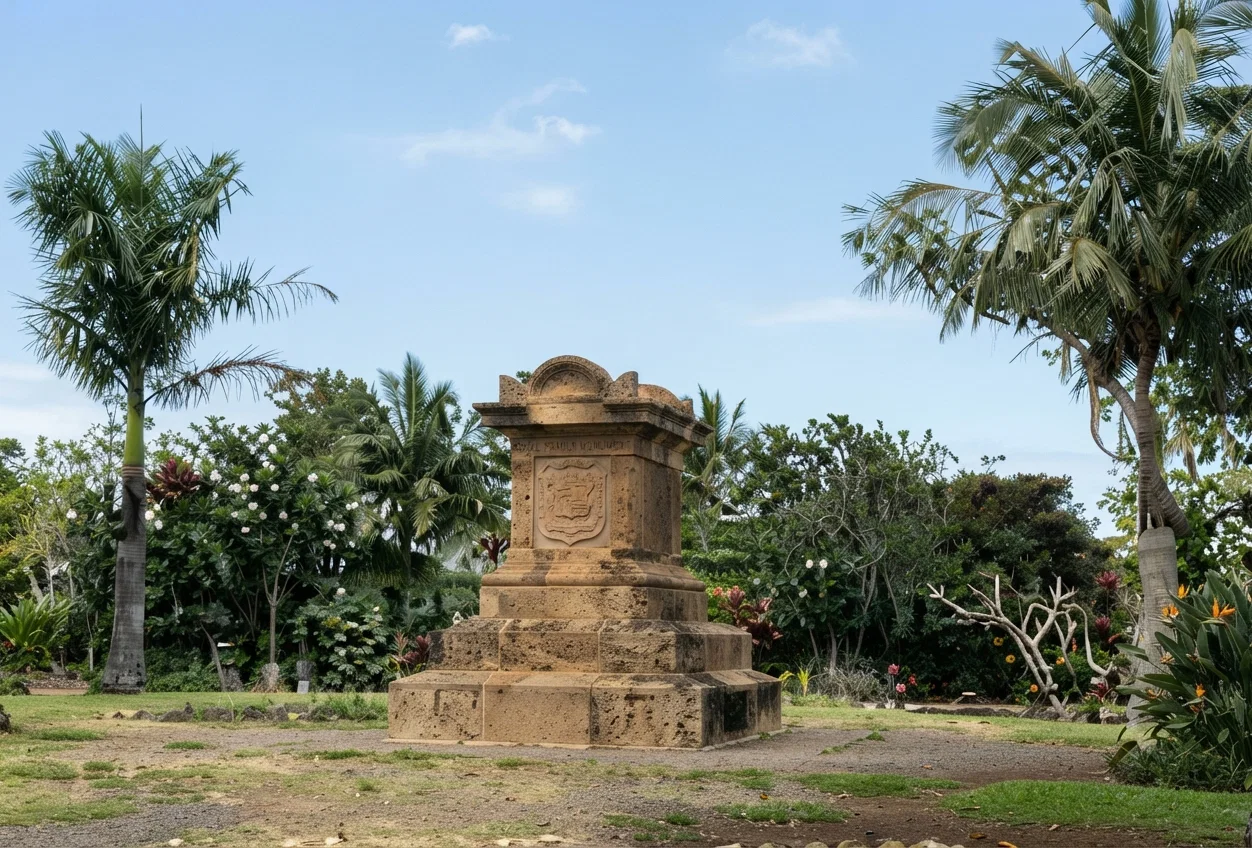
Royal Family Monument, Honolulu.
Yet this was just the means used by Kapiolani to prove the uselessness and depravity of idolatry and superstition. Coming to the foot of the great volcano, where a number of her people and relatives were gathered to see her test the power of Pélé, and among these King Kamehameha III., she spoke as follows: "I am now going to test the power of Pélé and Almighty God." Then she held in view a bunch of the berries held sacred to the goddess, and continued: "I shall go to the crater where you worship, I shall ascend to the top and challenge the wrath of Pélé; then if I am killed you will know Pélé was stronger than my God, and you shall serve your god, but if I am not killed, then your religion is a lie and you should serve my God." This was her farewell speech to her people, and she began her awful journey.
When near the crater she met one of the prophetesses of Pélé, who asked her if she was going to the crater to worship. "No," said Kapiolani, "I am going to test." She then began to ask her questions concerning the Scriptures, of which the prophetess had no knowledge, and finally asked her to come to the crater with her to see the test, which the prophetess, after some hesitation, agreed to do.
Arriving at the crater, Kapiolani at once climbed to its summit and challenged the wrath of the goddess. Waiting a moment for the wrath of the goddess, she held out the bunch of berries and began to eat the sacred fruit, at the center of their worship. Then she faced the assembly below and with clasped hands she raised her face toward heaven and thanked her Father for her deliverance from the awful superstition and wickedness of idolatry.
Queen's Palace, Honolulu.
No one who has never known the awful superstition and ignorance of a nation in such circumstances can imagine the courage required by this young girl to accomplish her mission of faith. She had been an outcast from home and friends, now her people could see the fruits of their superstition arrayed against that of the Almighty. If Pélé could not fulfil her power and uphold her rights as taught by her priests and prophets, certainly something must be radically wrong; and their religion after all must be a lie.
This act done by young Kapiolani was the means of the banishment of the service of idols on the islands. Altho the people were not ready to receive Christianity just then, the king commanded all idols to be destroyed, and himself helped to burn them. A few years later the fruit of this young girl’s faith was made public, when in 1839 one of the greatest revivals on the islands took place, and Christianity found a home there.
"She hath done what she could." She, alone in faith, rolled away the stone of superstition before the eyes of her people; she bathed their hearts in the Word of Truth, and she had shown them the way to everlasting Life. And, with all this, she had not asked "What reward am I to have?"