A COMING SCOURGE

7%

Pacific Press Publishing Company · OAKLAND, CALIFORNIA · Aug 2, 1899

FromSigns of the Times, Vol. 25, No. 31.

Read the full edition

A COMING SCOURGE.

AMONG the last-day evils, concerning which God warns His people, is what He calls "the northern army." Thus the prophecy opens:—
"Blow ye the trumpet in Zion, and sound an alarm in My holy mountain; let all the inhabitants of the land tremble; for the day of the Lord cometh, for it is nigh at hand; a day of darkness and of gloominess, a day of clouds and of thick darkness, as the morning spread upon the mountains; a great people and a strong; there hath not been ever the like, neither shall be any more after it, even to the years of many generations. A fire devoureth before them; and behind them a flame burneth; the land is as the Garden of Eden before them, and behind them a desolate wilderness; yea, and nothing shall escape them." Joel 2: 1-3.
Later in the chapter the Lord tells us that this great northern army is composed of the "locust, the cankerworm, and the caterpillar, and the palmer-worm," evidently four types of destructive insects. The ravages of the locust in the eastern hemisphere, and in our great western prairies is familiar to many. Not many years ago whole counties were laid waste and stripped of every green thing. At times the air was darkened by their approach. The palmer-worm, literally "feeder," is thought by some to be the larva of the locust, by some the cockchafer, by others the larva of some moth or butterfly.
The caterpillar, literally "devourer," is probably, says Smith's Bible Dictionary, a locust in larva state. The palmer-worm, the "pilgrim worm, a voracious, hairy caterpillar, the larva of some butterfly or moth" (Smith). This last is a good description of the gypsy moth, which has cost the commonwealth of Massachusetts, in direct appropriation, more than three-fourths of a million dollars to subdue, and private citizens even more, besides all the damage caused by its devastating raids. A brief account of its history in America is of interest.
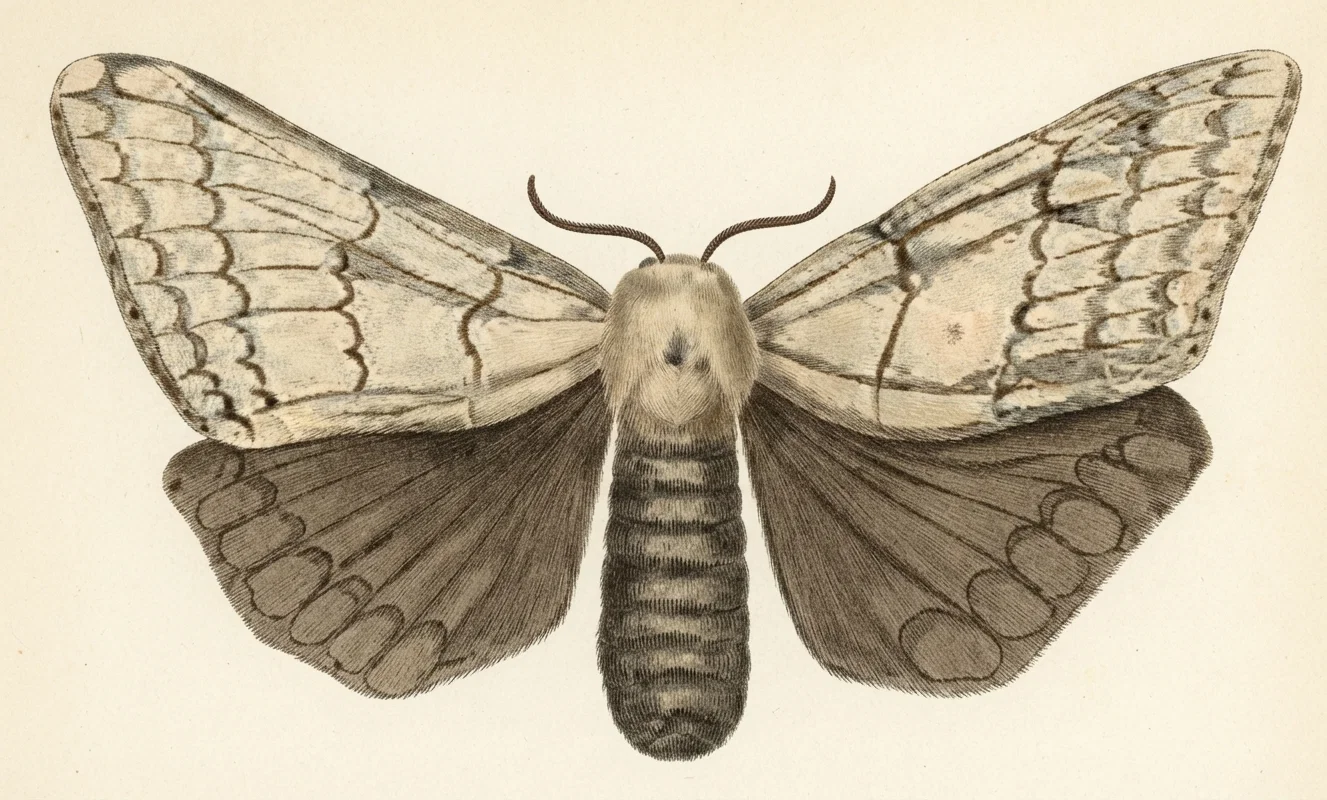
A little more than a quarter of a century ago a professor in Boston thought that he could cross the gypsy moth (so called from its wandering) with the Chinese silkworm moth, and so obtain a hardier silkworm. One of these moths escaped. The professor did all he could to secure it, notified others of its escape, but all failed.
Ten years ago that one moth had so increased that $25,000 was appropriated by the Legislature of Massachusetts for its extermination.
Men were employed to destroy the eggs. The next spring machines were invented for spraying the trees and destroying the caterpillars. But all this availed little. The sum of $50,000 was appropriated in 1890; the next year $100,000; the next $165,000, and so on and so on. Laws were passed; new devices used; Old World remedies were put in operation; lines were drawn around the district of the worm; parasites which fed upon the gypsy moth were imported from Japan, but all of little worth. In one town 75 children collected in 1893 68,000 egg masses, which, it is estimated, would have turned out at least 15,000,000 caterpillars. Millions of dollars have been spent in Massachusetts alone, and it was thought that the wandering moth had at least been confined to that State. But how vain are human devices even against little things!
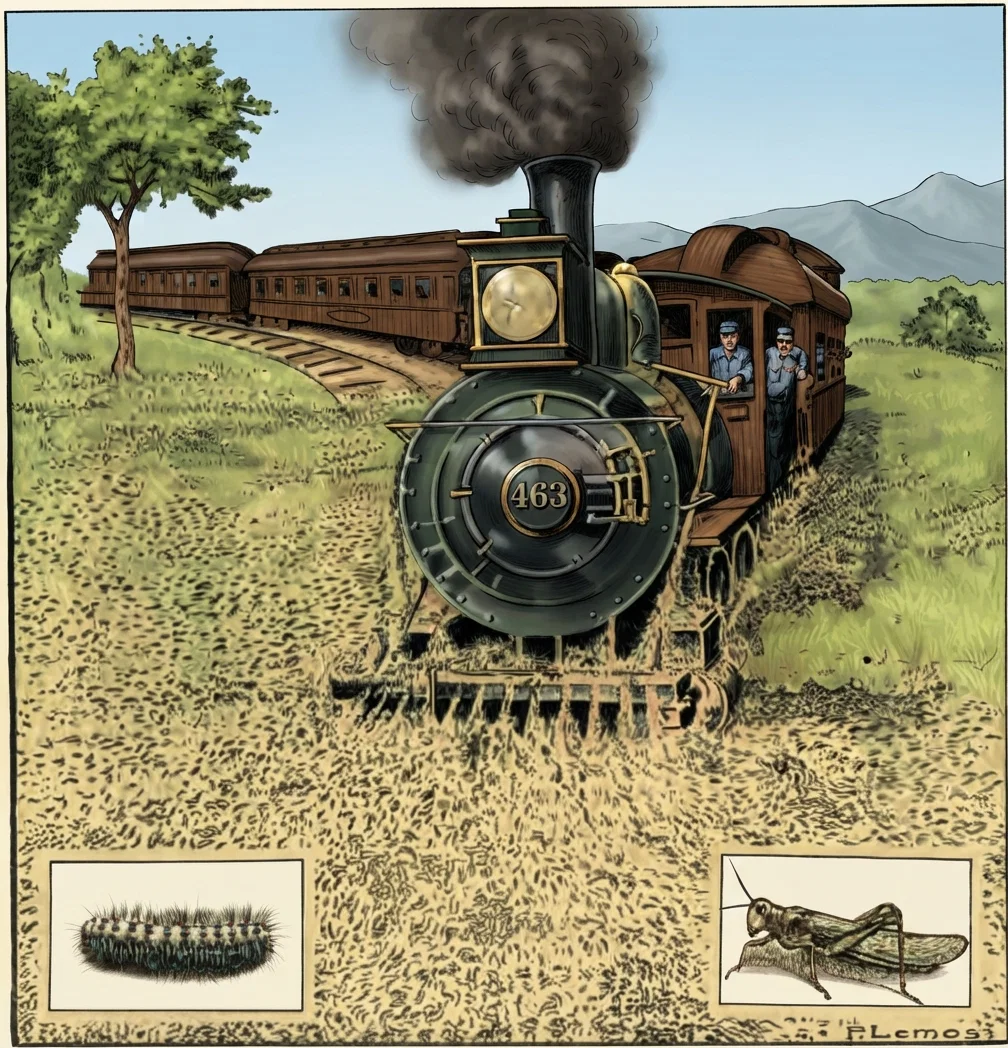
Only a short time ago, near Newport, Vt., a passenger train was actually held up by gypsy moths, a place where it was supposed they did not exist. Four times the train essayed, on a level track, to pass through the stream of caterpillars, said to be 200 feet wide and in places 8 inches deep, crossing the railway from one piece of woods to another. They covered the cowcatcher and lower parts of the engine. Their crushed masses of green and yellow gave forth a sickening odor, and the enormous quantity showed how utterly powerless it is for man to check the ravages of billions of little insects.
The Gypsy Moth.
The Gypsy Moth.
A Picture of the Train, of the Larva of the Gypsy Moth, and of a Locust.
Locusts were one of the plagues upon Egypt. Lice was another. The Lord declares in vivid language in the second chapter of Joel that the cankerworm, the caterpillar, the locust, and the palmer-worm are a great devouring army which shall ravage parts of the earth in the last days, and constitute one of the terrors of the time. Truly it is so, and man, with all his inventions and devices, is as powerless to prevent it as he is the tornado or the earthquake.
What shall be done? The Lord tells His people in this same prophecy; and that is to turn to Him with all the heart:—
"Therefore also now, saith the Lord, turn ye even to Me with all your heart, and with fasting, and with weeping, and with mourning; and rend your heart, and not your garments, and turn unto the Lord your God; for He is gracious and merciful, slow to anger, and of great kindness, and repenteth Him of the evil. Who knoweth if He will return and repent, and leave a blessing behind Him; even a meat offering and a drink offering unto the Lord your God?" Joel 2: 12-14.
Read the entire book of Joel; it is a prophecy of the last days more emphatically than it was of the days in which the prophet lived.