BILLY'S LUCK

1%

Pacific Press Publishing Company · Oakland, California · Jul 15, 1897

FromSigns of the Times, Vol. 23, No. 27.

Read the full edition

BILLY'S LUCK.

A Story for Boys.

BY SYDNEY DAYRE.
"I DON'T have any luck at all," said Billy sorrowfully to himself as he slowly walked toward his wretched home as night was closing in. "Only two errands to run to-day—one for ten cents and one for five cents."
"Got a horseshoe over your door?" asked one of his friends, a bootblack, to whom he had spoken.
"No. What good will that do?"
"Lots of good. Don't you know that there's luck in a horseshoe? Thought everybody knew that. Ever since I've had one over my door I've had all the work I could do. I just set out that time to try if there was anything in it, and I've had luck all the time."
"I know where there's a horseshoe," said Billy. "Found one in the street one day and chucked it under a board sidewalk."
"Get it out, then," said Jake. "I'll come round and help you get it top of the board over your door."
Jake was as good as his word and better, for he came bringing another horseshoe.
"Two are better than one," he declared.
"Miss Parsons says there's no such thing as luck," said Billy's sister, Hetty, as she heard what was going on.
"Well, we'll see," said Jake. "We'll watch now if Billy doesn't get up on his luck."
Billy brought out a wooden chair, on which he, with Jake's help, piled two or three boxes. On these Jake climbed up to reach the small ledge which projected over the door of the tenement house in which Billy's mother had two rooms on the ground floor.
"There!" said Jake as he set the two horseshoes carefully on end. "They're fixed all right."
"I can't see them," said Billy.
"Of course you can't. This shelf is in the way, unless you climb up there."
Billy did, and satisfied himself that they were so well placed as to make sure of good luck.
During the next few days he did his very best in the way of looking out for errands. Sometimes he thought he was doing better, but on the whole he began to feel that the horseshoes were not justifying the hopes based on them.
"Say," said Sam, a boy who lived in the room above Billy's, "let's us two go into partnership."
"What at?" said Billy.
"Selling papers."
"It's pretty hard work," objected Billy, who, to tell the truth, owed much of his ill-fortune to his laziness.
"You've got to work if you expect to get along," said the wise Sam. "Come on. We'll put in together and begin."
"O, I can't!" said Billy. "I've got to give all I get to mother every day."
Sam stood for a few minutes in thought.
"Say," he said, "I've got fifteen cents to begin on. That'll get six papers, and I'll divide with you, and when we get them sold, you can pay me back. Let's try our luck."
The partnership began and proved as successful as could have been hoped. Fired by the conviction that good luck must attend him, Billy worked as he had never worked before. Sometimes in going home for the evening he would strain his eyes when at the proper distance to get a view above the ledge at the horseshoes, which were so well proving their claim to be the bestowers of good-fortune. But it would be too dark for him to get a fair view of them; and in the morning he was always too much in a hurry as he started to work to remember to look back at them as he intended.
As the summer went on, some scarlet runners courageously made their way up the sides of the door. Some one had given a few seeds to Billy. He had rejoiced as the shoots first showed their dainty heads, and had so carefully watered them as they grew that in spite of the heat and dust they kept on until they met on the ledge above.
"Covering the horseshoes all up," said Billy, one day observing it with pleasure as he came near home. "But that won't spoil the luck at all."
The luck kept on. It was so delightful to Billy to bring his daily earnings to his mother, such happiness to see the glow of surprise and pleasure in her eyes, and to find comforts multiplying in the poor home, that Billy never thought of relaxing his efforts or going back to the old lounging days of looking for errands.
"Yes'm, it's a fine vine."
Billy had come home late one afternoon to find Miss Parsons, one of the teachers in the mission school near, making a visit to Hetty. She was a great friend of Hetty's, and Billy had often met her. He was pleased at her admiration of the scarlet blossoms.
"Billy planted them," said Hetty, who had a great admiration for her brother and his doings. "And it was Billy that bought that nice chair you're sitting in, ma'am, bought it for mother."
"That's nice," said Miss Parsons, warmly. "Billy must be doing well these days."
"Yes'm," said Hetty, with a beaming smile at Billy.
"It's all along of them horseshoes up there," said Billy, pointing above his head.
Hetty winked and shook her head at him in token that such things were not to be said before Miss Parsons, but Billy wilfully kept on.
"There's two of them up there. Jake Pratt says a horseshoe over your door always brings good luck. He and I put them up, and I've had the best kind of luck ever since. Hetty will tell you so," with a defiant smile divided between Hetty and Miss Parsons.
Miss Parsons returned the smile in full measure.
"I'm glad you have been so prospered, Billy," with a nod of sober confidence. "But are you sure the horseshoes had anything to do with it?"
"Sure as shooting," said Billy positively.
"I like," said Miss Parsons, "to look a little higher than the top of your door, Billy, to see where your blessings come from. There is a great white throne—not far from us, but kept from our sight just now. The Lord of heaven and earth is there, looking down in tenderest love and compassion on his children. All their blessings come from him. Even when he sends trouble and sorrow we know it must be in some way best, because he knows better than we can ever know what is best for us. He cares for us and will some day bring us to his own home. His loving compassion is over the very smallest and weakest of us. You believe all this, don't you, Billy?"
"Yes'm, I do."
"Then I don't quite like you to seem to be putting a horseshoe in his place—to be thinking the good comes from it."
"Ph-e-e-e-w!" Billy gave a long whistle. "I never, never thought of that before."
Miss Parsons was not in the habit of giving long lessons, so she went away, leaving Billy in deep thought.
"I believe it was the horseshoes," said a forlorn-looking little fellow who had drawn near. "I haven't got any horseshoes, and I haven't ever had any luck."
"Say, Tippy, I'll give them to you if you think they'll do you any good," said Billy. "No, you needn't bring out a chair, Hetty. I can get them from Sam's window."
He ran through a passage and up the stairs which led to Sam's room.
"I want to get the horseshoes," he explained to Sam as he entered the room.
"What horseshoes?"
"Those over our door."
"Were those yours?" Sam opened his eyes wide. "I didn't know they were. I took them ever so long ago. Put them with some old iron I had and sold them. Got that way the fifteen cents you and I went into business with."
Billy gave another whistle.
"Sam," he said solemnly after a pause, not able quite to give up his superstitious fancy all at once, "do you think our good luck could have been—just a little, you know—'cause of them horseshoes going into the money?"
"Well," said Sam, "not knowing much about horseshoes for luck, I can't say. But I think our good luck came of our setting in and working so hard. That's the only kind of luck that ever came to me."—Advance.
THAT the use of tobacco in some form is one of the most common causes of amaurosis, a form of blindness in which the nerve of sight is affected, is now generally recognized by medical authors, and by those who make a specialty of the treatment of disorders of the eye. Several cases of this form of blindness have come under the author's observation, and medical literature abounds in reports of these cases.
The following list of symptoms of tobacco-blindness every smoker would do well to commit to memory and think of every time he lights a pipe or cigar:—
Sudden or gradual impairment of vision; a blurring of objects; ability to see better in twilight than in full daylight; difficulty in distinguishing colors, especially red and green; after a time, partial, or complete and permanent loss of vision. In cases in which the disease has existed for a short time, and has not advanced to its worst stages, recovery takes place with great rapidity when the use of tobacco in all forms is wholly discontinued. In other cases, however, the impairment of vision which follows the long-continued poisoning of the nervous system with nicotine is permanent, not yielding to any known method of treatment. Probably the most frequent of all causes of this form of blindness are tobacco and alcohol, the effects of which are so nearly identical in these cases as to defy distinction.
The symptoms named as indicative of the approach or presence of tobacco-blindness, are all significant of the universal mischief in the vital economy of which the poison of tobacco is productive. The blurring of sight, dilated pupil, and ability to see better after twilight than in full daylight, are all evidences of paralysis. The little muscle which contracts the pupil is paralyzed by the nicotine, and allows the pupil to dilate. This lets in too much light, and confuses the images formed on the retina. This is why the person sees better after twilight.
The little muscles of the heart are in the same condition as those of the eye. The same is true of the muscles of the stomach. It is this paralyzing influence upon the muscles that does much of the mischief attributable to tobacco.
Another symptom connected with the eye, which the confirmed smoker may often notice, is the long retention of bright images in the eye. If a person looks at a bright object, as a window when the sun is shining out-of-doors, and then closes the eyes, or looks at a blank wall or a sheet of white paper, he will still see the form of the window, the sash bars, the glass, etc., for a few seconds. If the eyes are in a healthy condition, the image disappears very quickly, but when the nerves of the eye have been partially paralyzed by the use of tobacco, these images will sometimes remain for several minutes.

Ear Disease from Tobacco-using.

Tobacco-users are sometimes afflicted by a peculiar form of ear disease, the chief symptom of which is sudden loud or shrill sounds in the ears. These sounds are sometimes due to an enormous exaggeration of slight sounds, as a chirping of a cricket, the ringing of a bell, or some similar source of sound, but generally the sound is wholly subjective, that is, originates entirely in the ear, and is due to the diseased condition of the auditory nerves resulting from the use of tobacco.
These facts have been widely known for years, and yet they seem to have little influence with the users of the weed. So great is the fascination of this most unclean and injurious habit, most persons who have been long addicted to its use continue to indulge notwithstanding the clearest evidence that they are being seriously injured thereby.
The effect of the long-continued use of the narcotic is to paralyze the will and to weaken the judgment, so that considerations which would influence a man in the full, healthy command of his intellectual powers have but little weight with an old devotee of the pipe or the quid. Knowing full well the consequences, he will deliberately sit down to smoke or chew his favorite brand of the poisonous stuff as complacently as he would seat himself to partake of a meal of wholesome food.
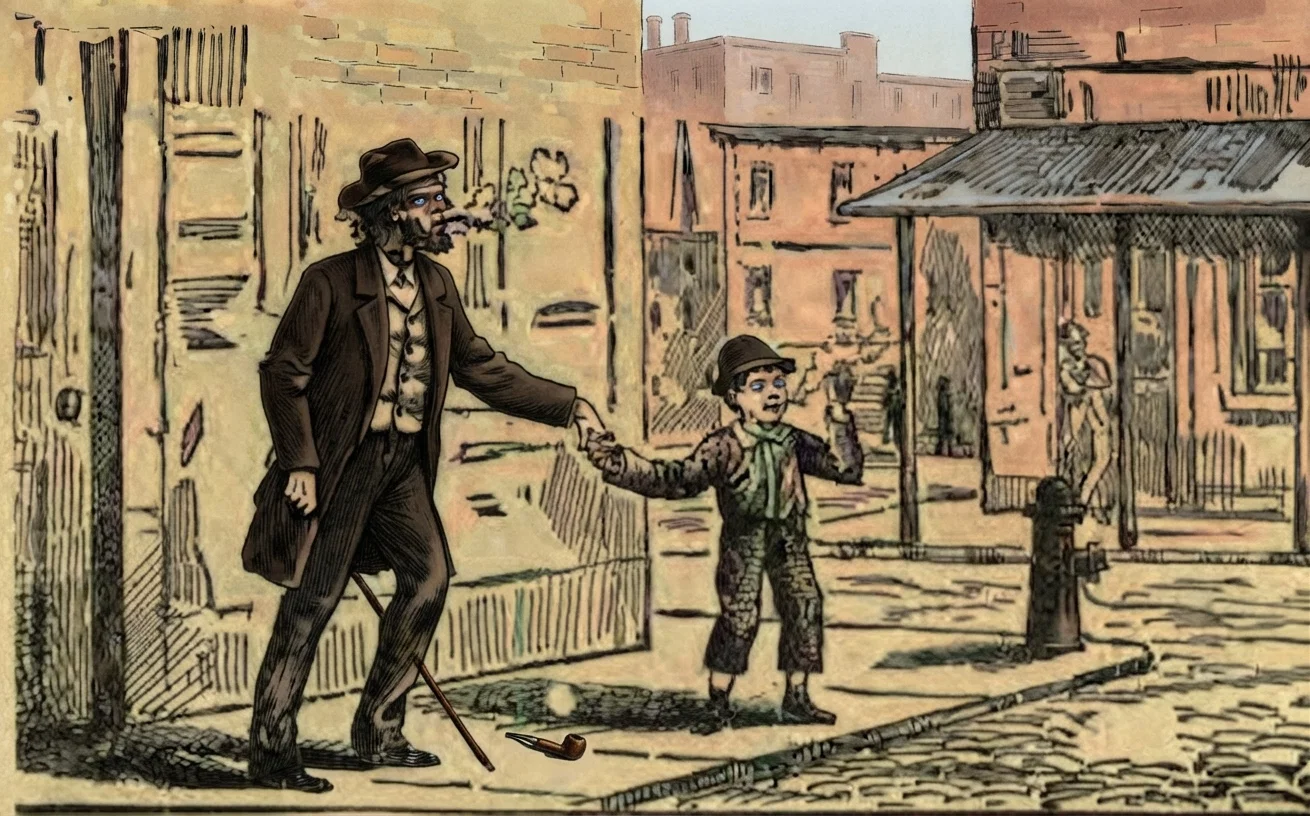
This indifference to consequences which is noticeable among the users of narcotics as a class, is well illustrated at the head of this article. A man who has become blind from the use of tobacco is still smoking the old pipe which has destroyed his invaluable eyesight, and is led about the streets by a small boy, who, instead of taking warning by the fate of the older transgressor, is following in his footsteps to the same unhappy end by the aid of a penny cigarette. Each of these poor tobacco slaves would undoubtedly endorse the sentiment of the tobacco-loving poet who wrote:—
"For thy sake, tobacco, I Would do anything but die."
Thousands go farther, and for the sake of the gratification of a depraved appetite knowingly and willingly sacrifice half a score or more of the best years of their lives.
J. H. KELLOGG, M.D.