It was an unprecedented thing for English royalty — the proposal of George V and Queen Mary to the British ministry, that in place of some representative of the king-emperor holding the Royal durbar in India, the king in person should visit his Indian dominions and be crowned emperor in the presence of the representatives of his three hundred million subjects at the ancient Mogul capital of Delhi.
The acceptance of the proposal came as a surprise to the empire, but as a pleasant one, especially to the multitudes of his majesty's Indian peoples, who at once welcomed the idea, and began planning for the glorious event set for December 12, 1911. It should be the most magnificent display that India could afford, and governors and native princes vied with one another in planning for the great occasion, the first of its kind since the Mogul emperors in the olden days held absolute sway over the destinies of this great blood-strewn empire. And so, in the early months of the year, ere yet the king had been crowned king of Great Britain at Westminster, the special representative of the government of India, Sir John Hewett, was upon the grounds in Delhi laying out a camp of magnificent proportions, covering five by seven miles square, a veritable city with full appointments, for the reception of the emperor and empress, governor-general and governors, princes and people, representatives of the many tongues and peoples in the broad domain of his imperial majesty in India.
Its Purpose
That the king-emperor, as well as his ministers and the government of India, had a deep-seated purpose in these plans, has from the first been conceded. India, together with the rest of the East, is fast developing that spirit of unrest, that awful element of discord, which has manifested itself in the Eastern peoples in recent years. The rôle of the conquered is becoming an unbearable thing to the teeming millions of the Asiatic plains, and the desire for at least some part in the control of their destinies is slowly but surely becoming one of the ruling passions of their lives. India is no exception, and with the advance of the education of the West has come the expanding of the desire for more to say as to the government of the country. Little by little this desire has been met by the rulers, yet not sufficiently rapid progress has been made to meet the demands of the subject peoples. As a consequence the more desperate have resorted to the violent tactics of the anarchists of the West, until deep-seated apprehensions of the loyalty of the Indian people have spread abroad.
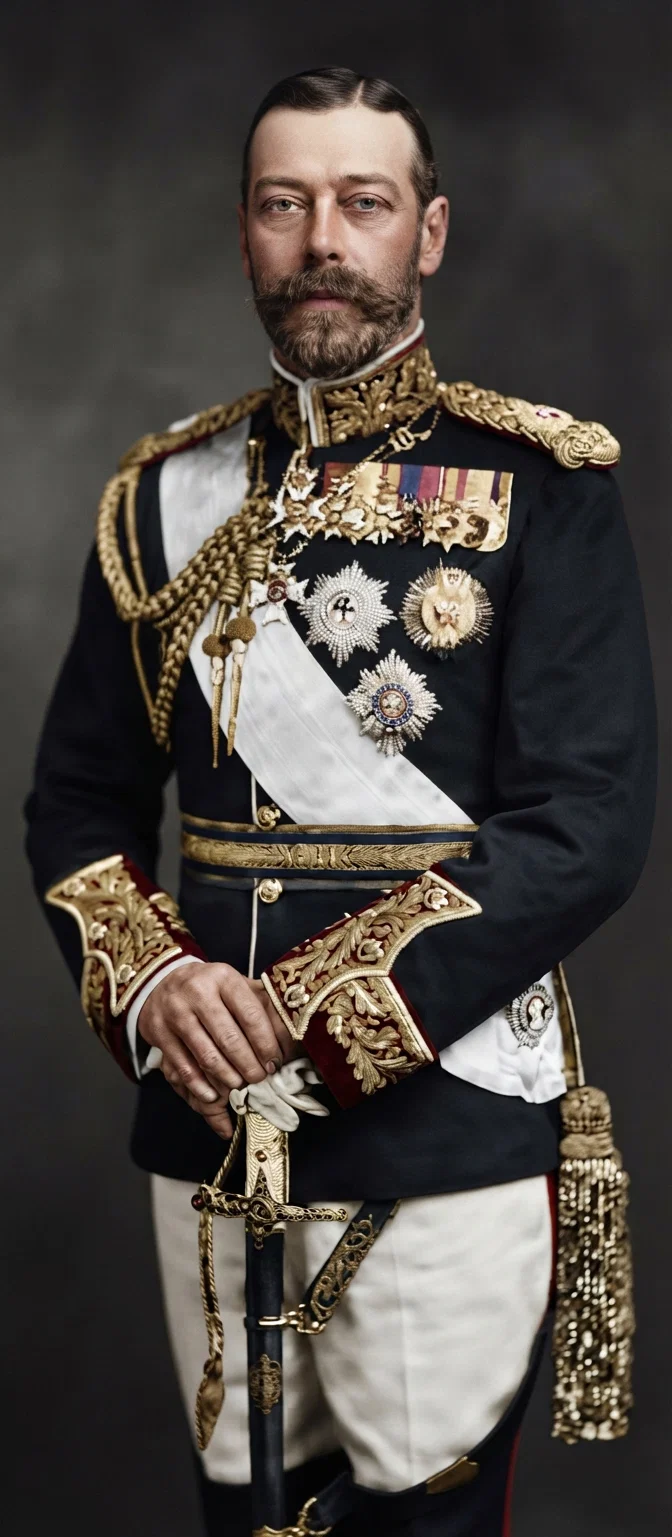
The king-emperor George V, from his latest portrait; the first English king to journey beyond Europe since Coeur de Lion. He is in field-marshal's uniform, and wears the decorations of four great orders. (From "Illustrated London News.")
THEIR MAJESTIES GEORGE V AND QUEEN MARY
But the Indian people in general are at heart loyal. They dearly love a king; to bow in homage to a sovereign in their own land is to them the greatest possible privilege. The gilt, the trappings, the magnificent display of wealth, of color, of all the regalia of sovereignty which go with kingship, are to them as incense. It is said that many of the village peoples have for years worshiped as from among the gods the portrait of the late Queen Victoria.
But on account of the unrest on the part of many of the leaders in Indian thought, and in the hope that a personal appeal through the appearance of the sovereign before them and crowned in their midst would turn the tide of ill-feeling and disloyalty, the plan of King George, who is said to love dearly his Indian subjects, was heartily approved by both the home and Indian governments.
London to Bombay
In the early days of November the imperial party embarked at Portsmouth for Bombay. The first stop was at Gibraltar, where they were visited on board by the officials of the place. The next stop was at Aden, the first of the cities of the Indian empire to greet the royal party en route. Aden is under the government of Bombay. In Aden their majesties went ashore, and received an address from the city, and an enthusiastic welcome on the part of the populace. Leaving Aden the same day, H. M. S. Medina, escorted by the cruiser squadron under Admiral Sir Colin Keppel, arrived in the harbor of Bombay on the morning of the 2d of December.
A Triumphal Progress
From the moment the Medina was seen entering the harbor of Bombay the route of their majesties has been the scene of one great, overwhelming tribute of loyal devotion, both to them personally and to the throne which they represent. Bombay, by her extensive11preparations at the bunder, along the royal route through the city, at the station, by illuminations of great beauty during the evening hours, and the intensely loyal demonstrations of her populace, has set the pace for the entire durbar period throughout the length and breadth of the peninsula.
The royal party remained in Bombay till the night of the 5th of December, and then in the royal express, whose cars were built for the occasion at the East Indian railway shops at Lillooah, they left for historic Delhi.
The arrival at Delhi took place on the morning of the 7th, and the king-emperor and his suite alighted at the old fort just as the bells of the city were striking the hour of 10 A.M. At the fort their majesties were received by the viceroy and provincial governors, and afterward by the ruling princes of the native States. Then followed the royal progress through the fort amid the firing of a royal salute, and the journey through the city to the theater that had been built for the reading of the address of the Imperial Legislative Council. This accomplished, the procession passed slowly on to the imperial camp, a magnificent cavalcade, fully representative of the greatness of the country and the occasion.
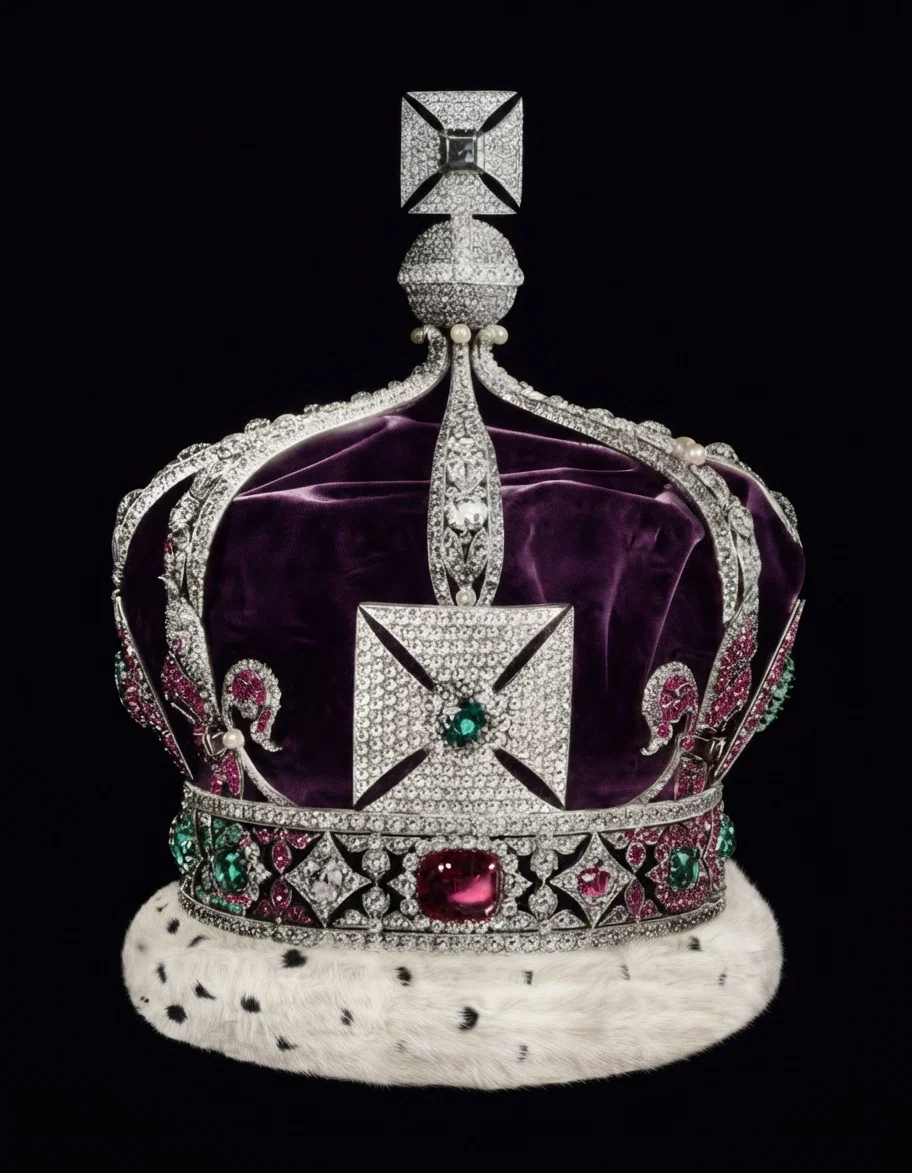
The new imperial State crown of India made for George V at the great durbar in Delhi. It contains 6,170 diamonds, with magnificent emeralds, rubies, etc. Its height, including the ermine, is 11¼ inches, the head-band 8¾ inches from front to back and 6¾ inches from side to side. It is of almost priceless value. (From "Illustrated London News.")
On the 8th came the reception of the chiefs and the ceremony connected with the laying of the corner-stone of the King Edward Memorial. The 9th found a further reception of the Indian chiefs in progress; and Sunday, the 10th, church service was held in the military camp before their majesties and the assembled troops. Monday, the 11th, was graced by the presentation of colors to a number of regiments, both English and Indian, who had been long in the service.
The Durbar
Tuesday, the 12th day of December, will long be remembered by the assembly which witnessed the coronation of his imperial majesty the king-emperor and her imperial majesty the queen-empress. The day dawned bright and beautiful. The multitude which had gathered from all parts of Hindustan for the coronation ceremony, began at an early hour to make their way from Delhi and the surrounding villages and towns to the amphitheater which had been prepared for the coronation ceremony; and full two hours before the midday hour which had been appointed, the amphitheater, the covered pavilion, and every available foot of space for hundreds of feet beyond in all directions, were filled with a waiting, expectant mass of people, from great dignitaries of State to the humblest cultivator of the soil.
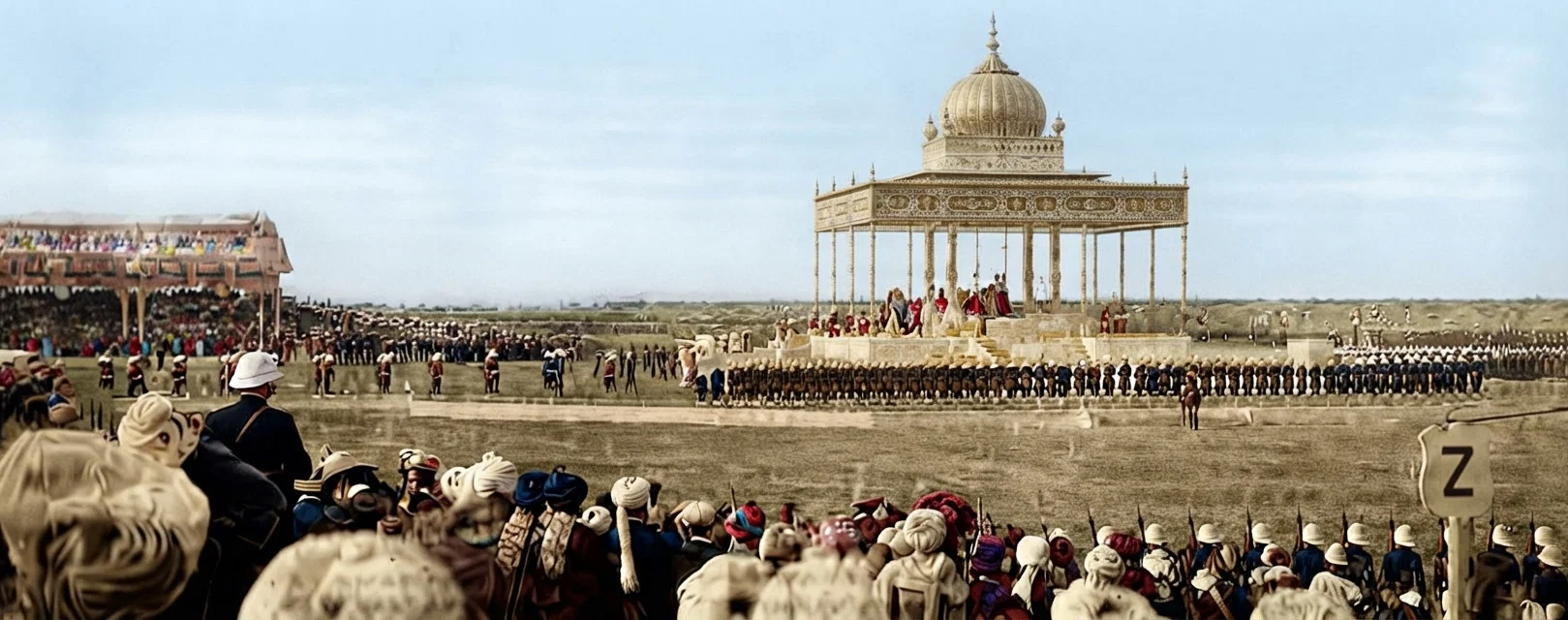
SEATED ON THE ROYAL THRONES, DELHI DURBAR
At sharp twelve the distant cheers of the crowds by the roadside announced the coming of the king, and soon the deep-throated boom of the cannon in imperial salute told of the arrival of their majesties at the royal shamiana. Here they received the homage of governors and ruling chiefs of British India. This was followed by the appearance of their majesties in imperial regalia in the royal pavilion, and the reading of the royal proclamation by the king. As he resumed his place on the throne, the proclamation of the viceroy was read, conferring, by royal command, the boons mentioned elsewhere in this article.
As the viceroy resumed his seat, the trumpets of the royal heralds sounded, calling the assembly to attention; and the chief herald, springing to his feet, called for three cheers for their majesties, the king-emperor and the queen-empress. The entire amphitheater arose en masse, and rent the air with their vociferations, while from the troops assembled in the center came a hoarse roar and a waving of flags, together with helmets swung aloft on fixed bayonets.
Then, after their majesties were seated, the king-emperor again arose, and a portion of the program not mentioned in any of the official announcements took place. His majesty, paper in hand, began to read, and there came to the ears of those nearest the throne that remarkable announcement which has transferred the capital of British India from Calcutta to Delhi, and restored a united Bengal to its people.
Their majesties, after the royal announcement, retraced their steps to the royal shamiana, entered the State coach, and preceded by the royal heralds and the cavalry escort provided, left the durbar by the opposite route from the one by which they had entered.
It was a grand occasion, a brilliant assemblage, beyond the power of the pen to picture adequately. Within the view were the central figures, their imperial majesties, their retainers, the gilded throne and pavilions, the vast array of12prominent men and women, European and Indian, representatives of many races, with their distinctive dress, mingled in many hues in the vast concourse; and then in front of the royal throne, in the great circle of the larger amphitheater, a multitude with garments that reflected every color of the rainbow, from the brilliant turbans of the schoolboys at the extreme rear to the many-hued multitude that was seated in the wings; and in the center of the arena the massed ranks of the picked troops of his majesty's Indian army, English, Scotch, Irish, Baluchis, Gurkhas, Punjabees, vying with one another in shining accoutrements and varicolored uniforms, and at the word of command ready to do service for the monarch they had this day honored. It was indeed an inspiring scene.
The Review
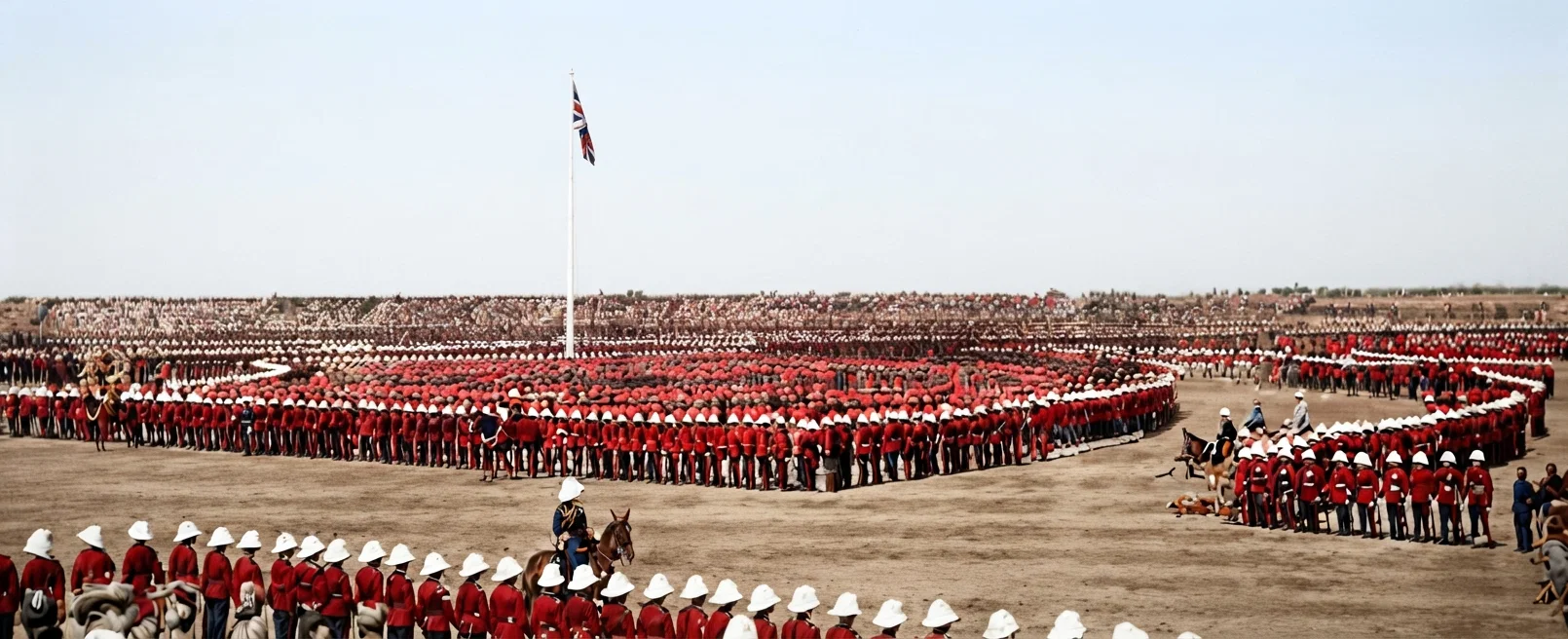
Thursday, the 14th, a review of his majesty's troops was held on the great maidan at the east of the durbar amphitheater. Fifty thousand of the best troops in India were drawn up for the inspection of their sovereign. The king and queen arrived at 10 A.M., and proceeded at once to the inspection of the troops drawn up in two great massed lines extending for a mile or more in plain view of the spectators. As the royal party finished the inspection of the lines, they returned to the reviewing stand, and the troops, by divisions, marched past his imperial majesty, as he sat on a black horse at the side of the commander-in-chief beneath the flying royal standard.
The divisions of the regular army, infantry, cavalry, and artillery first passed, and these were followed by detachments of the native State troops. In many cases these last were led by their rulers in person, and altho few in numbers, made a splendid appearance. At the close of the march the cavalry and artillery galloped past at the charge, and presented a stirring spectacle, and a fitting end to this great military display. The finishing touch was given when the entire army, having reformed in massed ranks in the center of the field, led by the massed bands of the various divisions playing "British Grenadiers," advanced to within two hundred yards of the reviewing stand, and together, with a volume of sound that surcharged the whole atmosphere, and must have stirred the graves of the old Mogul emperors, gave three rousing cheers for their imperial majesties. The order of the occasion was closed by the firing of an imperial salute as the royal party drove from the reviewing ground.
Before leaving Delhi the king-emperor laid the corner-stone of the new imperial capitol. This is the opening of a new chapter in the history of British India, and we trust is full of promise for its future.
The Royal Boons
In the message of the king-emperor and the viceroy, some announcements were made of boons for the people of India which have been received with warm welcome throughout the empire. Permission has been granted for Indian officers, men, and reservists, for conspicuous valor, to receive the Victoria cross. Also the Order of British India has been increased by fifty-two appointments. Other additions to the existing orders were also made.
One half month's pay was granted to all non-commissioned officers and men of his majesty's army, English and Indian. The continuation of the pensions of widows of deceased members of the Indian Order of Merit till death or remarriage; grants of land to certain individuals for conspicuous public service; the remission of sentence of certain prisoners in the Indian jails; the grant of fifty lacs of rupees for primary education, with the promise of liberal grants in future years; and a number of minor boons, were conferred.
In the final speech of the king, before referred to, those remarkable changes which fell as a bolt from the blue upon the ears of the hearers and upon the waiting empire were made, and in full text are as follows:
We are pleased to announce to our people that on the advice of our ministers, tendered after consultation with our governor-general in council, we have decided upon the transfer of the seat of the government of India from Calcutta to the ancient capital of Delhi, and simultaneously, and as a consequence of that transfer, the creation, at as early a date as possible, of a governorship for the presidency of Bengal, of a new lieutenant-governorship in council administering the areas of Bihar, Chutia Nagpur, and Orissa, and of a chief commissioner-ship of Assam, with such administrative changes and redistribution of boundaries as our governor-general in council, with the approval of our secretary of State for India in council, may in due course determine.
It is our earnest desire that these changes may conduce to the better administration of India and the greater prosperity and happiness of our people.
The Effect of the Royal Announcement
Needless to say the king's proclamation was received with astonishment, and for a time with a note of despair in Calcutta. Falling upon them as it did, without previous hints from any of the rulers of the country, and without consultation with the great business interests centered in the late capital city, it took some days to get the change and its consequences fully analyzed. But with the kindly words of the king in his subsequent visit to Calcutta, and with a careful weighing of the situation from all sides, there is now a note of hope from the papers of this city so vitally affected. And throughout the remainder of the country the announcement has been welcomed, because in the city of Delhi are centered the most sacred traditions of both the Mogul and the Hindu empire, and the restoration of the city to its former glory will be to center the affections of the people of all classes upon the present occupant of the imperial throne. Nevertheless there is a slight undercurrent of criticism which is apparent in spite of the king's presence, because of the fact that the people of India were not consulted in the matter of the change, and such a display of autocratic power was exercised in making it public.
Perhaps the most severely criticized part of the royal announcements is the repartition of the province of Bengal. Both at home and here in India there has been a strong feeling that this move of the government will not result, as is expected, in the restoring of peace to that province, but the rather will tend to make the discontented feel that by agitation they will, if they continue the agitation long enough, obtain the concessions they desire, of whatsoever character they may be. The province was first partitioned by Lord Curzon in the latter days of his vicerorship. The province had been unwieldy for administrative purposes, and that the work might be more economically done, he divided the province into two geographical sections. In so doing he separated the Hindu portion of the province between the two divisions, much to the anger of the Hindu Bengalis. As the result, an agitation sprang up among the people, which resulted in the assassination of a number of government officials, and the deportation of a large number of leading Bengalis for complicity in the various conspiracies. This discontent had spread to other parts of India, till the government was becoming gravely concerned over the future of the country. The royal visit, the changes in administration as outlined, are a bold stroke on the part of the rulers to meet the conditions that have arisen, and turn the tide of popular feeling back to the government. At least this is the general view of the situation.
There can be no doubt that the king's visit has appealed to the people in a manner which will be remembered for years to come. The greatest enthusiasm has been shown for the royal couple in all parts of the empire which they have visited. The native press has assumed a different tone, and with the European press of the country, has nothing to say but words of praise for the graciousness and the kindly good will that have been manifested by their majesties. But the question in the minds of many is, Will it last? Will not the grievance of to-morrow cause the disaffected to lose sight of the boons of to-day? This is feared by many. In the words of one leading gentleman, in private conversation, when the present conditions and the effect of the changes were mentioned, "Yes; but we will know better a few years hence." The Indian mind is at unrest. The troubled waters of the past are but an indication of a condition which is developing from beneath, and which will some day produce in India the conditions seen elsewhere in this portion of the world. It is only a question of time. "We will know better a few years hence." Meanwhile, we hope for the years of peace that the present visit portends.