The Saloon, a National Evil, Demands a National Cure
By B. G. Wilkinson
By B. G. Wilkinson
THERE is need for some one to blow a trumpet in Zion, to sound an alarm throughout the mountain. A terrible scourge, worse than an invading army, is going and growing throughout the land. The saloon is a national evil, and demands a national cure. As long as it exists, it carries on a work of destruction—a work always accomplished more easily than a work of construction.
Here is a building standing within a block. It can be entered by an ordinary store of merchandise or it can be entered by a saloon. The ordinary storekeeper must advertise; the saloon needs no advertising. The ordinary storekeeper must labor, persuade, and toil in order to lift his customers to the high ideals with which he in his business is acquainted. With the saloon-keeper it is different. It is necessary for men to labor and argue in order to dissuade his customers from buying his wares, in order that they may not sink to the lower ideal. Thus that building, by the entrance of the saloon, sinks to the lower level.
What is the effect upon the barkeeper? He enters the door with a conscience. When he quits he has left conscience behind. He enters the dram-shop perhaps with a tender heart. He leaves it with a heart of stone. The preaching of the love of God melts down the hearts of men, and makes them tender; they receive hearts of flesh, which are open to the impressions of higher things. But the course of the saloon-keeper's life is to steel the soul against human misery, to push on fallen humanity into deeper depths of wretchedness and poverty.
What is the effect of the saloon upon that little object on the counter? It is a bottle. Ordinarily the bottle has been fused to make possible the preservation of vegetables, fruits, and other articles which might bless, all the year round, the home of man. But that bottle on the saloon counter has wrapped its glassy frame around a poison. Like the building in which it is, and like the man who hands it out, it has been corrupted by the saloon. It entered the service of rum a noble object; it comes out of it a soiled instrument. And like the poor wretch into whose hands it is passed, it is only fit to be thrown into the gutter and to close its career with a crash. It is gone. But what of the individual who received its contents? The father enters the door of the saloon an affectionate husband, a loving parent; he returns home a crazed fiend, to stab the wife of his bosom and to outrage the child of his love. Can any one say that the saloon is not an all-consuming fiend, a poison incarnate? It is a national evil, and demands a national remedy.
Let Us Educate and Agitate
With all its power, yet still there is hope. For, after all, in this world it is quality, not quantity, which counts. One man's brains are more powerful than a million head of sheep. The people of quality are against the saloon; for the saloon thrives in the mire of degenerating quality. How shall we meet this gigantic evil? Let us educate the people.
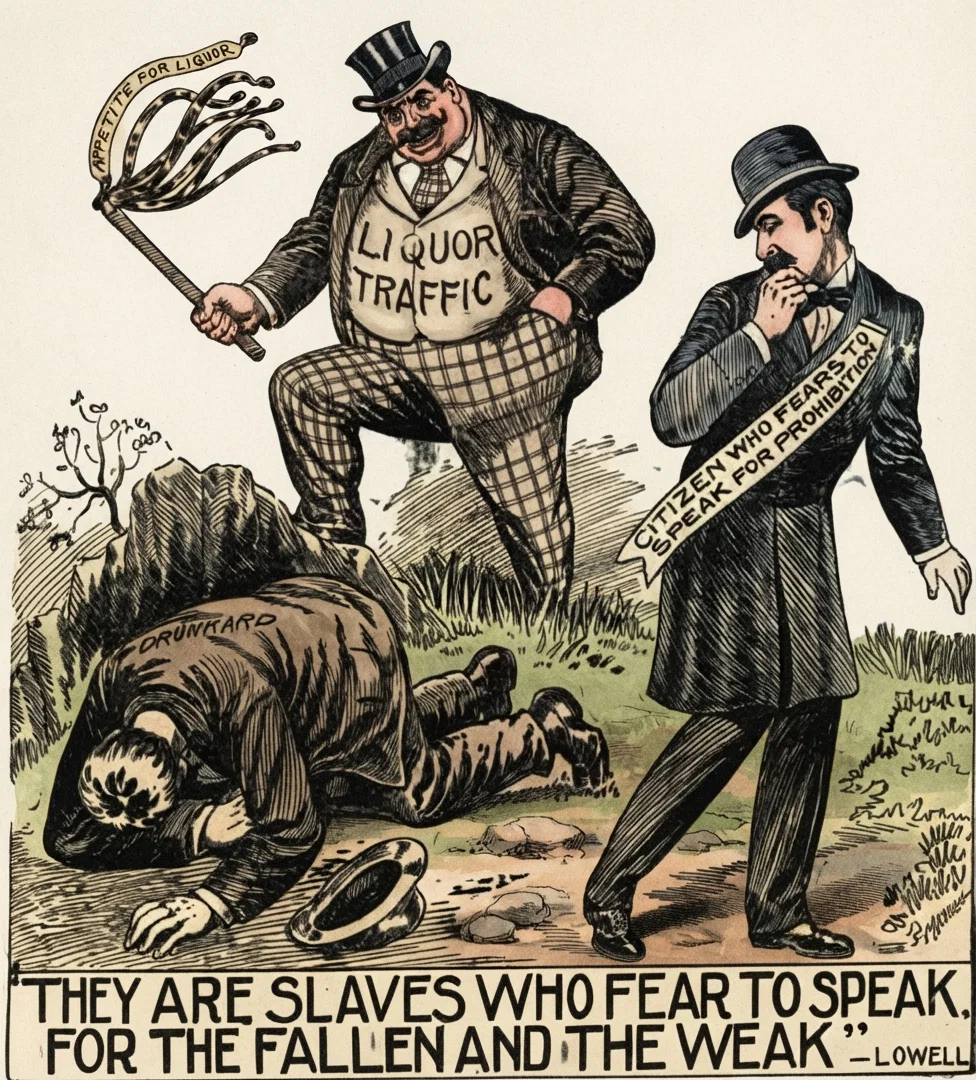
THEY ARE SLAVES WHO FEAR TO SPEAK, FOR THE FALLEN AND THE WEAK" - LOWELL
The saloon cries out for high license in order that it may have protection. But who is going to protect its victims? And who are its victims but the sovereign citizens of this land of liberty, wherein each man possesses as much freedom and opportunity as did ancient kings? Let us educate the common people, whose power of government the saloon would annihilate by seeking to destroy their self-control.
It is truly gratifying to know that in many of the popular decisions by vote of to-day, wherever the saloon has been victorious it has been victorious by only a small margin. This fact admonishes us that it is by our apathy and our abstaining from educating the people with greater energy that prohibition lost the day. We should seek to hold great temperance rallies, advertise them well, call out the people, and pour them full of the living facts relating to this great struggle. Agitate! Agitate! Agitate! It was agitation which shattered the great Louisiana lottery. First one State and then another refused to admit the operation of that gambling concern within their borders. Public conscience became aroused. And as its twenty-five years' charter in the State of Louisiana was about to expire, this towering lottery went begging throughout the different States, with a million dollars in its hand, for a chance to have somewhere to lay its head.
Effect of Alcohol
The knights whose errand to-day it is to overthrow King Alcohol must not forget their most powerful weapon—literature. Send forth everywhere the printed page. It drops within the mind a seed of thought which germinates, and germinates, until it becomes the conviction of the thinker. The printed page arouses no antagonism in the mind of the reader, which might be aroused if it were some person who stood before him, hectoring him into a belief. There was probably something more suggestive than impulse in the action of Luther when he threw the ink-bottle at the devil. Let us scale the courts of heaven, to bring down to earth, to blot out the spider-web of alcoholic ruin, more of that eternal ink which God Himself employs to blot out the sins of the human race.
Let us arouse the consciences of the people, make them acquainted with something that is better than the gratification of their carnal appetites, and reason will join with conscience in asking them to step forward to the front seat in the car of progress. Point out the dangers of the drug. When parents know that alcohol so changes the tissue cells of the little child as to prevent its normal growth, they will do to-day as did ancient Roman mothers,—they will withhold all fermented liquors from their children. When the adult learns, from the book of physiology, that every organic cell in his body has a little key which is called a "bond," which causes the cell to appropriate all newly digested food, and that alcohol destroys this "bond" and prevents growth, a powerful incentive will be created to shun and to destroy this detected destroyer. The book of physiology further tells us that in the system there exists a little substance known as an "antibody," whose function it is to meet and disarm little by little the poisons of some disease14which may be attacking us. To this defender also alcohol is a deadly antagonist. It destroys this little "anti-body," and leaves man more or less disarmed in the presence of assaulting disease.
The Better Way
How wonderful, then, in the light of these facts, is the value of God's Word! "Open Thou mine eyes," cried the psalmist, "that I may behold wondrous things out of Thy law." The glutton who sits down to the table and says, "There is no higher heaven than this," has no such experience as the psalmist. The most wonderful thing to him is the gratification of his carnal appetite. But tell him, demonstrate to him, the glories of the Word. When the divine Spirit clears his views, he will see and richly enjoy things more wonderful than those in which his carnal appetite seeks enjoyment. The advances of the alcoholic evil can be most effectually met by the sword of moral power. Like Paul, somebody will be led to acknowledge that the things he once loved he now hates, and the things he once hated he now loves. Somebody will then learn that there is transforming power in the Word.
One thing do not. Do not try to control the intemperance miasma by giving the Government complete control over strong liquor. It was tried in Russia, and with pitiful results. In order to restrict, regulate, and demolish the progress of intoxicating drinks within its borders, the Russian empire took over full control of the alcohol business. What was the result? The government itself fell a prey as easily to its seductive charms as did the men the State sought to elevate. So dependent became the government upon the revenues from the traffic, that on one occasion it requested the preachers of the State church to say no more against intemperance, lest the coffers of the city might suffer a shock. Five million dollars increase in revenue came to the empire, and they were pleased to have it keep coming. Therefore, punishment and exile to those scientists who reported to the International Temperance Congress at Vienna touching conditions within Czardom! And how pitiful it was to see 6,000 working men assemble and swear, out of political motives, to drink no more paternal whisky! California experienced somewhat the same history when for thirteen years it tried to control the liquor traffic. The population increased eight per cent during the same period in which liquor sales increased forty-one per cent, while the cost in crime increased three and one half times the income.
It Does Not Help in Taxes
In the next place, do not try to find comfort in high license. If the leech is sucking away our life-blood, what difference does it make whether he is permitted to continue because we squeeze out of him one drop or two drops? You say that high license will increase your revenues and lighten your taxes. Go around your neighborhood, if you will, and ask why it is that John Smith has lived twenty years in your neighborhood, and has property worth $15,000, on which the State may levy its taxes, while Sam Jones has also lived twenty years in the neighborhood, and has no property, but continually is an object of charity. Every one about you knows the reason. John Smith is a thrifty, industrious, sober man, but Sam Jones is a drunkard. Let us see then. How shall we best meet the saloon,—high license, low license, or no license at all?
I go out into the neighboring woods and capture fifteen vipers. I bring them home, the deadly, venomous, repulsive things! I put them into a box. Now what shall I do? Shall I bore fifteen small gimlet holes through which they might look out, and through which my child might look in? Or shall I bore fifteen medium-sized gimlet holes from which they might protrude their heads, but go no further? Or shall I take an auger and bore fifteen large-sized openings through which these vipers might come out to crawl around the house, and sink their deadly fangs into the flesh of my infants? Now, which do you advise me to do? I may tell you what I think ought to be done. The best thing is to take a hammer, open the box, and deal the deadly reptiles a crushing blow. Kill them dead, take them out, and bury them forever, beyond the possibility of a resurrection.
High license, low license, no license at all?—None and neither! Let us take the deadly saloon, whose fiery liquid is nothing less than a condensed stream of hell, and strike it a blow that will kill it dead, and then bury it forever, beyond the possibility of a resurrection.