The Sunday School

5%

Pacific Press Publishing Company · Oakland, California · Oct 21, 1897

FromSigns of the Times, Vol. 23, No. 41.

Read the full edition

The Sunday School

International Series.

LESSON VI.—SUNDAY, NOVEMBER 7, 1897.

PAUL IN MELITA AND ROME.
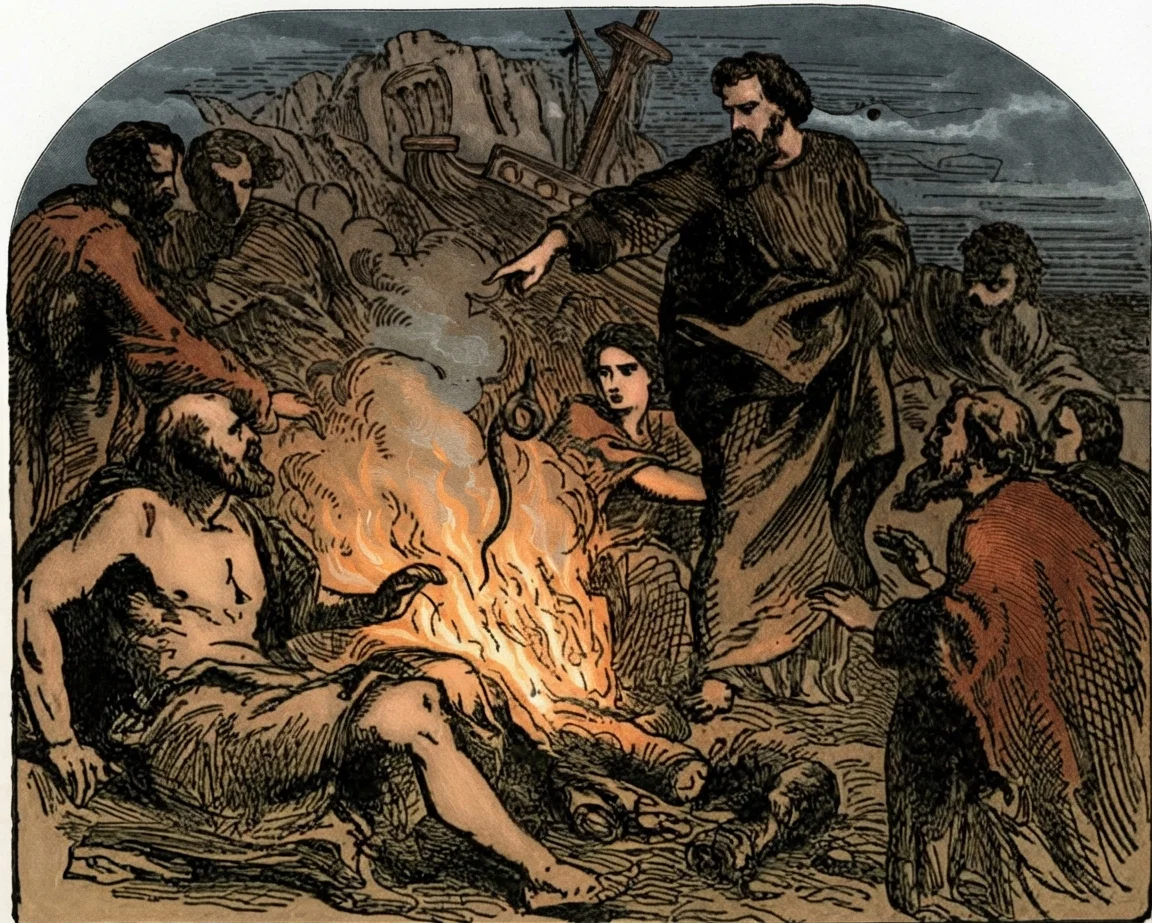
NOTE.—Notice particularly in this lesson Paul's work in Malta, gathering sticks and healing the sick; the fulfilment of the Saviour's promise in Mark 16: 18 and Luke 10: 19, which so changed the sentiment of the people; and Paul's losses made good by those whom he had benefited. It is thought that this shipwreck occurred about Nov. 1, A.D. 60, and the date of sailing away from the island is placed at about February 8, the date at which, according to Pliny, navigation here opens. For other miracles wrought by Paul see Acts 13: 9-11; 14: 8-10; 16: 16-18; 20: 9, 10. The present lesson section includes only the lesson scripture.

PAUL BITTEN BY A VIPER.

“But Paul shook his hand and threw the viper into the fire; and he received no harm.”—Syriac.

Lesson Scripture, Acts 28: 1-16.

1 “And when we were escaped, then we knew that the island was called Melita. 2 And the barbarians showed us no common kindness; for they kindled a fire, and received us all, because of the present rain, and because of the cold. 3 But when Paul had gathered a bundle of sticks, and laid them on the fire, a viper came out by reason of the heat, and fastened on his hand. 4 And when the barbarians saw the beast hanging from his hand, they said one to another, No doubt this man is a murderer; whom, though he hath escaped from the sea, yet Justice hath not suffered to live. 5 Howbeit he shook off the beast into the fire, and took no harm. 6 But they expected that he would have swollen, or fallen down dead suddenly; but when they were long in expectation, and beheld nothing amiss come to him, they changed their minds, and said that he was a god. 7 Now in the neighborhood of that place were lands belonging to the chief man of the island, named Publius; who received us, and entertained us three days courteously. 8 And it was so, that the father of Publius lay sick of fever and dysentery; unto whom Paul entered in, and prayed, and laying his hands on him healed him. 9 And when this was done, the rest also which had diseases in the island came, and were cured; 10 who also honored us with many honors; and when we sailed, they put on board such things as we needed. 11 And after three months we set sail in a ship of Alexandria, which had wintered in the island, whose sign was The Twin Brothers. 12 And touching at Syracuse, we tarried there three days. 13 And from thence we made a circuit, and arrived at Rhegium; and after one day a south wind sprang up, and on the second day we came to Puteoli; 14 where we found brethren, and were entreated to tarry with them seven days; and so we came to Rome. 15 And from thence the brethren, when they heard of us, came to meet us as far as The Market of Appius, and The Three Taverns; whom when Paul saw, he thanked God, and took courage. 16 And when we entered into Rome, Paul was suffered to abide by himself with the soldier that guarded him.”
Golden Text: “We know that all things work together for good to them that love God.” Rom. 8 : 28.

SUGGESTIVE QUESTIONS.

(1) Having escaped from the sea, what did they learn in regard to their landing-place? Verse 1. Note 1. (2) How were they received? Verse 2. (3) How did the “barbarians” show their kindness? Same verse. (4) In what humble service did Paul engage? Verse 3. Note 2. (5) What occurred as he laid his sticks on the fire? Same verse. (6) What did the “barbarians” think as the serpent hung upon Paul’s hand? Verse 4. Note 3. (7) What did Paul do with the viper? Verse 5. (8) What effect did it have upon him? Same verse. (9) What did those expect who had witnessed this? Verse 6. (10) What effect did Paul’s immunity from the poison have upon the “barbarians”? Same verse. Note 4. (11) Who resided in the immediate vicinity of the landing-place? Verse 7. (12) What course did he pursue toward the shipwrecked missionaries? Same verse. (13) In what way was Paul’s visit made a special blessing to the family of Publius? Verse 8. (14) What was the immediate effect of this miracle? Verse 9. (15) How did the people show their appreciation of the blessings they had received? Verse 10. (16) How long did they remain at this place? Verse 11. (17) In what ship did they set sail for Rome? Same verse. (18) What was their first landing-place on the way? Verse 12. (19) At what places did they next touch? Verse 13. (20) Whom did they find at Puteoli? Verse 14. (21) How were Paul and his companions encouraged on the way from Puteoli to Rome? Verse 15. Note 5. (22) On arriving at Rome what disposition was made of the prisoners? Verse 16.

NOTES.

1. Melita.—The present name of the island is Malta. It is a British possession, about 60 miles south of Sicily and 200 north of Africa. It is 17 miles long and 9 miles wide in its widest part.
2. Gathered a bundle of sticks.—“Whatever was to be done, if he were able to take part in it, he was never wanting, whether it was in counseling about a difficulty, in comforting under danger, or helping by bodily labor to relieve the general distress.”—Cambridge Bible. “Thus Paul held up the banner of the cross, and proved the Christian spirit. His conduct was his credential.”—Peloubet.
3. No doubt this man is a murderer.—They knew Paul only as a prisoner, and the fact that he had escaped the sea only to be bitten by a deadly viper was proof to their superstitious minds that Paul’s crime must be murder, as they believed that the god of justice would not allow a murderer to escape death. Retributive justice in this life was a part of their heathen creed.
4. When he should have swollen, or fallen down dead.—These were the usual effects of the bite of the viper, and were manifest immediately. Frequently the victim would drop down dead at once. In the case of others the body would immediately begin to swell. But the inhabitants of the island were astonished to see neither of these symptoms manifest in the one whom they had just seen bitten. Here was manifest the fulfilment of the promise of the Saviour to his disciples recorded in Mark 16: 18 and Luke 10: 19. Therefore, the inhabitants “changed their minds” in regard to the character of Paul. They knew that nothing but superhuman power could protect from the venom of this poisonous reptile, and at once mistook the one to whom the power was given for the originator of the power. Paul’s experience at Lystra shows an incident peculiarly contrasted with this. At first the inhabitants of that place proclaimed Paul a god, and proceeded to do him reverence; but they soon stoned him, on the accusation that he was a malefactor. “Neither the high priest, the Jewish parliament, the conspirators, the devil himself, the storm-lashed Mediterranean Sea, nor the venomous viper, can prevent his going to Rome. So we are going to heaven, and God is our continual guard. All nature is used by him for our good, and we need not fear.”—Wray.
5. When the brethren heard of us.—Their stay of seven days at Puteoli had given time for the news to be carried to Rome in advance that the prisoners, with the three Christians, were on their way to the capital. They were traveling along the famous Appian Way, over which many a Roman general had journeyed with his victorious army and chariots of war, bringing back the spoils of conquest and trains of captive “barbarians.” The meeting with his Christian brethren served to give new hope and courage to Paul. It was 142 miles by land from Puteoli to Rome, and it is altogether likely that the prisoners, including Paul and his companions, traveled the distance on foot. The fatigue of the journey may have accounted for the apparent depression of spirits noticed in verse 15.