GRAN'S THIEF

2%

Pacific Press Publishing Company · Oakland, California · Apr 5, 1899

FromSigns of the Times, Vol. 25, No. 14.

Read the full edition

GRAN'S THIEF.

"BUT where's your boy, Gran?" asked Ned's wife; for the old lady had appeared at the door alone. "Did you miss him? Didn't he get to the train in time?"
"No—yes—that is, he went back after my valise. You see I got in at half past six—I wrote Ned it would be seven; I didn't want to wait; I wanted to see you and this little man—Gran's old precious! so I started on to walk, left the telescope in the baggage-room—or, no, that ain't just it—a man took it. I came along, met Ned just as I was getting off the street-car. We stopped and talked a minute, then he went after it, and I came on. I tell you I'm glad to get here. I'm dusty and tired. But say, you little, old darling, what do you suppose Gran's got in that telescope for you? You won't appreciate it, but you will grow to it."
"What in the world, Claudie, do you suppose it can be?" asked the young mother, who was kneeling in an almost worshipful attitude before the two.
"Tell mother you can't ever guess if you try," said Gran in an exultant tone.
They sat on talking until they were interrupted by a quick step and an imperative voice, which asked:—
"Say, Gran, did you take that valise to the baggage-room yourself?"
"No, dear. A kind-looking man took it for me. It was awfully heavy."
"Yes, a kind-looking scamp—a tramp, a thief. You've been took in as usual. The baggage man—I know him well; he's reliable—he said there had been no man, woman, or child to the baggage-room with any valise this morning. Yours is not in sight anywhere. That fellow was a thief. Anything valuable in it?"
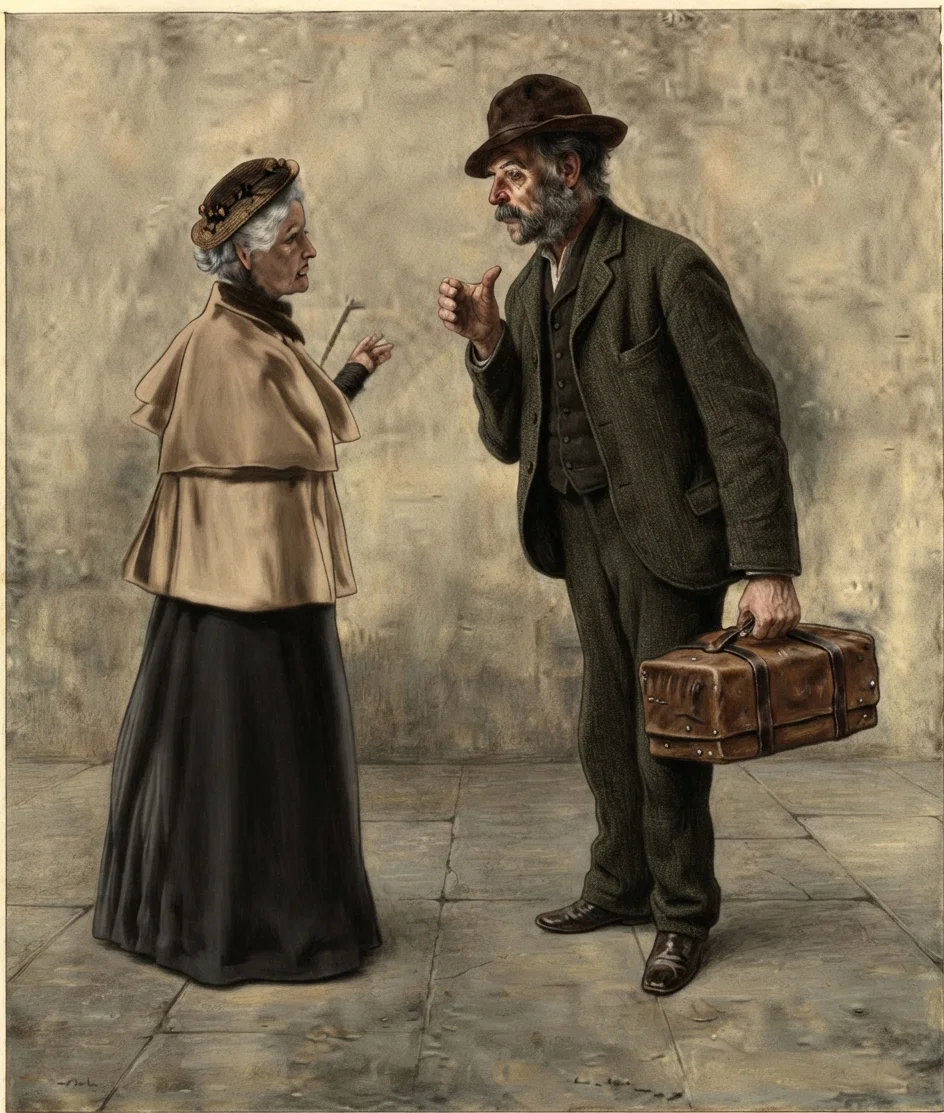
"Why, yes, of course. I don't go lugging trash about," with more fire in her tone than could have been supposed possible in Gran. "There was lots o' things,—my silk dress that you got me, my new Hiptonette, that I'd just paid twelve and a half for, little things and fixings, such as I always need, and, worst of all, my old Bible, all marked through so I can find anything I want, and the picture Bible that I bought for baby."
A kind-looking man took it for me.
"It's too bad, Gran, dear," said Emily. "I kept feeling as tho Ned ought to hurry, didn't I, Ned?"
"Yes, you did; and I wish I had; but I was working out in our little garden. I intended to be on time."
"You were, dear; the train was too soon."
"Changed time," was Ned's laconic reply.
For a minute nothing more was said; the case as to the valise was too hopeless for words. There were only three ways to meet it,—the fool's way, of senseless worry; the way of philosophical stoicism; and the way of Christian quietness and trust. Gran was the trustful Christian, Ned philosophical, and Emily wanted to be both, so that she could be like the two whom she loved best, barring the baby. Gran broke the silence.
"Well," she said, "I hope it will do him lots of good, poor fellow! I can get along, even if I should never see another Bible. I suppose before the Lord comes those who live till then may have to carry all that they have of it in their hearts and brains, and mine is there all right. Maybe that poor fellow needed just such a Bible all marked up as that is. He will probably sell the dresses and things. I don't like to think of that dress that I just wore at your wedding being hung up in a pawn-shop. But maybe that's the Lord's way for that dress too. Now I happen to think there is something in that pocket that maybe he has use for. My! but I'm glad I didn't have anything that I'd be ashamed to have a poor sinner find in my pocket or valise—not a thing that wouldn't do anybody good if they'd let it. But, come to think, that old Book might be worse'n dynamite, if that man did but know it, and "—she paused, and bowed her head on the wondering, upturned face of the child for a second, "and, I tell you, he's my tramp from this time; I shall pray for him every day as long as I live."
Ned walked quickly out, and Emily impulsively threw her arms about Gran, and sobbed: "O, I wish we were all like you! You don't seem to be angry one bit."
"But I am," said Gran vigorously. "I am very angry with the thing that could make a tramp and a thief, and I'm going to prove the power of my anger at sin by my love for a soul. I'll pray for him. I'll pray for him three times a day as long as I live, because he did that to me; and I'll pray that the commandments he'll find in that old Bible may all explode in his soul, and come down in a shower of promises all about him."
Gran was as good as her word. Three times a day in her room, at the prayer-time that she had with the baby every night, at the church prayer-meeting, she prayed for "one poor soul," as she called him in public; for "my poor tramp," as she called him in secret. The rest of the family called him "Gran's thief." The baby grew up to pray for him, and to ask many wondering questions.
"What makes us pray for him, Gran?" he asked one evening when he was about four years old.
"Because he is a poor sinner for whom Jesus died."
"Just as He died for me, Gran?"
"Yes, darling, just the same."
"And just as He died for papa and mama?"
"Yes, darling, just the same."
"Is that why we pray for him, and papa, and mama, and me too, all just alike?"
"Yes, dear, that is the reason. We are all sinners together, and must be saved by the same Jesus."
"Does Jesus love us all alike?"
"Yes, dear."
"But, Gran, you pray for your thief more than you do for anybody. Do you love him best?"
No answer from Gran."Maybe Jesus loves him best; is that the reason?"
"He needs more, because he has no one else to pray for him, I suppose," said Gran, "and a thief is such a great sinner that somebody must love him a great deal to make it possible for him to be saved."
"So Jesus loves him a great deal," said the child, "and I must love him a great deal too; so must you, Gran."
"Yes, indeed, so we must; poor soul!"
"But don't you want to see him, Gran?"
"Indeed, yes. I'd go a long way to see him."
"Does he want to see you?"
"I—I—don't know, dear. Sometimes I think he does."
"Maybe he'll come to see you some day, Gran, and I'll have him to play with. Is he as big as me?"
"O, yes, darling; he's a man as big as papa—bigger!"
"Does he look like my papa?"
"O, no, he looks rough, I think, rather, altho not so very rough, after all! He is tall, and thin, but straight; he has a stubby beard, and his face is very sunburned."
"What is sunburned, Gran?"
"Tanned, so that his face is—let me see—about the color of mama's gloves."
The child stood leaning on Gran's knee thoughtfully for a minute, and then he said:—
"Now I'll pray for him again, Gran;" and the two knelt, while the baby voice said:—
"O Jesus, we love yours and Gran's thief, and we want you to bring him here so we can see him, 'cause we wants to so much; so please, for Jesus' sake; amen! And I'm going to watch for him."
He sprang to his feet with a little happy jump, and continued gleefully: "I'll run and get him, and bring him right in where you are. Don't you think you'll be glad then?"
E. W. A. H. H.
(Concluded next week.)