Untitled article

3%

Pacific Press Publishing Company · Oakland, California · Jul 4, 1899

FromSigns of the Times, Vol. 25, No. 27.

Read the full edition

FROM REPUBLIC TO EMPIRE.

Judging the Future by the Past.
PATRICK HENRY found the best lamp for his feet, the lamp of experience. He knew of no way of judging the future but by the past. And from a human view-point this is true. Like causes produce like effects. We may see this in the history of past nations when we will not see it in our own experiences or our own nation.
The great reason why we may not learn the lessons of past experience in ourselves and our own nation is because of selfish prejudice. We do not wish to admit that we are making mistakes. We can not see that the same causes which produced senility, decrepitude, decay, and destruction in ancient Rome and in other persons will have the same effects upon our own land and in ourselves.
Yet they will; and he who compares impartially the life and times and tendencies of the latter days of the Roman Republic with the life and times and tendencies of our day, will see the ancient history reflected in a modern stage setting. The ancient men, the Latin language, the armor-plated guards and soldiers may be wanting, but like humanity is here, and like principles are in operation and dominant.
We present below an utterance upon these tendencies from the world-famous historian, John Clark Ridpath, LL.D., who views the matter not alone from the historian's study, but from the watchtower of the ardent American patriot that he is.
We have not space to quote all he says. It will be found in the Arena for September, 1898, in an article entitled, "The Republic and the Empire." Tho it was written before the later developments of the Spanish-American war, it forecasts the results of departure from right principles. Dr. Ridpath says (bold-face ours, italics his):—
"A revolution is at the door. It impends like a cloud on the horizon. Whether we shall accept it and its results remains to be determined; but that a great transformation of political society is in the dawn let no man longer doubt. What a few thinkers have been able to foresee and foretell, and what they have been ridiculed for foreseeing and foretelling, has risen like an exhalation of the night. The swift whirl of events, becoming even swifter, has brought the apprehended change upon us, and ere the century closes we are obliged, looking around upon what is virtually the wreck of our old-time institutions, to set arising over them the spectre of Imperialism.
"The proposition to transform the American Republic into an empire is not only put forth, but it has the support of all the special interests in the United States. . . . They do not openly propose, any more than the leaders at Rome proposed at the middle of the first century, B.C., to cast aside the name of the republic and adopt the name of the empire; but they proceed insidiously to use the old terminology and to discard the facts. The democracy of the New World is to be deceived with the retention of the name of the republic while the republic is robbed of its character and substance.
"I purpose in this paper to consider, first of all, the forms and disguises under which the ill-concealed spirit of Imperialism has come. This spirit expresses itselfin several ways, the full exposition of any one of which is sufficient to startle the lover of liberty and independence from his dreams.
"In the first place, the growing disposition towards Imperialism in the United States, involving the abandonment of the fundamental principles on which the republic is founded, has come under the guise of an insular ambition—a craving for the acquisition of territories in the ocean. This sentiment insinuated itself first of all among the commercial classes; then it took possession of the leaders of the dominant political party, and through them it has gained possession of the government.
"Nearly half a century ago this morbid insular lust began to disseminate its poison. Why such a passion should come among the American people it were hard to say. Had we not enough? Was not the territory of the United States already of continental extent? Had we not, and have we not yet, limitless powers of production? Was there anything wanting aforetime to the absolute completeness and perfection of the new American civilization without going beyond the almost measureless boundaries of the republic? Could not the rapacity and greed of the English-speaking race in the New World be repressed without seizing upon other lands and thereby introducing conditions which a democratic republic could not accept and live? Was it not time that the predatory instincts of the Anglo-Saxon pirates should be checked and the passion for conquest and spoliation be finally cooled on the shores of the great American lakes? But no; the age had not yet arrived when the Old-World order should cease. We must go the dreary round again; we must abandon the half-cultivated fields of the new civilized life, and set forth once more on a career of intrigue, of conquest, of Imperialism."
Dr. Ridpath then reviews at some length "the fundamental facts in our insular ambitions," showing the natural growth of territory, the increase of false ambitions, and how thwarted, till the recent complications over Hawaii, and the desire to be a great commercial nation coupled with the notion that a commercial nation must possess islands. Upon our relation with Cuba, he says:—
"The idea that we are in Cuba on a philanthropic and humane mission has gone to join the other misplaced, absurd, and hypocritical pretexts which history has flung with lavish hand into the limbo near the moon.
"Now we have Cuba, and the necessity is upon us, under the machinery of the staggering Republic, to make the most of the situation. We must do what we can. We shall have to establish an American government in Cuba. The issue is forced upon us.
"The necessity has come because the new Imperialism demanded it. Behold what a nut the affairs of Cuba will henceforth be for those statesmen at Washington who are so capable of conducting the affairs of the world and so impotent before the smallest complications of American society! Given for the inchoate statesmen the opportunity to govern something across the sea, and of a certainty he will reveal his genius. Given to the same statesman the strike of the nine thousand American weavers at New Bedford, or the woes of fifty thousand starving miners in western Pennsylvania, and he retires under the sofa to comfort himself with the platitudes of his creed and the consolations of his party platform."
He closes the part of his article relating to insular ambition thus:—
"Thus much for the insular ambition, which is the first expression of Imperialism in the United States. Passing from this ambition, which is only another form of the lust of conquest, we come to the political ambition as an element which tends to replace the republic with the empire. The imperialistic sentiment demands not only added territories and dominion on the seas, but it also demands an increase of political power. . . .
"It is this yearning for an increase of power, this rage to be something greater than a representative democracy, that is at the foundation of the whole imperialistic delusion. Lucifer, son of the morning, has dazzled the minds of the weak with the offer of power and glory; and this he will give them if they will discard democracy for empire. The political life in the United States has been deeply inoculated with this poison. The political life wants to augment itself and to glorify itself by getting into a garb more splendid than the garb of democracy."
The historian then reviews the progress and results of this lust of political power, its effects upon the nation in its alliance with controlling monied interests, its purchase of peace, and its assumption of control, and remarks:—
"Suppose, therefore, that we usurp new powers and glorify ourselves at the expense of the nation. Suppose that we cease to call our foreign representatives ministers and call them ambassadors. Suppose that we call our Secretary of State a premier. Suppose that we make up a cabinet of millionaires, and conduct the affairs of the government in the manner of princes. Suppose that we enlarge the navy until we shall be a 'first-class power.' Suppose that we go strutting and hectoring among the nations, menacing this one and overriding that one in the manner of the governments of Europe. Suppose that we go out on Quixotical excursions to rectify the manners and method of half the world. Suppose, in a word, that we gradually insinuate the spirit and purposes of empire in place of the spirit and purposes of the republic until the former shall be noiselessly instituted and the latter shall be quietly done away. Suppose, finally, that if anybody shall criticize us, if any shall denounce us before the world, he shall be anathema maranatha; we will call him anarchist, disturber, croaker; and if these gentle epithets be not enough, we will placard him as a liar!
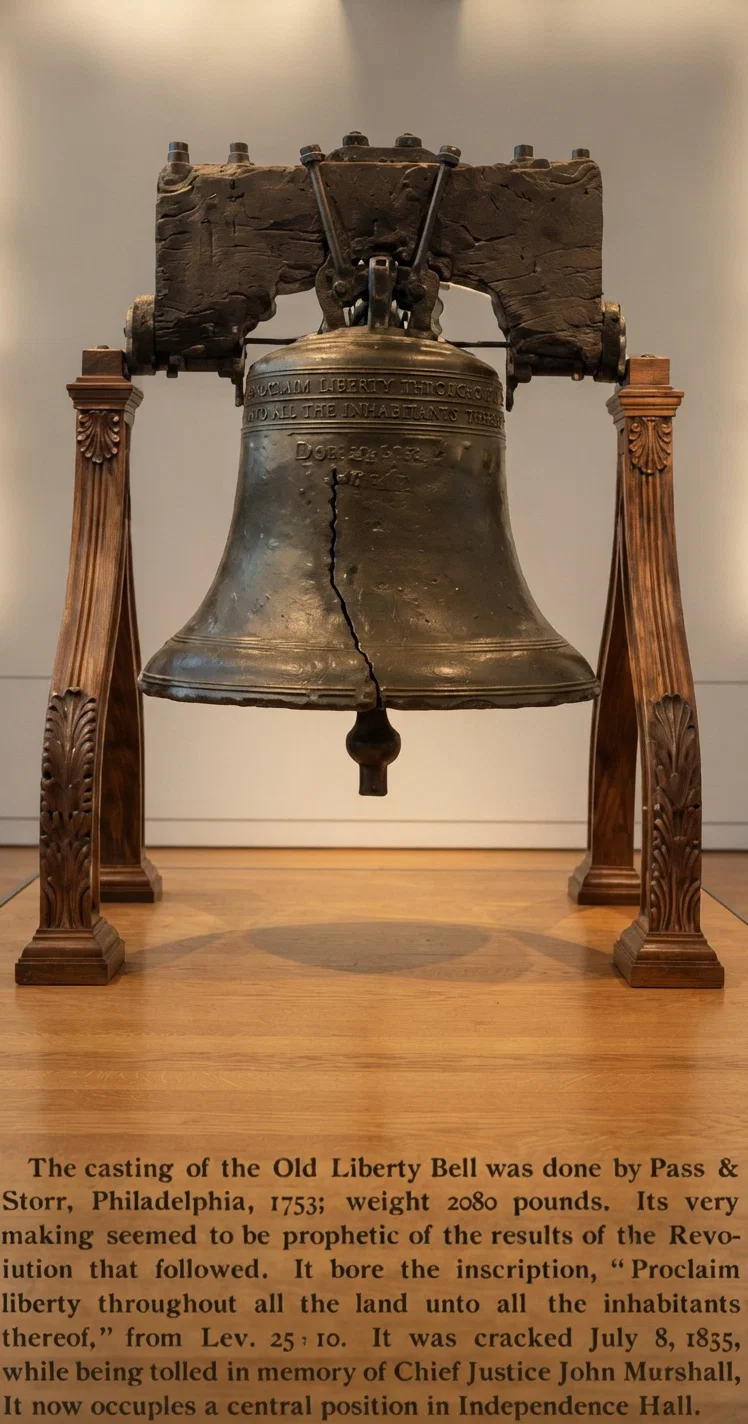
Old Liberty Bell. The casting of the Old Liberty Bell was done by Pass & Storr, Philadelphia, 1753; weight 2080 pounds. Its very making seemed to be prophetic of the results of the Revolution that followed. It bore the inscription, "Proclaim liberty throughout all the land unto all the inhabitants thereof," from Lev. 25: 10. It was cracked July 8, 1835, while being tolled in memory of Chief Justice John Marshall. It now occupies a central position in Independence Hall.
"Around this central stem of political ambition the new empire in America has arisen and twined like a poison vine. The vine is already as high as the oak. In the very topmost branches the leaves of the parasite are seen flourishing among the leaves of the immortal tree. It was thus in the latter days of the Roman republic. The new growth clambered up around the old, embraced it, choked it, drew from its life, strangled it to death."
Under this division the distinguished historian also shows that in most other nations there is a pride of ancestry which holds them to primitive ideals and perpetuates national life and unity; but many Americans have ceased to cherish the memories and doctrines and liberties of their fathers, the founders of the great republic, and are turning back to the Dark Ages for their ideals. The third tendency, which is noted, is in part as follows:—
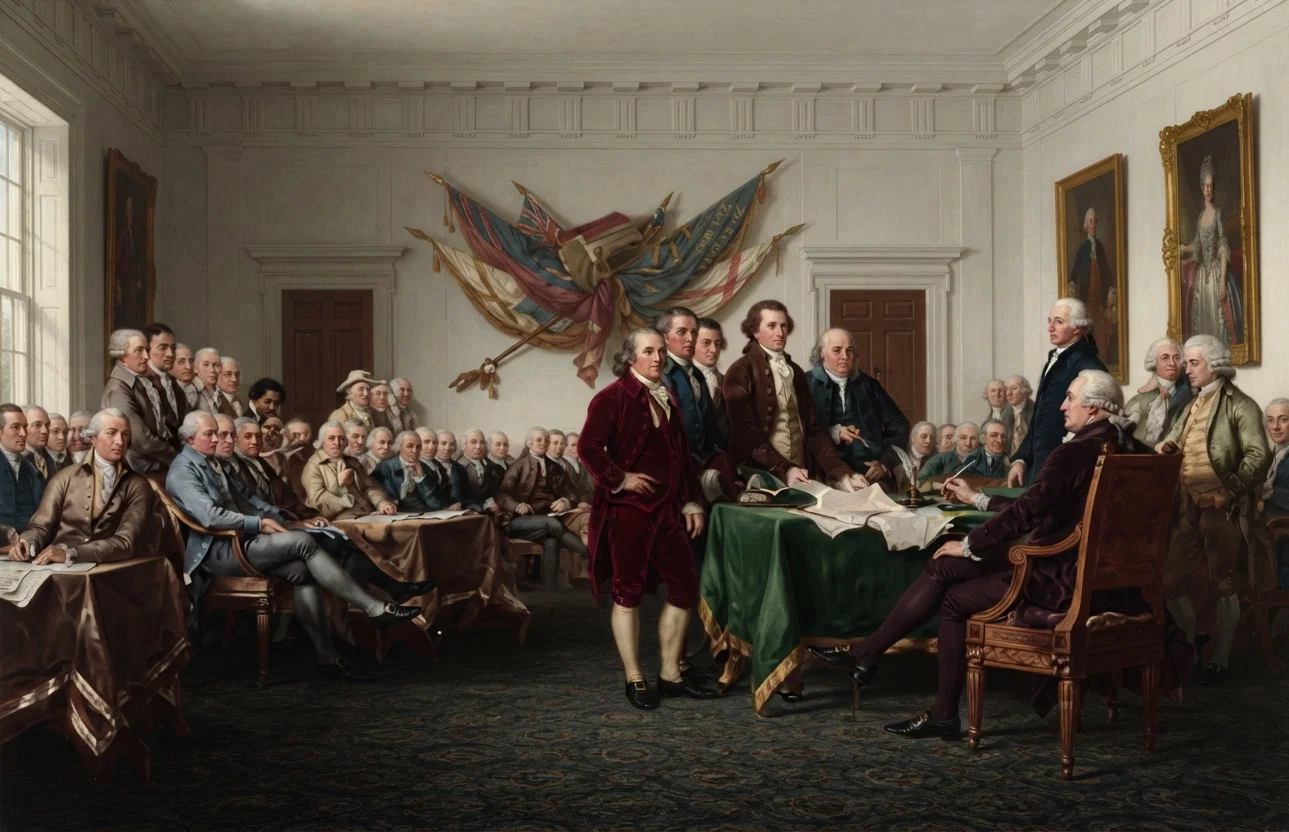
Signing of the Declaration of Independence.
"But the empire expresses itself not only in the form of insular ambition and in the lust for added political power and glory; it also reveals its character and purpose in the attempt to establish the rule of money over manhood in our country and throughout the world. One may at least understand something of the spirit which reaches out to seize the islands of the sea; that at least is rational. One may understand how ambition can find food in the creation of political splendors. An island is valuable, and splendors are dazzling. But as for the reign of gold, that is more difficult to fathom and comprehend. The empire stands for the reign of gold. It stands for the ascendancy of wealth, the subjection of the poor, and the obliteration of free manhood.
"The republic, on the other hand, has nothing in common with the reign of gold. It knows nothing of the institution of any power over society other than the expressed will of the people. Democracy? Plutocracy? How can these two things be and abide together? They can not. No free man, whether he be Democrat or some other, can hold office in the kingdom of gold. In that kingdom all men are subjects. In it citizenship is impossible. Never yet in human history has a nation yielded to the domination of wealth and at the same time preserved its liberties. Never yet in the past annals of mankind has a single example been afforded of a people at once luxurious and free. The moment that the acquisition of wealth becomes the prevailing motive of action with a given race or nation, that moment its vigor and its virtue begin to wane—that moment it ceases to be free and great. Under the circle of the sun there is not a single instance in which this deep-down law of human society has been set at naught."
What startling development of this plutocratic rule do we see in the multitude of trusts which, like a school of giant devil-fish, are suddenly and surely spreading their long tentacles over the land, seizing every productive industry, and crushing the very life out of small tradesmen and consumers. Professor Ridpath thus concludes:—
"My countrymen, we thus have three facts in which Imperialism expresses its purpose. The first of these is territorial acquisition—for the empire must conquer and expand. The second fact is that inflamed political lust of power which seeks to create a government apart from the people, over them, without their consent, and pressing them downagainst their protest. The third fact is the institution of plutocracy, which demands the other two for its maintenance and promotion. Concentrated wealth seeks to secure itself and to perpetuate its reign by means of a political system which maintains itself, not by free will, but by arsenals and armies and navies, in the manner of the European powers.
'In these garbs and disguises the Empire has come. It has overshadowed the Republic, and its apologists are forth in all the avenues of public opinion. They stand in every porch where they may be heard. To this end the book is written; to this end the magazine goes forth burdened with contributions intended to poison and pervert public opinion and to insinuate new ideas of society and State, inconsistent with the preservation of republican institutions. The forum and the pulpit resound with an acclaim which is neither the vociferation of ignorance or the paid argument of an advocacy to which all truth and human rights are strangers. Imperialism is openly advocated in high places as tho it were not rank treason. The republic may be seen swaying and rocking under the stress like a shaken tower struck by the assaults of a powerful enemy who is in league with the keepers of the house. It may be that our strong tower will go down. It may be, on the other hand, that we shall withstand the assault and come forth from the conflict with the experience of ages concentrated in our thought and purpose for the battles and achievements of the new era of humanity and hope.
'Certainly the century is in the twilight. It has been the greatest of the centuries, and the American Republic has been the greatest of its products. The centennial sun looks back upon us from the luminous clouds of his setting, and with stout hearts we, who still stand for the liberty and equality of all men, look upon the splendors of his couch, if by any hopefulness of vision we may discover the prophetic red shining through the curtains and betokening a fair to-morrow.'
The same great ominous facts have been outlined by a thorough student of history, Alonzo Trevier Jones, in his work, "The Two Republics," and "The Great Empires of Prophecy," and in the American Sentinel. Professor Ridpath treats the subject from the view-point of the patriotic and secular historian; Mr. Jones from that of the Christian historian, the watchman of the divine Word.
The secular historian and patriot hopes even against hope that the nation will recover from its fearful malady, a malady which in every other case has proved fatal. The Christian, reading its history in "the more sure word of prophecy," sees, much as he may wish it otherwise, the inevitable wreck of the nation, gives faithful warning of its coming doom, and labors to the extent of his powers to save men to that better country and kingdom, even the heavenly.
Who will candidly heed these things? Who will rise above the mists of prejudice or the blindness of pride and look at the great serious facts in the case? Who will look upon them from the only place from which the correct vision can be obtained, the heights of the mountains of God, the watch-tower of the "more sure word of prophecy"?