[The first article in this series appeared last week under the title of "Two Great Charters." This is article two. The whole series should be read. Editor S. of T.]
II—A New Order of Things
FROM the day when the first faint struggles of an enthralled conscience for liberty began in Europe, until the chains of soul bondage were finally broken, there was an unrelenting warfare carried on. The light of Savonarola flickered for a time in the murky gloom, and went out with his martyrdom. A church-ridden and church-fearing State laid heavy hands on every advocate of freedom. The State-recognized religion had become a powerful political machine, setting up and pulling down kings. Princes did its pleasure, trembled under its frown, and changed the policy of their government under threat of its excommunication. Nevertheless, in spite of excommunication, in spite of threats of death, and even in spite of death itself, there were loyal souls who would not bow the knee nor smother their consciences by a seeming acquiescence in that order of procedure.
Failure of the Reformers
Into that darkness, God projected the search-light of His Word through such instruments as Luther, Wyclif, Calvin, Zwingli, Melanchthon, and John Knox, men who loved God and feared nothing but sin. They were not perfect; but they had begun to see "as through a glass, darkly;" and groping toward the light with hearts fired with zeal for the truth, they guided out of that darkness and up toward that dawning light a mighty host grown weary with the tyranny and exactions of a State-enforced religion. So long had they dwelt under the tutelage of that kind of religion, that they were unable at times to carry out in practise the liberty which they preached. It was because of such tutelage that we find Calvin consenting to the death of Michael Servetus.
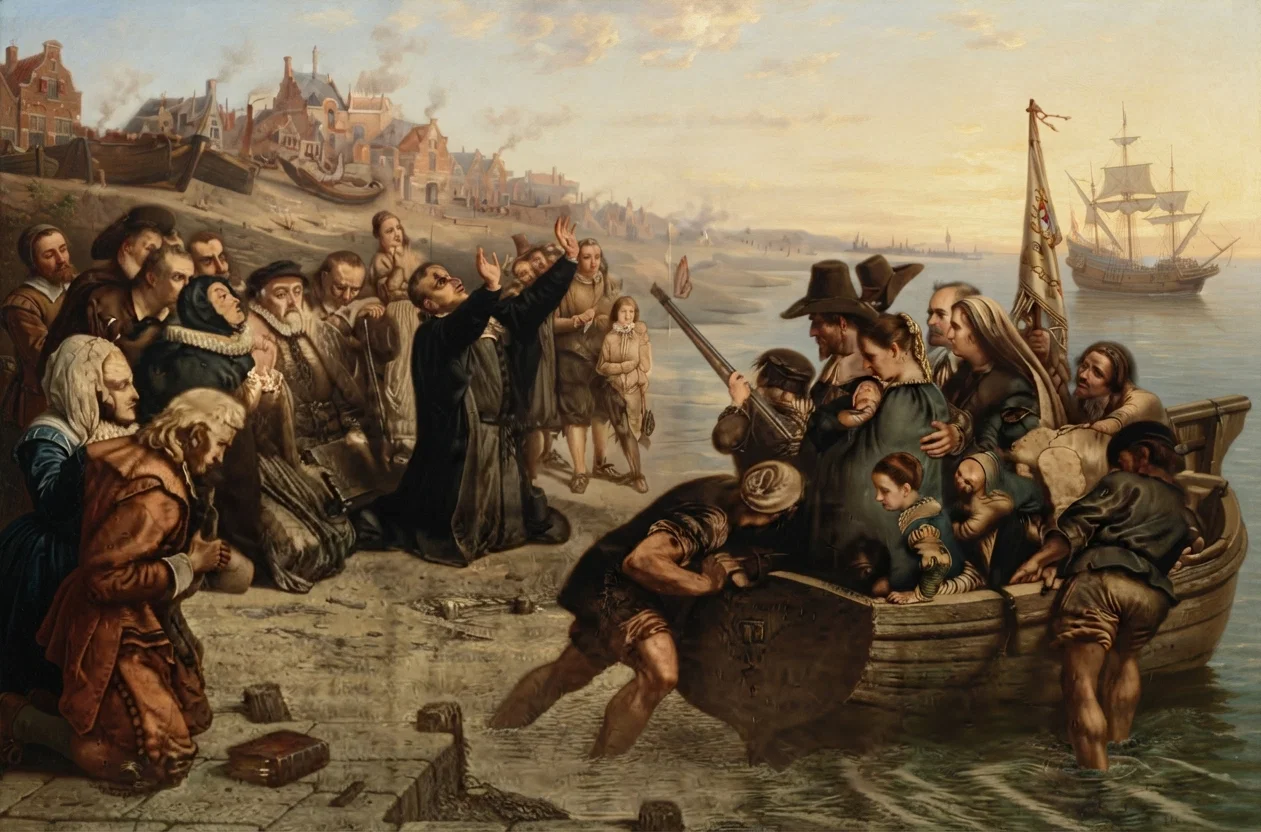
The departure of the Pilgrims at Delfshaven, for America. They left the Old World to escape the intolerance of what they thought was a perverted religion, and they set up in this land an intolerant régime of what they considered the true religion of Christ. Nevertheless it put to death Baptists and Quakers. No church is good enough to be trusted with civil power; and no State can afford to take that risk.
Luther had taken his stand upon the Bible and the Bible alone as man's legitimate rule of faith and practise. He declared:
"It is with the Word we must contend, and by the Word we must refute and expel what has gained a footing by violence. I would not resort to force against such as are superstitious, nor even against unbelievers. Whosoever believeth, let him draw nigh; and whoso believeth not, stand afar off. Let there be no compulsion. Liberty is of the very essence of faith."—"History of the Reformation," D'Aubigné, book 9.
"No one can command or ought to command the soul except God. It is futile and impossible to command, or by force to compel, any man's belief. Heresy is a spiritual thing, which no iron can hew down, no fire burn, no water drown." "Whenever the temporal power presumes to legislate for the soul, it encroaches."—"Religious Liberty," King, page 8.
That was good doctrine; but even the Reformers could not, in the general darkness of their day, hold consistently to it. It was soon found that Protestant hierarchies and synods could fine and imprison and torture and burn dissenters from the State religion as vigorously as under the older name. They found it difficult to cut loose from that papal principle of the union of religion and the State. We hear Calvin saying:
"Godly princes may lawfully issue edicts for compelling obstinate and rebellious persons to worship the true God and to maintain the unity of the faith."
In spite of Luther's noble stand for freedom in the things of God, we hear him saying, in denouncing the Anabaptists:4"Let the sword exercise its rights over them."
"Since it is not good that in one parish the people should be exposed to contradictory preaching, he [the magistrate] should order to be silent whatever does not consist with the Scriptures."
That made the magistrate the judge and censor of religious teaching, to prohibit what he saw fit, and to favor the proclamation of whatever agreed with his opinion.
We see thus that Europe in Reformation days was not far removed in principle from the church which the Reformers denounced, and their conduct toward dissenters proves them not far removed in practise.
Influence of Anabaptists
History declares that fifty thousand Anabaptists perished in Europe. A hundred years of persistent persecution succeeded in crushing out the Anabaptist movement in Switzerland and Germany. By fire and by water they testified with their lives for the blessed Gospel of soul freedom. Those who escaped with their lives from Germany and Switzerland—from Lutheranism, Calvinism, and Catholicism—found a refuge in the Netherlands, and their teachings began again to spread abroad over Europe.
This was the "old order of things." It began in union of Church and State, bore fruit in religious oppression, and it literally drenched a continent in blood. But the hour had struck for a "new order of things." The drowning of the Anabaptists could not drown the principles for which they stood—and fell. The shedding of their blood could not drain the vitality out of the truths they held. It is not generally known that with them originated the expression, "Every man has a right to worship God according to the dictates of his own conscience;" but such is declared to be the case. Their principles were these:
"That secular authority has no concern with religious belief; that Christians do not kill or punish with imprisonment or the sword, but only with exclusion from the body of believers; that no man should be compelled by force to believe, nor should any be slain on account of his faith."—"Der Wiedertäuffern Ursprung, Furpang, Secten, Wesen," etc., Bullinger.
It was impossible that their doctrines should perish. The study of God's Word was awaking in the bosom of mankind a consciousness of man's individual accountability to God. The commands of the Decalogue, iterated and reiterated in the ears of the people, were causing men to question whether they could take the lives of their fellow men because of differences of belief, and be guiltless of murder. The leaven was working, and the result could not but manifest itself in the years that were to come.
In England
Anabaptists fleeing from the bitter persecution of Catholic and Protestant alike, crossed the English Channel by thousands, and settled in the eastern and southern counties of England. They were not received with open arms. There was hardship still in store for them, but they kept their light burning undimmed. James I declared, "I will make them conform, or I will harry them out of England."—"Religious Liberty," King, page 63. Richard Hooker denominated freedom of conscience "a loose and licentious opinion of the Anabaptists."—Ib., page 64. The Westminster Confession, adopted in 1647, set forth the illiberal principle that "civil government is designed to support the external worship of God, to preserve the pure doctrine of religion, and defend the constitution of the church."
According to that document it was the duty of the civil officers to preserve the unity of the faith under penalty of the law. Whatever Rome had done, that document authorized the church-and-state officials to do. And Henry VIII, the titular head of the English Church, determined to rid his realm of these dissenters, issued a decree commanding them to depart within ten days from the date of the decree, "on pain to suffer death, if they abide and be apprehended and taken."—"Wilkins's Concilia," volume 3, page 776. Their only crime was "wicked errors and abominable opinions."
In spite of these persecutions, the principles of soul freedom held by the Anabaptists continued to be disseminated throughout the realm. The influence of their persistent teachings in the Netherlands resulted in the establishment of religious freedom in that country when its independence was secured. From those teachings, industriously and fearlessly promulgated in Western Europe and England, have sprung the liberties which the Government of the United States now guarantees to its people. Those principles came to our shores as the colonists came, not welcomed by the majority, and yet winning their way until they succeeded in making persecution hateful here, and in striking the shackles off the minds and consciences of the founders of the young nation.
The Beginning of the New Order
So can we trace the teachings of the Anabaptists from the blood-sprinkled soil of Europe and England, where they paid with their lives for the propagation of their principles, and see them leavening the spirit of the American nation, until they take concrete form in the Constitution of the United States. Those heretical doctrines and "pestilent opinions," those principles which outlawed those who held them, and could find little or no recognition in the Old World, became the stable foundation of a nation whose influence is felt in all the world.
But this happy consummation was not reached in the New World unhindered. The seeds of oppression had found fertile soil, and the pestilence of persecution wrought sad havoc in colonial America. Religion was established by law; church support and church attendance were compulsory; freedom of religion was denied; and even America was compelled to pay the price—the price of blood—for freedom to worship God.
Roger Williams, wandering among the forests of New England in winter, housed in the wigwams of the savages, illustrated the spirit of the times; and out of that womb of intolerance was born a State whose influence has exceeded that of any other State in the Union in making certain for all Americans the freedom of the soul.
The same principles for which Roger Williams stood, and for which the Anabaptists before him had contended, we find eloquently set forth in that memorable document issued by the Presbytery of Hanover in Virginia, which declared that "the duty which we owe to our Creator, and the manner of discharging it, can only be directed by reason and conviction, and is nowhere cognizable but at the tribunal of the universal Judge;" that "to engage in the exercise of religion agreeable to the dictates of our own consciences, is an unalienable right" which "can never be transferred to another;" that "the kingdom of Christ, and the concerns of religion, are beyond the limits of civil control."
These principles were finally crystallized in the Virginia Bill of Rights, article 16, which reads: "That religion, or the duty which we owe to our Creator, and the manner of discharging it, can be directed only by reason and5conviction, not by force or violence; and, therefore, all men are equally entitled to the free exercise of religion according to the dictates of conscience; and that it is the mutual duty of all to practise Christian forbearance, love, and charity towards each other.” And those principles were definitely adopted by the nation when its Constitution was made to declare that “Congress shall make no law respecting an establishment of religion, or prohibiting the free exercise thereof.”
There stands the nation, and out of that chaos of oppression was it born. The doctrines of freedom preached under the shadow of the gallows and in the smoke of martyr fires, have come to fruition, and upon the shoulders of every intelligent American rests the responsibility of seeing to it that the great boon conferred upon us at so great a price of suffering and sacrifice shall not be swept away in the clamor for religious legislation. The separation of Church and State, in fact as well as in theory, is the only thing that can guarantee the religious liberties of the people; and that separation can not be insured if the people permit the enforcement of any religious ordinance under penalty of law.